A beanie can look polished on a screen and still miss the mark under trade show lights. Bright aisles, fast glances, and crowded booths expose weak color choices quickly. That is why the trade show woven label Beanies Sample Checklist matters: it turns a subjective approval into a practical inspection of fit, readability, and production readiness.
The sample is the first real proof that the knit, the woven label, and the shape work together on an actual head. A logo that reads clearly in a mockup can blur once the cuff is folded, the fabric stretches, and the lighting shifts from soft office light to harsh LED panels. On a show floor, tiny flaws are not tiny for long.
"If the logo does not read clearly in bright indoor light, the sample is not ready."
That simple rule saves a lot of expensive backtracking. It also keeps the approval process focused on what the product must do in the real world: represent the brand, hold its shape, and survive the deadline.
Trade Show Woven Label Beanies Sample Checklist: What to Inspect First
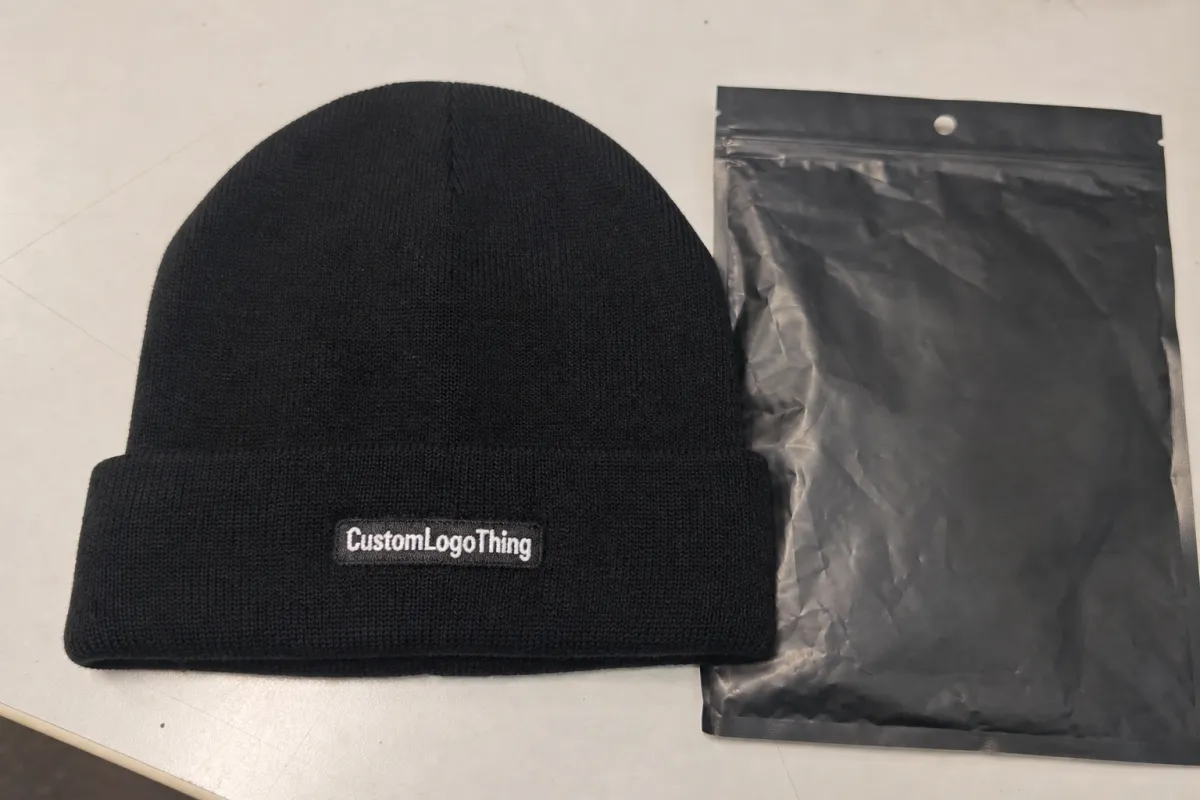
Start with lighting. Trade show halls often use cool white LEDs in the 5000K to 6500K range, and those lights can flatten colors that looked rich on a design screen. A navy body can turn nearly black. A muted border on the woven label can disappear faster than expected. Check the sample where it will actually be used, not only under office bulbs.
Then place the beanie on a head or on a form that behaves like one. Flat-table checks miss the details that matter most: how the cuff sits, whether the label pulls when the knit stretches, and whether the crown collapses in a clean shape. A label that looks centered when the beanie is lying flat may drift slightly once it is worn.
Use this first-pass list:
- Logo clarity: Can the mark be read from 4-8 feet away?
- Label placement: Is the woven label level and consistent with the cuff edge?
- Color match: Does the body yarn still fit the intended brand color under bright light?
- Hand feel: Is the label soft enough for wear, or does it feel sharp at the seam?
- Shape: Does the crown sit naturally, or does it look stiff and boxy?
That last item is easy to underestimate. A beanie with a tall crown or loose rib knit can photograph well in a product shot but still look awkward on a person. Booth visitors are not studying a flat lay. They are glancing while walking, talking, and carrying three other samples.
Practical rule: if the sample looks only slightly off, do not assume bulk production will correct it. Bulk usually repeats the same decision. It does not politely fix it for you.
How the Sample Process Works From Artwork to Approval
A clean sample process starts before the first stitch. It starts with the artwork file. Woven labels have limits, and those limits are much tighter than many buyers expect. Thin strokes, tiny type, and soft gradients often look fine on a screen but lose definition in thread. In practice, text below about 5-6 pt equivalent and very fine linework under roughly 0.35-0.5 mm can become unreliable once translated into a weave.
After the file review, the supplier usually prepares a digital mockup. That step helps with layout, placement, and size. It cannot show drape, stretch, or the way the label reacts when the cuff is folded. Treat it as a layout check, not a final approval.
A workable proof chain often looks like this:
- Artwork review and label size confirmation
- Color mapping against thread charts or Pantone references
- Material confirmation for the beanie body and label backing
- Physical sample build
- Buyer inspection and written notes
- Revision or sign-off
The fastest approvals usually come from clear inputs: one logo file, one target label size, and one color reference. Slow approvals often start with requests like "make it pop" or "make it more premium." Those phrases sound helpful, but they do not tell production what to change.
If the supplier can provide both a digital proof and a physical sample, use both. They answer different questions. The digital version confirms layout. The physical version confirms how the beanie actually behaves. One does not replace the other.
For buyers building a broader booth package, it helps to keep branding consistent across related items such as tags, inserts, and packaging. Coordinated pieces from Custom Labels & Tags can reduce the risk of a polished beanie sitting next to mismatched collateral.
For transit and pack-out discipline, the packaging sector offers a useful habit: test the weakest link, not just the finished look. The ISTA standards are built around shipping reality, and that mindset helps when samples need to move between merch teams, marketing, and operations before the show clock runs down.
Fit, Material, and Branding Factors That Change the Final Look
Not every beanie wears the same way. A tighter rib knit will usually hold a woven label more cleanly than a looser slouch knit. The trade-off is feel: tighter knits often look more structured, while softer knits can feel casual but less precise in the branding zone. That decision affects how the sample should be judged.
The woven label itself matters just as much. Higher thread count and tighter weaving generally sharpen edges and improve logo definition, but they can also make the label stiffer. A softer satin-finish label may feel better against the forehead seam, yet it may lose detail if the art is busy or too fine. Buyers often want both softness and crispness. Manufacturing usually asks them to choose a priority.
Color contrast can make or break the read. Dark-on-dark branding may look premium in a catalog and nearly vanish in a crowded booth. White-on-black can create strong visibility, but it can also feel loud if the rest of the booth is restrained. The best choice depends on the space the product will occupy, not just the logo by itself.
A simple way to think about contrast:
- Low contrast: quieter, more subtle, and easier to place in a premium assortment
- Mid contrast: often the safest choice for trade show readability
- High contrast: gets attention fast but exposes small registration or placement errors
Material choice changes the equation too. Acrylic beanies are common because they hold shape well and usually stay economical at scale. Acrylic-wool blends often feel richer and warmer, though they may need closer attention to shrinkage, fiber consistency, and care expectations. If the item will be worn right after the show, hand feel matters more than many spreadsheets admit.
Durability deserves a direct question. Ask how the woven label edges behave after repeated stretching, rubbing, and folding. Some buyers compare abrasion or pilling logic against ASTM-style testing references, even if the supplier does not provide a full formal report. The point is practical: the sample should not only look right on day one, it should still look presentable after actual use.
Process, Lead Time, and Turnaround: How to Plan for Show Deadlines
Tight schedules make sample discipline expensive or valuable, depending on how early the buyer starts. Miss a correction window by two days and the fix can turn into a freight upgrade, a split shipment, or a product that arrives after the first booth day. The sewing itself may be quick. The slow part is usually the approval chain.
Typical timing often looks like this:
- Artwork and proof review: 1-2 business days if the file is clean
- Sample build: 5-12 business days depending on label complexity
- Transit to buyer: 2-5 business days domestically, longer internationally
- Internal review and feedback: ideally the same day, rarely more than 48 hours
- Re-sample: another 3-8 business days if the change is limited
The hidden delay is almost never the machine time. It is the time it takes for several people to agree on one answer. Marketing may want stronger contrast, sales may want a softer feel, and operations may be trying to protect the ship date. One person should own the final decision. Otherwise, the sample keeps changing while the calendar keeps moving.
Leave room for a second round. Even a sample that is 90% right may still need a placement shift, a label size reduction, or a thread color adjustment. That final 10% is often what keeps a show launch from becoming a scramble.
If the order includes paper inserts or package elements, align those approvals with the beanie sample timeline. Otherwise the apparel may be ready while the support materials are still waiting on sign-off. For paper sourcing, FSC remains a useful reference point for responsible material choices.
Cost, MOQ, and Quote Variables to Compare
Sample pricing looks inconsistent until the specs are compared line by line. A stock-based beanie sample and a fully custom woven label sample are not the same purchase, even if both are described in similar language. The easiest mistake is comparing quotes without checking what is included.
These factors move the number most often:
- Label complexity: more colors, tighter weave detail, and special borders increase cost
- Beanie body: rib knit, slouch shape, cuff height, and fiber blend all affect price
- Sample type: stock sample versus fully custom sewn sample
- Rush timing: compressed schedules can carry a meaningful premium
- Shipping method: courier, air, and consolidated freight do not price the same way
For planning purposes, many buyers see stock-based samples in the roughly $18-$35 range. A more customized woven label sample often lands closer to $45-$95, depending on setup work, label detail, and the supplier's process. Rush handling can add another $25-$60 on top. Bulk pricing is a different calculation entirely, and unit cost usually improves as quantity rises.
| Sample / Order Type | Typical Cost Range | Best For | Watch Outs |
|---|---|---|---|
| Stock beanie sample with sewn label | $18-$35 | Fast visual approval | May not match final knit exactly |
| Fully custom woven label sample | $45-$95 | Checking final brand presentation | Longer build time, more revision risk |
| Rush re-sample | $25-$60 add-on | Show deadlines with a narrow buffer | Higher chance of compromise if changes are broad |
| Bulk order at higher MOQ | Lower unit cost, varies by spec | Known design with stable demand | Less room for late design changes |
MOQ needs the same scrutiny. A lower MOQ helps when testing two colorways or debating label placement, but it often raises the unit price. A higher MOQ can improve pricing, yet it only works if the design is already locked. Ask for a quote that separates sample cost, bulk cost, setup charges, revision allowance, and freight. If those pieces are bundled together, comparison shopping becomes guesswork.
For teams building a broader branded kit, a paired order with custom beanies and label support can simplify coordination. The key is transparency. If the quote is clean, approvals are easier to manage and there are fewer surprises later.
Common Mistakes That Delay Approval or Inflate Reorders
The biggest mistake is approving from a digital image alone. A screen proof can confirm placement, but it cannot show how the weave breaks around tiny details or how the label feels after the beanie stretches. That gap is where many reorders begin.
Requesting too many variations at once creates another problem. Three colorways, two label sizes, and a different cuff height may sound efficient, but it usually muddies the feedback. The team ends up staring at a stack of almost identical samples and nobody can explain which version won. One variable at a time is cleaner and easier to defend internally.
Vague feedback slows production too. Comments like "make it pop" or "make it more premium" do not tell a supplier what to alter. Better notes are specific: increase label contrast, shift placement 4-5 mm left, or reduce the logo width by 8%. That language can be acted on immediately.
Shipping timing is another silent problem. If the sample arrives two business days before booth load-in, the team has almost no room to rework it. A delay in freight booking can snowball into a missed show window, especially when several reviewers need to sign off before production can move.
Finally, do not ignore booth context. A beanie that looks balanced on a white desk may disappear beside bright signage, reflective displays, and other branded merchandise. Trade show lighting is unforgiving. The right version is usually not the loudest one. It is the one that remains readable after a buyer glances at it for two seconds and keeps walking.
Expert Tips and Next Steps Before You Place the Bulk Order
Use a pass/fail checklist before anyone signs off. That sounds plain, but it removes emotion from the decision. If the sample passes fit, logo clarity, placement, hand feel, and color accuracy, it moves forward. If one category fails, the revision stays specific and the next round is easier to manage.
A simple internal structure works well:
- One person owns the final decision
- One written note records the requested changes
- One updated proof confirms what carries into production
- One ship date is locked after the sample is approved
That process can feel strict, but it prevents the sample from becoming a moving target. Once marketing, sales, and operations all start editing the same item from different angles, the order drifts. The result is often a product that no one intended to approve in the first place.
Hold the sample at arm's length, then place it on a head form under the same lighting expected at the show. That quick test catches more problems than most buyers expect. It also gives a more honest read of whether the label is doing its job from a real visitor's distance.
The value of the trade show woven label Beanies Sample Checklist is not perfection. It is certainty. A good sample tells you that the branding reads clearly, the fit works, the costs are understood, and the schedule is still under control. If those four things line up, the bulk order has a much better chance of arriving on time and looking deliberate.
What should be on a trade show woven label beanies sample checklist?
Include fit, label placement, logo clarity, color accuracy, hand feel, and stitch quality. Add a lighting check under bright indoor LEDs, because booth conditions can change contrast a lot. Finish with written approval so production starts from one agreed spec.
How long does a woven label beanie sample usually take before a trade show?
Timeline depends on artwork readiness, sample complexity, and shipping distance. A clean file may move quickly, but it is smart to leave room for at least one revision cycle if the first sample needs changes. Extra buffer before freight booking protects the launch schedule.
What affects the cost of sample beanies with woven labels?
Pricing usually changes with label detail, number of colors, material choice, and whether the sample is custom or stock-based. Rush handling, multiple sample versions, and setup work can increase the quote. Ask for sample and bulk pricing separately so the final order is not misunderstood.
Should I approve a beanie sample from a digital proof or wait for the physical version?
Use the digital proof to confirm artwork layout, not final texture or size perception. Approve only after checking the physical sample for stretch, drape, and label readability. A screen cannot show how the beanie will look under booth lighting or on real heads.
How many sample variations should I request for a trade show beanie order?
Start with the version most likely to sell, then test one or two meaningful alternatives. Too many options slow feedback and make the decision harder to defend internally. Keep variations tied to one variable at a time, such as color or label placement.
For buyers who want one clean path from mockup to bulk order, the best approach is to treat the trade show Woven Label Beanies sample checklist as a production control tool rather than paperwork. Check the sample in the right light, on the right shape, against the right schedule, and the approval decision becomes much clearer before the show clock starts running.


