Apparel Woven Label Beanies Factory Quote for Brand Buyers
If you need an apparel woven label Beanies Factory Quote, the fastest route is not a long email chain full of half-answers. It is a clean spec sheet: beanie style, label size, label placement, quantity, and shipping destination. Most delays come from missing basics, not from any mysterious factory process. A beanie can survive heavy wear, but the woven label is what keeps the brand visible after stretch, friction, and washing.
From a buyer’s perspective, woven labels usually make more sense than printed marks on winter accessories. They look sharper up close, hold small text better, and keep their shape on a knit surface that moves every time the hat is pulled on. That matters on gift sets, retail shelves, and private-label programs where the product has to look finished without a lot of explanation. If the quote is going to be useful, it has to reflect the actual construction, not a vague “custom beanie” line item.
There is also a practical angle that gets ignored until the first complaint lands in customer service. Woven labels resist the washed-out look and cracked ink that can show up on printed decorations after repeated wear. They can also make a plain stock beanie feel like a deliberate retail product instead of an off-the-shelf blank. That difference is small on a spreadsheet and very visible in person.
Practical rule: the cheapest quote is not always the best one. The useful quote is the one that makes the construction clear, exposes the cost drivers, and leaves less room for surprises later.
For seasonal programs, packaging and shipping handling matter too. If your beanies will move through retail distribution, it is worth checking carton expectations against common distribution testing methods, including ISTA guidelines. That is not extra caution for its own sake. It is a way to avoid crushed cartons, bent labels, and unnecessary rework.
Beanie Body, Label Build, and Placement Options
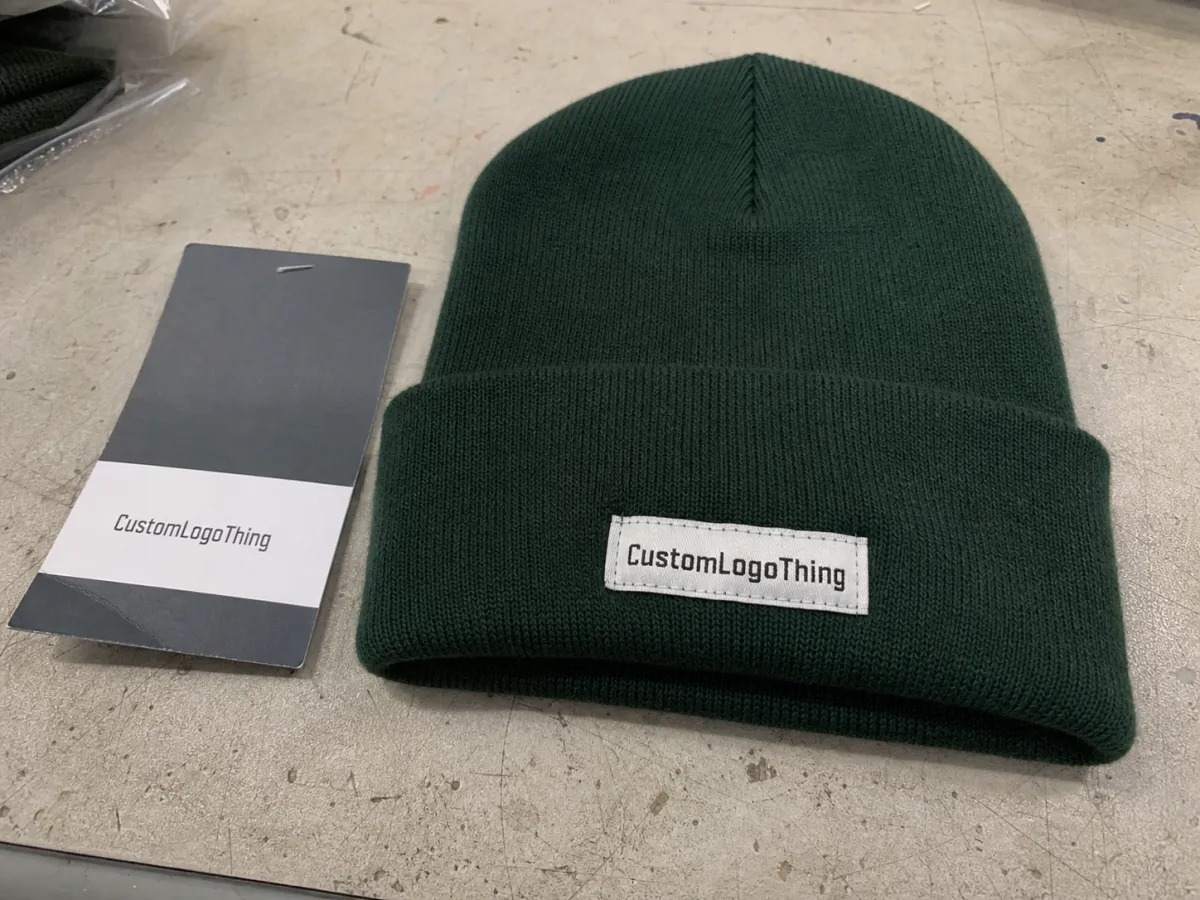
Beanie style shapes the label decision more than many buyers expect. A cuffed knit beanie gives you a clean front panel or cuff zone for branding. Slouch beanies have more relaxed placement options, but less structure, so a label can twist if the attachment is sloppy. Ribbed fits stretch more, which means the label size and stitch plan have to account for movement. Double-layer constructions provide stability, though they also require attention to seam positions and what the label will feel like against skin.
Most buyers choose from four label formats: center-fold, end-fold, loop label, and sew-on patch. Center-fold labels are common because they hide the stitching and sit neatly on the cuff. End-fold labels look cleaner at the edges and work well on side-seam placement. Loop labels are narrow and flexible, useful when the brand mark needs to stay subtle. Sew-on patches look more substantial, but they also add bulk, so they fit thicker knits better than thin, lightweight beanies.
Placement matters just as much as format. A front cuff placement gives high visibility. A side seam placement is quieter and usually more comfortable. Back seam placement keeps the front clean, which some premium brands prefer. A woven tab on the cuff edge can work for minimalist branding, but the factory has to control seam tension so the knit does not pucker. On a beanie, a half-centimeter of slippage can change the whole look.
Before asking for an apparel Woven Label Beanies factory quote, send these basics:
- Finished beanie size and cuff height
- Label dimensions and fold style
- Placement location, ideally marked on a photo
- Whether the label is decorative, functional, or both
- Target order quantity and delivery country
If your trim direction is already set, it helps to align the label request with the broader branding system on our Custom Labels & Tags page or through Contact Us. A beanie label, hang tag, and packaging spec should speak the same design language. If they do not, the line looks disconnected even when each piece is decent on its own.
Specs That Change Hand Feel, Durability, and Color Match
Quotes move when specs get real. The main drivers are yarn type, knit density, label weave density, stitch count, fold style, and attachment method. A thicker acrylic or acrylic-wool blend beanie usually handles a sew-on label better than a thin jersey-knit style. Fine-gauge knits can support small labels, but the stitching has to be controlled or the fabric will ripple. That kind of issue is hard to spot from a flat mockup and easy to miss if nobody asks for a real sample.
Color is another area where buyers get surprised. Woven labels are thread-based, so they do not behave like printed paper or screen ink. Pantone matching is approximate, not perfect. On a good run, you can get a close visual match, but you should expect thread-to-thread variation. If a logo uses tiny gradients or delicate micro text, simplify it before requesting pricing. The factory can only weave what the construction allows.
Logo size matters more than most people think. Tiny text that looks clean on a screen can disappear once it is woven at 12 mm or 15 mm high. On beanies, a simple logo block with strong contrast usually performs better than a busy mark that tries to say too much. If readability matters, ask for a sample woven at two sizes. That costs less than approving a bad run and discovering the problem after bulk production.
Comfort is not a side issue. A rough label edge on a beanie sits close to the forehead or ear area, which means the customer feels it every time they wear the product. Ask about edge softness, stitch backing, and abrasion resistance. If the factory offers a wear check, take it seriously. Some teams also use basic rub testing or compare against abrasion expectations similar to ASTM-style checks to catch scratchy finishes before production moves forward.
There are three questions a label spec has to answer before it is ready: will it look sharp, will it survive wear, and will it feel acceptable on skin? If any of those are uncertain, the quote is not ready either.
One more detail that matters in winter accessories: beanies stretch, then recover, then stretch again. A woven label that looks acceptable on a table may distort once the cuff is pulled on. That is why production teams often check label width against knit elasticity instead of relying only on artwork dimensions. It is a small adjustment with outsized impact.
Pricing, MOQ, and Unit Cost Drivers
Price for a beanie quote usually breaks into a few moving parts: the beanie body, the label, the sewing or attachment labor, sampling, and freight. If the beanie is stock-supported and the factory is only attaching a woven label, the entry price can stay fairly contained. If the body is fully custom knit, with custom yarn colors and packaging, the quote climbs quickly. That is not factory padding. It is setup time, labor, and material reality.
For simple woven-label beanies, MOQ can often start around 100-300 pieces if the base beanie is stock and the label is the main customization. For fully custom knit beanies, expect more like 300-1,000 pieces or higher, depending on yarn, gauge, and color count. Mid-volume orders usually give the best balance of price and flexibility. Tiny runs are possible, but the unit cost will remind you that one-off production is never cheap.
Here is the kind of price structure a buyer should expect:
| Option | Typical MOQ | Typical Unit Cost | What Moves the Price |
|---|---|---|---|
| Stock beanie + woven label | 100-300 pcs | $1.10-$2.80 | Label size, stitch count, one-color vs multi-color label |
| Custom knit beanie + woven label | 300-1,000 pcs | $2.30-$4.90 | Yarn blend, knit density, logo detail, size range |
| Fully custom knit beanie with premium trim | 500-1,500 pcs | $3.80-$6.50+ | Special yarns, embroidery, packaging, color count |
| Sample or pre-production piece | 1-3 pcs | $30-$120 | Artwork complexity, revision rounds, shipping method |
Those ranges are practical buying numbers, not marketing language. If you want lower unit cost, increase quantity, simplify the label, and avoid tiny logo details that force the factory to slow down. Cutting corners in the wrong place backfires. A poor weave on a logo, too many label colors, or repeated revisions can turn a “budget” order into an expensive one with mediocre results.
Ask for separate pricing on sample fee, bulk unit price, setup cost, and freight. Also ask whether the quote is EXW, FOB, or landed. If freight is not included, do not mentally include it anyway. That is how buyers compare numbers that are not actually comparable.
One useful test is to ask for three quantities at once, such as 300, 500, and 1,000 pieces. The spread often shows whether the factory is pricing for real production efficiency or padding every tier. A sharp drop at higher volume is normal. Flat pricing across all quantities usually means the factory has not broken the order down carefully.
Production Steps, Turnaround, and Lead Time
A clean production flow keeps the order moving. First comes quote confirmation. Then artwork review. Then proof or sample. After approval, the factory moves into bulk knitting or stock sourcing, label attachment, quality control, packing, and shipping. If one of those steps is vague, the schedule slips. Usually by more than the buyer expected.
For timing, use practical ranges. Quote response can take a few business days if the spec is complete. A simple sample or digital proof may take about a week. Bulk production often runs several weeks, depending on quantity and material availability. If the order is seasonal, the calendar gets tighter because everyone is chasing winter capacity at the same time. That part is predictable, even if it is not convenient.
Delays usually come from missing artwork details, slow color approvals, sample revisions, or a change in quantity after the quote is issued. The worst delay is the kind you create yourself by changing the label size after the factory has already prepared the sewing plan. Every revision resets something. Sometimes everything.
Buyers can protect the schedule by doing three things early:
- Approve the artwork and specs before asking for final pricing.
- Confirm the shipping destination and delivery window up front.
- Assign one decision-maker so the factory is not waiting on five opinions.
If your program also includes hang tags or retail packaging, think about carton flow at the same time. FSC-certified paper options are worth considering for branded inserts and tags, and you can review certification basics at FSC. That does not make the beanie better by itself, but it does keep the packaging story cleaner for brands that care about sourcing.
Lead time also changes with attachment method. A woven label sewn into a cuff can be straightforward. A patch with extra reinforcement, contrast thread, or multiple placement points takes longer and usually requires more inspection. A buyer who understands that from the start usually gets a more realistic quote and fewer surprises at the end.
What a Reliable Beanie Factory Should Prove Before You Buy
Good factories do not hide behind vague promises. They show consistent samples, answer technical questions directly, and give you a quote that is specific enough to hold up in production. If the factory cannot explain the label placement, thread choice, or stitch method, the quote is not ready for a serious order. A real factory quote should feel like a spec sheet with prices, not a guessing game with polished wording.
Trust also shows up in how the factory handles repeat orders. Can they match the earlier label color? Can they hold the same placement on every style or size? Do they send production photos, or at least clear QC updates before shipment? Those details matter more than a smooth sales pitch. Late shipments and loose stitching are expensive in winter. One bad batch can wipe out a season’s sell-through window before the second replenishment even lands.
A buyer should also ask for proof of material sourcing and quality control. That does not mean turning the first inquiry into an audit. It means asking for the basics: yarn origin if relevant, label construction method, QC checkpoints, and packing standards. If the order will move through retail distribution, ask how cartons are packed and whether they can support standard distribution testing logic. That is normal, not fussy.
The best suppliers are not the loudest. They are the ones that make the process boring. No surprises, no shifting answers, no unexplained cost jumps. If the quote is glossy and thin on detail, treat that as a warning sign. Cheap can be fine. Undefined is where buyers get burned.
Another sign of a serious factory is how they talk about defects. Good suppliers will name the likely failure points before you ask: twisted labels, stitch tension, mismatch between beanie stretch and label width, loose thread tails, uneven folding, and color drift across dye lots. That kind of specificity usually comes from real production habits, not from a script.
What to Send for an Accurate Factory Quote
If you want a usable quote fast, send the factory the real inputs, not a vague request like “custom beanie price please.” The best requests are short and complete. They give the manufacturer enough to price without guessing, and they leave less room for corrections later.
Send this list:
- Logo file in vector format if possible
- Beanie style: cuffed, slouch, ribbed, or double-layer
- Label size, fold type, and placement
- Target quantity and any tiered quantities you want priced
- Color references or Pantone targets
- Ship-to country, port, or ZIP/postal code
- Whether you want stock beanies, fully custom knit, or a hybrid build
If the artwork is not final, include a reference photo and a budget range. That usually gets you to a usable estimate faster than waiting for perfection. Buyers often think a half-finished brief slows things down. In practice, it often helps the factory spot the real decision points early.
Ask for a revised quote that separates sampling, bulk, freight, and any extra sewing or packaging. Ask for price breaks at multiple quantities. Ask what happens if the label size changes by 5 mm or if you need a second colorway. Those are the exact questions that keep a project from turning into a mess halfway through.
It also helps to state what will be checked at approval. If the sample is being judged on color only, say so. If hand feel matters more than appearance, say that too. A factory can work with priorities. It cannot read them reliably from an email that only says “looks good.”
If you need direct help, send the spec through Contact Us and include your mockup or reference image. If you are still comparing trim options, review Custom Labels & Tags so your beanie quote and your branding pieces stay aligned. The cleanest quote is usually the one that matches the actual production path, not the one that sounds the most attractive in isolation.
For buyers building winter assortments at scale, that discipline matters. A woven label may be a small component, but it affects appearance, comfort, stitch time, QC, and final price. The best apparel Woven Label Beanies factory quote is specific enough that you can compare suppliers fairly and practical enough that the order can be built without guesswork.
How do I get an apparel woven label beanies factory quote fast?
Send the beanie style, logo file, label size, placement, quantity, and shipping destination in one message. If the artwork is not final, add a reference photo and brand color codes so the factory can estimate without waiting on extra back-and-forth. Ask for separate pricing on sampling, bulk units, and freight so the quote is actually usable.
What details change woven label beanie pricing the most?
Quantity, label color count, label size, and whether the beanie is stock or fully custom usually move the price the most. Extra stitching, special yarns, packaging upgrades, and rush timing also push the quote up. Tiny logos and complex weave patterns cost more because they take more setup and reduce production efficiency.
What is the MOQ for custom woven label beanies?
MOQ depends on whether the factory is supplying the beanie body, only attaching the label, or building a fully custom knit style. Simple woven-label programs can often start lower than full custom knit orders, but the unit cost is usually better at mid-volume. Ask the factory for tiered pricing at multiple quantities so you can see where the breakpoints actually are.
Can I approve a sample before bulk production starts?
Yes, and you should if the label placement, hand feel, or color matching matters to the brand. A sample helps catch problems like label size issues, stitching tension, or logo details that do not read well on knit fabric. Use the sample approval as the final checkpoint before bulk so production does not drift off spec.
How long does beanie production usually take after quote approval?
Simple orders may move quickly, but custom yarn, label development, and sample approval can add time. A realistic schedule usually includes a quote phase, sample or proof phase, bulk production, quality control, and shipping time. The fastest way to shorten lead time is to approve artwork and specs early and avoid changing them midstream.

