Buyer Fit Snapshot
| Best fit | Unit Load Boxes Wholesale for Safer Bulk Shipping Programs projects where brand print, material claims, artwork control, MOQ, and repeat-order consistency need to be specified before quoting. |
|---|---|
| Quote inputs | Share finished size, material target, print colors, finish, packing count, annual reorder estimate, ship-to region, and any compliance wording. |
| Proofing check | Approve dieline scale, logo placement, barcode or warning zones, color tolerance, closure strength, and carton packing before bulk production. |
| Main risk | Vague material claims, crowded artwork, missing packing details, or unclear freight terms can make a low unit price expensive after revisions. |
Fast answer: Unit Load Boxes Wholesale for Safer Bulk Shipping Programs should be specified like a repeatable production item. The safest quote records material, print method, finish, artwork proof, packing count, and reorder notes in one written spec.
Production checks before approval
Compare the actual filled-product size with the drawing, then confirm tolerance on folds, seals, hang holes, label areas, and retail display edges. Reserve space for logos, QR codes, warning copy, and material claims before decorative graphics fill the panel.
Quote comparison points
Review material grade, print process, finish, sampling route, tooling charges, carton quantity, and freight assumptions side by side. A quote is only useful when the supplier can repeat the same color, closure quality, and packing count on the next order.
Unit Load Boxes Wholesale for Safer Bulk Shipping Programs
A load can leave the dock looking spotless and still fail three states later. A hairline seam split, a corner that takes one hit too many, a stack that bows under its own weight - that is often how damage starts. Buyers searching for unit load boxes wholesale usually find out fast that the box is not just a shell. It is part of the load's structural math, and in many bulk shipping programs it behaves more like an engineered component than a carton.
The failure points are usually small. A footprint that leaves too much open space. A wall style that looks fine on paper but collapses under stack pressure. A closure that loosens after the pallet starts vibrating in transit. Each one seems manageable on its own, yet together they create the kind of loss that never shows up cleanly on a spreadsheet. Strong unit load boxes wholesale programs close those gaps. Fewer crushed cartons. Less repacking. Cleaner pallet builds. Less time spent fixing freight that should have already moved out the door.
Buying for recurring distribution changes the question entirely. The goal is not to order the heaviest box in the catalog. The goal is to match the containment system to the product, the lane, and the way the warehouse actually runs. That is the real value of unit load boxes wholesale: repeatable specifications, dependable performance, and a purchasing path that makes sense to procurement, operations, and shipping at the same time.
I have watched enough dock crews battle bad packaging to know the hidden cost is rarely dramatic. It is the extra labor, the re-closed cartons, the claims calls, the late trucks, and the one annoyed customer service rep who has to explain why an order showed up looking like it went through a storm. This article stays focused on the decisions that matter in real orders: construction, specifications, Pricing, Lead Times, and the information a buyer should have ready before asking Custom Logo Things for a quote. If you are comparing related formats, our Wholesale Programs page and Custom Packaging Products catalog are useful reference points for Corrugated Shipping Boxes and pallet boxes as well.
Why do unit load boxes wholesale reduce hidden shipping losses?
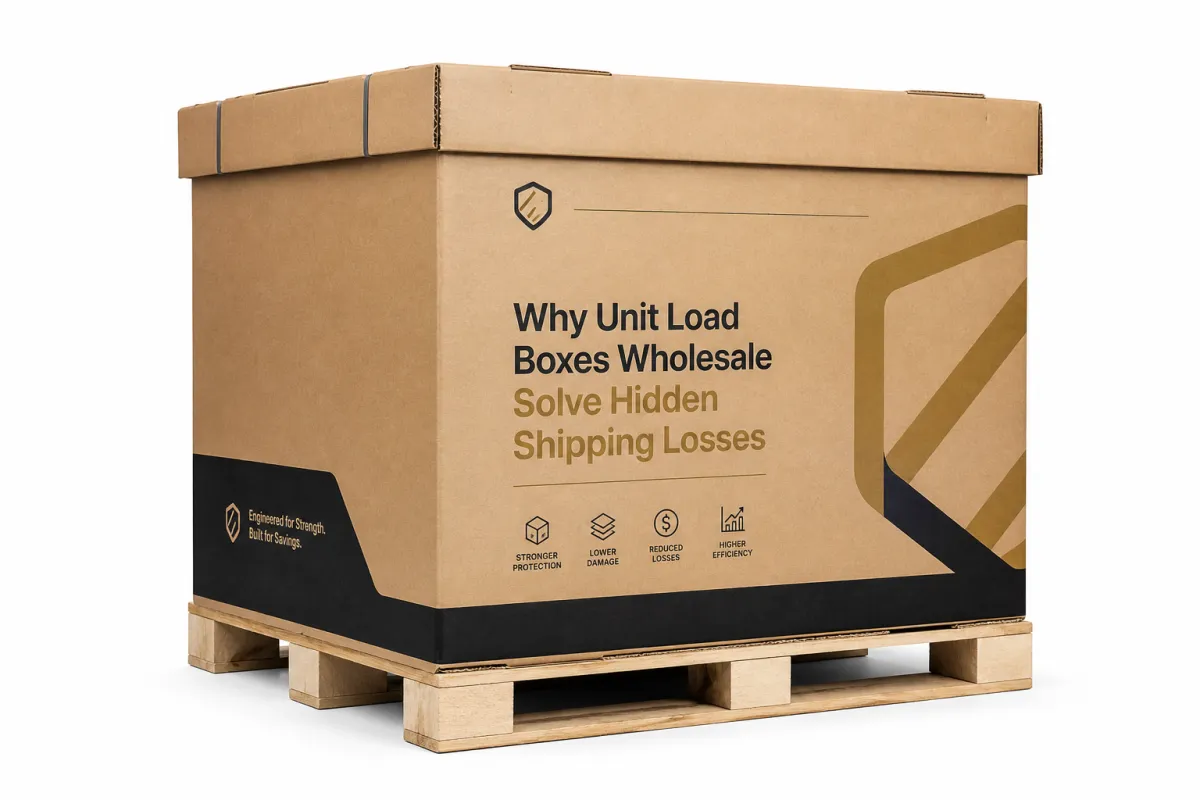
Most freight damage does not begin with a dramatic drop. It starts with pressure, vibration, and time. A corner crush that looks harmless at the dock can become a split seam by the end of transit. A box that bows by a fraction of an inch can throw a pallet off balance. That is why unit load boxes wholesale should be judged by how they behave under real handling, not by how neat they look before packing.
For packaging buyers, the hidden cost is rarely just the replacement product. Rework labor adds up. Claims consume staff hours. Delays push customer orders off schedule. Someone still has to sort the good units from the damaged ones. Well-built unit load boxes wholesale programs cut that waste by keeping the load intact from stretch wrap to final receipt. A lot of companies underestimate how much labor disappears once the box is matched correctly to the load.
Shipping damage often traces back to a design mismatch rather than rough treatment alone. A load that is too tall for its base, too heavy for the board grade, or too loosely packed for the closure style can fail on a lane that is otherwise ordinary. That is why unit load boxes wholesale buyers need to think about pallet geometry, product density, and stack pattern before they worry about graphics or branding.
In practical terms, the box has four jobs: contain the product, support compression, survive handling, and stay economical across repeat orders. When those four jobs line up, unit load boxes wholesale becomes a controlled purchasing decision instead of a recurring headache. B2B shipping teams especially feel the difference because predictable packaging saves time every single cycle.
There is a warehouse side to this that gets ignored. Cleanly spec'd boxes move faster because workers are not fighting odd dimensions, unstable layers, or excess void fill. On a busy distribution floor, that matters just as much as freight protection. A better unit load boxes wholesale purchase can reduce touchpoints and shorten load-build time before the truck ever backs up to the dock.
Real-world takeaway: if the shipping method changes every month, the packaging spec drifts and damage risk usually rises with it. If the method stays stable, unit load boxes wholesale can be tuned closely enough to deliver repeatable results without buying more material than the load needs.
Unit Load Boxes Wholesale: Product Construction and Options
The construction conversation starts with corrugated board grade, wall style, and flute profile. Those three choices set the tone for how the box handles compression, impact, and moisture. For many unit load boxes wholesale orders, single-wall corrugated works for moderate loads. Heavier or more fragile freight often calls for double-wall board, reinforced corners, or a die-cut style that locks the load more tightly.
Regular slotted containers remain common because they are efficient and easy to produce, but they are not the only option. Die-cut styles can improve fit, tighten closure control, and create cleaner panel alignment for unitized freight. Buyers comparing unit load boxes wholesale options should think about how the box will be loaded, whether it will be stacked, and whether workers need top access, side access, or both. That sounds basic, but it is where a lot of packaging specs go sideways.
Common options include hand-hole cutouts for easier lifting, moisture-resistant treatments for humid lanes, partitions for mixed SKUs, and print for handling instructions or internal identification. Those details matter because a box that looks simple on paper can become awkward on the floor if the team has to guess which side opens or where a layer belongs. Good unit load boxes wholesale design removes that guesswork.
- Single-wall corrugated: common for lighter consolidated shipments and lower stack pressure.
- Double-wall corrugated: better for heavier loads, longer dwell time, or frequent warehouse handling.
- Die-cut construction: useful for tighter footprint control and cleaner assembly.
- Reinforced corners or inserts: helpful when the product has point loads, rigid edges, or odd geometry.
- Moisture treatment: worth considering for humid climates, cold-chain touchpoints, or long transit windows.
Matching the box to the load method matters too. A palletized bundle that moves as one unit may need a different structure than a stacked case that gets broken apart later in the warehouse. In unit load boxes wholesale work, the right format usually lowers void fill, improves pallet efficiency, and keeps freight weight under control. That sort of fit pays off every time the order repeats.
Custom Logo Things often sees buyers focus only on outside dimensions, but the product inside drives the design more than most teams expect. Dense components, fragile assemblies, and mixed SKUs each create different demands on the closure method and wall strength. The more a load can shift, the more important it becomes for unit load boxes wholesale to follow actual product behavior instead of a catalog assumption. Otherwise, you are kinda guessing with cardboard, and that is never a great plan.
Specifications That Matter in Unit Load Boxes Wholesale
If you are requesting a quote, the most useful data points are usually the simplest ones: inside dimensions, estimated load weight, pallet footprint, stack height, and the handling method used from packing line to destination. Those numbers define the performance target for unit load boxes wholesale far better than a vague description like "heavy-duty box."
Dimensional accuracy matters because even a quarter inch can change how neatly a load nests on a pallet. That becomes a bigger problem if you are building to 48 x 40 pallets, using fixed rack spacing, or loading mixed quantities in a container plan. In those cases, unit load boxes wholesale should be spec'd to reduce overhang, protect corners, and keep the stack centered so the load does not walk during transit.
Compression resistance is another practical variable. Buyers may hear board terms like ECT and burst strength, but the real question is whether the box will hold up under the number of layers, the dwell time, and the way it is handled. For many unit load boxes wholesale programs, edge crush strength is the better starting point because it relates directly to stack performance. If the shipment sits in a warehouse for days or weeks, compression testing becomes even more relevant.
Transit conditions matter just as much as board grade. Vibration, humidity, temperature swings, and repeated handling all affect how the box behaves after it leaves the packing area. That is one reason packaging engineers still refer to ISTA test methods and ASTM compression checks during development. If your team wants a standards-based framework, ISTA is a useful reference point for distribution testing, and a well-built unit load boxes wholesale spec should reflect the kind of abuse the lane actually creates.
Labeling and compliance should also sit in the same conversation. Handling arrows, product identity, traceability marks, and scan zones can all shape the final layout. If the board source matters to your sustainability or sourcing team, FSC certification is worth asking about for fiber sourcing. For many unit load boxes wholesale orders, that is not the primary buying driver, but it can matter during approval.
A packaging buyer can speed up the quoting process by sending sample dimensions and a few photographs of the current ship method. A picture of the pallet top, the closure style, and the product arrangement often says more than a long email. That is how unit load boxes wholesale becomes a practical engineering conversation instead of a guessing game, and it often shortens the path to a pallet-ready spec.
- Inside dimensions: critical for fit, void control, and pallet efficiency.
- Board grade: tied to weight, compression, and puncture resistance.
- Stack height: affects how much vertical load the box must carry.
- Moisture exposure: helps determine whether a coating or stronger board is needed.
- Handling cycle: manual, forklift, conveyor, or long-term storage all change the spec.
For buyers comparing options, the best spec sheet is the one that tells production exactly how the shipment will live in the real world. That is especially true for unit load boxes wholesale, because being slightly wrong can show up as damage, delays, or a redesign that better input could have prevented from the start.
Unit Load Boxes Wholesale Pricing, MOQ, and Volume Breaks
Price matters, but it should never be the only number on the page. The main cost drivers are board grade, size, print complexity, internal reinforcement, order quantity, and whether the design can run on standard production equipment or needs custom tooling. In unit load boxes wholesale buying, a simple size with light print usually prices far better than a heavy double-wall format with inserts and multiple ink hits.
MOQ affects the economics directly. Smaller runs are often practical for fit trials, seasonal demand, or replacement of an existing box format, but the unit price generally improves as quantity rises. That is why procurement teams buying unit load boxes wholesale should ask for a price ladder, not a single number, and compare total landed cost across the expected reorder cycle.
Volume breaks matter because the first quote may not be the most useful quote. A 1,000-piece run might fit a pilot order, while a 5,000-piece run may cut unit cost enough to justify extra shelf space or a larger replenishment plan. For unit load boxes wholesale, the right comparison is usually not "cheapest box" but "lowest total cost once freight damage, storage, and labor are included."
| Option | Typical Unit Price at 1,000 | Typical Unit Price at 5,000 | Best Fit | Notes |
|---|---|---|---|---|
| Single-wall RSC | $1.05-$1.85 | $0.78-$1.35 | Moderate loads, standard warehouse handling | Efficient for repeat use where stack pressure is controlled |
| Reinforced die-cut box | $1.40-$2.60 | $1.00-$1.95 | Tighter pallet fit, better closure control | Useful when the load needs better alignment and less movement |
| Double-wall pallet box | $2.25-$4.75 | $1.65-$3.40 | Heavier freight, higher stack load, longer transit windows | Often worth it if product damage is expensive or claims are frequent |
These are illustrative wholesale ranges only. Actual pricing for unit load boxes wholesale depends on dimensions, board grade, print coverage, and shipping destination. Always confirm live pricing before tying a program to a budget number.
Freight class and pallet count matter too. A slightly more expensive box can still lower total cost if it reduces damaged returns, cuts cube waste, or lets more units fit per pallet. That is the part many buyers miss. A well-chosen unit load boxes wholesale program can save money even when the box line item rises by a few cents, because the cost of damage downstream is usually much higher than the packaging delta.
A box that prevents even a small percentage of transit damage can pay back its upgrade cost faster than most people expect, especially in programs with repeat shipments and high handling frequency.
Planning on an annual basis usually gives a clearer picture than looking only at first-order quantity. A quote based on 1,000 pieces can mislead if the actual forecast is 20,000 pieces over twelve months. In unit load boxes wholesale work, the annual view often opens better pricing structures, cleaner production scheduling, and steadier inventory planning.
That is also why it helps to compare more than board strength. Storage space, on-site assembly time, freight class, and the likelihood of returns or claims all belong in the same calculation. A supplier that understands those variables can make unit load boxes wholesale feel like a controlled purchasing decision instead of a reactive one. And frankly, that is what most shipping teams are trying to buy: fewer surprises.
Process and Timeline for Unit Load Boxes Wholesale Orders
The workflow is straightforward, but good inputs make it faster. First, the buyer shares dimensions, estimated load weight, pallet footprint, closure method, print needs, and any notes on storage or transit. Then the packaging team recommends a structure, reviews price options, and confirms the final spec before production is scheduled. That is the most efficient route for unit load boxes wholesale because it keeps the quote tied to reality instead of assumptions.
If an existing ship method is already in place, photos help more than most people expect. A picture of the current pallet, the product arrangement, and the way the load is wrapped can show whether the board grade is too light, whether the footprint is off, or whether a closure change would solve the issue without pushing material cost higher. In unit load boxes wholesale work, good documentation often shortens the path to a reliable spec.
Timelines depend on complexity. Standard sizes with simple print usually move faster than highly custom structures, and a straightforward reorder can sometimes turn faster than a first-time build. As a practical benchmark, many unit load boxes wholesale orders land in the 12-15 business day range from proof approval for standard custom work, while more complex structures, inserts, or multiple sample rounds can take longer. That is normal, and it is better to plan for it than to rush the spec.
Proofing should not be treated as a formality. A virtual spec check is often enough for simple jobs, but physical samples make sense when the load is fragile, unusually heavy, or handled repeatedly. If the program depends on high compression strength or close pallet fit, a sample can save a lot of expense later. That is one of the most useful habits in unit load boxes wholesale buying: validate before you scale.
- Share the product dimensions and load weight.
- Confirm the pallet footprint and warehouse handling method.
- Review the structural recommendation and quote.
- Approve the proof or sample.
- Release production and set the reorder calendar.
Forecasting matters as well. The more accurately a buyer can estimate repeat demand, the easier it is to hold price and schedule capacity. For teams that reorder on a steady cadence, unit load boxes wholesale works best when the forecast is shared early and one internal contact owns approvals. That reduces delays, avoids spec drift, and keeps production aligned with shipping needs.
If your organization prefers a central sourcing path, our Wholesale Programs page outlines how volume ordering and repeat supply can be managed without losing track of the spec. That kind of structure matters because unit load boxes wholesale should feel operationally predictable, not like a one-off scramble every time the warehouse needs more boxes.
Why Choose Us for Unit Load Boxes Wholesale Supply
The best reason to choose a supplier is not polished sales language; it is the ability to translate shipping requirements into a box that actually fits the load. At Custom Logo Things, the focus is on practical packaging that matches product weight, stack behavior, and handling reality. That is where unit load boxes wholesale delivers real value: less waste, fewer damaged units, and a spec that does not force the warehouse to work around the box.
Technical fit matters more than generic claims. A good supplier should know when a single-wall board is enough, when the structure needs reinforcement, and when a small change in footprint will save more material than a thicker board ever could. Buyers who source unit load boxes wholesale should expect that kind of practical guidance because it turns packaging from a commodity purchase into a controlled logistics tool.
Repeatability is another advantage. Once a format is proven, the same box should perform the same way on each reorder, provided the product and handling method stay consistent. That kind of consistency is valuable for procurement, quality, and shipping teams alike. It is also one of the main reasons businesses stay with a packaging partner after the first successful unit load boxes wholesale run.
Production flexibility matters too. Some programs need a simple reorder. Others need revised print, a new insert, or a modest size change to match a product update. A supplier that can move through those changes without forcing a full reset saves time and avoids confusion. For unit load boxes wholesale, that flexibility is often the difference between a smooth replenishment cycle and a warehouse emergency.
For companies that care about broader packaging strategy, our Custom Packaging Products page is a useful way to compare related formats and see how unitized shipping fits into the rest of the packaging line. The point is not to sell a box by itself; the point is to build a buying program that supports storage efficiency, freight protection, and clean order fulfillment. That is the kind of result buyers should expect from unit load boxes wholesale.
What buyers usually notice after the switch:
- Fewer crushed corners and split seams during transit.
- Cleaner pallet stacks and less rework at the dock.
- More predictable purchasing because the spec stays stable.
- Better use of cube, which can improve freight efficiency.
- Less waste from overboxing and oversized filler materials.
In plain terms, the value shows up in damage reduction and operational calm. A buyer does not need hype; they need a box that performs and a supplier that communicates clearly. That is the standard we keep in mind for unit load boxes wholesale, and it is the standard most serious packaging teams should demand as well.
Next Steps for Unit Load Boxes Wholesale Buyers
The fastest way to get a useful quote is to gather four essentials before you reach out: product dimensions, target load weight, pallet footprint, and expected annual volume. If you can add photos of the current packout, that helps even more. Those details give the packaging team enough context to recommend the right unit load boxes wholesale structure without wasting time on back-and-forth.
After that, compare two or three structural options instead of one. A standard RSC, a reinforced die-cut design, and a double-wall version may all work, but they do not solve the same problem at the same cost. Comparing them side by side makes it easier to balance material expense, protection level, handling convenience, and storage density. That is the most sensible way to buy unit load boxes wholesale for a recurring program.
If the shipment is fragile, unusually heavy, or stacked for long dwell times, ask for a sample or spec review before the full order is released. Early validation prevents expensive corrections later, and it often reveals a simpler design than the one originally requested. That is the kind of practical check that keeps unit load boxes wholesale decisions grounded in performance instead of habit.
Use this action list before requesting pricing:
- Send exact inside dimensions and product weight.
- Share the pallet pattern and warehouse handling method.
- Provide current packaging photos if available.
- State whether print, barcodes, or handling marks are needed.
- Ask for pricing tiers that reflect realistic reorder volume.
From a buyer's point of view, the best results usually come from fit, protection, and total shipping economics, not from choosing the cheapest carton on paper. That is the real lesson behind unit load boxes wholesale: when the box matches the load, the freight moves cleaner, the warehouse works faster, and the cost per shipped unit becomes easier to control over time. If you only remember one thing, make it this: the right spec beats the biggest box, and a disciplined reorder plan beats chasing the lowest sticker price.
What sizes are most common for unit load boxes wholesale orders?
Common sizes usually follow pallet footprints, warehouse shelf spacing, or the footprint of the product bundle being shipped. The best size is the one that minimizes void space while still allowing safe loading, stacking, and closure. In practice, the "most common" size is not always the best size; it is just the one that happens to fit a legacy workflow. Buyers often uncover savings after they stop copying the old spec and start measuring the actual load.
How do I know which board grade to use for unit load boxes wholesale?
Match the board grade to the product weight, stack height, handling frequency, and transit conditions. Heavier or more fragile loads generally need higher compression resistance and better puncture protection. If the shipment sits in a hot trailer, a damp warehouse, or a long storage lane, that should push the spec upward. A sample test is smarter than arguing over board labels for three weeks.
Can unit load boxes wholesale orders include print or labeling?
Yes, many wholesale orders can include product identification, handling instructions, barcodes, or branding. Keep print needs simple if the goal is speed and cost control, or specify the exact label zones if scan accuracy matters. We usually see the best results when print serves operations first and branding second. Otherwise, the box ends up looking polished but doing nothing useful.
What affects the price of unit load boxes wholesale most?
The biggest pricing drivers are size, board grade, quantity, print complexity, and whether the design is standard or fully custom. Freight, storage, and damage reduction should also be included when comparing total cost. A cheaper carton can be the more expensive choice once claims and rework enter the picture. That is where the spreadsheet gets honest.
How long does a unit load boxes wholesale order usually take?
Standard configurations generally move faster than custom structures, especially when sizing and print are already approved. Lead time depends on sample approval, production schedule, and whether any structural testing or revisions are needed. For many programs, a straightforward order can move in a couple of weeks after approval, while complex builds take longer. If timing is tight, say so early. That saves everybody a headache.

