Vitamin unstructured dad hats Bulk Order Planning starts with a practical buying problem: how do you source a cap that feels relaxed, ships efficiently, and still looks deliberate inside a wellness kit? Soft-crown dad hats usually solve that better than structured caps. They flatten more easily in cartons, photograph well in flat-lay packaging, and feel less like leftover promo stock once they reach the customer.
That last point matters. A hat included with vitamins is not just decoration. It affects carton fill, unboxing quality, fit complaints, reorder consistency, and the amount of internal cleanup a launch requires after approvals are finished. If the cap is part of a supplement bundle, it needs to support the brand without creating extra friction in fulfillment or procurement.
The buying process works best when the hat is treated as a spec-driven product, not a casual add-on. Crown shape, fabric, closure, decoration method, and packaging all change cost and turnaround. Ignore those variables and the quote may look low while the landed cost climbs. Define them early and the order behaves more like a production plan than a guess.
Why soft-crown dad hats fit vitamin launches better than structured caps
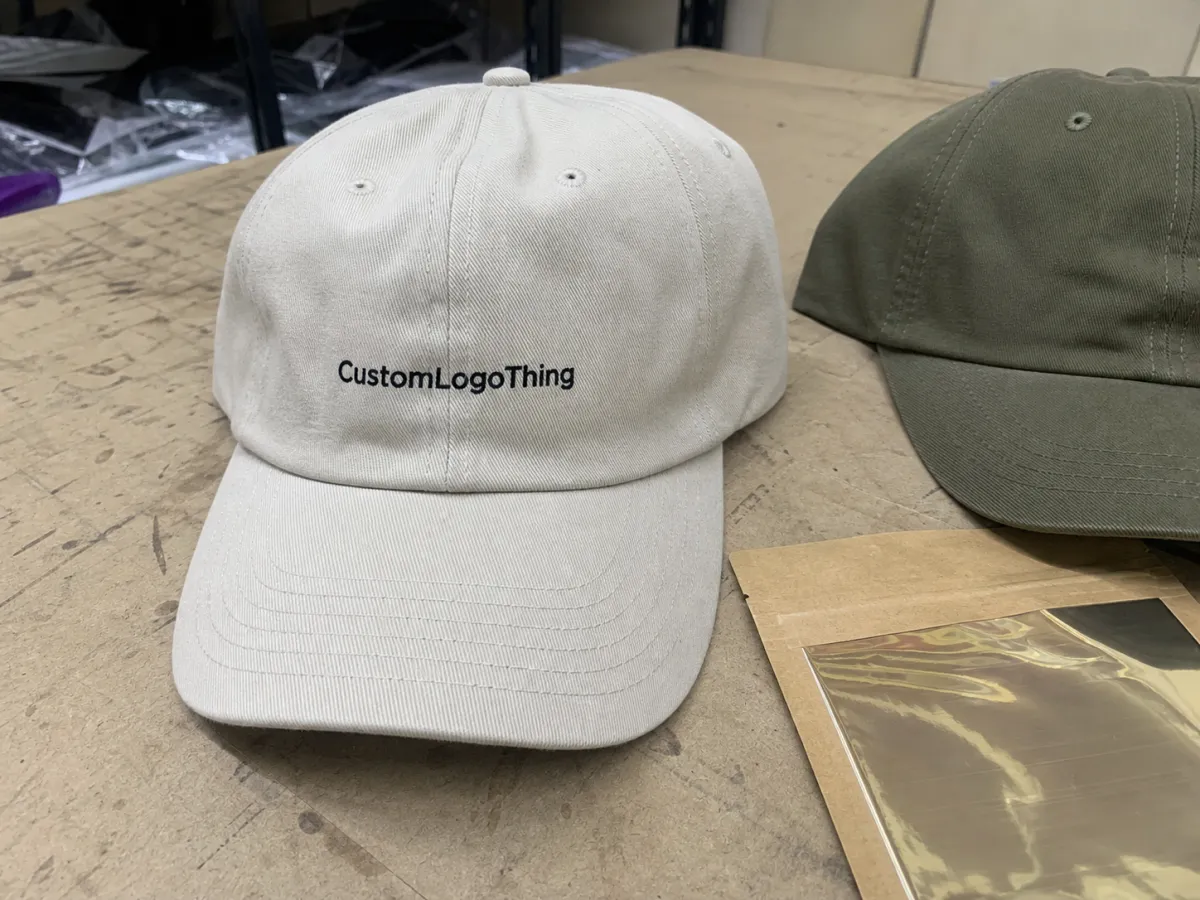
Structured caps create a sharper silhouette, but that look can feel too retail-heavy for vitamin kits, wellness mailers, and supplement launch boxes. An unstructured front panel bends naturally and keeps the logo from looking overbuilt. For brands selling sleep support, hydration mixes, greens, or daily multivitamins, that softer posture usually matches the product message better than a rigid promotional cap.
There is also a packing advantage that gets overlooked. A soft crown nests into a kit with less wasted air and usually creates less pressure against neighboring items. That helps when a box includes bottles, sachets, inserts, or rigid trays. In a fulfillment center, a cap that collapses flat is easier to place and less likely to force a last-minute change in the pack-out sequence.
Fit also becomes more forgiving. Dad hats generally accommodate a wider range of head sizes because the crown sits lower and the closure has more adjustment range. That does not eliminate fit complaints, but it lowers the odds. For a wellness brand, fewer complaints mean fewer support tickets and less noise around a campaign that should be judged on product response, not apparel issues.
Then there is the branding effect. A soft-crown hat tends to feel casual and human. That matters for supplement companies trying to avoid the hard-sell look that still clings to many promotional items. A muted cap with a restrained mark can read as part of the lifestyle, not a billboard. That distinction is often what makes repeat wear more likely, which is the real test of merch quality.
The comparison with structured caps is useful because the difference shows up in both cost and behavior. Structured caps can support larger art and hold a firmer front panel, but they often require more deliberate packaging and can be less comfortable for everyday wear. If the hat needs to live inside a vitamin subscription box or a one-time launch bundle, the softer format usually fits the job better.
How crown shape, fabric, and closure change the final look
Fabric choice changes the hat faster than many buyers expect. Washed cotton has the easiest drape and usually delivers the most broken-in feel straight out of the carton. Brushed twill looks cleaner and gives embroidery a more consistent base, especially when the logo has fine edges or small type. Canvas is tougher and more defined, but it can feel heavier and hold a stiffer line at the front. If the brand wants an understated, wearable piece, washed cotton often wins. If the artwork needs a sharper field, brushed twill can be safer.
The crown itself changes logo behavior. A stiff front panel can support larger art without warping, but a soft crown works better with smaller marks, low-density embroidery, or a patch that does not need a perfectly flat face. That is why many supplement brands keep the front logo around 2 to 2.5 inches wide and avoid oversized coverage unless the hat is meant for a retail program. On neutral colors, a smaller logo often reads more premium than a larger one.
Closure choice affects both price and perception. A self-fabric strap feels relaxed and usually suits lifestyle bundles or direct-to-consumer kits. A metal buckle gives a more finished retail look and usually signals a little more care in construction. Slide closures are practical for promo use because they are quick and simple, but they can feel lighter than a stitched strap with hardware. For a gift set, the closure should match the rest of the packaging tone.
Color deserves the same attention. Neutral tones such as stone, washed black, olive, navy, and sand usually fit supplement branding better than bright colors because they do not compete with bottles, pouches, or label art. A contrast underbrim can add depth without turning the cap into a loud object. Add multiple colorways and the project becomes more complex: more setup, more inventory splits, and a greater chance of slight shade variation between lots. That is not always a problem, but it should be in the quote from the start.
One practical detail: the more distressed or washed the fabric is, the more variation you should expect from piece to piece. Buyers sometimes interpret that variation as inconsistency, when it is actually part of the material behavior. For a clean health-product presentation, the better choice is often a lightly washed fabric rather than a heavily distressed one. The cap should look relaxed, not worn out.
Spec sheet checkpoints that control fit, imprint quality, and packaging
If the spec sheet is thin, the quote will be vague. A useful cap spec starts with the basics: panel count, brim curve, sweatband type, eyelet count, stitch density, closure style, and label placement. Those details affect how the hat fits, how long decoration takes, and whether the supplier can reproduce the same item next quarter without rebuilding the file from scratch. For vitamin unstructured dad hats Bulk Order Planning, that is the difference between a repeatable program and a one-off guess.
Decoration limits should be written down before the first mockup. Embroidery often looks best around 2.25 to 2.75 inches wide on a soft crown, but it can lose clarity if the art is too dense or too detailed. Tiny text is the usual problem. Patches can hide some stitching limitations, yet they bring their own variables: border shape, edge finish, adhesive strength, and how the patch sits on a curved front panel. Side and back branding should be checked for seam interference, because a mark placed too close to a seam can distort once the hat is worn.
Thread color matters more than buyers expect. Two logos with the same artwork can look very different if one uses a tight thread palette and the other uses subtle contrast colors. A health brand usually benefits from restraint. High-contrast stitching can make a clean cap feel busier than intended. If the artwork is already bold, the hat should usually be simpler.
Packaging needs the same level of discipline. Ask whether the hats are bulk packed, polybagged individually, packed 25 or 50 per inner carton, or prepared for retail-ready presentation. If the order includes hangtags, barcode stickers, or kitting into a vitamin bundle, those requirements belong on the same sheet. Carton count and carton marking should be approved with the product mockup so the warehouse team is not guessing later.
A good hat spec is not a style sheet; it is a control document. If the logo, packing method, and carton marking are all agreed before production starts, the supplier has fewer chances to misread the order.
For shipment testing and carton integrity, ask whether the supplier follows ISTA distribution testing methods or a comparable internal QC process. If the caps will move through retail channels or long-distance freight, a basic drop and compression review can reveal weak packaging before it becomes a claim. If the brand also cares about fiber sourcing for paper components, FSC certification can matter for cartons and inserts.
A practical note on fit specs: one-size-fits-most is common, but it is not a quality guarantee. Buyers should ask for the actual circumference range and the minimum/maximum closure extension. A cap that technically adjusts wide enough can still feel awkward if the strap tail is too long, the sweatband is stiff, or the rear opening sits too high. Small details. They make a visible difference.
Pricing, MOQ, and unit-cost levers for bulk cap orders
Price is shaped more by construction choices than by the hat itself. Stitch count, thread color changes, patch construction, woven labels, and custom packaging all add labor or setup time. A simple embroidered dad hat can be economical at moderate volume, but the cost rises quickly if the logo uses multiple colors, the crown includes a specialty patch, or the order needs individual labeling for retail. At larger volumes, setup gets spread out. At smaller runs, every extra feature shows up immediately in the unit cost.
MOQ is not just a factory number. It is the result of colorways, decoration method, and production flow. One logo on one color in one closure style may hold a lower MOQ, sometimes around 100 to 300 pieces depending on the supplier. Add three colorways, a side logo, and custom inner labels, and the practical MOQ can climb to 300 to 500 or more because the order now requires more separate setup and more inventory coordination.
To compare offers fairly, ask for landed cost in layers. A quote should separate sample fee, ex-factory production cost, freight, duties, and any special handling such as split shipment or storage. A unit price that looks strong on paper can lose its appeal once cartons move by air instead of ocean, or once the buyer realizes packaging was not included. Landed cost matters more than the headline number.
| Option | Typical Cost Effect | Best Fit |
|---|---|---|
| Single-color embroidery on washed cotton | Lowest setup; often the cleanest unit cost at volume | Core vitamin bundles and simple giveaways |
| Multi-color embroidery with woven label | Moderate increase from extra stitch time and materials | Brand merch and DTC launches |
| PVC or woven patch plus custom hangtag | Higher due to patch tooling and insertion labor | Retail programs with stronger shelf appeal |
| Custom polybag, barcode, and carton labeling | Small per-unit lift that becomes meaningful on large orders | Wholesale distribution and warehouse intake |
As a rough working range, many buyers see simple bulk embroidered dad hats land around $3.40 to $5.25 per unit at mid-size quantities, depending on artwork and build. Add more decoration, packaging, or tighter QC requirements and the number moves upward. At larger volumes, especially around 3,000 to 5,000 pieces, the same cap can fall closer to the low-$2 to mid-$3 range before freight, but only if the spec is stable and the order is not split across too many variants. The point is not the exact number. It is understanding which line item is pushing it.
One more variable often misses the first quote: freight mode. Air can save time, but it can also erase the advantage of a low unit price. Ocean freight rewards patience and stable forecasts. If the launch date is fixed, the buyer may pay more for speed. That tradeoff should be explicit, not discovered after approval.
Production steps, proofing, and turnaround planning
The production path is simple on paper and less tidy in practice. It usually runs from inquiry to artwork review, then mockup, then sample or digital proof, then bulk production, QC, packing, and dispatch. Each stage has a different risk. Artwork review can stall on a bad file format. Proofing can stall on color correction. Production can stall on a late change to placement or packaging. The order stays on time only if the buyer treats each checkpoint as real.
Timing is usually the first place an order slips. If the supplier needs a physical sample, add five to seven business days before bulk work starts. Once the proof is approved, many cap programs need roughly 12 to 18 business days for production, though fabric availability and decoration complexity can extend that. Freight time sits on top of that. If the hats are tied to a launch date, trade show, or subscription drop, a buffer of two to three weeks is sensible.
Late approvals are the hidden cost. A color change after mockup approval can reset the schedule. A packaging edit can alter carton counts and delay the pack-out line. Missing vector artwork can stall the first proof for days. These issues are small individually. Together, they can push an order outside the window. That is why a milestone list helps: proof approval date, production start date, inspection window, and estimated ship date.
Inspection should not be a vague promise. Ask for photo confirmation of logo placement, a carton count check, and if possible a pre-ship review of a sample from the production lot. For higher-volume orders, batch checks are more useful than one perfect photo. They show whether the run is holding steady across multiple cartons, not just the first unit off the line.
Another common delay sits in the artwork file itself. Vector artwork is usually the cleanest starting point, but even vector files can cause trouble if the designer used extremely thin lines, tiny text, or too many nested shapes. Those elements often disappear or thicken once translated into thread or patch form. A good proof process catches that. A rushed one does not.
What a dependable bulk-hat supplier should show before you sign
A dependable supplier proves consistency before asking for commitment. That means clear sample photos, a spec confirmation sheet, stitch and placement checks, and a revision trail that makes sense. If the supplier cannot show how the logo will sit on the crown, how the closure will be finished, or how cartons will be marked, the risk moves to the buyer. Good vendors reduce that risk with documentation, not reassurance.
Packaging-aware suppliers often have an edge because they understand the downstream work. They know how cartons are labeled, how units are counted, how kitting changes packing flow, and how retail-ready formats affect warehouse intake. A basic cap broker may know the product, but a packaging-minded partner sees the shipment as a whole. That matters when the order has to enter a vitamin program without extra repacking.
Service is measurable. Response time matters. Revision clarity matters. So does the willingness to quote alternatives without forcing a redesign. If one fabric changes the unit cost by a dollar but shortens the schedule by a week, that is useful information. If the supplier offers a second option with fewer color changes, that helps the buyer compare tradeoffs instead of guessing.
Support after the order is placed matters as much as the sample stage. Reorders should not require the buyer to rebuild the entire file set. A good partner keeps the spec confirmation, logo placement, and packaging notes on file so the next run is faster and less exposed to drift. If the supplier can support that kind of continuity, the program becomes easier to scale.
If you are comparing programs, the details inside Wholesale Programs can help frame the conversation. For common process questions, the FAQ is a practical starting point before files are sent or pricing is requested.
Buyers often focus on the hat sample and ignore the packing system. That is a mistake. A clean sample is useful, but the real test is whether the supplier can repeat the same result inside a bulk shipment.
Ask one more question before signing: what happens if a component is delayed or discontinued? Transparent substitution rules matter. A supplier that explains how it handles strap hardware, label stock, or carton changes is usually easier to work with than one that hides uncertainty until the last minute. That kind of clarity can save a launch more effectively than a slightly lower quote.
Order-ready checklist for quotes, samples, and reorders
The fastest way to get a useful quote is to send a complete brief. Start with the logo file in vector format, then add target quantity, preferred cap colors, decoration method, placement size, delivery address, and any packaging requirement. If the order needs multiple variants, list each variant separately. A clean brief reduces back-and-forth and gives the supplier a real basis for cost and schedule.
Before final approval, request an itemized sample path and landed-cost estimate. That should include sample fee, production cost, freight method, and any extra charge for packaging or split shipment. If the order will be stored, distributed to multiple addresses, or inserted into vitamin kits, make sure that handling plan is visible in the quote. Hidden logistics costs are where many merch budgets leak.
Reorder planning should begin before inventory looks tight. A safety threshold is not the same as a panic threshold. For recurring programs, many buyers keep at least one production cycle plus transit time in reserve. That gives room for a second order without stopping the campaign. If the brand expects seasonal spikes, mark the reorder window on the calendar before the first shipment lands.
For teams that want a cleaner process, turn the brief into a standard form. That form should live with the SKU history so the next buyer does not rebuild it from scratch. The more repeatable the setup, the easier vitamin unstructured dad hats Bulk Order Planning becomes across launches, promotions, and replenishment.
The final check is simple: does the cap still make sense if it is separated from the marketing deck and judged as a product? If the answer is yes, the order is probably well planned. If the answer depends on optimism, the spec needs another pass.
FAQ
What drives pricing for vitamin unstructured dad hats in bulk?
Stitch count, thread colors, and decoration method usually move the unit price the most. Packaging choices, colorway count, and freight terms can change the landed cost more than buyers expect, especially if the order needs custom labeling or split shipments.
How do I choose the right MOQ for a vitamin dad hat order?
Match the MOQ to your colorway count and whether you need one logo placement or several. Choose a quantity that supports launch demand without creating excess inventory risk, and ask whether separate variants will trigger separate setup charges.
How long does bulk production usually take after proof approval?
Timing depends on fabric availability, decoration method, and whether a sample is required first. A written milestone schedule helps prevent launch delays when approvals or packaging changes move late, and it is wise to add freight time on top of production time.
Can I mix colors or logo placements in one unstructured dad hat order?
Yes, but extra colorways or placements can trigger new setup costs and higher MOQ requirements. Confirm every variant on the quote so the final pricing reflects the actual production plan, not a simplified version of it.
What artwork should I send for a vitamin unstructured dad hat bulk order?
Send a vector logo file, preferred placement size, and any Pantone or brand color references. Include notes on embroidery, patch style, and packaging so the first mockup is accurate and the supplier is not forced to guess.
What is the most common mistake buyers make?
They approve the sample without confirming packaging and carton counts. The sample may look perfect, but bulk logistics can still break the launch if the packing method was left vague.

