Buyer Fit Snapshot
| Best fit | void fill for small business what for packaging buyers comparing material specs, print proof, MOQ, unit cost, freight, and repeat-order risk where brand print, material, artwork control, and repeat-order consistency matter. |
|---|---|
| Quote inputs | Share finished size, material target, print colors, finish, packing count, annual reorder estimate, and delivery region. |
| Proofing check | Approve dieline scale, logo placement, barcode or warning zones, color tolerance, and any recyclable or compostable wording before bulk production. |
| Main risk | Vague material claims, crowded artwork, or missing packing details can create delays even when the unit price looks attractive. |
Fast answer: Void Fill for Small Business What: Material, Print, MOQ, and Cost should be specified like a repeatable production item. The safest quote includes material, print method, finish, artwork proof, carton packing, and reorder notes in one written spec.
What to confirm before approving the packaging proof
Check the product dimensions against the actual filled item, not only the sales mockup. Ask for tolerance on folds, seals, hang holes, label areas, and retail display edges. If the package carries a logo, QR code, warning copy, or legal claim, reserve that space before decorative graphics fill the panel.
How to compare quotes without losing quality
Compare board or film grade, print process, finish, sampling route, tooling charges, carton quantity, and freight assumptions side by side. A lower quote is only useful if the supplier can repeat the same color, closure quality, and packing count on the next order.
Void Fill for Small Business: What Actually Works Best
A carton can look packed tight and still fail the first drop test. That is the real tension behind void fill for small business: empty space costs money the moment a box starts moving, and most damage begins with motion, not with the product itself.
Void fill is anything that keeps a product from shifting inside a shipping carton. Kraft paper, air pillows, molded pulp, foam, and custom inserts all fall into that group. The best choice for void fill for small business is rarely the fanciest one. It is the option that protects the product, keeps packing speed realistic, and does not chew through margin every time a label prints.
The tradeoff is plain enough. More protection usually means more material, more labor, or both. Less material usually means more risk. The answer is not “pick the cheapest filler.” That is how businesses end up paying for returns, replacements, and customer service calls that never appeared in the supplier quote. Good void fill for small business is a process decision, not a random supply purchase.
For most shops, the packaging conversation starts with the box rather than the filler. If the carton is oversized, flimsy, or mismatched to the product, filler becomes a bandage. Useful, yes. Ideal, no. The smarter move is to pair the right carton with the right void fill for small business so the item lands where it should, stays there, and arrives looking like someone cared enough to pack it properly.
Void Fill for Small Business: Why Empty Space Is Expensive
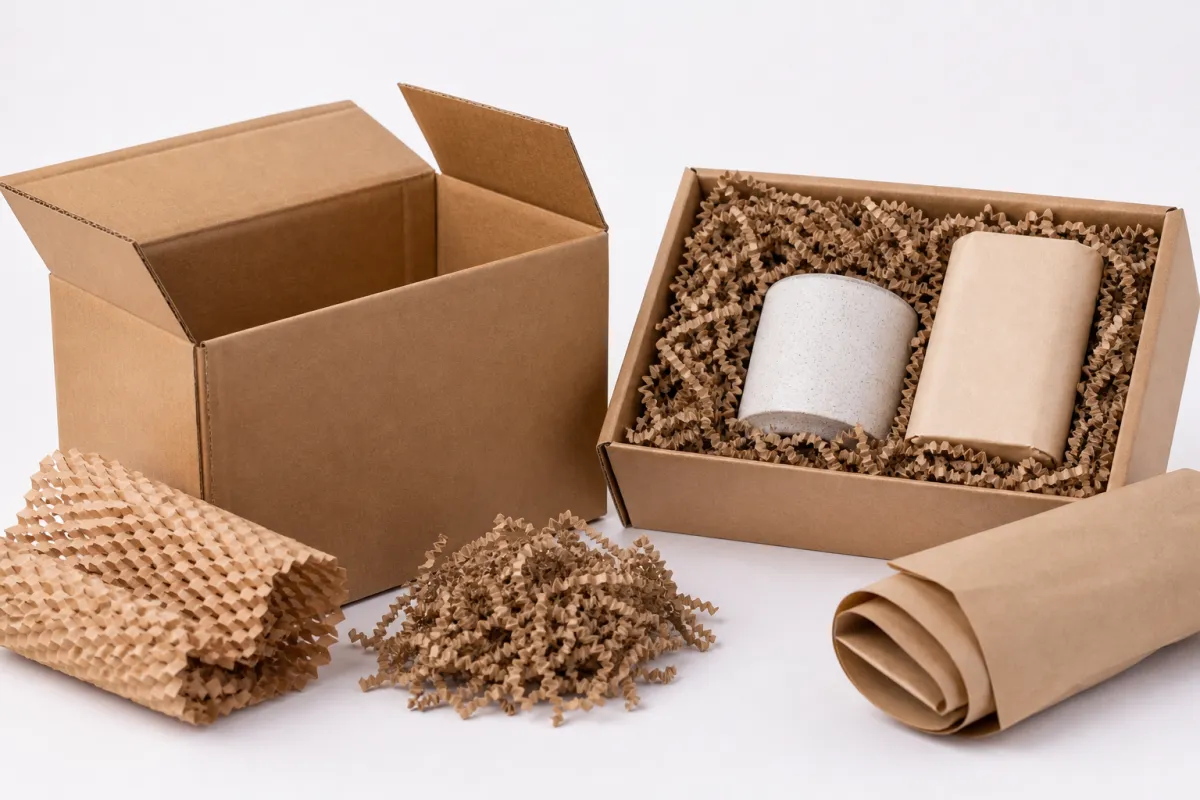
Empty space is not free. It raises the chance that a product hits a wall, a corner, or another item inside the box the moment the shipment gets dropped, tipped, vibrated, or stacked. That is why void fill for small business matters so much in practice. A box can survive a careful hand lift and still fail in a conveyor lane, on a truck floor, or under a heavier parcel pressing down on it.
Think about the first impact. If a fragile item can slide even half an inch, it builds momentum before it contacts the carton wall. That is enough to chip glass, crack a molded jar, scuff a printed gift box, or crush a corner on a cosmetic set. The product does not need a dramatic drop to fail. It only needs room to move. That is the basic reason void fill for small business is not optional for many shipments.
The hidden cost goes beyond breakage. Extra movement increases returns, and returns drain time in a way spreadsheets often hide. Your team has to answer the email, inspect the damage, issue the replacement, and sometimes re-ship the order at full freight cost. If your customer received a badly packed box, the unboxing experience also takes a hit. A crushed insert or rattling carton makes the brand feel cheap, even when the product inside is solid.
Dimensional weight adds another layer of pain. A carton filled with too much air can jump to a higher shipping tier fast, especially once the package crosses a carrier threshold. The empty space hurts twice: it invites damage and increases freight cost. That is why void fill for small business should start with carton fit, then filler selection, then packing method.
Void fill for small business is really about control. The goal is not to make the box look stuffed. The goal is to immobilize the item so it cannot reach the carton wall with enough energy to break. If the box passes a shake test and the item stays centered, you are closer to a workable system than if the carton simply feels full.
“If the product can slide, it can break. If it can rattle, it can return.”
That sounds blunt because it is. The most common failure I see is a team judging the package by feel instead of behavior. A snug-looking box is not the same as a protected box. Void fill for small business only works if it stops motion in all directions, not just on the top layer.
How Void Fill for Small Business Protects Products in Transit
The basic physics are simple. A product inside a carton fails when outside force turns into inside movement. Drop the box, and the item keeps moving until something stops it. Shake the box, and the item pounds the walls over and over. Stack the box, and the filler compresses until the product has room again. That is why void fill for small business must do more than pad the package. It has to hold the product in place and absorb the abuse that shipping systems deliver.
Different materials solve different problems. Kraft paper crumples and springs back enough to absorb shock while filling gaps around awkward shapes. Air pillows are light and fast, which helps when you need to block movement in larger cartons without adding much weight. Foam shapes and inserts do the most precise job because they cradle a product in a fixed location. They are especially useful when the item has a fragile finish, odd geometry, or a high replacement cost. Good void fill for small business usually matches the filler to the product, not the other way around.
For glass jars, bottles, and candles, you want more controlled positioning than loose filler can provide. For cosmetics and gift sets, you often need a combination approach: a primary insert around the product and a secondary filler to stop side-to-side movement. For parts and accessories, paper or air pillows may be enough if the box size is close and the item is not brittle. For apparel add-ons, paper can be plenty because the goal is often presentation plus light stabilization. That is the practical range where void fill for small business earns its keep.
Shipping abuse is not just one drop. It is a chain of abuse. There are corner drops, face drops, conveyor vibration, compression under heavier cartons, and impact from sorting equipment. A package that looks perfect on the packing table may still fail after 20 minutes in the carrier network. That is why smart teams test void fill for small business against real handling, not against wishful thinking.
A simple rule of thumb works well: the box should immobilize the product, not merely cover it. If you can feel the item shift when the carton is gently shaken, there is still a problem. If the item can touch the carton wall after a drop, the filler has not done its job. The best void fill for small business creates controlled immobilization. That is a cleaner target than “fill the empty space.”
- Paper is good for wrapping, gap filling, and mixed shapes.
- Air pillows are good for blocking movement in light shipments.
- Foam or molded inserts are better for fragile or high-value products.
- Loose fill can work, but it is usually messy and inconsistent for small teams.
For businesses that want an outside reference point, the ISTA test methods are a useful benchmark. You do not need a full lab to learn from the idea behind them: packages should be tested for drops, vibration, and compression in ways that reflect actual transit conditions. That mindset is far more useful than trusting a supplier brochure. It also keeps void fill for small business grounded in performance instead of marketing.
The same logic applies to sustainability. A material that reduces breakage but creates waste complaints can still be the wrong fit. If your customer base expects fiber-based packaging, paper and molded pulp often make more sense. If your priority is minimal package weight, air pillows may win. If you want traceable fiber sourcing, FSC-certified paper stock is worth a look. The best void fill for small business balances shipping performance with brand expectation.
Key Factors That Decide the Right Void Fill
Product fragility is the first filter. A ceramic mug, a glass bottle, and a folded T-shirt do not need the same level of control. Heavy or breakable items need tighter stabilization than soft goods or sturdy accessories. That sounds obvious, but plenty of packing rooms still treat every order like it can be solved with a roll of paper. Void fill for small business should start with the product’s failure mode. What cracks? What dents? What bends? What scratches?
Box size and fit come next. Oversized cartons almost always waste material and raise the chance of damage. If a product is swimming in a box, the filler has to work harder just to keep the item centered. That means more material and more labor. In practice, carton selection does more damage control than many businesses realize. Better box fit often cuts your need for void fill for small business in half, which is a nice way to spend less without becoming careless.
Order mix matters too. A business shipping one SKU all day can standardize fast. A shop packing wildly different products needs a more flexible approach. If the team sees a fragile bottle one minute and an apparel accessory the next, the filler choice has to be simple enough to follow without a debate at the bench. The more complex the catalog, the more valuable a clear void fill for small business standard becomes.
Sustainability expectations are another real factor, not a slogan. Some customers dislike plastic air pillows because they see them as waste. Others care more about receiving an intact order than the exact filler type. Both reactions are normal. If you sell premium gifts, a clean paper-based packout may match the brand better. If your priority is low weight and fast packing, air pillows may be the better compromise. The most practical void fill for small business respects the customer experience without making operations miserable.
Warehouse speed matters more than most owners expect. A filler that takes too long to dispense, shape, or tear can turn every packing station into a bottleneck. If packers need three hands to use it, the savings on material can disappear in labor. I would rather see a slightly more expensive filler that is easy to use than a bargain option that creates a line at the bench. Void fill for small business should help the line move, not turn every order into a craft project.
There is one more factor people skip: standardization. If your team needs to choose between four fillers, six box sizes, and two kinds of inserts for every order, mistakes will creep in. The best system is usually the one with the fewest decisions. That is not laziness. That is how you keep pack quality consistent when the day gets busy, and yeah, when it gets busy, the bench gets kinda unforgiving.
Void Fill for Small Business Pricing: What It Really Costs
Price per unit is only the first line on the bill. Kraft paper might look cheap until you factor in dispenser hardware, storage space, and the extra hands needed to crumple it correctly. Air pillows may look pricier on paper, but they can speed up packing enough to lower labor cost per shipment. Foam and molded inserts can cost more upfront, yet they can cut damage rates on fragile items so much that the math flips in your favor. That is the part of void fill for small business pricing that too many buyers skip.
Here is a useful way to think about common options. These are rough ranges, not gospel, because volume, print coverage, carton size, and region all change the picture. Still, they are good enough for planning.
| Void Fill Option | Typical Material Cost | Labor Impact | Best Fit | Main Tradeoff |
|---|---|---|---|---|
| Kraft paper | Low to moderate; often cost-effective at scale | Moderate if manually crumpled, low with dispenser | Mixed-SKU orders, general shipping, presentation packing | Uses more labor if the process is not standardized |
| Air pillows | Low per shipment for light products | Low once the inflation setup is in place | Light items, larger cartons, high-speed pack lines | Less useful for sharp edges and very heavy products |
| Loose fill | Moderate, depending on volume | Can be messy and slow | Low-volume shipping with simple products | Storage mess, inconsistent protection, customer annoyance |
| Molded pulp | Higher upfront, often better at volume | Low once inserted correctly | Fragile goods, premium unboxing, repeatable SKUs | Tooling or setup can take longer |
| Foam inserts | Highest for many small businesses | Low to moderate | Very delicate, high-value, oddly shaped products | Higher material cost and weaker sustainability story |
The hidden costs are where the real damage happens. A broken shipment can cost the product, the freight, the labor, the reshipment, and the customer relationship. If your average replacement order costs $18 in product and $9 in shipping, one damaged box can wipe out the savings from dozens of cheap fillers. That is why void fill for small business should be priced against total loss avoidance, not against the sticker on the carton workbench.
Volume changes the math quickly. Low-order businesses often value convenience because the team is small and every minute counts. Higher-volume shippers should optimize per-order cost because the tiny differences add up fast. A filler that saves 20 seconds per pack can matter a lot at 150 orders a day. Likewise, a better insert that cuts your damage rate from 4% to 1% can pay for itself faster than most owners expect. That is the realistic lens for void fill for small business pricing.
Do the math across three buckets: cost per shipment, cost per protected unit, and cost per avoided return. If you only track material spend, you will likely choose the wrong option. If you track damage rate and pack time too, the better choice usually becomes obvious. On the sourcing side, paper options with FSC certification can support a cleaner sustainability story, which matters for brands that want a traceable fiber chain. That is where FSC is worth a look, especially if your packaging claims need to stand up to questions.
One more practical note: cheap filler that lives in a giant storage tote can still be expensive if it consumes floor space. Small businesses often buy the right material and then forget about the physical footprint. If your backroom is already crowded, a bulky filler that needs a huge bin can create more friction than it solves. Void fill for small business has to fit the operation, not just the invoice.
For budget planning, a rough starting point is to compare options in a batch of 100 shipments, then run the same 100-order test with labor timing and damage tracking. That gives you better data than a single quote ever will. The winner is usually not the cheapest material. It is the system that delivers the lowest total landed cost while keeping the packing line calm.
Step-by-Step Process and Timeline for Choosing Void Fill
Start with the product, not the filler. List your top shipping risks by product type, carton size, and carrier behavior. If a product is glass, painted, glossy, sharp-edged, or oddly shaped, write that down first. If it ships with accessories, note whether the accessories can rattle or scratch the main item. That is the real input for void fill for small business, because the filler must answer the risk, not the other way around.
- Identify the problem package. Pick the three orders that cause the most damage, complaints, or pack-time variation.
- Test two or three options. Use real products and real carton sizes, not mockups that look tidy on a desk.
- Run drop and shake checks. A basic corner drop, face drop, and short shake test can reveal a lot before customers do.
- Measure pack time. Time the full process on a normal batch, because speed matters as much as protection.
- Write the standard. Document the box size, fill amount, product orientation, and any insert rules.
- Train and review. Roll it out to the team, then check damage after the first shipping cycle.
That process sounds simple because it is. The trick is actually doing it instead of guessing. A small business does not need a lab coat to get useful data. It needs a repeatable check. If the product survives one drop test and one shake test, and the pack time stays acceptable, you are close to a workable void fill for small business setup.
Timeline matters too. If a new filler takes a week to source but saves 30 seconds per order, that might still be a great trade for a growing shop. If a filler requires custom tooling or a longer lead time, factor that into your launch plan. A lot of teams only think about the first shipment. They should be thinking about the first busy month. Void fill for small business needs to survive real volume, not just a calm test day.
There is also a standards angle worth respecting. You do not need to certify every box, but the spirit of void fill for small business testing should echo the work done in shipping standards such as ISTA and common transport-performance practices. If your package survives the abuse you can realistically expect, you have a better chance of reducing claims later. That is practical quality control, not theory for theory’s sake.
If the shipment is unusually fragile or high value, a more formal test run can be worth the money. Not every business needs that level of validation, but some do. I have seen a few owners assume the package was fine because it “looked good,” then spend months paying for preventable breakage. That is one of those lessons nobody wants twice.
Here is a realistic rollout timeline for many small teams:
- Day 1-2: collect sample orders and current damage data.
- Day 3-5: test candidate fillers with real products.
- Day 6: compare labor time and protection results.
- Day 7: write a one-page pack standard.
- Week 2: train the team and monitor exceptions.
- Weeks 3-4: review damage rate and adjust if needed.
If you move at that pace, you can usually choose a solid void fill for small business option without dragging the whole operation into a six-month packaging project. That is the sweet spot. Fast enough to act, careful enough to avoid repeating expensive mistakes.
Common Mistakes With Void Fill for Small Business
The biggest mistake is using too little filler and calling the box tight. Tight does not matter if the product still has room to hit a wall. A packed-looking carton can still be a bad carton. If the item moves, the shipment is under-protected. That is why void fill for small business has to be judged by motion control, not by how full the box appears.
Another common error is choosing the cheapest option without checking labor, storage, or returns. A low-cost material can be expensive if it slows the packer or causes more damage. Small businesses feel that pain faster than larger firms because one bad batch can throw off the week. The buyer who only looks at unit price is missing half the picture. Good void fill for small business choices always include the human cost of using the material.
Mixing too many fillers is another way to create chaos. One station uses paper, another uses air pillows, and a third uses random loose fill because nobody wrote the standard down. The result is inconsistent pack quality and constant training questions. If you want cleaner results, pick one primary system and one backup. Simplicity is not glamorous, but it works. That is especially true for void fill for small business operations with small teams and frequent turnarounds.
Ignoring box fit is a classic waste of money. If the carton is wrong, more filler is usually a patch, not a fix. You are better off adjusting the box dimensions before you keep buying more material. I have seen businesses use a mountain of filler to compensate for a box that was two sizes too large. That is not a packaging strategy. That is just paying extra to recreate the same problem in a more expensive form. Void fill for small business should help you fit the product, not hide a bad carton choice.
Skipping testing is the final expensive habit. Some teams wait until customers report damage, then scramble to find a solution. That means the learning happened on the customer’s dime. It is a terrible way to build a packaging system. A basic test batch would have shown the issue before the first complaint came in. If you only remember one thing from this section, remember this: test early, or pay later. That is the cleanest lesson in void fill for small business.
- Too little fill leaves movement in the box.
- Wrong box size forces filler to do the carton’s job.
- Too many filler types create confusion at the bench.
- Cheap-only buying ignores labor and return costs.
- No testing turns customers into your quality control team.
There is no prize for having the most packaging SKUs in the back room. A calm, repeatable process beats a cluttered one almost every time. That is why void fill for small business works best when it is boring, documented, and easy to follow under pressure.
Next Steps: Build a Void Fill Standard Your Team Can Follow
Start with a one-page decision chart. Put your top products on it, list the box size, and note which filler each item gets. That way the packer does not need to guess every time a new order lands on the table. A good chart reduces mistakes, speeds up packing, and makes training easier. That is the point of void fill for small business: less debate, fewer bad packs, better repeatability.
Set a minimum test standard for new packaging. I like one drop test, one shake test, and one packaging-time check. Nothing fancy. Just enough to tell you whether the material protects the item and whether the team can use it without slowing down. If a new option fails any one of those, it needs another look. That is a practical way to manage void fill for small business without turning the job into research theater.
Track two numbers every week: damage rate and average pack time. If damage rises, the filler or carton fit may need adjustment. If pack time rises, the material may be too awkward or the process too complicated. Most businesses do not need ten packaging dashboards. They need two numbers and the discipline to look at them. That keeps void fill for small business decisions grounded in real performance.
Keep one backup filler on hand for peak periods, but do not stock every option available. Extra inventory ties up cash and space fast. Pick the backup that is versatile enough to cover your most common exceptions. For many teams, that is paper. For others, it is air pillows. The right answer depends on the product mix, the carton assortment, and the amount of labor you can spare. That is the usual reality behind void fill for small business.
If you need a clean rule for buying, use this: choose the filler your team can repeat, afford, and trust. Repeatable means the same result from one packer to the next. Affordable means the full cost makes sense, not just the material cost. Trust means the box actually arrives intact. When those three line up, void fill for small business stops being a headache and starts being a quiet advantage.
For most shops, the best answer is not one perfect material. It is a standard that fits the product mix, protects against the shipping abuse you actually see, and keeps the packing bench moving. Get that part right, and void fill for small business becomes one of those unglamorous choices that saves money every week. If you only do one thing after reading this, test your two most common SKUs in the boxes you already use, then write down the filler that keeps them from shifting. That is the kind of small, concrete move that pays off.
What is the best void fill for small business shipping fragile items?
For fragile items, the best void fill for small business is the one that stops movement first and cushions second. Kraft paper works well for mixed packing because it can wrap and wedge around different shapes. Air pillows are better for light items that need space blocking. Very delicate products often need a custom insert or molded support, because loose filler alone does not control the product well enough.
Is paper or air pillow void fill for small business cheaper?
Paper is often easier to source in small quantities, but it can take more labor to use properly. Air pillows may cost less per shipment when speed matters and the product is light. The real answer for void fill for small business depends on labor time, storage space, and return damage, not just unit price. If the paper slows your pack line or the air pillows are overkill, the cheap option can stop being cheap.
How much void fill should a small business use per box?
Use enough void fill for small business so the product does not move in any direction when the box is gently shaken. A package should not sound hollow, and the item should not hit a wall if the carton is tipped or dropped. The correct amount is whatever your actual product needs inside the real carton size. Generic fill amounts are a lazy shortcut, and packaging usually punishes lazy shortcuts.
When should a small business switch from loose fill to inserts?
Switch when the product shifts too much, arrives damaged, or needs repeatable placement. Inserts make more sense for high-value, fragile, or oddly shaped items. If packers need too much judgment to fill the box correctly, inserts usually save time and reduce mistakes. That is a common turning point in void fill for small business planning: once the product becomes picky, the packaging needs to become more precise.
How do I choose void fill for mixed-size orders?
Pick the option that works across most of your orders, then reserve special solutions for the outliers. For mixed catalogs, paper or a combination system usually adapts better than one rigid format. Standardize on a few box sizes before adding more filler types, or the process gets messy fast. The easier your void fill for small business standard is to follow, the less training, confusion, and damage you will deal with later.
Related packaging resources
Use these related guides to compare specs, costs, quality checks, and buyer decisions before making the final call.
- Shipping Carton MOQ for Startups: Pricing and Lead Times
- Wholesale Box Dividers for Glassware: Specs and Pricing
- Branded Void Fill Kraft Paper: Smarter Shipping Basics
- Zipper Pouches with Logo: Shipping Packaging Guide


