People often start with the decoration cost and end up missing the real story. Beanies with Woven Tag with Logo Patch Cost is not driven by one line item; it is shaped by the body knit, the patch material, the tag placement, the approval cycle, and the way the order is packed for shipping. A cheap decoration quote can still become an expensive landed cost if the rest of the spec is loose.
This style is popular because it looks finished without drifting into full cut-and-sew territory. A woven tag gives the beanie a consistent branded cue, while the patch creates the visual anchor customers notice first on a shelf, a team store page, or an event table. That combination usually lands in a useful middle ground: more polished than a blank knit cap, less costly than deeply customized headwear.
The practical advantage is simple. Retail buyers want something that photographs well, folds cleanly, and survives handling. Wholesale buyers want repeatability, a controlled unit cost, and fewer surprises in production. A beanie with a woven tag and a logo patch can satisfy both, but only if the spec is written tightly enough to avoid guesswork.
Why this beanie style works for retail and wholesale buyers
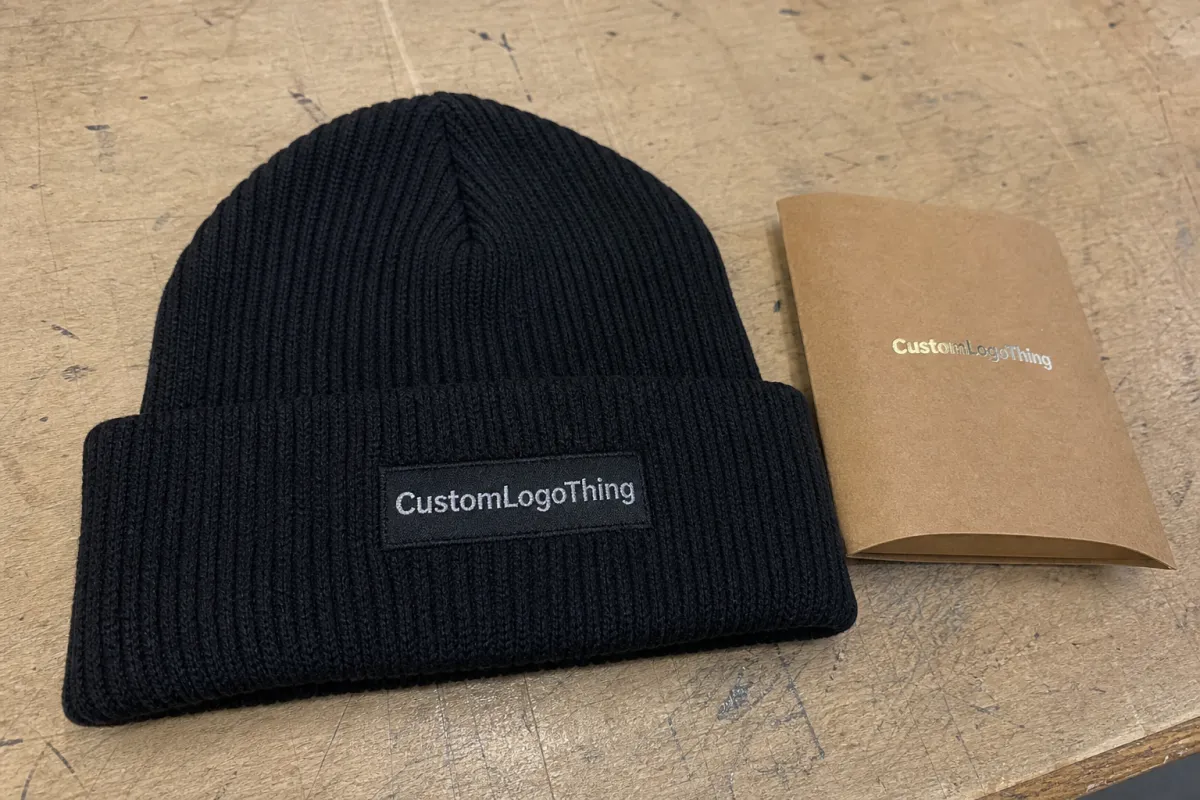
A beanie earns its shelf value in a few seconds. If the knit looks sloppy, the decoration is off-center, or the patch size overwhelms the cuff, buyers notice immediately. A woven tag and a logo patch help because they split the branding job: the tag handles identity, and the patch handles front-facing impact. That division is useful. It keeps the hat from feeling overdesigned.
There is also a consistency benefit that matters more at scale than people expect. A woven tag stays visually stable across colorways, which means a black beanie, a charcoal beanie, and an oatmeal beanie can still feel like part of the same program even if the patch art shifts between drops. That is not a glamorous detail, but it helps when a collection expands over time.
For retail, the question is perceived value. A plain acrylic beanie might cost less at the factory, yet it often sells like a commodity. Add a sewn label and a well-sized patch, and the product can move into a higher price band with less resistance. The difference is not just branding. It is construction confidence. Buyers can feel when a beanie holds its shape and when the patch was chosen for the knit instead of forced onto it.
For wholesale, the calculation is more unforgiving. If the order is going to teams, stores, or event programs, the decoration has to survive packing, transit, and repeated handling. Heat transfers can be fine on some garments, but on knit headwear they are often the first thing to look tired. Sewn labels and stitched patches usually hold up better. The margin may be a little higher, yet the replacement rate is usually lower.
There is a boundary worth keeping in mind. A premium-looking patch cannot rescue weak yarn, loose stitching, or a cuff that collapses after folding. The decoration adds value only when the base garment is stable enough to support it. That sounds obvious, but many quotes hide the weakness in the body spec and overstate the decoration.
How to read beanies with woven tag with logo patch cost
The quickest way to compare quotes is to separate the beanie into three buckets: the body, the decoration, and the finishing. If a supplier gives you one blended number, ask for the breakdown. Otherwise you are comparing estimates with different assumptions, which is how buyers end up choosing the cheapest quote that was never complete.
The body is usually the starting point. Standard acrylic rib knit beanies often land around $1.10-$2.20 per piece at modest wholesale quantities. Recycled acrylic tends to run a little higher, commonly $1.45-$2.80, because the yarn price and color consistency are less forgiving. Wool blends and heavier gauge knits can move into the $2.20-$4.50 range depending on yarn quality, structure, and whether the hat is single-layer or double-layer.
The decoration layer adds its own logic. A sewn woven tag is usually the lowest-cost branding element, while a woven patch, faux leather patch, PVC patch, or embroidered patch adds more labor and often more setup. That does not mean the cheapest option is always the best one. A small woven tag can look refined on a minimal cuff, but if the logo needs detail or contrast, the patch has to do more of the visual work.
Packaging can shift the quote more than expected. A beanie shipped in bulk cartons is cheaper than one folded to retail standard, packed in an individual polybag, and labeled with a barcode. Insert cards, hang tags, size stickers, and folding instructions add labor in small increments. By themselves, those increments are minor. Together, they can change the unit cost enough to affect margin.
That is why a clean quote should name the body spec, decoration method, tag placement, packaging format, sample policy, and freight terms. If any of those are vague, the number is not reliable. A low quote with missing details is not a bargain. It is a future correction.
Patch styles, tag placement, and what is included in the order
Patch language can be slippery. “Logo patch beanie” sounds specific, but it can describe several very different products. The patch could be woven, embroidered, faux leather, PVC, rubberized, or even a simple woven label enlarged for the front cuff. Each one changes cost, texture, and the way the logo reads from a distance.
Here is the useful breakdown:
- Sewn woven tag - small, flat, and low-profile; best for quiet branding and repeat colorways.
- Woven logo patch - good for crisp shapes and fine lines; often the best value for detailed artwork.
- Faux leather patch - cleaner and more premium-looking; best for simple graphics and minimal copy.
- PVC patch - durable and dimensional; often used for sport, utility, or outdoor styling.
- Embroidered patch - familiar and tactile; works well when the logo tolerates thread build-up.
Placement changes the result as much as the patch material does. A cuff patch is the most visible and usually the strongest retail option. A side-seam woven tag is more restrained and can work well if the front patch already carries the brand. An inside label is useful for internal branding, but it rarely helps sell the product by itself. Front-facing real estate still matters.
Buyers should also ask what is included in the quoted unit. Is the beanie fully assembled with the patch stitched on and the tag in place, or are loose components being shipped for local finishing? That distinction affects labor, freight, and inspection. If the supplier cannot state whether the patch is attached before carton packing, the quote is unfinished.
For teams or retail lines that compare label options often, it helps to review Custom Labels & Tags alongside patch samples. Minor differences in edge finish, backing, stitch count, and thread density change the feel in hand. A product that looks decent in a proof can still feel generic if those details are ignored.
Spec choices that change the quote
Material choice is the first major cost lever. Standard acrylic remains the most common budget option because it knits consistently and is easy to source in volume. Recycled acrylic adds a modest premium, usually because the yarn cost is higher and the supplier has to manage color matching more carefully. Cotton blends feel softer, but they usually need tighter pattern control to keep stretch and recovery where they should be. Wool blends cost more still, and not only because the fiber itself is pricier. They also demand better process control.
Construction can move the number almost as much as the yarn. A single-layer beanie is lighter and cheaper, but a double-layer cuffed beanie usually feels more substantial and gives the patch a firmer base. Higher stitch gauge can improve the finish, though it can slow production. Crown depth, cuff height, rib density, and overall body length are not cosmetic details. They change the knitting program and the amount of handling required after knitting.
Patch variables are equally important. A 2-inch woven patch is a different job from a 3.5-inch shaped patch with tiny text and a stitched border. More detail means more thread changes, more proofing, and more risk that the artwork must be simplified. Clean shapes are cheaper than custom die-cut outlines. Backing type matters too. Sewn-on is usually the safest. Adhesive or hook-and-loop options can add cost and may reduce wash durability.
Artwork cleanup is where many quotes quietly drift upward. Tiny letters, thin lines, gradients, and intricate icons can all force revisions. If the logo cannot be simplified without losing the brand, expect more proof cycles and a higher chance that the patch needs a different construction method. A supplier quoting from a rough PNG is guessing. A supplier quoting from vector art and a written spec is pricing production.
| Option | Typical add-on at 300 pcs | Best fit | Main tradeoff |
|---|---|---|---|
| Sewn woven tag | +$0.12-$0.25 | Clean branding, low-profile retail look | Very small logo area |
| Woven logo patch | +$0.25-$0.55 | Fine detail, crisp text, branded front panel | Needs artwork cleanup if the logo is dense |
| Faux leather patch | +$0.30-$0.70 | Premium look with simple graphics | Not ideal for tiny text |
| PVC patch | +$0.35-$0.85 | Durable, dimensional, sporty retail style | Can require tooling fees |
| Embroidered patch | +$0.28-$0.60 | Classic texture and softer branding | Less clean for micro-detail |
Cost, pricing tiers, and MOQ for custom orders
Beanies With Woven tag with logo patch cost drops as quantity rises, but not in a straight line. The first run is the hardest to price efficiently because setup, artwork prep, and approval work are spread across fewer units. The next break usually appears around 300 pieces. By 1,000 pieces, the setup burden starts to shrink enough that the unit cost looks far more attractive.
A realistic pricing band for a standard acrylic beanie with one woven tag and one patch might look like this: 100 pieces at roughly $3.80-$6.50 each, 300 pieces at $2.90-$4.80, and 1,000 pieces at $2.10-$3.80. These are not universal numbers. Yarn choice, patch type, packaging, and shipping terms all move the final figure. Still, the ranges are useful because they expose quotes that are too low to be credible or too high to justify.
MOQ usually follows the slowest part of the order, not the easiest. If the body is standard but the patch is custom shaped, the patch minimum can become the limiting factor. If mixed colors, mixed patch positions, or multiple logo versions are requested, the MOQ tends to rise. That is not arbitrary. It reflects the extra handling time and the larger risk of sorting errors.
These are the common cost buckets that show up in real quotes:
- Sample fees - often $25-$80, sometimes credited back on bulk orders.
- Setup charges - artwork cleanup, knit program preparation, or label placement programming.
- Tooling fees - more common on PVC or molded patch styles.
- Packaging add-ons - polybags, insert cards, hang tags, barcode labels, retail folds.
- Freight - varies by destination, carton count, and ship method.
The cheapest quote is not always the best deal. Usually, the missing cost shows up later in packaging, revisions, or patch corrections. A quote that looks tidy because it leaves out half the job is worse than a quote that tells you the truth.
Ask for the quote with body spec, patch size, placement, packaging, and ship terms spelled out. Those five items determine whether the number is usable or just decorative.
Lead time and production workflow from proof to shipment
Production for custom beanies is straightforward in theory and slow in practice. The sequence usually runs like this: inquiry, artwork review, digital proof, sample or pre-production approval, bulk knitting, patch application, folding, packing, and shipment. If a supplier skips one step to save time, that is not efficiency. That is risk.
After proof approval, a typical lead time for a straightforward order is often 12-20 business days. More complex patch shapes, close color matching, or extra revision rounds can push that longer. A sample usually adds 5-10 business days depending on whether the supplier is making a knit sample, a patch sample, or a fully assembled pre-production piece. Freight sits on top of that, and ocean and air freight live in different schedules entirely.
Some orders move faster because they are boring. Standard yarn, standard cuff height, one patch location, one tag location, one approved logo version. Those jobs are easier to schedule and less likely to be delayed by a late correction. The slow orders are the ones with vague color names, multiple artwork versions, or a new request after approval to change the fold, the label position, or the carton count. Each change adds handling. Handling costs money.
If a launch date matters, build a cushion. First-time orders need more protection than repeat runs because there is always one more thing to check. Reorders are easier only when the spec is locked and the factory can match the previous run without reinterpreting the details.
Artwork checks and approval issues that delay orders
Most delays start with artwork that was not ready. Low-resolution files, tiny text, inconsistent color references, and vague placement instructions are the usual culprits. A woven patch has finite space. If the logo depends on hairline strokes or micro type, the supplier will need to rebuild it, and that adds both time and cost.
Vector files are the safest starting point. AI, EPS, or editable PDF files are far easier to work with than a compressed PNG. If brand color matters, include Pantone references or at least a precise color note. If the logo belongs on the cuff and the woven tag belongs on the seam, say so clearly. A one-line spec is often better than a paragraph filled with marketing language.
A practical spec sheet should include the beanie color, material, cuff height, patch size, patch shape, tag location, quantity, target ship date, and packaging requirements. That list may look basic, but it prevents the kind of revision loop that turns a quote into a moving target. Every extra proof adds time. Sometimes it also adds cost, because the factory has already spent labor on the previous version.
One more detail matters more than buyers usually expect: consistency between artwork and approval notes. If the proof shows a 2.5-inch patch and the order note says 3 inches, someone has to stop and confirm which one wins. These are not big problems individually. They become expensive when they happen late.
If you are still comparing label styles while building the spec, keep our label and tag choices in view. The cleaner the document, the faster the quote, and the easier it is to compare beanies with woven tag with logo patch cost across different suppliers without mixing up the assumptions.
Quality checks, packaging options, and shipping terms
Quality control on knit headwear is not just about whether the box arrives. A beanie can look fine in a proof and still fail on the line if the patch sits crooked, the tag is off-center, or the knit tension changes from piece to piece. Ask for checks on stitch consistency, patch alignment, seam strength, and color tolerance. If the supplier can map those checks to recognized textile test methods, even better. If they only say “we inspect everything,” ask for a written process.
Packaging deserves the same discipline. A beanie shipped loose in bulk is cheaper than one folded retail-ready in an individual polybag with a hang tag and barcode, but the second version is often the right one for retail buyers. Online sellers and gift programs usually need cleaner presentation. For cartons that will travel a long way or face rough handling, ask whether the supplier uses distribution-style testing. The ISTA packaging test standards are a useful benchmark when packaging risk starts to matter.
Shipping terms also change the final cost picture. EXW can make the supplier quote look lowest, but it leaves more freight coordination on the buyer. FOB is cleaner when the supplier handles export handoff. Delivered terms are convenient on paper, though the freight margin is often built in somewhere. The only useful question is who pays, when the risk changes hands, and whether the terms are written clearly enough to avoid a dispute later.
For paper inserts or hang tags, FSC-certified stock is a better choice than unverified paper when the job calls for documentation. That does not make the beanie better by itself. It does make the order more defensible when a buyer asks what was actually specified. The same applies to carton labels, pack lists, and barcode formats. A small error there can slow receiving more than any decoration issue ever will.
In practice, the landed cost is not just the unit price multiplied by quantity. It includes the freight, the packaging labor, the receiving time, and the chance that a nonstandard carton label creates a problem at the warehouse. Those hidden costs rarely appear in the headline quote, yet they decide whether the order was truly profitable.
What is the typical beanies with woven tag with logo patch cost per piece?
Pricing usually declines as quantity increases because setup and decoration labor are spread across more units. For a standard acrylic beanie, a rough range might be around $3.80-$6.50 at 100 pieces, $2.90-$4.80 at 300 pieces, and $2.10-$3.80 at 1,000 pieces. The final number depends on yarn, patch type, packaging, and shipping terms.
Does adding a woven tag and logo patch increase MOQ?
Sometimes, yes. Each decoration step can add its own minimum material order or setup requirement. Simple sewn tags usually keep MOQ lower than custom-shaped patches or multiple decoration placements. Standard colors and a single logo version are the easiest way to hold MOQ down.
Which patch type gives the best value for custom beanies?
Woven patches often give the best balance of detail and cost, especially for logos with clean lines or small text. Faux leather works well for simple premium branding, while embroidered patches offer texture with a classic feel. The best value is the option that fits the logo without forcing extra revisions.
How long does production take after I approve the proof?
Simple orders often take 12-20 business days after proof approval. Add more time for custom patch shapes, extra revision rounds, or color matching that needs tighter control. Samples can add 5-10 business days depending on whether the supplier is making a knit sample, patch sample, or full pre-production piece.
What files do you need for an accurate quote on beanies with woven tags and patches?
Send vector artwork if possible, plus patch size, beanie color, quantity, packaging needs, and target ship date. Pantone references help if color accuracy matters. A clear spec sheet reduces revision loops and makes the quote far more reliable.
The best quotes are the ones that read like production, not optimism. If the body spec, decoration method, tag location, packaging, and shipping terms are all defined, beanies with woven tag with logo patch cost becomes a manageable question instead of a moving target. Tight specs produce tighter pricing. Loose specs produce surprises, and surprises are expensive.


