Retail Merch Beanies with logo patch cost usually comes down to three things: the blank quality, the patch spec, and how clean your order file is. Miss one of those and the quote starts drifting, usually upward. Beanies look simple. They are not.
A knit cap can be made to look cheap in a dozen small ways. The yarn pills too fast. The cuff twists. The patch sits crooked. The color match is close enough to annoy everybody. A retail buyer notices these things faster than a factory rep does, because the buyer has to imagine the item on a shelf, under bad lighting, next to five other winter accessories with the same promise.
That is why a patch matters so much. It gives the product a focal point and makes the beanie read like merchandise instead of leftover stock. A good patch does not just carry the logo. It makes the entire item feel planned.
For resort stores, campus shops, team programs, and gift retail, that difference shows up in pricing power. A beanie with a clean logo patch can support a higher ticket than a plain knit with tiny embroidery nobody can read from more than arm’s length. The decoration is not decoration. It is part of the value equation.
Why logo-patch beanies sell when plain knit merch sits
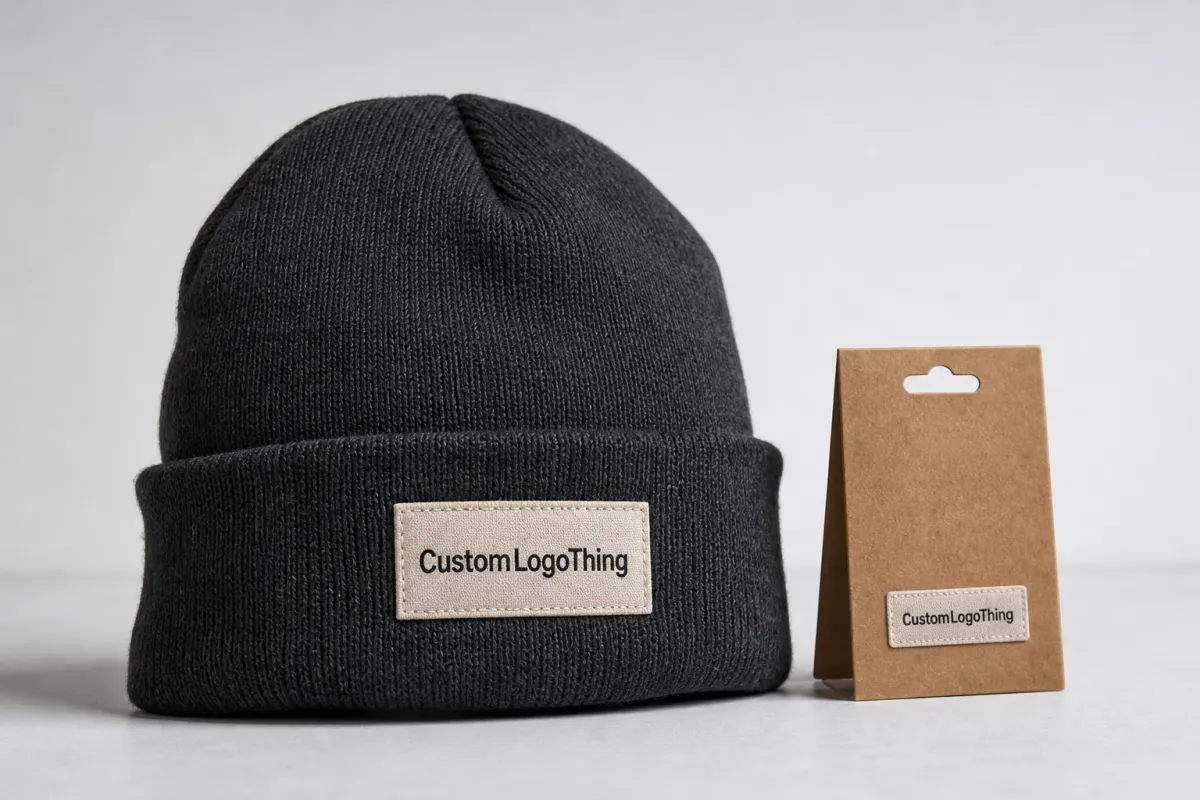
Plain knit merch has a habit of disappearing into the display. A patch changes that. It creates contrast, shape, and recognition in one spot. Shoppers scan first and think later. If the brand mark is obvious, the product gets a chance. If it is subtle to the point of invisibility, it gets ignored. That is retail. Not poetry.
Retail merch Beanies with Logo patch cost a little more to make than a bare blank, but the decoration often pays for itself in shelf impact. A patch gives the product a cleaner story. It looks intentional. It can also make the item easier to photograph for ecommerce and easier to merchandise in a wall display or bin, because the logo establishes a clear front.
Patches also solve a common knit problem: thick ribbed fabric can swallow embroidery. On chunky cuffs, small stitches disappear into the texture or start puckering once the beanie stretches. A woven or leather patch sits on top of the knit and keeps the logo legible. That matters more than people want to admit. Nobody buys a winter cap because the thread tension was excellent.
There is a pricing side to this too. A slightly higher production cost can be fine if the finished product looks more premium and sells at a better margin. That only works if the patch and blank align with the retail channel. A souvenir shop can handle a playful, higher-markup beanie. A hardware store or outlet aisle usually cannot. Same object. Different economics.
A cheap blank with a weak logo still looks cheap. A decent blank with a clean patch looks like a product somebody approved on purpose.
Packaging matters as well. Beanies are soft goods, which makes them easy to mishandle. A centered patch, neat fold, and clean hangtag placement can make the whole unit feel retail-ready. Crooked decoration or sloppy fold lines do the opposite. The cap may be technically fine. It still looks rushed.
That is why buyers should compare retail merch Beanies with Logo patch cost against the final shelf price, not against a raw blank price. The lowest unit number is often the wrong number to chase. The better question is simple: which version has the strongest retail story for the margin I need?
Which beanie bodies work best for retail merch
Cuffed beanies are the safest bet for most retail programs. The cuff creates a natural decoration zone and keeps the patch centered and visible. It also gives the cap enough structure to hold shape after packing and shipping. If the order needs broad appeal, cuffed is the least risky silhouette. It works for sports shops, tourist stores, and branded winter assortments that need to sell without much explanation.
Slouch beanies have a different personality. They feel more fashion-led and a little more relaxed. That can be good for streetwear or boutique retail, but the larger crown area can make patch placement feel less consistent when the beanie is worn. A patch that looks balanced on a table may shift visually on the head. Fine if the brand wants casual. Not fine if the logo has to sit in one exact place every time.
Fisherman beanies sit lower and tighter. They have a sharper, more compact shape and less room for oversized branding. Smaller patches can look very clean on this body. Big patches usually do not. They can overpower the silhouette and make the cap look top-heavy, which defeats the point of a low-profile style.
Pom beanies are more seasonal and more playful. They work when the merch mix can support a fun look. They do not work as well for minimal branding or serious retail programs. The pom creates movement and volume, so the patch needs to be sized and placed with that in mind. Otherwise the product looks busy for no reason.
Material choice changes the final feel almost as much as shape. Acrylic is the workhorse: affordable, easy to source, and stable across colorways. Acrylic-wool blends feel warmer and usually read as a step up in quality, which helps if the retail price needs more room. Recycled yarns can support a sustainability angle, but the handfeel, color consistency, and pilling behavior need to be checked before bulk approval. Eco claims do not matter much if the beanie feels scratchy.
Gauge matters too. A tighter knit gives the patch a better base and usually holds its shape better through packing and wear. A looser knit can feel softer, but it stretches more and can distort the decoration area. That means patch placement has to be more carefully controlled. Buyers often underestimate this, then wonder why the sample looked crisp and the bulk felt looser. The answer is usually in the knit structure.
Color selection should be made before decoration approval. Dark bodies can make light patches pop, but they also expose lint and can make small alignment mistakes more visible. Light bodies look clean and retail-friendly, but they can flatten contrast if the patch colors are too close. The best body color is the one that supports the logo, the channel, and the target price at the same time.
Patch types, placement, and spec details buyers should lock
Woven patches are usually the safest pick for logos with fine detail, small text, or thin lines. They keep the artwork crisp and flat, which is exactly what most retail buyers want. Embroidered patches give more texture and a more traditional look, but tiny type can get mushy if the design is too busy. Leather patches lean toward heritage or outdoor branding. PVC patches are more dimensional and sporty. Woven labels sit in a quieter lane and work well when the brand wants something subtle instead of loud.
That first choice shapes everything else. Placement comes next. Cuff placement is the standard because it gives the patch a built-in billboard. Crown placement can work, but only if the style, size, and patch shape make sense together. A 40 mm patch may feel clean on a ribbed cuff and oddly small on a slouch body. Scale is not a detail. It is the difference between sharp and awkward.
Buyers should lock the variables that affect repeatability. Patch size, border style, attachment method, thread count, color matching, and orientation all change the final result. If the patch is sewn on, specify the stitch path and edge finish. If it is heat-applied, ask what backing is used and whether the knit can take the application temperature without distortion. If the patch sits across a seam or fold, say so in the proof. Do not assume the factory will “read the vibe.”
One practical rule: the more decisions you leave open, the more room the supplier has to interpret. Interpretation sounds flexible until half the order arrives with patch placement drifting a few millimeters. That sounds small. It is not. Retail buyers can spot the inconsistency immediately, especially on a wall of identical caps.
| Patch type | Look and feel | Best use | Typical cost impact |
|---|---|---|---|
| Woven | Flat, clean detail | Retail logos with fine text | Usually the best value for cost per piece |
| Embroidered | Raised texture, classic feel | Bold logos and heritage brands | Moderate; can rise with thread colors |
| Leather | Premium, understated | Outdoor, lifestyle, gift shop assortments | Higher; often adds setup charges |
| PVC | Dimensional, sporty | Bold merch programs, cold-weather streetwear | Higher; custom molds usually add tooling fees |
| Woven label | Light, minimal | Subtle brand mark, secondary placement | Usually moderate to low |
A clean spec sheet saves more money than a lot of “urgent” follow-up emails. If the patch size, finish, placement, and backing are all defined, a supplier can quote accurately and sample faster. If they are not, the project turns into guessing. Guessing is how a budget gets rebuilt one correction at a time.
Retail merch beanies with logo patch cost, pricing, and MOQ
Retail merch Beanies With Logo Patch cost is driven by five main factors: the blank beanie, the patch material, the number of colors, the decoration method, and the shipping destination. Packaging can matter too, especially if the order needs individual polybags, barcode stickers, size inserts, or a specific fold. Those extras sound minor until they are multiplied across 500, 1,500, or 3,000 units.
For a straightforward run, a plain acrylic cuffed beanie with a basic woven patch at 300 to 1,000 pieces might land around $2.20 to $4.80 per unit before freight. Better yarn, a denser knit, or a larger patch pushes that number up. Leather and PVC usually move the price into the $3.50 to $6.50 range quickly, especially once tooling or setup is included. Small orders feel this the hardest because setup charges are spread over fewer pieces. That is math, not bad luck.
MOQ exists because factories do not build a custom knit run for free. Simple programs often start around 100 to 300 pieces, but low minimums usually come with a premium. Mixed colors can raise the floor again because the factory has to manage more yarn inventory, more labeling, and more handling. The more custom the body or patch, the more the MOQ starts acting like a rule instead of a suggestion.
Every quote should show how the unit cost changes with volume. Ask for pricing at 100, 300, 500, and 1,000 pieces. Ask for patch setup charges and artwork conversion fees. Ask whether molded patches carry tooling costs. Ask whether the sample cost is refundable after bulk approval. Ask for carton charges and packout fees if the order needs special packing. If the supplier gives one pretty number and nothing else, that is not a quote. That is bait.
- Unit price at 100, 300, 500, and 1,000 pieces.
- Setup charges for the patch and any artwork conversion.
- Tooling fees for molded or custom-shaped patches.
- Sample cost and whether it is refundable after bulk approval.
- Re-order price, carton fees, and packaging cost.
- Freight assumptions so the landed number is real.
The smartest budgeting move is to compare at least two builds: one with a lower-cost woven patch and one with a more premium finish. That shows whether the decoration upgrade actually improves the retail story or just sounds nicer in a meeting. If the better patch adds 20 to 40 cents and supports a much higher shelf price, the math is easy. If it barely changes the look, keep the simpler spec and protect margin.
Process, timeline, and turnaround from proof to bulk ship
The production flow should be boring. That is the goal. Artwork review, patch mockup, sample approval, bulk production, inspection, packing, freight booking. If a supplier tries to jump from logo file to bulk promise, slow them down. Fast is fine. Unclear is expensive.
Proofing usually takes a few days if the artwork is clean and the patch size is already decided. Samples often take one to two weeks, depending on patch type and current factory load. Bulk production commonly falls in the three to five week range after sample approval. Yarn stock, seasonality, and order size can push that out. Shipping adds its own clock, and it does not care about your launch date.
The delays usually happen in the same places. Artwork arrives in the wrong format. Pantone references are vague. The logo changes after the first proof. Someone decides the patch border should be different after the sample is already cut. Every one of those changes adds time. Most are avoidable if the buyer is willing to decide early.
If the order is going into retail cartons, ask how the goods will be packed and whether the case count matches your storage plan. For shipping carton durability and transit checks, the basic principles of ISTA testing are useful even if you are not running a full lab program. If the project includes recycled packaging or paper inserts, FSC claims should be verified before print approval, not after cartons are already waiting on the dock.
Retail buyers also have to think about receiving, not just production. If the beanies need hangtags, barcode labels, or master carton marks, those details should be set early. A tidy production plan saves time at receiving and lowers the odds of a pallet of almost-right goods sitting in limbo because the label spec was never nailed down.
For a typical custom order, I would want the proof approved first, then the sample reviewed against exact patch placement, then bulk released only after carton count and packout are confirmed. That sequence sounds slower than firing off a green light and hoping for the best. It is not slower. It just avoids the kind of mistakes that cost money later.
What a dependable supplier should prove before production
There is a difference between someone who sends a price and someone who can actually deliver the order. A quote-seller stays broad and vague. A real production partner explains the blank, the patch, the timing, and the tolerances in a way that survives scrutiny. Buyers should care about that difference because a low quote is useless if the factory cannot hit the spec.
Good signs are easy to spot. Clear material photos. Previous retail examples with consistent patch alignment. A sample that matches the proof closely. Willingness to confirm color tolerances before payment. Packaging options that are specific instead of mushy. If the supplier can tell you what happens when the logo is too close to the cuff edge, they probably know what they are doing.
You also want honest tradeoffs. A leather patch may look premium, but it can be less forgiving on a stretchy knit body. A PVC patch can pop on display, but custom molds add tooling fees and usually slow sampling. A woven patch often gives the best price-to-detail ratio, but it will not deliver the same dimensional feel as molded decoration. That is fine. Not every order needs to pretend it is luxury.
Brand risk is the real issue. A cheap run that misses color, patch placement, or fit costs more than a slightly higher quote from a supplier who controls the details. Retail is unforgiving. Customers notice when a beanie looks off, even if they cannot explain why. They just skip it and move on.
Buyers who want to reduce risk should ask for a photo sample before mass release, especially if the order is seasonal or tied to a launch window. If the supplier hesitates, that hesitation is information. A partner who knows what they are doing understands that a clear sample protects both sides.
What to approve before you place the order
Before the purchase order goes out, approve the artwork scale, patch finish, beanie color, carton count, and decoration position. That sounds basic because it is basic. Yet a lot of orders still go sideways because the buyer signed off on a logo file but never confirmed how large the patch should appear on the actual hat.
Use a short checklist. Request a sample image or physical sample. Confirm the unit cost at the target MOQ. Verify the production start date. Lock the shipping method. Ask for the re-order price if the item performs well. Five checks, maybe six if the packing is complicated. That is enough to prevent most surprises and gives you a real budget number instead of a hopeful one.
Ask how the order will be inspected. A decent supplier should be able to explain alignment checks, trim checks, stitch checks, and carton checks without sounding defensive. If the answer is vague, the control plan is probably vague too. That is not where savings live. Fifty cents saved on paper disappears fast when the bulk needs rework.
If you are choosing between two patch options, compare them side by side against the retail price you plan to charge. One may raise the retail merch beanies with logo patch cost by a small amount and give you a better shelf story. The other may be cheaper but weaker in the store. Do not buy the cheaper-looking item because the spreadsheet is prettier. That is how teams end up explaining markdowns later.
The practical answer is usually simple: compare two patch builds, request one sample, and confirm the final retail merch beanies with logo patch cost before you scale the run. That keeps the budget honest, the spec tight, and the retail result a lot less frustrating.
What affects retail merch beanies with logo patch cost the most?
Patch material is the biggest swing. Woven and embroidered patches are usually cheaper than PVC or leather. Order quantity matters just as much, because setup charges get spread across fewer pieces on small runs. Blank beanie quality, color matching, and packaging can push the landed number up fast.
What MOQ should I expect for custom beanies with a logo patch?
Simple runs often start around 100 to 300 pieces, but MOQ depends on patch style, yarn color, and how custom the body is. Lower MOQs are possible, yet the unit cost usually rises because setup does not disappear. If you need multiple body colors, ask whether each color combo has its own minimum.
How long does logo patch beanie production usually take?
If the artwork is clean, proofing can move in a few days. Samples usually take about 1 to 2 weeks, depending on patch type and current factory load. Bulk production often falls in the 3 to 5 week range after approval, plus freight time. Changes after proof approval are what usually slow everything down.
Can I mix beanie colors in one retail merch order?
Yes, if the blank style and patch spec stay the same. Color splits can increase MOQ or change the cost per piece because the factory has to manage more inventory and more handling. Ask for pricing by color combo before you commit, not after the quote is already approved.
Is a woven patch or PVC patch better for retail beanies?
Woven patches are usually better for fine detail and a flatter, cleaner retail look. PVC patches create a more dimensional, sporty feel and tend to stand out on display. Pick the one that fits the brand, the ticket price, and the channel. Do not pick based on whatever looks trendy this week.


