A seasonal apparel drop can look premium or sloppy because of one detail: the bag. In a wine club pvc garment bags Unit Cost Review, the real question is not the cheapest sticker price. It is whether the bag protects the garment, fits the packing line, and survives handling without creating rework.
That distinction matters because wine clubs are not buying a disposable sleeve. They are buying presentation, cleaner fulfillment, and fewer touches per order. A low quote can become the expensive option once damaged goods, repacking, or customer complaints show up.
PVC Garment Bags sit in a useful middle ground. They are more polished than a basic poly mailer and less rigid than premium retail packaging. For clubs that ship seasonal apparel or use garment bags in tasting rooms and storage, that balance can work well if the spec is tight.
Why PVC garment bags can outperform cheap mailers for wine clubs
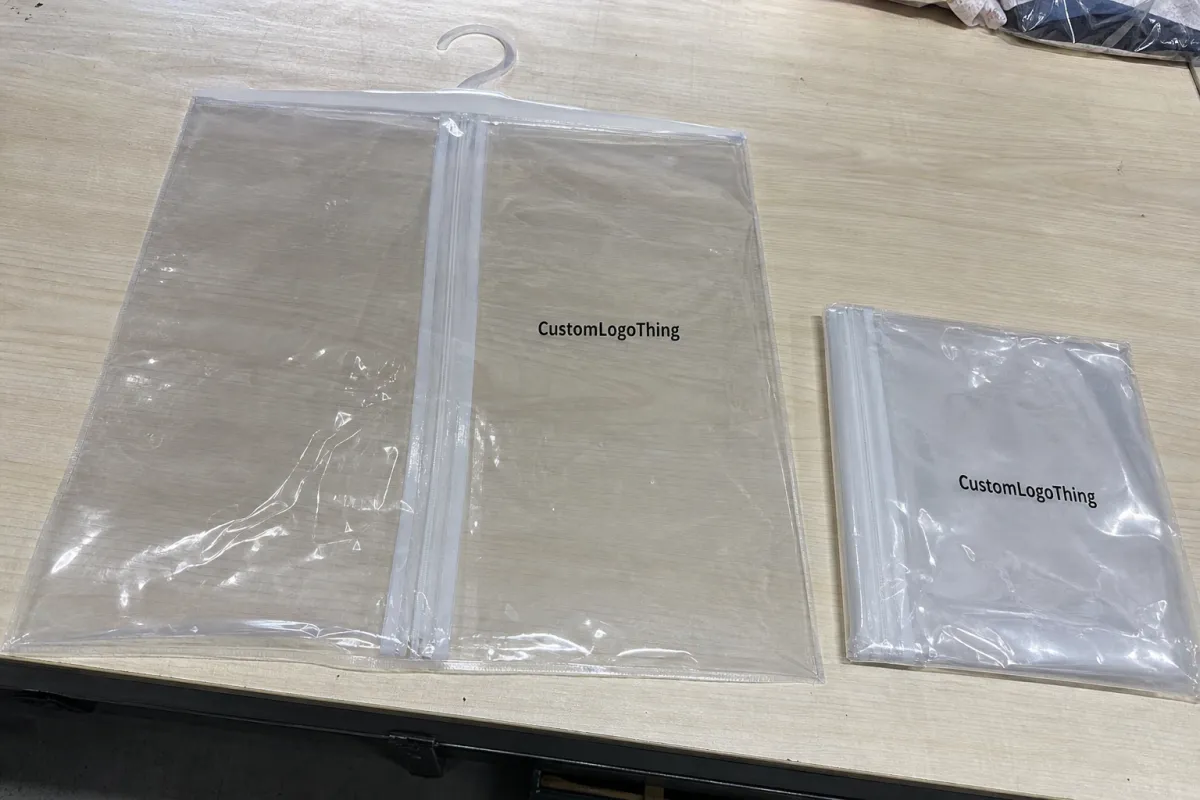
For wine clubs, packaging usually has to do two jobs at once: protect the item and feel deliberate when the member opens it. A basic mailer can cover protection. A well-made PVC garment bag can handle both, especially for folded apparel, uniforms, or gift sets that should arrive crisp instead of compressed.
This is where the economics get interesting. A cheap bag that wrinkles a shirt, scuffs in transit, or forces staff to add tissue, inserts, or a second layer is not cheap anymore. Labor, rework, and replacements are real line items, and they usually appear after procurement has already approved the quote.
Presentation is not fluff in a membership business. Members compare each delivery with the last one. A clear or frosted PVC bag can make a seasonal piece feel curated without pushing the order into boutique-packaging territory.
There is also the storage side. Garment bags help keep inventory separated, reduce dust, and make picking easier when several sizes or colorways are in the same run. If the team packs faster and reopens fewer shipments for correction, the bag has already earned part of its price.
The downside is that PVC is not magic. It can show scratches, pick up odor if the material is low grade, and yellow over time if the formula is poor. The buying decision is not “PVC or nothing.” It is which spec gives the right balance of presentation, durability, and cost for this program.
Practical takeaway: the lowest quote rarely wins if it creates rework, extra inserts, or a weaker member experience. For recurring club shipments, the smarter metric is total landed cost and how the bag performs after opening, handling, and storage.
What spec details actually move presentation and cost
PVC Garment Bags can look simple from a distance, but small changes in construction move price and function more than buyers expect.
Clarity is the first choice. Clear PVC shows the garment and works well when the product itself is part of the reveal. Frosted PVC hides fingerprints, packing marks, and minor wrinkles, which can make the bag feel cleaner and more premium. Semi-opaque or tinted versions sit between those two.
Thickness matters just as much. A thin bag may be fine for one-time presentation. A thicker gauge holds shape better, resists tearing at stress points, and usually looks better on the line. The tradeoff is cost and bulk: too heavy raises shipping weight, too light increases damage risk.
Closure style affects both function and cost. Zippers are common because they are easy to open and close, but zipper quality varies a lot. Cheap zippers snag, split, or feel rough after a few cycles. Top openings, hanger access, and side gussets all change how the bag behaves in storage and transit.
Decoration is another price lever. A simple one-color logo is far cheaper than coverage-heavy printing or multi-color artwork. Print placement matters too. If the mark needs to read from across a tasting room, the layout may require larger coverage, tighter registration, and more setup.
Odor and finish deserve attention as well. Some low-cost PVC has a strong plastic smell out of the carton, which can be a problem for member gifts or retail-facing presentation. Glossy film can look brighter but show scratches faster. Frosted film usually hides handling marks better.
The spec sheet to lock before requesting quotes
Quotes get messy when the spec is vague. A bag sized for a folded tee is not the same as one made for a jacket, and a supplier can only quote cleanly when the dimensions are real. Before requesting pricing, lock the size, closure style, hanger opening, gusset depth, and any extras such as a front pocket or insert sleeve.
Thickness should be described in the same language every supplier uses. Some quote in mil, some in gauge, and some in microns. If the goal is durability without a bulky feel, ask for the lightest spec that still holds shape, protects the garment, and stays neat in transit.
Decoration needs to be finalized early too. Logo size, print colors, print location, and whether the mark must read cleanly from a distance all affect setup. Artwork on clear film may also need a different approach than artwork on frosted film because contrast and registration tolerance are not the same.
Carton requirements belong on the spec sheet, not in the margin. Ask for carton count, master carton labeling, barcode needs, pallet pattern, and whether the bags need retail-ready packing. If the warehouse scans every carton into a system, a missing label or inconsistent count can slow receiving and create a hidden cost outside the bag price.
Sample approval should happen before scale pricing gets treated as final. A clean quote based on incomplete dimensions is just a placeholder with better formatting. The more exact the spec, the more useful the unit cost becomes.
- Finalize size: length, width, and gusset depth.
- Confirm closure: zipper, snap, or top finish.
- Set decoration: logo size, colors, and placement.
- Define packing: carton count, labels, and pallet rules.
- Approve samples: before any bulk commitment.
Unit cost ranges, MOQs, and the hidden fees that matter
Bulk pricing usually improves as quantity rises, but not in a perfectly neat curve. The cost is shaped by size, thickness, print coverage, packing method, and whether the order needs custom hardware or unusual finishing. Two suppliers can quote the same garment bag and still be selling different products.
Base bag cost is only one line. Sampling, setup charges, freight, import handling if relevant, and split-shipment fees should sit on the same sheet. If the supplier charges screen or plate fees, or if a custom zipper pull requires tooling, those charges should be spread across the full run so the per-piece number is honest.
| Order Tier | Typical Cost Per Piece | What Usually Changes | Buyer Note |
|---|---|---|---|
| 1,000 units | $1.20-$1.85 | Higher setup charges, less efficient packing | Useful for testing a new club program |
| 3,000 units | $0.82-$1.35 | Better bulk pricing, lower tooling impact | Common starting point for repeat apparel drops |
| 5,000 units | $0.62-$1.05 | Better production efficiency, steadier freight planning | Often the sweet spot for unit cost |
| 10,000 units | $0.48-$0.88 | Best cost leverage, but more capital tied up | Works when the spec is stable and repeatable |
MOQ pressure is real. Smaller runs are useful when the club is testing a new member gift or trying a seasonal drop for the first time. Reorders on the same spec often unlock better pricing because the supplier already has the artwork, dimensions, and production setup.
There is a trap here: the lowest unit cost does not always produce the lowest landed cost. A slightly higher price that arrives on time, matches the sample, and avoids damage can beat a cheaper option by a wide margin. For a membership business, the hidden cost is often replacement inventory or a delayed ship date, not the number on the invoice.
One useful check: ask every supplier to quote the same size, thickness, print coverage, carton count, freight destination, and ship window. If those pieces are not aligned, the spreadsheet is fiction.
"The lowest quote is not always the lowest cost. If the bag arrives wrong or weak, the warehouse pays for it twice."
Production timelines and the points where orders slip
Most buyers want the order flow to be simple, and in a good run, it is. Inquiry comes first. Then spec confirmation. Then artwork review. After that, the supplier sends a sample or proof. Production should not start until the proof is approved. Once manufacturing is complete, the bags move through inspection, packing, and shipment to the warehouse or fulfillment center.
Delays usually come from changes after approval. A revised logo, a size adjustment, or a different closure style can add days fast. Specialty parts stretch the schedule too. If the order depends on a custom zipper pull or a nonstandard print method, material sourcing and test runs may extend the timeline more than expected.
Lead time is not just factory time. It includes sourcing, print setup, quality control, carton consolidation, and transit. A domestic run may be ready in 10 to 15 business days after proof approval. An offshore order may take 20 to 35 days before freight, sometimes more during peak season.
For launch-driven programs, build in a buffer. A wine club shipment tied to renewal month, holiday gifting, or a seasonal apparel release has consequences if the packaging arrives late. Finished goods may have to sit, inventory may need to be re-slotted, and the club may ship without the presentation piece.
Milestones should be visible. Confirm the art deadline, sample approval date, production start date, expected completion, and shipment window. If one of those moves, the buyer should know early.
If the outer cartons will move through parcel networks, it helps to ask whether the packaging aligns with test methods such as ISTA protocols. If the broader pack includes paper cartons or inserts, FSC certification can support sourcing documentation. Those details do not change the garment bag itself, but they matter once the order sits inside a larger packaging system.
Quality-control checks that prevent expensive surprises
Catalog photos are useful. They are not quality control. A serious buyer should ask for sample checks on seam strength, zipper action, clarity, print registration, and odor. If the bag is meant to be reused or handled repeatedly, the zipper should glide without sticking and the stitching should stay even.
Consistency is often the deciding factor on repeat business. A wine club program depends on the second and third batch matching the first one in color, size, closure quality, and print placement. If one lot drifts, the packing line starts eating time in sorting and correction.
Here is the kind of inspection that actually helps: check for film haze, scuffs, off-center printing, weak welds, zipper snagging, and inconsistent gusset depth. Measure a few samples against spec, not just against each other. If the bag is folded for carton packing, open and refold a sample to see whether creases or memory marks make the presentation look tired before the product even ships.
Service quality matters because it reduces risk. A strong supplier answers spec questions quickly, documents revisions cleanly, and flags cost impacts before the order is locked. Weak communication usually predicts a loose production process.
Look for operational details that simplify the handoff to your warehouse or fulfillment partner. Clear carton labels, accurate master data, export packing, and willingness to align with the receiving team save time in ways that are hard to see on the quote. The most helpful supplier is the one that causes fewer mistakes.
If two suppliers are otherwise close, ask each to explain how they inspect the exact spec you want. A supplier that can describe tolerances, inspection points, and pack-out standards in plain language is usually the safer bet.
How to compare suppliers without being misled by a low quote
Price comparisons get noisy fast. One supplier may quote a thinner bag with a lower-cost zipper. Another may include stronger film, better print registration, and more careful packing. Both can claim to be competitive, but only one will hold up once the order is in the warehouse.
Start with a clean comparison sheet. Same dimensions. Same thickness. Same closure. Same print coverage. Same carton count. Same freight destination. Same ship window. If any of those differ, the numbers are not truly comparable.
Then compare the parts that usually get ignored. Ask whether sample cost is credited back on the bulk order. Ask whether artwork revisions are included or billed after the fact. Ask whether the supplier charges for split shipments or pallet changes. Ask whether the production timeline is quoted from proof approval or from deposit receipt.
Sustainability claims can complicate the discussion. PVC is practical and visually strong, but it is still PVC. If the wine club has a packaging policy tied to recycled content or lower-plastic messaging, this may not be the right bag for every use case.
If the use case is short-term presentation, controlled storage, and occasional reuse, PVC can be a sensible option. If the use case is a long-life garment carrier or a brand with strict environmental positioning, the buyer should compare alternatives instead of forcing PVC into every program.
The point of the review is not to romanticize the material. It is to separate useful specs from marketing noise. A bag is a bag until it starts touching labor, damage rates, and customer perception. Then it becomes part of the business.
FAQ
What drives the unit cost of wine club PVC garment bags?
Size, material thickness, closure type, print coverage, order quantity, and packing method are the main drivers. Freight, sampling, setup charges, and rush fees should be added before you compare quotes so the real cost per piece is not understated.
What MOQ should I expect for custom PVC garment bags for a wine club?
MOQ depends on the factory and the exact spec, but smaller runs usually carry a higher unit price. If you plan to reorder the same design, ask whether the supplier can price a pilot run now and a lower tier later once the spec is established.
How long does production usually take after approval?
Lead time starts after artwork and spec approval, then includes sourcing, production, QC, packing, and transit. Late design changes are the most common delay, so do not approve the proof until the dimensions and print details are final.
Can PVC garment bags work for apparel and gift kits?
Yes. The same base material can be adapted for folded apparel, premium giveaways, and bundled member kits. The right size depends on whether the item hangs, folds flat, or needs extra gusset depth to prevent crushing.
What should I ask for in a quote to compare suppliers fairly?
Ask for the same exact size, thickness, print setup, carton count, freight destination, and ship window from every supplier. Request unit price, sample cost, MOQ, and any hidden fees so the comparison reflects true landed cost.
Keep those details aligned and the decision gets much easier. The best result is not the cheapest bag on paper; it is the bag that protects the product, supports the workflow, and makes the decision defensible.

