In stationery pvc garment Bags Bulk Order Planning, the expensive mistake is usually not the film. It is the spec drift. A hanger slot cut too narrow, a zipper that fights the fold, a finished size that misses the garment by a few centimeters. Small errors, big bills.
These bags are bought for practical reasons, not decoration. Apparel brands, laundries, retailers, and distributors need a bag that fits the garment, survives repeated handling, and does not slow down packing. If the bag looks good but fails on the line, it is a bad buy. Pretty is not a performance metric.
The cheapest quote can turn expensive fast if the bag is 1 cm off. That is not drama. That is a rework order waiting to happen.
Why planning reduces rework
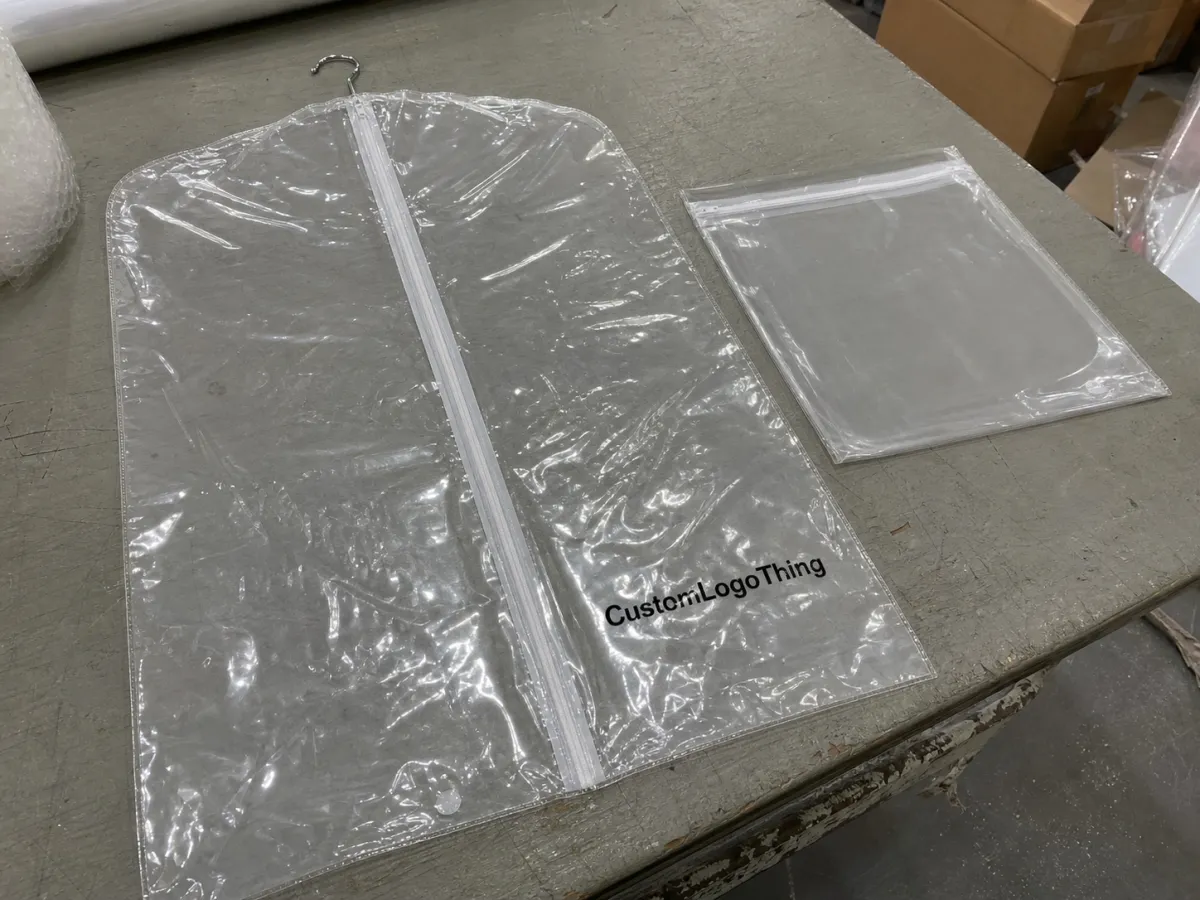
Most buyers start with a sample and then ask for pricing. That is fine, as long as the sample reflects the real use case. A showroom suit cover, a travel garment bag, and a seasonal storage bag do not need the same construction. They should not be priced as if they do.
For bulk orders, the first question is not, “How shiny is the PVC?” It is, “What does this bag have to do?” Does it need to hang on a rack, fold into a carton, open and close every week, or protect a coat for months in storage? The answer drives everything else: film thickness, closure style, seam reinforcement, even carton count.
Planning matters because the hidden costs show up later. Rebagging labor, damaged garments, rejected cartons, and rushed freight can wipe out any savings from a lower unit price. A bag that fits the first time is boring. Boring is good.
There is also a repeat-order issue. If a supplier cannot reproduce the same dimensions, print placement, and pack-out count next season, the operation gets messy fast. Bulk buyers do not need a one-off hero sample. They need consistency the second and third time around.
- Fit keeps the garment from bunching or dragging inside the cover.
- Closure quality keeps the bag usable after repeated handling.
- Packability keeps the warehouse from fighting the product.
- Repeatability keeps reorders from becoming a new project every time.
That is the real value of stationery PVC Garment Bags Bulk Order planning: fewer surprises, fewer corrections, and fewer people standing around asking why the bags do not match the spec that was approved.
PVC garment bag styles and use cases that actually fit
PVC Garment Bags come in more variants than the catalog copy suggests. Clear, frosted, and semi-transparent film each solve a different problem. Clear film gives maximum visibility for retail presentation. Frosted film hides scuffs better and usually looks cleaner after handling. Semi-transparent film sits in the middle if the buyer wants a little privacy without losing product visibility.
Closure choice matters just as much. Zippers are the most common option for full enclosure and repeated use. Fold-over flaps and snap closures can be cheaper, but they are not always right for heavier garments or for bags that move through a busy packing area. Hook-and-loop can work in quick-access applications, though it is not magic. It wears, it catches lint, and it can get expensive once the volume rises.
The common bulk formats are simple enough: suit bags, dress bags, coat bags, shirt covers, travel garment bags, and specialty covers for uniforms or multi-piece sets. Each one changes the dimensions and the handling pattern. A travel bag may need a stronger handle and a heavier zipper pull. A retail display bag may need a cleaner front panel for branding. A uniform cover may need an ID window or a label pocket. None of those add-ons is free.
| Style | Best for | Typical MOQ | Rough unit price | Notes |
|---|---|---|---|---|
| Clear PVC | Retail display, simple storage, high visibility | 1,000-3,000 | $0.45-$1.20 | Best for visibility; shows wrinkles and scuffs more easily. |
| Frosted PVC | Premium storage, backroom use, cleaner presentation | 2,000-5,000 | $0.60-$1.45 | Hides handling marks better and usually feels a bit more premium. |
| Printed or accessorized | Branded retail, travel kits, frequent reuse | 3,000-10,000 | $0.85-$2.40 | Handles, zippers, logos, and reinforced seams push cost up quickly. |
The price spread is real because the labor spread is real. A plain clear cover cuts simpler. A printed bag with hardware needs more steps, more checks, and usually more scrap control. If the order includes multiple features, the quote will follow. Production does not care that the sample looked tidy.
For buyers comparing options, the cheapest style is not always the cheapest program. A slightly heavier frosted bag can reduce complaints, especially if the bags are handled often or stored in stacked cartons. Pick the style that fits the workflow, not the one that just photographs well.
Thickness, size, and print specs to lock first
Lock the finished size before arguing about film gauge. That sounds obvious, but buyers still ask for pricing without a real measurement set. The factory needs the garment length, shoulder width, hanger allowance, and any gusset depth before it can quote responsibly. A bag that is too short does not become acceptable because the film is thicker. It just becomes a heavier mistake.
Thickness is the next big decision. Thinner film lowers cost and folds easily, but it creases faster and feels less substantial. Heavier film adds structure and resists dents. It also tends to hold a cleaner presentation under repeated handling. For many programs, 0.12-0.18 mm works for light storage and presentation, 0.20-0.30 mm suits sturdier retail or reuse, and 0.35 mm+ makes more sense for travel-style use or rougher handling.
Print details should be fixed early too. Decide logo size, print position, one side or two, and how many colors you actually need. If the artwork needs a pre-production proof, ask for it before cutting starts. A proof after production begins is not a fix. It is a delayed problem.
There are a few details that look minor until they affect the order:
- Zipper pull style and whether it needs branding.
- Seam reinforcement near the hanger opening and stress points.
- Pack count per carton so receiving and warehouse storage stay predictable.
- Outer carton labeling for SKU, size, and print version.
- Odor tolerance, especially for enclosed storage or premium apparel.
If the bag will be opened and closed often, ask how the zipper tape is attached and what failure point the factory sees most often. If the design uses a hanger slot, ask whether the opening is reinforced. If the bag is supposed to stand up to repeated retail handling, ask for the tolerance on the finished size and the seal line. Those are not picky questions. They are the questions that prevent returns.
For many bulk programs, a practical tolerance is around +/-3 mm on smaller items and +/-5 mm on larger formats, depending on material and construction. The exact number matters less than the fact that the number exists and the supplier can explain how they control it. Vagueness is not a quality system.
Cost, MOQ, and quote drivers
PVC garment bag pricing usually comes down to a short list of inputs: dimensions, thickness, closure type, printing, accessories, and carton requirements. If a quote ignores one of those, it is not really a quote. It is a guess wearing a spreadsheet.
MOQ tracks setup effort. Plain clear bags can often start at lower quantities because there is less artwork prep and fewer custom parts. Printed bags, unusual shapes, and extra hardware usually need more volume to make the setup worthwhile. A buyer planning seasonal drops or store rollouts should ask for tiered pricing at 1k, 3k, 5k, and 10k units. That shows where the unit cost actually moves instead of hiding behind a single number.
There are a few quote traps that show up over and over:
- Incomplete measurements with no finished width, height, or gusset.
- Unclear artwork that does not show size, color count, or placement.
- Missing freight so the unit price looks better than the landed cost.
- Ignored duty or tax because the buyer never asked for a full landed number.
- Mixed terms such as comparing ex-works pricing with delivered pricing.
Ask for sample charges separately. Ask whether there are proofing fees if the artwork changes. Ask whether custom hardware or special seal tooling changes the cost structure. If the supplier cannot break those pieces out, the budget conversation is already too loose.
As a working rule, the best comparison is not unit price alone. It is unit price plus sample cost plus freight plus any secondary handling. That is the number finance will actually care about. Everything else is decoration.
Price ranges depend on the program, but rough bulk quotes for standard PVC Garment Bags often sit in the ranges listed above. Clear bags land on the low end. Printed, reinforced, or accessory-heavy builds sit higher. If the order needs packaging inserts, label cards, or custom carton print, expect the quote to move again. That is normal, not surprising.
Production steps, samples, and lead time planning
The usual path is straightforward: inquiry, spec sheet, artwork proof, sample approval, material cutting, sealing, inspection, packing, and shipment. Skip one step and the timeline usually stretches in the least helpful way possible. The more custom the bag, the more important it is to lock the proof before bulk material is committed.
Lead time depends on complexity, but realistic planning beats wishful planning every time. A simple sample can often be turned in a few business days. Bulk production commonly takes 12-25 business days after approval, depending on order size, finish, and factory load. Transit is a separate clock. Air is fast and expensive. Sea is cheaper and slow. Neither one cares about launch dates.
The delays are usually predictable:
- Late artwork changes after the sample was already approved.
- Missing measurements that force another clarification round.
- Color corrections because the proof was never signed off clearly.
- Slow buyer feedback during proof and sample review.
- Rush shipping requests after production has already started.
For seasonal programs, add buffer time. Not because it sounds prudent on a slide deck, but because it avoids paying for expensive freight when the calendar gets tight. A one-week buffer is boring. It is also cheaper than panic.
If the bags will be stacked, stored, or shipped in cartons, the outer packaging should be treated as part of the product. Ask whether cartons are drop-tested or at least checked against basic transit handling. The ISTA standards library is a useful reference if you want to think about shipping abuse before the first pallet leaves the factory. If the program uses paper-based outer packs or inserts, FSC guidance may matter for sourcing documentation.
What a reliable supplier should show before you order
A good supplier should be able to show more than product photos. Ask for material details, QC checkpoints, sample records, and repeat-order consistency. If they cannot explain how they check sealing strength, edge finish, zipper function, and carton labeling, then the order is being handled on faith. That is not a plan.
Short production videos help more than polished brochures. Not because you need theater, but because you need proof that the process is controlled. You want to see clean sealing lines, consistent folding, and accurate packing counts. A 5,000-piece order should not feel like a lottery ticket.
Response speed matters too. Fast correction on dimensions or artwork saves real money. A low quote from a slow supplier can cost more than a higher quote from someone who asks sensible questions early. The order only looks cheap before the corrections start.
Look for actual tolerances, not hand-waving. Many programs can work with a few millimeters of variance, but the supplier should state what is acceptable for the specific build. The same goes for carton counts, folding method, and packaging style. If those are not documented, the reorder process gets sloppy fast.
Repeat orders are the real test. A serious supplier should be able to keep the build, print layout, and pack-out notes organized enough that the second order is faster than the first. If every reorder has to be rebuilt from screenshots and memory, the operation has a documentation problem.
One more practical point: ask what happens if a run fails inspection. Rework policy, replacement terms, and inspection standards should be clear before the PO goes out. Buyers usually regret that question only when they forgot to ask it.
How to prep a clean first order
The fastest route to a usable quote is to send five things: garment type, finished dimensions, thickness target, print needs, and target quantity. That is enough for most suppliers to price the order without guessing. Guessing is what creates the second round of emails nobody wants.
If there is a reference bag, send it. If there are photos of the garment inside the bag, send those too. A basic tech pack is even better. The point is simple: stop the spec from drifting before the factory starts cutting film.
Use a short approval sequence and stick to it:
- Confirm sample size and closure.
- Approve the artwork proof in writing.
- Verify carton count and folding method.
- Lock the ship date before bulk production starts.
Then compare quotes line by line. Ask for sample timing, bulk lead time, freight estimate, and landed cost. If a supplier will not itemize the order clearly, the budget will be harder to defend later. That is usually the whole story right there.
stationery pvc garment bags Bulk Order Planning works best when the buyer treats the bag like a working component, not a generic accessory. Fit, closure, thickness, print, cartons, and timeline all matter. Get those right and the order moves quietly. Miss them and the cheap bag gets expensive in a hurry.
FAQ
What MOQ is normal for stationery pvc garment bags bulk orders?
MOQ depends on size, thickness, and whether the bag is printed or plain. Simple clear bags often start lower, while custom-printed or accessorized versions usually need more volume. Ask for tiered pricing at 1k, 3k, 5k, and 10k units so you can see where the unit cost really drops.
How do I choose the right PVC thickness for garment bags?
Use thicker film for heavier garments, repeated handling, or reuse in storage and retail. Use thinner film only for light protection and presentation, because it creases more easily and feels softer under load. The bag should match the garment weight, not just the budget.
What measurements and artwork do you need for a bulk quote?
Send finished width, height, gusset, closure type, logo size, and print position. If you do not have a tech pack, a reference bag plus a photo of the garment inside the bag usually gives the supplier enough information to avoid a size mistake.
How long does production usually take after sample approval?
Simple unprinted orders are usually faster than printed or accessory-heavy versions because there are fewer setup steps. Bulk production commonly takes 12-25 business days after approval, and shipping time needs to be counted separately so the full delivery date stays realistic.
Can stationery pvc garment bags bulk order planning include custom printing?
Yes. Print coverage, color count, and logo placement can raise both MOQ and unit cost, so the artwork should be locked early. Ask for a pre-production proof before approval so the design is checked before the run starts, not after.

