A woven label beanies Print Method Comparison sounds tidy until the first sample arrives. Then the knit stretches, the logo shifts, and the method that looked perfect on a flat mockup starts telling the truth. Beanies are small, curved, and textured. They do not forgive bad decoration.
The main decision is not whether a decoration looks good in isolation. It is whether it survives wear, folding, friction, and washing while still looking intentional. That is where woven labels, embroidery, screen print, heat transfer, and patches stop being marketing terms and start being production choices.
Buyers usually want three things at once: a clean brand look, a reasonable price, and a timeline that does not eat the launch date. Sometimes all three line up. Usually they do not. So the job is to compare the methods with real production limits in mind, not just whatever the render happened to show.
There is one more wrinkle. A woven label is not a print method at all. It is a sewn branding component. But people compare it with print methods because it competes with them for the same space on the cuff or body. That makes sense. The beanie does not care what the decoration is called. It only cares how much abuse it has to take.
Woven Label Beanies Print Method Comparison: What Actually Holds Up
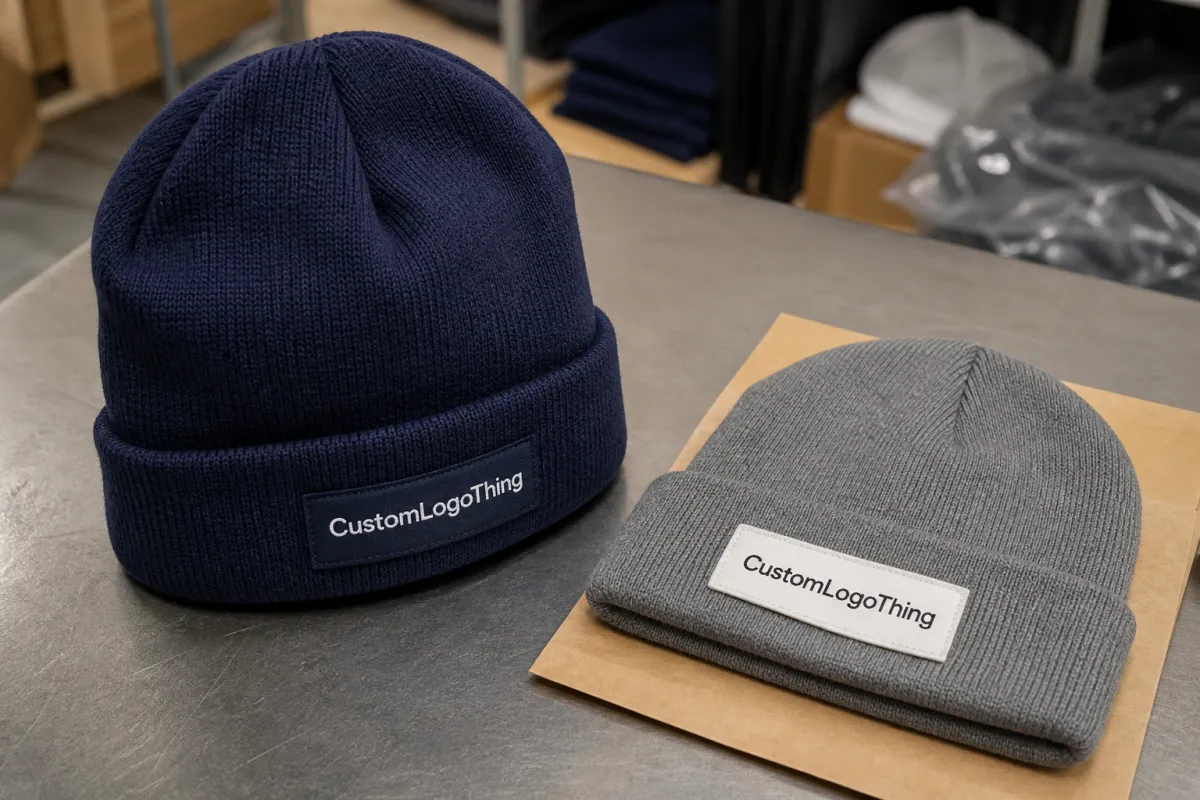
Most orders start with a price request and end with a design correction. That is not sarcasm. It is routine. A logo that works on a cap or hoodie may fail on a beanie because the knit structure is looser, the surface is less flat, and the branding area is much smaller. A woven label often wins when the brand needs a clean, premium marker. Print wins when the artwork needs detail or speed. Embroidery wins when the logo can tolerate stitch depth and the buyer wants something more durable than ink on knit.
The surprises usually come from scale. Tiny lettering disappears into ribbing. Thin outlines look crisp on screen and fuzzy on yarn. Bold shapes survive better, but they need enough contrast to read from a distance. Buyers also underestimate how much the cuff moves. A decoration that looks centered on a table can drift once the beanie is folded, stretched, or worn down over a forehead.
That is why a practical comparison has to include more than aesthetics. You need to look at handfeel, stretch recovery, decoration thickness, unit cost, minimums, and how much setup the method adds to the schedule. If the beanie is for retail, the finish needs to feel deliberate. If it is for promotions, readability matters more. If it is for workwear, durability usually beats everything else.
The fabric sets the rules. The decoration either respects them or looks expensive for the wrong reasons.
Another common confusion: people assume the same vendor can handle the beanie and the packaging with the same production logic. Not true. A beanie decoration may be woven, stitched, printed, or heat-applied. The hang tags, belly bands, and cartons are a separate decision. Those usually involve digital printing, offset printing, or flexographic printing, with CMYK or spot color choices affecting cost and lead time. Keep the decoration and the paper goods in their own buckets. Mixing them up makes quotes messy and comparisons useless.
How Each Decoration Method Lands on a Beanie
Woven label sew-on is the most controlled option. The label is woven separately, then stitched onto the cuff, side seam, or hem. The result is crisp and tidy, especially for logos, wordmarks, and small brand marks. It also adds a physical edge, which can look sharp or feel bulky depending on placement and label size. On a thin acrylic beanie, oversized labels can feel clumsy fast.
Embroidery stitches directly into the knit. It gives dimension and can feel more substantial than print. The catch is that embroidery has a floor. If the artwork is too small, too detailed, or too delicate, it turns into a knot of thread and wishful thinking. Simple shapes, thicker letters, and reduced detail produce better results. Digitizing matters here. A bad digitized file makes even a good logo look confused.
Screen print places ink on the surface. It works best on smoother knits and larger, simpler graphics. On a tight, even beanie body, it can look clean and economical. On a chunky rib knit, the print can fracture or lose edge clarity because the surface is simply not flat enough to hold the image well. Soft-hand inks help, but they do not erase the limits of the fabric.
Heat transfer uses a printed film or transfer sheet that is applied under heat and pressure. It is useful for small runs, tight artwork, or multi-color graphics that would be expensive to embroider or screen print. Quality varies a lot. Some transfers stay flexible and light. Others sit on top of the knit like a plastic label with confidence issues. Testing the exact transfer type matters more than the sales name attached to it.
Patch application includes woven patches, embroidered emblems, PU patches, faux leather patches, and felt badges. These can be sewn or heat-applied. They add structure and a stronger fashion or outdoor feel, but they also add thickness. That can be a feature on a heavyweight cuff and a problem on a thin, soft beanie that needs to fold neatly in packaging.
DTG is rarely the right answer for beanies. On paper, direct-to-garment sounds flexible. In practice, knit texture and stretch make consistency a headache unless the fabric is unusually smooth and the design has already been proven on that exact substrate. For most orders, I would treat DTG as an exception, not a default.
When a buyer asks for Custom Labels & Tags, I usually check whether the beanie needs one branding layer or two. A woven label can handle the core brand mark while a small print or size marker carries the rest. Splitting the job that way often keeps the finish cleaner and the production less brittle.
Fit, Stretch, and Wear Behavior That Change the Decision
Beanies are not judged like posters. They are judged in motion. The knit stretches when it is pulled over a head, folds when the cuff is rolled, and rubs against jackets, hair, and gloves. That changes the way every decoration behaves. A logo can look excellent flat and then distort the moment the fabric bends.
Fabric construction matters more than many buyers expect. Fine-gauge beanies usually handle detail better than chunky rib knits. Acrylic blends can take embroidery well, but the stitch density needs to be balanced so the beanie does not feel stiff. Cotton blends may feel softer, though they can also show puckering more clearly if the decoration is too heavy. Polyester tends to hold print better than many loose knits, but even there the surface texture sets limits.
Durability is not just about washing. It is about abrasion, edge lifting, seam stress, and whether the logo still reads after repeated folding. The cuff takes the most abuse because people grab it, tug it, and stretch it every time they put the beanie on. A sewn label handles that well if the stitching is neat. Embroidery also holds up well if the stitch count is not excessive. Surface prints are more vulnerable to fatigue, especially if the design sits across a high-stretch area.
That leads to a useful shorthand:
- Premium retail: woven label or refined embroidery.
- Outdoor or workwear: embroidery, patch, or a sturdy sewn label.
- Budget giveaway: simple screen print or basic transfer.
- Fashion drop: label-led branding with tight placement control.
For packaging and shipping, the decoration is only part of the risk. Folded goods can rub during transit, which is where a raised patch or thick embroidery may need more protective packing. Testing against ISTA shipping concepts is useful for that kind of sanity check, especially if the order ships in cartons with inserts or folded sleeves. If the paper components matter too, FSC sourcing is worth asking about instead of treating sustainability like decorative copy.
Cost, MOQ, and Unit Price Tradeoffs by Method
Unit price is the easy number to chase. It is also the number most likely to lie by omission. Setup, sampling, sewing labor, and rework can change the final economics enough to make the cheapest quote look silly in hindsight. For a proper Woven Label Beanies print method comparison, the total landed cost matters more than the per-piece headline.
| Method | Typical setup | Common MOQ | Approx. unit price range | Best fit |
|---|---|---|---|---|
| Woven label sew-on | $25-$80 for weaving and prep | 100-300+ | $0.25-$0.70 | Clean retail branding, side tabs, cuff labels |
| Embroidery | $40-$120 for digitizing and setup | 50-200+ | $0.40-$1.25 | Bold logos, durable branding, premium feel |
| Screen print | $25-$75 per screen or color setup | 100-500+ | $0.18-$0.60 | Simple art, larger graphics, budget runs |
| Heat transfer | $35-$90 for art prep and transfer setup | 25-100+ | $0.30-$0.85 | Short runs, sharper detail, fast launches |
| Patch application | $30-$100 depending on patch type | 100-300+ | $0.45-$1.50 | Heavier branding, tactile premium look |
Those ranges are not arbitrary. They reflect where labor shows up. Embroidery shifts more work into machine time, so simple logos can be efficient. A woven label itself may be inexpensive, but sewing it neatly onto each beanie adds hands-on work. Screen print stays economical only as long as the color count stays low and the artwork is simple. Heat transfer can be the fastest route for a small run, but the quality depends heavily on the film, the press settings, and the operator not rushing through the stack like it owes them money.
If the artwork uses three or four colors, ask whether it can be reduced to spot colors. On tiny beanie branding, complex CMYK effects often add noise without adding value. If packaging is included, compare the print method separately. Digital printing usually suits short runs and variable content. Offset printing can make more sense on larger volumes. Flexographic printing often wins when the run is long and the repeat is stable. Different job, different math.
Process and Lead Time: From Sample to Final Production
The production path is simple on paper: art review, method selection, sample approval, bulk scheduling, decoration, inspection, packing. The difficulty is that every step exposes a different mistake. Bad art gets caught first. Bad sizing shows up in sampling. Bad alignment turns up in bulk. Bad packaging usually waits until the cartons are already sealed, because of course it does.
Lead time depends on the method. Embroidery needs digitizing and stitch correction. Woven labels need weaving time, then sewing labor. Screen print can move quickly if the art is simple and the setup is straightforward. Heat transfers are often the fastest to prepare, but the final result still depends on curing and application control. Patches can be quick once the patch style is fixed, though the attachment method can slow the line if the piece is thick or awkward.
For normal custom orders, the rough timing is usually:
- Heat transfer: often 5-10 business days after approval.
- Embroidery: often 7-15 business days, depending on stitch count.
- Screen print: often 7-12 business days if the design is simple.
- Woven label applications: often 10-20 business days because of weaving and sewing.
Rush work is possible, but not by magic. A transfer job may be expedited if the printer has the right film in stock. A sewn label run is harder to rush if the sewing line is full or the labels have not been woven yet. Seasonal drops need buffer time. The actual delay is usually not production. It is late approval, incomplete art, or a sample that was clearly never checked at full size.
A clean proof saves more time than a rush fee. Most order delays start with artwork nobody measured on the actual beanie.
Step-by-Step Method Selection for Your Beanie Order
The quickest path to the right method starts with the brand goal. Ask what the beanie should feel like in hand: premium, sporty, corporate, promotional, or fashion-forward. Then decide where the branding sits. A front cuff gets more attention and more stretch. A side tab is calmer and usually better for subtle branding. A body print can work, but only if the knit and the artwork both cooperate.
- Define the job: retail, giveaway, staff uniform, or event merch.
- Pick placement: front cuff, side seam, patch area, or body print.
- Rank priorities: durability, softness, speed, or lowest cost.
- Shortlist two methods: one safe option and one budget option.
- Resize the art: test it at actual beanie scale, not poster scale.
- Ask for real samples: compare fabric, handfeel, and visibility in daylight.
That last step is the one people skip and regret. A flat proof cannot show how the knit behaves under tension. A sample can. It also shows whether the decoration feels too stiff, too shiny, too bulky, or just off in a way that is hard to describe but easy to feel. That matters more than polished mockup language.
A practical comparison also helps: request one premium method and one lower-cost backup. Side by side, the difference is obvious. If the premium version only improves the look a little but doubles the cost, that is useful information. If the cheaper version looks fine in mockups and awful in hand, that is useful too. Not every low-cost option is a trap. Some are just the honest answer for a short run.
Before sending the quote request, check five things: logo size, placement, quantity, deadline, and beanie color. Dark yarn with dark thread is still the classic way to create accidental stealth branding. Nobody needs that surprise.
Common Mistakes That Make Beanies Look Cheap
The first mistake is oversizing the logo. A huge graphic on a small cuff warps the fabric and makes the beanie look like it is carrying a billboard. Smaller, cleaner branding usually reads better.
The second mistake is trying to force too much detail into a knit that cannot hold it. Ultra-thin letters, tiny outlines, and crowded icons fall apart quickly. Coarse texture eats precision. If the logo needs perfect edges to make sense, it probably needs to be simplified before production.
The third mistake is approving a sample without wearing it. Fold the cuff. Stretch the knit slightly. Check the logo under daylight and indoor light. A decoration that looks controlled on a table can shift or distort once the beanie is actually on a head.
The fourth mistake is picking the lowest quote and only later discovering that the method does not fit the product. That usually creates a second round of sampling and a longer lead time. Cheap is only cheap when it still works.
The fifth mistake is sloppy placement. Off-center labels, thread colors with weak contrast, and label dimensions that overpower the cuff all make the piece feel rushed. Buyers notice that instantly, even if they cannot explain why.
A beanie looks premium when the decoration follows the fabric. It looks cheap when the decoration tries to fight it.
Too many colors are another classic problem. A five-color logo on a small hat often reads as clutter. A single-color mark, a clean woven label, or a restrained patch can do more with less. That is not playing it safe. That is reading the product correctly.
Specs, Samples, and Quote Details That Matter
If you want a quote that is actually useful, send the vendor the details that affect production: flat artwork, beanie style, logo size, placement, quantity, yarn or fabric content, and deadline. Leave those out and the pricing will be broad enough to be almost decorative.
Ask for two sample approaches when possible. One should reflect the preferred method. The other should test the backup option. That gives you a real comparison of texture, durability, and visual impact instead of forcing a decision from a screen file that has never touched fabric.
Before approving bulk production, run a quick internal check:
- Wear the beanie for a few minutes.
- Fold the cuff the way a customer would.
- Stretch the knit slightly and inspect the logo.
- Check the decoration under daylight and indoor light.
- Compare total landed cost, not just piece price.
That last item matters because setup, sewing, samples, and rework can change the economics more than the base unit price does. A slightly higher quote with better consistency is usually the better buy. A quote that looks cheap and comes with a sloppy finish is not a bargain. It is a problem that has not happened yet.
For brands that want a clean retail result, the best answer in a Woven Label Beanies print method comparison is rarely the cheapest method on paper. It is the one that matches the knit, the logo, the placement, and the wear pattern without adding avoidable bulk or failure points. That is the part buyers remember after the delivery is opened and the samples are actually handled.
Which method lasts longest in a woven label beanies print method comparison?
Sewn-on woven labels and embroidery usually last longer than surface prints because they handle stretch and abrasion better. Placement still matters. A cuff edge gets more stress than a lower-profile side tab or patch area.
Is embroidery better than print for beanies with a woven label?
Embroidery is usually better when the logo is bold and the brand wants a premium, durable feel. Print can be the better option for very small art, faster turnaround, or lower unit cost on a simple design. The right answer depends on the artwork, not the habit.
What is the cheapest option for small beanie orders?
A simple screen print or a minimal woven label is often the lowest-cost path, but setup fees can change that on very small runs. Always compare unit cost plus prep, because a cheap-looking per-piece price can hide a costly setup.
How much lead time does a custom woven label add to beanie production?
Custom woven labels usually add time for weaving, approval, and sewing. The delay is often manageable, but not if the artwork keeps changing or the label style needs exact color matching. Stock label options move faster than fully custom ones.
Can I combine woven labels with printing on the same beanie?
Yes. That is often a smart layout if the woven label carries the brand name and a small print adds a campaign message or size cue. Keep the combined decoration restrained so the beanie still feels wearable. Overloaded hats rarely age well.


