Zipper Pouches for Apparel Wholesale Pricing
A folded tee in a thin sleeve can look unfinished before the customer even sees the garment. A clean zipper pouch changes that first impression fast. It gives apparel a more controlled silhouette, protects the fold, and makes the product feel deliberate rather than improvised. That matters whether the item is headed to a retail shelf, a fulfillment center, or a wholesale account that judges packaging as closely as product.
The practical question is not whether the pouch looks good in a mockup. It is whether the size fits the garment, whether the closure holds up through packing and transit, and whether the quote still works once printing, tooling, freight, and samples are added. That is where Zipper Pouches for Apparel wholesale pricing becomes more than a search phrase. It becomes a buying decision with real margin consequences.
Good packaging can lift perceived value without materially changing the apparel itself. Bad packaging can do the opposite. A wrinkled, dusty, or overstuffed pouch tells the buyer the product was an afterthought, even when the shirt inside is well made. Packaging is not decoration. It is part of the product presentation and, in many programs, part of the product economics too.
A pouch should protect the garment, present it cleanly, and fit efficiently in the carton. If it does only one of those three things, it is probably too expensive.
Why zipper pouches change the first impression of apparel
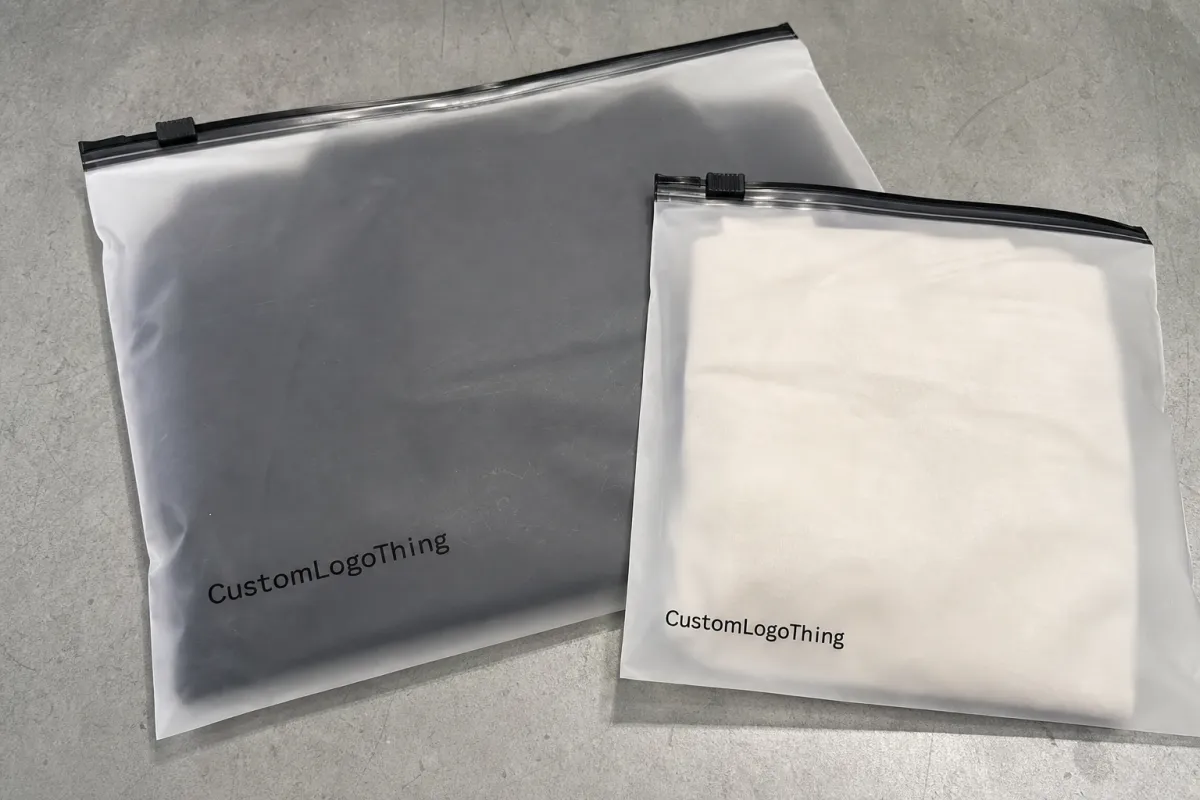
Buyers often judge the pack before they touch the fabric. That is not vanity; it is how receiving rooms, store teams, and customers sort through product at speed. A zipper pouch gives folded apparel a crisp outline, keeps pieces aligned, and reduces the chance that the first touch is a dusty one. For basics like tees, socks, leggings, and accessories, the difference between a pouch and a loose polybag is visible from several feet away.
Clear and frosted pouches are especially useful when the garment itself needs to stay visible. The color, texture, folding pattern, and label position can all be seen without opening the pack. That helps during receiving counts and makes shelf presentation easier to manage. It also cuts down on handling, which matters more than many buyers realize. Every extra touch increases the chance of wrinkles, fingerprints, static cling, or zipper damage.
There is also a storage argument. A pouch keeps stacked garments cleaner in the warehouse and reduces surface scuffing during shipping. It will not replace good carton engineering, but it does add a useful layer between the garment and the rougher parts of the supply chain. In wholesale programs, those small protections add up across thousands of units.
The visual effect is real, but so is the operational effect. When a pack is transparent enough for quick identification, teams spend less time opening cartons and sorting inventory. That kind of efficiency rarely shows up in a catalog description, yet it has a direct impact on labor and error rates. If the packaging helps the buyer move faster, it is doing real work.
Materials, zipper styles, and sizing for folded garments
Choose the film by use case, not by habit. Clear polyethylene and CPP-style films are common for apparel because they balance cost, clarity, and flexibility. A thinner film can work for lightweight items and sample runs, while a thicker film is better for repeated handling, stacking, or longer distribution routes. For many programs, the useful range sits somewhere around 60 to 120 microns, depending on the pouch size and how much abuse it will take before the customer opens it.
There is no single material that is cheap, rigid, highly transparent, and premium-feeling all at once. If the brief asks for all four, the budget usually pays for the compromise. Buyers should decide which attribute matters most. A display pack needs clarity. A warehouse pack needs durability. A luxury presentation pack may need a thicker, more structured film that stands upright better on a shelf.
Size is where a lot of expensive mistakes start. A pouch that is too small stresses the closure, creases the garment, and creates a poor fit around the corners. A pouch that is too large wastes film, increases carton volume, and makes the contents look loose. The right approach is to build around the folded dimensions of the actual garment, then leave just enough room for loading. The gap should be intentional, not generous.
Zipper style matters more than buyers expect. A standard press-to-close track is usually the lowest-cost and most familiar option. It is also the easiest to source consistently. Heavier tracks or more decorative closures can feel sturdier in hand, but they add cost and can complicate lead time. Tear notches should be used only when quick opening is a real requirement. Hang holes make sense for display packs, not every order. Each extra feature affects tooling, labor, and pricing.
Gussets are useful only when the product needs depth. Hoodies, coordinated sets, and bulkier knits may need side or bottom expansion to keep the pack from looking compressed. Flat tees and socks usually do better in a flat pouch. That simpler build is faster to produce, easier to stack, and cheaper to ship. Sometimes the quiet solution is the correct one.
For programs where handling and transit are serious concerns, ask whether the pouch spec has been tested against real shipping conditions, not just a visual mockup. Carton compression, vibration, and drop exposure can expose weak seals and underbuilt film much faster than a desktop review. If the pouch is part of a broader packaging system, the rest of the pack should be tested with the same discipline.
Print, color, and branding specs that affect unit cost
Printing is one of the fastest ways to move a pouch from functional to branded, but it is also one of the fastest ways to raise the unit cost. A single-color logo on a clear pouch is usually the most economical branded option. It keeps setup simple, limits ink coverage, and preserves the garment visibility that many apparel programs need. Once the spec moves into multi-color work, full-bleed printing, metallic effects, or special finishes, the price rises for understandable reasons: more setup, more ink, and more production time.
A clear pouch with a printed logo panel is often the sweet spot. It gives the brand identity without covering the entire pack, and it usually costs less than fully printed film. That format works especially well for private label basics, mid-tier retail, and seasonal launches that need to look polished without absorbing too much packaging budget. If the apparel color is part of the appeal, keeping a window or transparent area is usually the smarter choice.
Color control is another place where small decisions change the quote. Tight Pantone matching costs more than a loose visual match. Printing on one side costs less than printing both. A simple front placement is easier to proof and easier to reproduce consistently than wrapping artwork around the pouch. None of that is glamorous, but it keeps the order predictable. The more variables you add, the more the price becomes a moving target.
For fast-changing graphics, ask whether the supplier can update the print without reworking the entire setup. That matters for limited drops, seasonal programs, and private label lines that change artwork every few months. If the design changes before production is locked, the real cost is not just the new artwork. It is the extra proof cycle, the extra time, and the risk of a misprinted batch. With Zipper Pouches for Apparel wholesale pricing, clarity at the quote stage is worth more than a clever design later.
| Option | Typical MOQ | Typical Unit Price | Best For | Cost Driver |
|---|---|---|---|---|
| Clear pouch, no print | 1,000-3,000 | $0.08-$0.16 | Basic tees, socks, samples | Material thickness and size |
| Clear pouch, one-color logo | 3,000-5,000 | $0.11-$0.22 | Retail basics, branded sets | Print setup and coverage |
| Frosted pouch with logo panel | 5,000+ | $0.14-$0.28 | Premium apparel, display packs | Film finish and print method |
| Custom color, special zipper, full print | 8,000+ | $0.22-$0.45 | Brand launches, custom retail lines | Tooling, ink, and component changes |
Zipper Pouches for Apparel Wholesale Pricing and MOQ Basics
Wholesale pricing usually moves in steps, not in a smooth curve. The first real drop often comes once the order moves past sample quantity and into production volume. That is why a quote for 500 pieces can look very different from a quote for 10,000, even if the pouch looks identical on paper. Material yield, setup time, and production efficiency all improve when the run gets larger.
MOQ is driven by several things at once: film width, zipper component sourcing, print setup, and how much of the pouch is custom. A plain clear pouch may be available at a lower minimum than a fully branded bag with a custom zipper color and special finish. That does not mean the supplier is being difficult. It means the order needs enough volume to justify the setup.
Good quotes separate the moving parts. Unit price should be shown apart from setup, sample cost, freight, and any tooling. If all of those numbers are merged together, the lowest-looking quote may become the least useful one once revisions start. Buyers should also ask whether freight is calculated by weight or by carton volume. Apparel pouches are light, but they can still become expensive to ship if the carton dimensions balloon.
A useful mental check is to ask whether the packaging cost supports the final retail price. If the pouch is protecting a low-cost basic, a simple clear pack may be enough. If the item is positioned as premium, a more refined finish may be justified. The right spec is the one that fits the product story and the margin, not the one that looks best on a sample board.
As a rough rule, three pricing tiers tend to show up repeatedly:
- Basic clear pouch: strongest value for high-volume staple apparel.
- Branded one-color pouch: often the best balance of cost and presentation.
- Fully custom pouch: justified only when packaging is carrying a large part of the brand experience.
Process and lead time: from quote approval to carton delivery
A clean order process starts with a complete spec sheet. The supplier needs quantity, pouch dimensions, artwork, film preference, zipper style, and destination before the quote can be trusted. If any of those details are missing, the price can drift later. The same order that looked simple in email often becomes more complicated once the actual production choices are made.
After approval, the sequence usually runs through proofing or sampling, production, inspection, packing, and freight booking. A paper proof is helpful for layout and color placement, but a physical sample is what reveals the real issues: zipper feel, seal strength, film clarity, edge trimming, and how the pouch behaves with the garment inside. That is especially true for apparel, where a few millimeters can change the way the pack lies flat.
Lead time depends on volume, printing complexity, and the supplier’s schedule. Simple clear runs move faster. Custom color work, multi-step printing, and specialty closures take longer. A reasonable planning window for many apparel pouch orders is about 12 to 15 business days after proof approval, with freight added on top. That is a planning estimate, not a promise. Customs, artwork revisions, and seasonal congestion can all push the date.
Rush orders cost more for a reason. They disrupt the line, shorten inspection windows, and compress freight options. If the launch date is fixed, build buffer time into the schedule from the beginning. The cheapest mistake in packaging is usually the one avoided by not waiting until the last week to approve artwork.
Quality checks that keep garments clean, flat, and retail-ready
Packaging defects show up quickly in clear pouches because the material leaves little room to hide. Zipper alignment, seal consistency, film haze, and edge trimming should all be checked before bulk production starts. A small fault in the sample stage can become a large problem once it repeats across a full order. Rework is always more expensive than inspection.
Dust and scratches are the obvious issues, but static, waviness, and zipper mis-engagement matter too. Under bright store lighting, even minor flaws are visible. That is why handling and packing conditions matter as much as the print itself. A pouch that looks fine on a table may look much worse after it has been stacked, moved, and unpacked several times.
The fit should be tested with the actual folded garment, not with a guess. A tee, a hoodie, and a multi-piece set do not behave the same way inside a pouch. Thickness changes at the corners, the zipper line shifts, and the pack may bow if the garment is too close to the closure. Fit testing catches those issues before they turn into carton-wide problems.
For retail-ready programs, ask whether the pouch stacks cleanly, opens without snagging, and stays closed during normal warehouse handling. If the order will move through multiple channels, those details matter more than a polished photo. A pouch that survives packing and still looks straight on arrival is doing its job. If the program is sensitive, an inspection standard such as AQL 2.5 can help make expectations clearer, but even a simple visual checklist is better than none.
The lowest quote is not always the lowest-cost order. A sloppy pouch can create sorting delays, rework, and presentation problems that are far more expensive than the film itself.
What a reliable supplier should prove before you place the order
They should provide a real sample, not only a photo. A picture can hide uneven seals, weak zipper engagement, poor clarity, and edge waviness. A sample tells the truth immediately. It also shows whether the pouch holds its shape once the garment is inside, which is the part that matters most in apparel packaging.
They should explain the quote in plain language. If the price changes because of material width, print setup, zipper type, or freight class, that should be easy to understand. A supplier that cannot explain the cost structure usually does not understand the production structure either. That is a risk when the order has a deadline and a budget attached to it.
They should give a realistic production window and identify the likely delay points. Proof approval, art correction, line congestion, packing, and transit can each move the schedule. A careful estimate is more useful than an optimistic one that leaves no room for revision. In packaging, the schedule is often won or lost before production starts.
They should ask about the garment type, fold style, destination market, and channel before recommending the pouch. A bag for lightweight undershirts is not the same as a pouch for heavyweight hoodies. Domestic pallet shipments and export cartons do not demand the same level of packaging stiffness either. Good suppliers treat the pouch as part of the supply chain, not a decorative extra. They understand that a packaging spec has to work in the warehouse, on the truck, and on the shelf.
What to send next for a fast, accurate quote
Start with the essentials: quantity, folded garment dimensions, pouch size, material preference, and whether the pack should be clear, frosted, or printed. If you know the apparel type, include that too. A pouch for a folded tee may not be the right fit for a knit set or a thicker hoodie, even if the flat dimensions look close.
Add zipper preference, hang hole, tear notch, gusset, and any finish requirements only if they matter to the program. Each feature affects price, lead time, or both. If the artwork may change later, say so before the quote is locked. Revisions after setup are where many apparently simple orders become frustrating.
Include the shipping destination and the target delivery date so freight is quoted in the same pass as production. A unit price without transport context is incomplete. It can help with a rough comparison, but it does not tell you the landed cost, and landed cost is what the margin actually feels.
Zipper pouches for apparel wholesale pricing works best when the request is specific and the budget is honest. The cleaner the brief, the fewer surprises later. That is true for the supplier, the buyer, and the person who has to explain why the cartons are late.
What is the MOQ for zipper pouches for apparel wholesale orders?
MOQ depends on size, material, print coverage, and custom components. Simple clear pouches usually allow lower minimums than fully printed or specialty packs. Ask whether the minimum is tied to film sourcing, print setup, or total unit volume, because those are not the same constraint.
How does size affect zipper pouch wholesale pricing?
Larger pouches use more film and usually cost more to ship because cartons take up more space. Oversizing also raises the risk of loose presentation and wasted packing volume. The best size holds the garment neatly without paying for unnecessary air.
Can zipper pouches for apparel be printed on both sides?
Yes, but double-sided printing usually adds setup time and cost. In many cases, a logo panel on one side delivers most of the branding value for less money. Comparing both options in the same quote makes the price difference easier to judge.
What is the typical lead time for wholesale zipper pouches?
Lead time varies with quantity, print complexity, and current production load. Many orders need about 12 to 15 business days after proof approval, then more time for freight. Sampling, artwork revisions, and customs can extend the schedule.
What details do you need to quote zipper pouches for apparel?
Send the pouch size, quantity, material preference, print requirements, folded garment dimensions, and destination. Add zipper style, hang hole, gusset, and any special finish if those affect the build. A complete brief produces a cleaner quote and fewer surprises later.


