Most buyers begin an apparel Frosted Zipper Bags unit cost review by looking for the lowest quote. That usually works until the hidden costs show up: rework, damaged goods, packaging that looks thin on shelf, or a bag that tears during packing. A slightly better spec can cost a few cents more and still reduce total spend once returns, scrap, and labor are counted.
For custom apparel, Frosted Zipper Bags sit in a practical middle ground. They look cleaner than plain poly bags, feel more premium than a thin clear sleeve, and avoid the higher unit cost of rigid packaging. For folded tees, socks, underwear, activewear, and seasonal launches, they can hold the line on cost while still improving presentation.
The point is not to buy the cheapest bag. The point is to buy the bag that fits the product, survives handling, and does not force you into a second round of spending later. Packaging has a habit of appearing inexpensive right up until it isn’t.
Why frosted zipper bags can lower real packaging cost
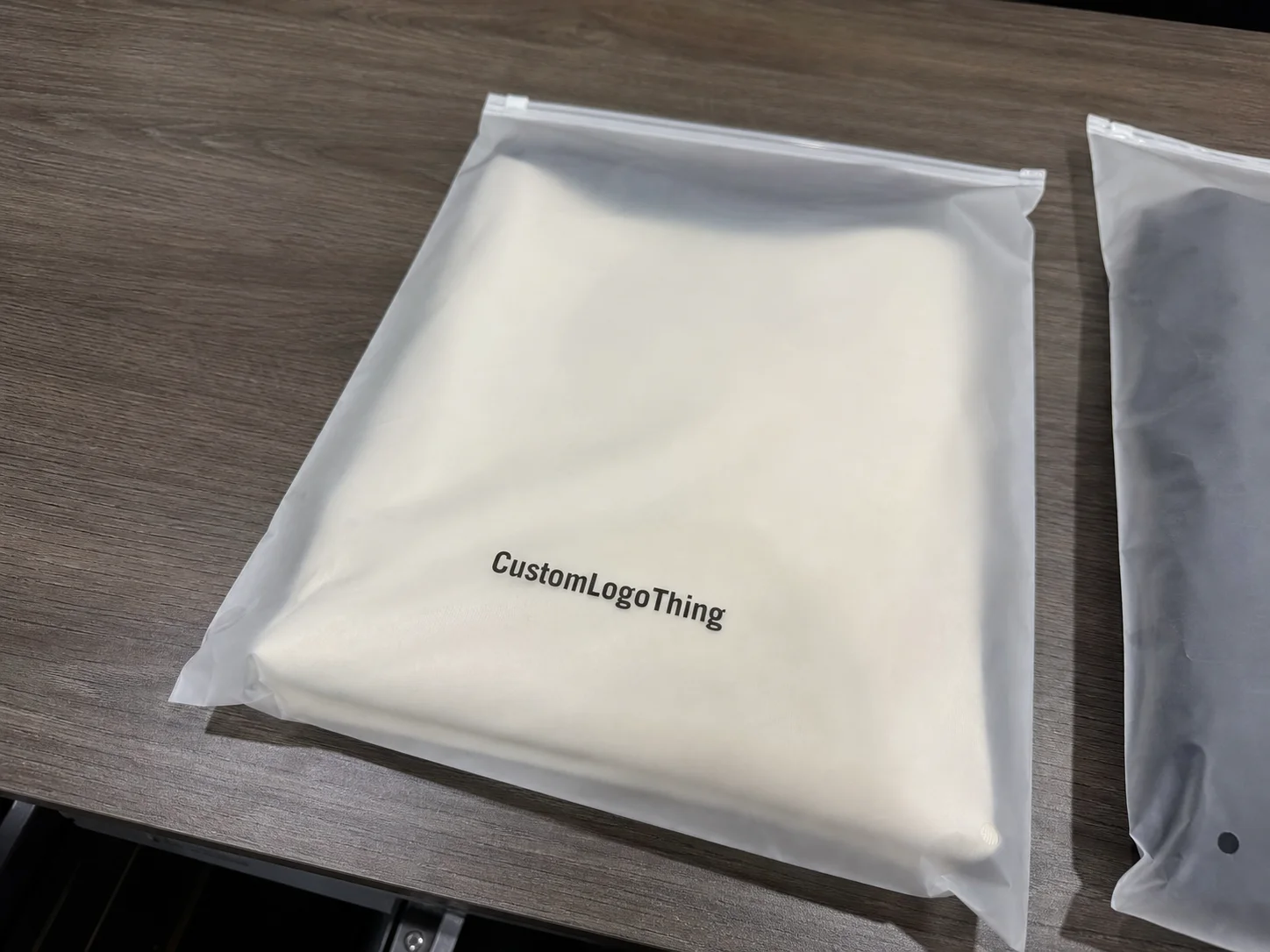
The lowest-looking unit price often creates the highest total cost. Thin bags split in packing. Oversized bags waste film and freight space. Poor print registration leads to rejects. If the finished product arrives looking untidy, that can spill into customer perception, repeat orders, and replacement costs. During a packaging review, those are the costs that matter more than the headline quote.
Frosted zipper bags improve presentation without moving you into box-level expense. The matte, diffused finish softens the look of the package and reduces the glare that makes clear poly sometimes look harsh or unfinished. The bag still gives enough visibility for warehouse identification and SKU recognition, which is useful for folded garments that move through fulfillment quickly.
For e-commerce, the benefits are simple rather than dramatic. The bag protects against dust and light scuffing, helps keep folds tidy, and gives the customer a more deliberate opening experience. In retail or wholesale prep, the semi-transparent look speeds variant checks without forcing staff to open every pack. That saves time, and time is part of packaging cost whether buyers track it or not.
Where do costs creep up? Usually in three places:
- Oversized dimensions that add resin and make the pack look loose.
- Print coverage that is larger than the brand actually needs.
- Excess thickness chosen for appearance rather than product weight.
Frosted bags work best when the goal is controlled spend with enough polish to support the product. They are not luxury packaging, and they do not need to be. They just need to protect the garment, present it well, and stay predictable across production runs.
“We thought packaging was a minor line item until customers started comparing our shirts to other brands. The bag changed perceived value faster than the product page did.”
Apparel zipper bag construction, finishes, and sizing
Most custom apparel zipper bags are made from LDPE, EVA, or frosted PE blends. LDPE is the workhorse because it is flexible, seals reliably, and usually keeps cost down. EVA feels softer and more premium, but that improvement comes with a higher price. Frosted PE blends land between the two and give the matte look many apparel brands want without the hard shine of basic clear film.
The closure system matters as much as the film. A standard press-to-close zipper is usually the lowest-cost option and is fine for most apparel packs. Upgrades such as stronger zipper tracks, hang holes, tear notches, or euro slots add usability and retail appeal, but each one changes the cost per piece. None of those features is free, even if they sound small in a meeting.
Frosted finish changes both visibility and branding. Clear bags show everything, which is useful for instant identification but can look basic. Opaque bags hide too much and create sorting headaches. Frosted bags sit in the middle: enough visibility for operations, enough softness for presentation, and enough surface treatment to make the product look considered rather than improvised.
Sizing is where many buyers lose money. They start with garment category instead of the actual folded dimensions. A tee might be labeled “medium” or “large,” but the bag needs to fit the folded shape, not the size tag. A standard folded tee may fit a bag around 10 x 13 inches. Thicker hoodies, fleece pieces, or multi-item sets often need 12 x 16 inches or more, depending on the fold and zipper placement.
Common construction options
- Flat zipper bags for tees, underwear, socks, and slim folded garments.
- Gusseted styles for thicker items, sets, or folded hoodies.
- Hang-hole or euro slot for retail display.
- Custom printing for logo placement, size marking, or brand messaging.
- Resealable zipper for repeated opening and repacking.
A more premium tactile finish usually means a slightly higher unit price. That is not a flaw; it is a tradeoff. The real question is whether the finish earns its place in the packaging budget. If the answer is no, the spec is too elaborate for the product.
Spec targets that actually matter for apparel shipments
A useful apparel Frosted Zipper Bags Unit Cost review starts with the spec sheet, not the quote. If the spec is loose, the pricing will be loose too, and that usually creates comparison problems. The details that matter most are thickness, width, height, zipper type, finish consistency, and print area. Miss one of those and two quotes may look similar while describing different products.
Thickness affects both cost and durability. Thin bags reduce material spend, but if they split during packing or shipping, the savings disappear quickly. For lightweight apparel like socks or underwear, a moderate gauge is often enough. For heavier garments, thicker film is worth the extra cents. A bag that survives the supply chain is not overbuilt; it is simply appropriate.
Print specifications need just as much discipline. A small one-color logo is usually the most economical route. Spot colors are manageable. Full-coverage artwork pushes ink usage, setup complexity, and reject risk. If the design covers much of the bag, the quote will rise. That is standard print economics, not a surprise.
Buyers should also ask about practical performance details:
- Odor control for enclosed apparel packs.
- Static behavior, especially for synthetic garments.
- Finish consistency across the full production run.
- Dimensional tolerance so bags do not vary beyond packing limits.
For retail and fulfillment use, packaging should also line up with basic handling expectations. Packaging guidance from Packaging School / packaging.org and distribution testing references like ISTA are useful starting points. That does not mean every apparel pouch needs formal lab testing. It does mean the bag should be considered part of the product system, not an afterthought.
The rule of thumb is simple: size the bag to the folded garment plus a small allowance for packing. Too tight and the team fights the packaging. Too loose and the product slides around, which wastes space and makes the pack look less disciplined.
Apparel frosted zipper bags unit cost review and MOQ basics
Price moves most predictably with material, size, thickness, print complexity, zipper style, and order quantity. If two quotes differ sharply, either one of them is missing a cost element or the specs do not match. That is why a meaningful apparel Frosted Zipper Bags Unit Cost review has to compare like with like.
Small runs cost more per unit because setup charges and tooling fees are spread across fewer pieces. Larger orders lower the bulk price because the fixed costs are diluted. A 1,000-piece order can feel expensive. A 10,000-piece order often looks far better on paper. Same item, different math.
Directional pricing ranges for custom frosted zipper bags often look something like this:
| Order Tier | Typical Unit Cost | What Usually Drives It | Buyer Takeaway |
|---|---|---|---|
| 1,000–2,000 pcs | $0.22–$0.45 | Higher setup charges, smaller spread of tooling fees | Useful for testing, not ideal for best pricing |
| 3,000–5,000 pcs | $0.14–$0.30 | Better material efficiency, steadier production pricing | Often the sweet spot for growing brands |
| 10,000+ pcs | $0.08–$0.18 | Volume economies, lower setup impact per piece | Best for repeat SKUs and stable demand |
Those ranges are directional, not guarantees. A plain unprinted bag sits toward the lower end. A fully customized pack with heavier film, more complex printing, or upgraded closure details sits higher. Size also matters more than many buyers expect: a small tee bag and a larger hoodie bag can belong to different cost bands even if they use the same artwork.
MOQ changes the buying strategy. For a test launch, a lower MOQ can protect cash flow and reduce inventory risk. The tradeoff is a higher unit price. For repeat SKUs, buyers should push for volume pricing and keep dimensions stable across reorder cycles. Changing the bag size, print layout, or zipper detail every season is a quick way to keep costs from settling down.
Hidden charges matter more than many quote sheets admit:
- Plate fees or printing setup charges
- Sampling and courier cost
- Rush fees for compressed timelines
- Freight that can exceed the product cost on smaller runs
If you want a real unit cost review, ask for product cost and freight to be separated. A low bag price with expensive shipping is not a bargain. It is just an incomplete quote.
Process and lead time from artwork to shipment
The workflow is straightforward if the inputs are clean. It usually starts with inquiry and size confirmation, then artwork review, sample approval, production, quality control, and shipment. Each step can move quickly or stall depending on how clear the buyer’s information is. Clean specs move; messy ones linger.
For stock-style or lightly customized bags, lead time is usually shorter. For fully custom printed runs, the timeline stretches because the supplier may need artwork approval, proofing, and sometimes a physical sample before mass production begins. A practical range for many custom orders is 10-20 business days after proof approval, with shipping added on top depending on the method and destination.
Sampling is worth the time. A digital mockup can hide zipper stiffness, film feel, print alignment, and actual color behavior. A physical sample shows whether the bag opens cleanly, folds properly, and fits the garment without bulging. One approved sample can prevent an entire production run from going off-spec.
Most delays are not mysterious:
- Artwork arrives in the wrong format.
- The buyer changes dimensions after quoting.
- Logo placement keeps shifting.
- Proof approval takes longer than planned.
Freight has to be part of the timeline and the budget. Air shipping is faster, but it can erase margin on larger or heavier orders. Sea freight usually makes more sense for volume, but it needs more schedule padding. If the launch date is fixed, that needs to be built into the order plan before production starts.
Some buyers also review broader environmental and waste-handling guidance through the EPA when packaging decisions touch material reduction or disposal policy. That is a sensible check, especially for brands trying to balance presentation with packaging volume.
What to compare before you approve a supplier
Do not choose a supplier on unit price alone. That is the fastest way to end up paying for poor consistency, weak zipper performance, or a reprint nobody budgeted for. A competent supplier should be able to explain the material, print method, zipper style, and tolerance range without evasiveness.
Before approval, compare these points:
- Material consistency between sample and mass production.
- Zipper reliability and how smoothly the bag closes and reopens.
- Print alignment and color stability across the run.
- Defect handling if the shipment arrives off-spec.
- Repeat order support without dimension drift or color drift.
Ask whether they can help refine the spec. A useful supplier will say if your bag is too large for the garment, if the print is too busy for the format, or if a cheaper closure would still meet the functional need. A supplier that answers every question with vague optimism is not providing guidance. It is just filling the silence.
Sample policy also matters. If the supplier will not send a sample or cannot explain how the sample relates to production output, treat that as a warning sign. The first order is important, but repeatability is what protects margin over time.
Always compare total landed cost, not just the headline unit price. One supplier may look cheaper until freight, samples, rush charges, and rework are added. Another may quote slightly higher on paper but save money through fewer defects, better fit, and lower follow-up labor. That is usually the better deal.
Next steps to lock spec, price, and production
If you want a clean quote, send three items first: the target garment size, the quantity, and the print requirements. That alone removes a large share of pricing confusion. If you can include a rough folded size or a product photo, even better. Better inputs nearly always produce better quotes.
Ask for a unit cost table by quantity break. A useful quote should show how pricing changes at 1,000, 3,000, 5,000, and 10,000 pieces, not just one friendly number. Request sample and shipping estimates too, so the comparison includes the full landed cost. That is the only way to make an apparel frosted zipper bags unit cost review meaningful.
Before approval, ask for a spec sheet and a proof. That is the last chance to catch a size mismatch, logo placement issue, or thickness that does not match the order intent. If possible, compare options using the same exact spec. Otherwise, you are not comparing prices. You are comparing assumptions.
Practical buying discipline usually comes down to four things:
- Keep the bag size close to the folded product.
- Choose the lightest thickness that still protects the garment.
- Keep printing restrained unless branding truly needs more coverage.
- Select MOQ based on demand, not vanity.
Once those points are settled, the quote becomes easier to interpret and the production risk drops. That is usually the cleanest path to stable Packaging Cost Without surprises during fulfillment.
What affects apparel frosted zipper bags unit cost the most?
Size, thickness, and material choice usually move the price first. Printing complexity and total order quantity are the next biggest drivers. Extra features like hang holes, gussets, or special zipper styles raise cost.
What MOQ should I expect for custom frosted zipper apparel bags?
MOQ varies by size, print method, and whether the bag is stock or fully custom. Smaller runs are possible, but the unit cost will be higher. For better pricing, buyers should plan around a volume that spreads setup costs efficiently.
Are frosted zipper bags better than clear bags for apparel?
Frosted bags usually look more premium and hide clutter better. Clear bags are better when product visibility is the top priority. For branded apparel, frosted bags often give a stronger retail presentation.
How long does production usually take after artwork approval?
Lead time depends on customization level and order size. Simple orders move faster than printed custom runs. Sampling, proof approval, and freight selection all affect the final timeline.
What should I send to get an accurate quote fast?
Send bag dimensions, quantity, thickness target, and print details. Include artwork files or a logo mockup if printing is needed. Ask for both unit price and landed cost so you can compare suppliers properly.


