A beautiful printed bag can still become a warehouse problem. Mixed sizes, bent headers, loose bundles, weak labels, or a 42 lb master carton that nobody wants on a fulfillment shelf can erase the value of a clean retail presentation. That is why a jewelry Brands OPP Header Bags Carton packing spec matters as much as artwork for earrings, necklace cards, charms, bracelets, and small accessories that must arrive flat, clean, counted, and ready to load into bins or onto pegs.
Most buyers start with the bag face. Understandably. The logo, gloss, barcode, and header layout are visible to the customer. Yet from production and receiving angles, the carton standard decides whether finished packaging is easy to count, easy to store, and protected from crushing during transit. It also gives the supplier a measurable standard to repeat on reorder.
What Jewelry Brands OPP Header Bags Carton Packing Spec Means
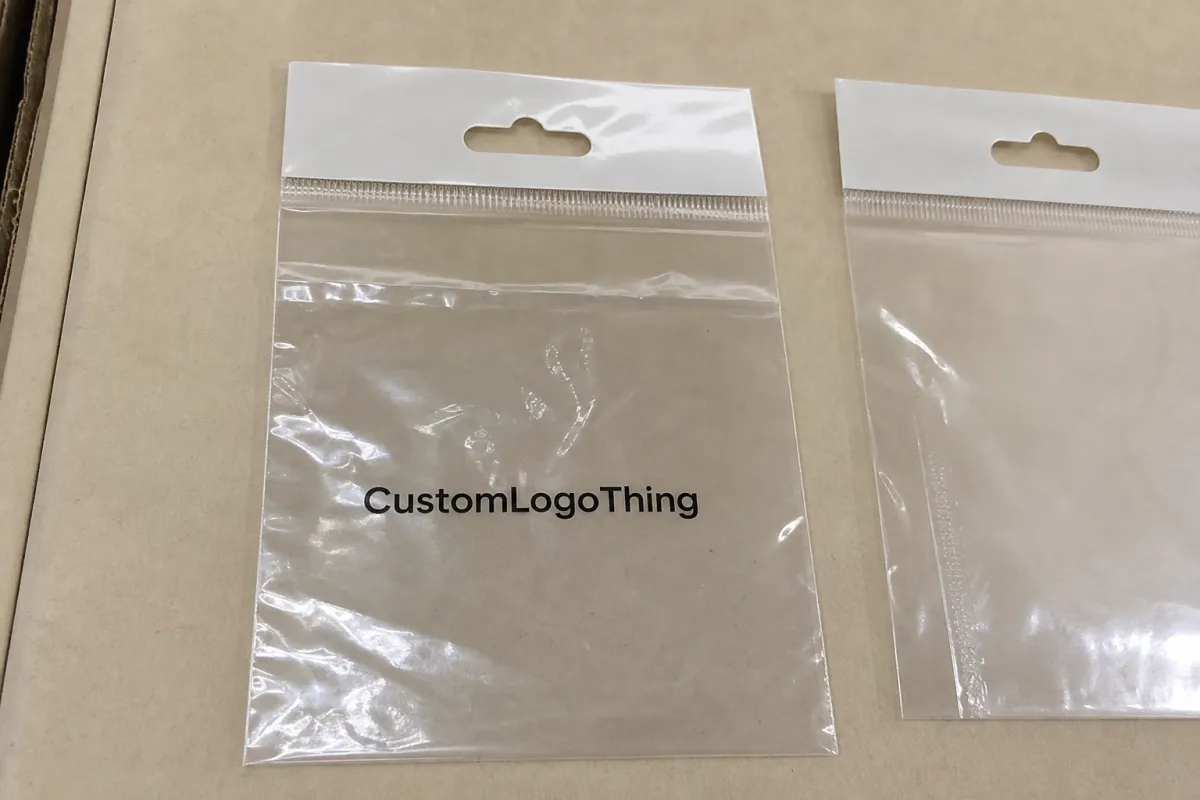
OPP header bags are clear oriented polypropylene bags with a defined header area at the top. The header may be printed directly on film, left clear for a card insert, or built with branding, barcode space, size callouts, and a hang hole for peg displays. Jewelry brands use them because OPP is glossy, fairly stiff, and transparent, so the product card remains visible while the package still looks retail-ready.
A Carton Packing Spec is the written packing standard behind the finished bag. It tells the supplier how many bags go into one polybundle, how many bundles go into an inner carton or master carton, the carton length, width, and height, gross weight, net weight, label content, barcode placement, moisture protection, and any separation rules for SKUs. If the bag is the finished packaging item, the carton spec is the operating instruction for moving it through production, shipping, receiving, and storage.
The distinction is simple but often missed. The bag specification controls finished bag size, usable product cavity, film thickness, header height, adhesive strip, flap length, hang hole style, venting, and print details. The carton packing specification controls how those bags are counted, bundled, boxed, labeled, palletized if needed, and released for shipment.
Jewelry packaging needs tighter rules than many commodity poly bags. A plain hardware bag can tolerate some scuffing or compression. A glossy jewelry header bag cannot always hide a curled top edge, wrinkled print, distorted barcode, or crushed hang hole. If a receiving team has to open every carton to separate similar sizes, the savings from a low bag quote disappear fast.
Practical rule: if the packaging will be handled by a retailer, marketplace warehouse, subscription kit packer, or third-party fulfillment center, define the carton count and label format before mass production, not after the bags are finished.
A useful jewelry Brands OPP Header Bags Carton packing spec answers four questions: what is the bag, how is it packed, how is it labeled, and how will the buyer verify it on arrival?
How OPP Header Bags Are Built for Jewelry Retail Displays
OPP film has a crisp, glassy appearance. Common thicknesses include 30 micron, 35 micron, 40 micron, and 50 micron, though the right choice depends on bag size, header stiffness, and display method. For small earring cards, 30-40 micron film is often enough. For larger bracelet cards or wider retail cards, 40-50 micron may feel better because the bag is less floppy and the header holds shape more reliably.
Construction choices deserve careful review. A bottom-seal bag may work well for flat carded goods, while a side-seal style can suit certain narrow products. The buyer should confirm the finished outer size, usable cavity, header height, and whether there is a lip, flap, resealable adhesive strip, or permanent seal. Even a 5 mm difference in cavity height can decide whether a necklace card loads smoothly or catches at the seal.
Header design does more than carry a logo. It supports the product on a peg, gives space for barcode scanning, keeps the top edge neat, and may show material, size, compliance, or collection details. Hang holes are usually round, sombrero-style, euro-slot, or custom punched. A euro-slot is often better for retail pegs; a round hole may be fine for lightweight cards and simple displays.
For jewelry use, the sample should be tested with real product cards. Load the earring card. Close the flap. Hang it on a peg. Stack 100 or 250 pieces and check whether the header stays flat. A flat sample on a table can look perfect, while a packed carton reveals creasing, print scuffing, or adhesive that lands too close to the product cavity.
OPP is attractive and cost-effective, but it is not the softest film. It can crease under pressure, and glossy surfaces show rub marks if stacks move inside the carton. That is why the packing spec should include inner protection and compression control, not only bag dimensions.
Key Carton Packing Factors Buyers Should Confirm
Start with the count structure. The spec should state units per inner polybundle, bundles per inner carton if used, inner cartons per master carton, and total pieces per master carton. Round numbers are easier to count: 100 pieces per bundle, 5 bundles per carton, 500 pieces total; or 250 pieces per bundle, 4 bundles per carton, 1,000 pieces total. Operators like clean math. Receiving teams do too.
Carton dimensions should be written as length × width × height, usually in inches or millimeters, with a tolerance such as ±5 mm for small cartons or ±10 mm for larger export cartons. Gross weight and net weight belong on the same spec. For jewelry header bags, many brands try to keep master cartons under about 30-35 lb for easier shelf handling, although parcel carriers and warehouses may set different limits.
Carton strength is not only about heavy products. Header bags are light, but their edges and printed tops can deform if cartons collapse under stacking pressure. For domestic parcel movement, double-wall cartons may be excessive for small runs, but a decent single-wall corrugated carton with suitable edge crush strength is still worth specifying. For export or palletized freight, compression strength matters more. If formal transit testing is required, ISTA protocols can help define drop, vibration, and handling expectations.
Inner protection can be simple. Clear inner poly bags keep counted bundles together. Kraft interleaves or chipboard pads help keep headers flat. Silica gel may be useful if cartons travel through humid routes or sit in ocean freight, though it should be sized sensibly and kept away from direct product contact where required. Empty corner space should be controlled so stacks do not shift during parcel movement.
- Carton label: item number, SKU, print version, bag size, purchase order, quantity, carton number, and country of origin if required.
- Barcode: confirm whether the barcode belongs on the bag, inner pack, master carton, or all three.
- Mixed cartons: state clearly whether mixing sizes or designs is allowed, and how each section must be separated.
- Inspection points: count accuracy, label match, carton condition, weight range, and carton dimension check.
Mixed-size risk deserves real attention. Two OPP bags may look almost identical until someone measures the cavity or reads a tiny size code. If multiple jewelry bag sizes share one master carton, use separate inner bags, visible labels, and a carton label that lists each SKU and quantity. If the warehouse does not allow mixed cartons, write “no mixed SKUs per master carton” directly into the spec.
Cost, MOQ, and Unit Cost Drivers in Header Bag Packing
Unit cost starts with the bag, but it does not end there. Film thickness, finished size, header height, print coverage, color count, adhesive strip, hang hole punching, order quantity, and SKU count all affect pricing. A 40 micron clear OPP header bag with one-color header printing will not price like a 50 micron bag with full-coverage print, resealable adhesive, euro-slot punch, and three size versions.
As a rough planning range, simple custom OPP header bags may land around $0.04-$0.12 per piece at higher quantities. Smaller custom runs, heavier film, multi-color print, special header construction, or unusually tight packing rules can move into the $0.12-$0.28 range or higher. These are estimating ranges, not guarantees. Resin pricing, print method, freight basis, waste allowance, and order quantity can shift the number.
Carton packing changes unit cost too. Smaller carton counts improve warehouse handling and reduce compression, but they increase carton material, labeling, and labor per unit. Very large cartons may reduce packing material cost, yet they can create curled headers, bulging cartons, and slower receiving. A carton that saves half a cent per bag is not a bargain if a retailer charges a relabeling or noncompliance fee.
| Packing Choice | Typical Use | Cost Effect | Risk to Watch |
|---|---|---|---|
| 500 pieces per master carton | Small jewelry cards, frequent SKU pulls | Higher carton and labor cost per piece | More cartons to receive and store |
| 1,000 pieces per master carton | Standard earring or charm bags | Balanced for many custom runs | Check header compression and carton weight |
| 2,000+ pieces per master carton | Very small flat bags, bulk warehouse storage | Lower packing material cost per piece | Higher chance of curled headers or counting errors |
| Mixed SKUs in one carton | Small assortments or launch kits | May reduce freight cartons | Requires strong inner labeling and receiving approval |
MOQ depends on setup. Custom printing may require plate or cylinder preparation, artwork separation, machine changeover, trial waste, and quality checks. Special header dimensions, nonstandard adhesives, or dedicated carton labels add more steps. If several jewelry lines can share one bag size and one carton count, the supplier can usually run more efficiently.
Ask for the quote as a complete system, not just a bag line. Confirm quantity tiers, sample cost, setup charges, print plate charges, packing material charges, freight basis, and whether final carton dimensions are included before mass production. For packaging programs with multiple SKUs, reviewing prior packaging layouts in Case Studies can help teams see how repeatable structures are usually documented.
The cheapest quote is often the least useful quote if it leaves out the packing method. A full quote should cover the printed bag, inner packing, master carton, labels, QC checks, and shipping documentation. That is the real cost of a working carton packing spec.
Process, Timeline, and Approval Steps Before Production
The normal flow is inquiry, size confirmation, material recommendation, artwork layout, bag drawing or dieline, quotation, sample or pre-production proof, packing spec approval, mass production, QC, carton labeling, and shipment release. Timelines depend heavily on how clean the starting information is. A buyer who provides jewelry card dimensions, artwork files, quantity by SKU, preferred carton count, and warehouse label rules will move faster than a buyer who sends only a photo.
For many custom OPP header bag orders, artwork and quotation may take 1-3 business days after complete details are received. Sampling can take roughly 5-10 business days depending on print complexity and material availability. Mass production may run 12-20 business days after proof approval for common structures, while more complex printed work or larger multi-SKU orders can take longer. Shipping time is separate.
Sample approval should be physical whenever the package fit is tight. Check product fit, flap closure, adhesive position, header stiffness, hang hole strength, print alignment, barcode scan quality, and stack behavior. If a necklace card is 70 mm wide and the finished bag is also 70 mm wide, it will not load cleanly. Add practical clearance, often 2-5 mm per side depending on card thickness and loading method.
Artwork approval has its own checkpoints. Confirm color references, safe zones, bleed, print registration tolerance, barcode size, and whether the printed area crosses a seal or fold. Glossy film can affect barcode readability, so barcode grade expectations should be tested where scan compliance is strict. ASTM test methods are often used in packaging labs for film and seal evaluation, while retailer requirements may add scan and label rules of their own.
Before production starts, sign off the packing spec. That means units per bundle, inner pack count, master carton quantity, carton label format, carton dimensions, gross weight target, palletization if needed, and mixed-SKU rules. In-process QC should catch seal strength, dimensions, hole punching, and print registration. Final inspection should verify packing counts, carton labels, carton condition, and shipment readiness.
Build in review time. Sample shipping, artwork corrections, holiday shutdowns, freight booking, and retailer routing approvals can add days or weeks. If sustainability claims or paper header inserts are involved, verify certification language early; FSC labeling, for example, has specific rules and cannot be added casually because it sounds good.
Common Spec Mistakes That Cause Delays or Chargebacks
The most common mistake is approving only the bag dimensions and artwork while leaving carton quantity, carton size, inner packing method, or label content undefined. Production finishes the goods, then everyone starts asking how many pieces should go into each carton. That sequence is backwards. Carton packing should be approved before production release.
Unclear measurements cause trouble too. State whether dimensions refer to internal usable space, finished outer bag size, header height, product cavity height, or flap length. A buyer may request a 3 × 4 inch bag and mean the usable cavity, while the factory may interpret it as the finished outer size including seals. For carded jewelry, that difference can make the bag too tight or oddly loose.
Overpacking is another familiar problem. Too many bags in one carton can flatten headers, curl edges, wrinkle printed film, weaken hang holes, or make the carton bulge beyond carrier limits. Once a header takes a curved set, it may not lie flat again on a retail peg. Underpacking is not harmless either. Too much empty space allows stacks to slide, scuff, bend, or arrive uneven, and freight cost per usable bag rises.
Mixed cartons create hidden labor if the rules are vague. If three bag sizes use the same clear film and similar header art, receiving teams may miscount or pull the wrong packaging during fulfillment. Separate inner packs, color-coded labels, or size labels can prevent a simple mistake from turning into a picking problem.
Barcode and retail compliance details need more care than they usually get. A barcode printed too close to a seal may distort. A code under a fold may scan poorly. A barcode on the individual bag may not help if the warehouse needs a carton barcode for receiving. If a retailer routing guide specifies label size, placement, or carton number format, copy those requirements into the packing spec.
The practical correction is a one-page sheet. Include a bag drawing, material line, count table, carton label sample, carton dimensions, weight target, mixed-carton rule, and approval signature. Keep it with the purchase order. For teams building a broader custom packaging program, reviewing structured examples in packaging case studies can help clarify how detailed a production-ready spec should be.
Actionable Next Steps for a Clean Packing Spec
Start with the product, not the bag. Measure the actual jewelry card length, width, thickness, and loaded profile. A flat earring card is different from a necklace card with a chain pocket or a bracelet card with raised elastic. Then decide finished bag size, header height, hang hole style, adhesive or flap requirement, film thickness, print artwork, quantity by SKU, and destination warehouse rules.
Make the carton decision early. Choose a target carton quantity that balances counting, safe stacking, carton weight, freight efficiency, and warehouse storage. For many jewelry packaging runs, 500 or 1,000 pieces per master carton is easier to manage than a huge bulk carton. Not always. Very small bags may pack safely in higher counts if inner bundles are controlled and compression is tested.
Ask for a spec sheet that covers both construction and packing. A quote line saying “custom OPP header bag, 40 micron, printed” is not enough for repeat production. The spec should define the bag, print, sealing, inner packing, master carton count, carton label, and inspection criteria. If the same bag will be reordered every season, that sheet becomes the control document.
- Send jewelry card dimensions and loaded product thickness.
- Confirm finished bag size, cavity size, and header height.
- Choose film thickness, adhesive style, and hang hole type.
- Approve artwork with barcode position and safe zones.
- Set units per bundle and total pieces per master carton.
- Approve carton label content before shipment.
- Keep the approved spec with the reorder file.
Test with real product cards. Load actual earrings, necklaces, charms, or bracelets into the sample bag. Hang the bag on a peg. Place a stack into a trial carton or simulate carton compression with a counted stack. Check the header after several hours. If it curls, scuffs, or traps air awkwardly, adjust the count, inner protection, or film thickness before mass production.
Confirm labels before shipping. The master carton label should show SKU code, bag size, print version, quantity, carton number, PO number, barcode if required, and any retailer routing data. Inner bundle labels may be worthwhile for mixed SKUs or high-volume warehouses. If cartons are palletized, confirm pallet height, stretch wrap, pallet label, and carton orientation too.
For jewelry brands, OPP Header Bags Carton Packing spec work is not paperwork for its own sake. It is the bridge between a nice-looking bag and packaging that arrives counted, clean, retail-ready, and easy for the warehouse to handle. A few clear decisions before production can prevent bent headers, wrong counts, relabeling labor, and avoidable chargebacks after delivery.
FAQ
What should be included in a jewelry brand OPP header bag carton packing spec?
Include finished bag size, usable cavity size, header height, film thickness, print details, hang hole style, adhesive or flap construction, units per bundle, bundles per carton, total carton quantity, carton dimensions, gross weight, net weight, and label format. For jewelry packaging, also state whether different sizes or designs can be mixed in one carton and how those SKUs must be separated and labeled.
How many OPP header bags should go in one master carton?
The right count depends on bag size, header stiffness, film thickness, print sensitivity, warehouse handling limits, and freight method. Many buyers prefer round counts such as 500 or 1,000 pieces because they are easy to audit, but the carton should not be so full that headers curl, film wrinkles, or the carton bulges.
Does carton packing affect the unit cost of custom OPP header bags?
Yes. Smaller carton counts can increase carton, label, and labor cost per piece, while oversized cartons may reduce packing material cost but raise damage and handling risk. The best unit cost usually comes from a balanced spec that protects the bags, keeps counts simple, and avoids repacking or relabeling.
What is the usual approval process for custom jewelry OPP header bags?
The typical process is size confirmation, artwork layout, quotation, sample or proof approval, carton packing spec approval, mass production, QC, carton labeling, and shipment release. Buyers should approve physical fit, print position, sealing method, hang hole performance, carton count, and carton label before production.
Can multiple jewelry bag sizes be packed in the same carton?
It can be done, but it should be written clearly in the packing spec with separate inner packs, clear labels, exact quantities, and a carton label that identifies all included SKUs. If the warehouse or retailer does not allow mixed cartons, each size or print version should be packed in its own labeled master carton.


