Pet Treat Brands opp header bags carton packing spec basics: bag size, OPP film, headers, case counts, pricing, QC checks, and packing details before ordering.
Pet treat brands OPP header bags carton packing spec: what it really means
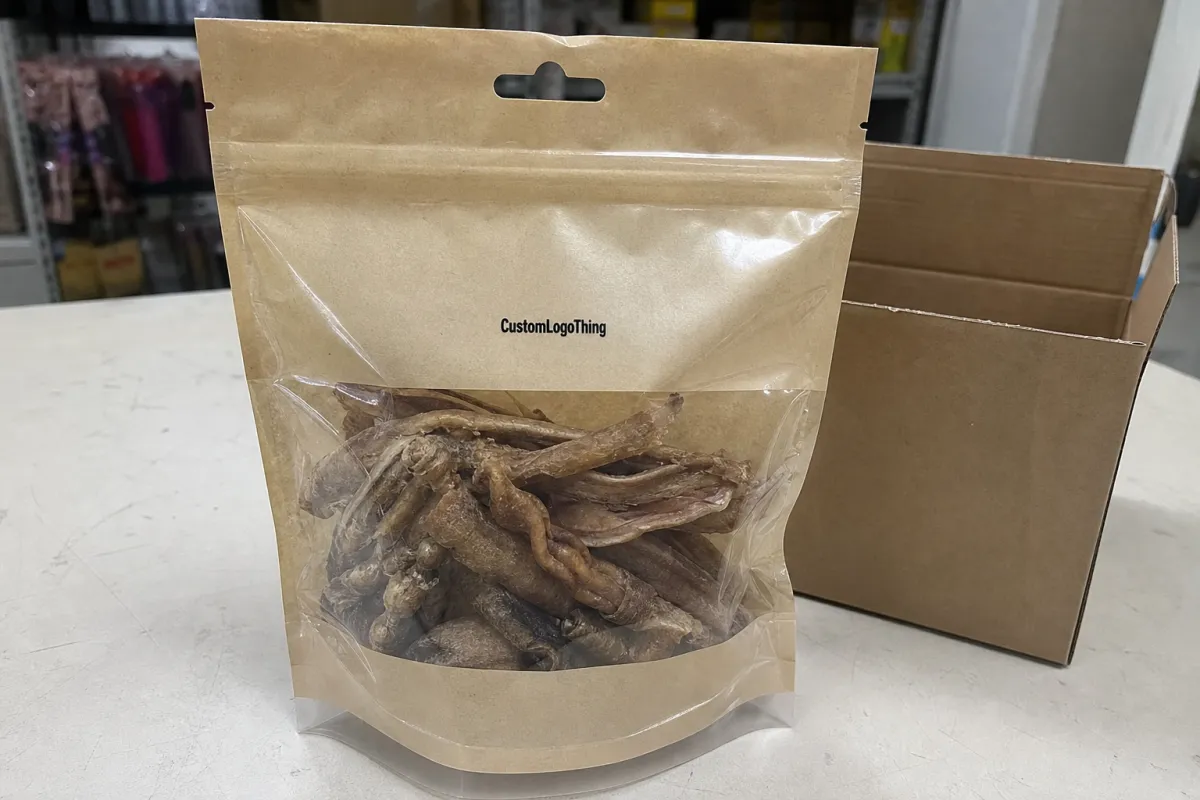
Two pet treat bags can look almost identical on a peg hook. One hangs straight, scans cleanly, ships without curling, and reaches the retail floor ready to sell. The other arrives wavy, scuffed, or short-counted. The difference is rarely the logo alone. It usually sits inside the Pet Treat Brands opp header bags carton packing spec, a compact phrase that links the bag structure, retail hanging format, and master carton instructions into one operating document.
OPP means oriented polypropylene. It is a clear, glossy plastic film often used for lightweight retail packaging where visibility and a crisp printed presentation matter. Compared with many softer polyethylene films, OPP feels snappier in the hand and tends to sit flatter on a peg display. That makes it useful for dry biscuits, single chews, sample packs, toy-and-treat bundles, promotional add-ons, and individually wrapped pet treats.
A header bag has a reinforced or defined top area. The header may include a round hang hole, euro slot, sombrero hole, folded film lip, printed card-style top, or added reinforcement. It is not decoration. It carries the filled bag’s weight while the product hangs in store, sometimes for weeks, and it also gives the brand room for a logo, flavor callout, barcode, claim, or price message.
Pet treat packaging needs a little restraint. OPP can be excellent for dry, light, visually appealing products, but it is not automatically right for every formula. If the treat touches the film directly, confirm the food-contact side against the product type, oil level, moisture level, aroma, and applicable regulatory requirements. A dry baked biscuit behaves nothing like an oily jerky strip. Freeze-dried pieces raise a different problem: crumbs, dust, and product breakage at the bottom seal.
The carton packing spec tells the packing team how many bags go into an inner bundle or master carton, how the bags face, whether they lie flat or stand upright, what carton size is used, how cases are labeled, and how lot information remains traceable. It also affects freight cost, warehouse receiving, retail compliance, and damage rates.
Practical rule: if a header bag must hang nicely in store, it first has to survive counting, bundling, carton pressure, warehouse handling, and freight movement.
That is why the bag and carton should be specified together. Treating them as separate tasks often produces good-looking samples that behave badly once packed 100 or 250 at a time.
How OPP header bags work from film to retail peg
OPP starts as polypropylene film that has been stretched, usually in one or two directions, to improve clarity, stiffness, and dimensional stability. The orientation process gives OPP its clean gloss and crisp feel. For many lightweight dry pet treat applications, it delivers a polished shelf appearance at a practical cost.
A typical OPP header bag includes a front panel, back panel, side seals, bottom seal or folded bottom, top opening, header area, and hang hole. The header may be formed from the same film folded over and sealed, made from a separate printed card, or strengthened with extra material. A 20 g sample pouch and a 180 g chew-stick bundle place very different stress on the same peg.
Closures shape both labor and product protection. Open-end bags with adhesive strips are common for hand-packed programs because they are fast, simple, and do not require heat-sealing equipment. Flap closures can work for promotional packs. Heat-sealed closures provide a stronger finish but need controlled dwell time, temperature, and pressure. Wicketed formats can support faster loading in some production rooms. Staple-and-card formats create a familiar retail header look, though metal staples may be undesirable for some pet or food-adjacent programs.
Printing has similar tradeoffs. Surface printing is often economical for simple branding, especially when the bag will not face much abrasion. Reverse printing places ink behind a clear layer in a laminated structure, improving scuff resistance and protecting fine text or heavy ink coverage. Laminated constructions cost more and usually carry higher minimums, but they can be justified for premium artwork, darker backgrounds, or bags that will be handled repeatedly.
Many buyers spend most of the review cycle on the front artwork. The first packed carton deserves almost as much attention. A glossy header bag still has to stack, count, and orient correctly inside a case. If the header bows under pressure or the hang holes rub against a rough carton wall, the bag can look tired before a store employee ever puts it on a peg.
Testing should happen with the real product, not just an empty mockup. Drawings help, but treats settle. Crumbs migrate. Oils can mark film. Irregular shapes create pressure points along side seals and corners. For programs with retailer compliance requirements, ISTA transit testing may be worth discussing; the International Safe Transit Association publishes packaged-product test procedures that help buyers evaluate more than the beauty shot.
Key spec details: size, film gauge, hang hole, and seals
The first size on a quote is usually the flat finished bag size. That number is useful, but incomplete. Buyers also need usable fill space, header height, seal allowance, closure space, and product clearance. A bag listed as 4 inches by 7 inches flat does not provide 4 inches by 7 inches of usable product room after side seals, bottom seals, header depth, adhesive area, and product thickness are included.
Measure the filled product footprint, not just the treat. Three biscuits may overlap. A bundle of sticks may form a lumpy center. Freeze-dried treats may break into crumbs that settle along the bottom seal. A sensible pre-quote check is to measure three hand-packed samples: the tightest fill, the average fill, and the worst-case bulky fill. That simple step can prevent bowed bags and distorted cartons.
Film gauge balances cost, stiffness, clarity, puncture resistance, and hang strength. Thin OPP can look very clear and reduce unit cost, but it may wrinkle or tear around a hang hole if the product is too heavy. Thicker OPP adds body and often improves hanging presentation. For light sample bags, buyers may evaluate film around 30–40 microns. For heavier dry treats, sharper products, or wider bags, 50–60 microns or reinforced structures may be more appropriate. The exact choice depends on filled weight, bag shape, seal design, and closure method.
Header height matters more than many first-time buyers expect. A shallow header may not leave enough room for a logo, hang hole, barcode, top seal, or price message. A taller header improves branding but reduces usable product space unless the full bag length increases. For peg displays, the hole position should be centered and far enough from the top edge to resist tearing. Heavier packs often need a euro slot or reinforced hang area rather than a small round hole.
Seal placement needs to be drawn clearly. Side seals, bottom seals, header seals, reseal strips, adhesive zones, and hang-hole punches all affect artwork. Do not place barcodes, QR codes, nutrition panels, ingredient statements, or lot-code zones too close to crimped or sealed areas. Barcodes need quiet zones, and those quiet zones should remain flat after filling. A barcode that scans perfectly on an empty proof can fail on a curved, tightly packed bag.
A complete pet treat Brands OPP Header Bags Carton packing spec should include tolerance ranges. Plastic film converting has normal variation in width, length, seal position, print registration, and hole placement. A practical spec might allow ±2 mm on certain dimensions while requiring tighter control on barcode position or hang-hole alignment. Confirm tolerances with the converter before final artwork release, not after production has started.
| Spec item | Common options | Buyer consideration |
|---|---|---|
| Film thickness | 30–60 microns for many lightweight OPP header bags | Match gauge to filled weight, puncture risk, and desired stiffness |
| Hang hole | Round hole, sombrero hole, euro slot, reinforced hole | Heavier bags need better tear resistance and enough header depth |
| Closure | Adhesive strip, flap, heat seal, staple-and-card | Hand packing favors simple closures; stronger seals may need equipment |
| Carton orientation | Flat, upright, nested, bundled, same-facing | Controls scuffing, header curl, carton bulge, and receiving accuracy |
Pricing, MOQ, and unit cost drivers for custom header bags
Bag pricing is never based only on length and width. It reflects film type, film thickness, print method, color count, order quantity, tooling, machine setup, waste during make-ready, inspection, packing labor, and carton configuration. A stock-size unprinted OPP header bag can be inexpensive to start. A custom printed laminated bag with a reinforced euro slot, tight barcode placement, and retailer-specific case labels carries cost at several points in the process.
MOQ, or minimum order quantity, is a production reality rather than a sales trick. Custom printed OPP bags require setup time, printing plates or cylinders in many processes, machine calibration, film waste, color matching, and inspection. Those fixed costs have to be spread across the order. Unprinted or lightly customized bags may have lower entry quantities. Custom sizes, special hang holes, high ink coverage, lamination, matte finishes, anti-static treatment, or special carton packing usually increase MOQ and lead time.
For planning, simple custom OPP header bags may fall around $0.06–$0.18 per unit at moderate quantities. More complex printed or reinforced builds can move into the $0.18–$0.35+ range depending on size, quantity, finish, and packing requirements. These ranges are not guaranteed quotes. Freight, duties, tariffs, proofs, packing labor, and artwork handling can shift the landed cost. Still, they help explain why a 5,000-piece trial run often costs far more per bag than a 50,000-piece production run.
The carton packing spec affects price in quieter ways. Inner poly bundles, counted stacks of 50 or 100, corrugated dividers, same-direction facing, lot-code separation, special retailer labels, heavier export cartons, and lower gross-weight limits all add material or labor. Smaller cartons can improve handling and reduce crushing, but they increase case count. Larger cartons may reduce case count but can create bulging, bending, and freight damage if overpacked.
Ask for two or three quantity breaks. Also ask for at least one alternate gauge or structure. A buyer might compare 40 micron OPP with 50 micron OPP, or a standard euro slot with a reinforced header. The best value point is not always the lowest unit cost. It is the build that protects the bag, displays well, passes receiving, and avoids rework.
Before requesting pricing, gather the finished bag size, header height, film gauge target, artwork, number of print colors, order quantity, filled product weight, preferred carton count, shipping destination, and retailer requirements. For broader context on how packaging decisions affect presentation and fulfillment, review the Custom Logo Things Case Studies.
Process and timeline: from sample approval to carton packing
A clean production process starts with specifications, not artwork. The normal flow is straightforward: collect product details, confirm product-contact needs, review artwork, create dielines, produce proofs or samples, approve structure, approve print, convert the bags, inspect quality, pack cartons, label cases, and ship. Skip one step and the problem usually appears later, often when cartons are already full.
The first technical question is the filled product. A flat biscuit sample may need only modest clearance. A bulky dehydrated chew may require extra width and a heavier film. A bundle of sticks can create sharp ends that stress side seals or poke at the film. If the product is oily, crumbly, moist, dusty, or fragrant, the film structure and closure deserve closer review.
Artwork proofing is not only a logo check. Review the dieline for safe zones, bleed, hang-hole position, seal areas, barcode quiet zones, lot-code space, and any copy that must remain readable after filling. Keep critical text away from folds, punches, and crimps. If the header will be folded or sealed, do not place required information where the manufacturing process can distort it.
Sampling can happen in layers. A digital mockup checks layout. A blank size sample checks fit. A pre-production printed sample checks color and structure. A filled-product test checks hanging strength, carton fit, barcode scanning, and handling. For retailer-facing packaging, the final filled test carries the most weight because it reveals what flat proofs hide.
Quality control should be written into the process. Common checks include finished width and length, header height, hole position, seal strength, adhesive placement, print registration, color consistency, barcode readability, count accuracy, and carton label accuracy. For pet products, also confirm that lot coding and traceability are not buried inside the case or blocked by bundle wrap.
Production lead time varies. Stock film and standard tooling can move faster, with some sampling or production windows in the range of 10–20 business days after proof approval. Custom printed film, lamination, specialty finishes, custom cartons, offshore components, or retailer approval cycles can push schedules longer. Build in time for internal signoff, barcode verification, regulatory copy review, retailer review, and transit.
The carton count and orientation should be finalized before mass production. A late change from 100 bags per carton to 250 affects carton dimensions, gross weight, freight quotes, pallet patterns, warehouse slots, and receiving instructions. The written approval chain should include design, purchasing, operations, and quality so nobody is surprised by the final packing spec.
Packing spec mistakes that cause damage, delays, and extra freight
The most common mistake is sizing the bag from product width and height only. Depth matters. Product movement matters. Header clearance matters. A treat that looks fine in a flat drawing can create a rounded pouch once packed, and that bulge may throw off the barcode angle, carton stack height, and retail peg alignment.
Underestimating filled weight is another costly error. Hang holes tear, headers curl, side seals stress, and packs begin to lean on the peg. For a light sample, a simple round hole may be fine. For a heavier pack, a reinforced euro slot, taller header, thicker film, or different bag shape may be needed. Test the hanging pack for several days, not five minutes.
Barcode and compliance placement can create avoidable receiving problems. Barcodes near side seals may not scan consistently. QR codes on curved areas can fail. Nutrition panels and ingredient statements, where required, need readable flat space. Retailers may specify minimum case label sizes, scannable carton labels, mixed-SKU restrictions, or lot-code visibility. Those requirements belong in the packing spec early.
Carton orientation is easy to ignore until the shipment arrives. If filled bags are laid under uneven pressure, headers can curl. If loose bags shift in transit, corners scuff and film wrinkles. If cartons are overpacked, cases bulge, bags deform, and warehouse teams spend extra time correcting counts. Underpacking creates the opposite problem: too much movement, wasted freight cube, and weaker pallet stability.
Specify inner counts. State whether bags are bundled in 25, 50, or 100. Say whether they face the same direction. Call out carton markings, SKU separation, lot-code position, gross weight target, and whether mixed SKUs are allowed. If sustainability claims, recycling language, or fiber sourcing claims appear on outer cartons, make sure the statement is supportable; the Forest Stewardship Council offers guidance around responsible fiber sourcing claims for paper-based materials.
Approving artwork before filling a real bag can also backfire. A centered logo on a flat empty bag may shift visually once the product creates thickness. A barcode may land on a curve. A flavor callout may be hidden behind the treat itself. For pet brands running multiple flavors, one shared structure may not fit every SKU equally well, especially if piece count, weight, or treat shape changes by flavor.
Practical next steps before you request a custom bag quote
Before contacting a packaging manufacturer, prepare a concise pre-quote packet. Include the product type, filled weight, approximate treat dimensions, number of pieces per bag, retail display method, and whether the product touches the film directly. If the product is dry, oily, dusty, sharp, fragile, fragrant, or irregular, say so. Those details change the bag spec.
Create a filled-product sample, even if it is hand-packed. Use the intended number of treats and arrange them the way the packing team would. Then measure three things separately: the product itself, the preferred finished bag size, and the target carton count or carton size. If the warehouse wants 100 bags per case and the retailer wants cartons under 30 lb gross weight, both limits need to be in the brief.
Decide what the bag’s main job is. Is it visibility? Hanging strength? Freshness support? Promotion? Tamper evidence? Easy hand packing? Automated loading? Retailer compliance? Each priority changes the build. A clear, economical OPP bag for a giveaway sample is not the same project as a heavier retail-ready pack with a premium printed header.
- Product details: treat format, filled weight, pieces per bag, moisture or oil concerns, sharp edges, crumb level.
- Bag details: finished size, header height, film gauge, closure style, hang hole type, print coverage, lot-code area.
- Artwork details: editable files, logo formats, color references, barcode files, regulatory copy, retailer-required zones.
- Carton details: inner bundle quantity, master carton count, carton dimensions, orientation, gross weight target, label placement.
- Logistics details: shipping destination, pallet notes, mixed-SKU rules, warehouse receiving instructions, retailer compliance notes.
Ask suppliers for practical alternatives rather than one exact build. Request two film gauges, two carton counts, or a standard hang hole compared with a reinforced option. Good suppliers should be able to explain the tradeoffs plainly: cost, MOQ, lead time, stiffness, puncture resistance, scuff resistance, and packing labor. If you are comparing broader branded packaging formats, the Custom Logo Things packaging case study library can help frame the discussion.
Document the approved carton packing spec in writing. Include case quantity, inner bundle quantity, carton dimensions, gross weight target, bag orientation, case label location, lot-code handling, pallet notes, and mixed-SKU rules if relevant. A one-page packing spec can prevent a surprising amount of waste.
Before placing an order, treat the Pet Treat Brands opp header bags carton packing spec as an operations document, not just a packaging description. Done well, it helps the finished bags look good, pack efficiently, scan correctly, ship cleanly, and arrive ready to sell.
FAQs
What should be included in a pet treat OPP header bag carton packing spec?
Include finished bag size, film gauge, header height, hang hole type, closure style, print details, filled product weight, bags per inner bundle, bags per master carton, carton dimensions, carton weight target, packing orientation, label placement, lot-code handling, and retailer-specific instructions. The spec should be clear enough that a packing team can follow it without guessing.
How do I choose the right OPP film thickness for pet treat header bags?
Base the film thickness on filled weight, treat shape, puncture risk, desired stiffness, and display method. Lighter flat samples may use thinner OPP, while heavier or sharper treats usually need thicker film, stronger seals, or a reinforced header area. Testing with filled samples is the safest way to confirm the choice.
Does the carton packing spec affect the price of custom OPP header bags?
Yes. Carton count, inner bundling, carton strength, special orientation, retailer labels, and packing labor all influence cost. A more controlled packing format can protect the product better, but it may increase labor, materials, and freight considerations.
What is the best hang hole style for pet treat brands using header bags?
Round holes can work for light packs. Euro slots or reinforced holes are often better for wider or heavier retail displays. The right choice depends on product weight, peg style, header height, film gauge, display duration, and how the bags are packed during shipping.
How early should pet treat brands confirm the header bag packing spec?
Confirm it before production approval, ideally during sampling. Late changes to carton count, bag orientation, or case labeling can affect carton size, freight cost, pallet patterns, warehouse receiving, and production scheduling.


