Printed PVC Zipper Garment Bags Logo Print Specification: What Buyers Actually Approve
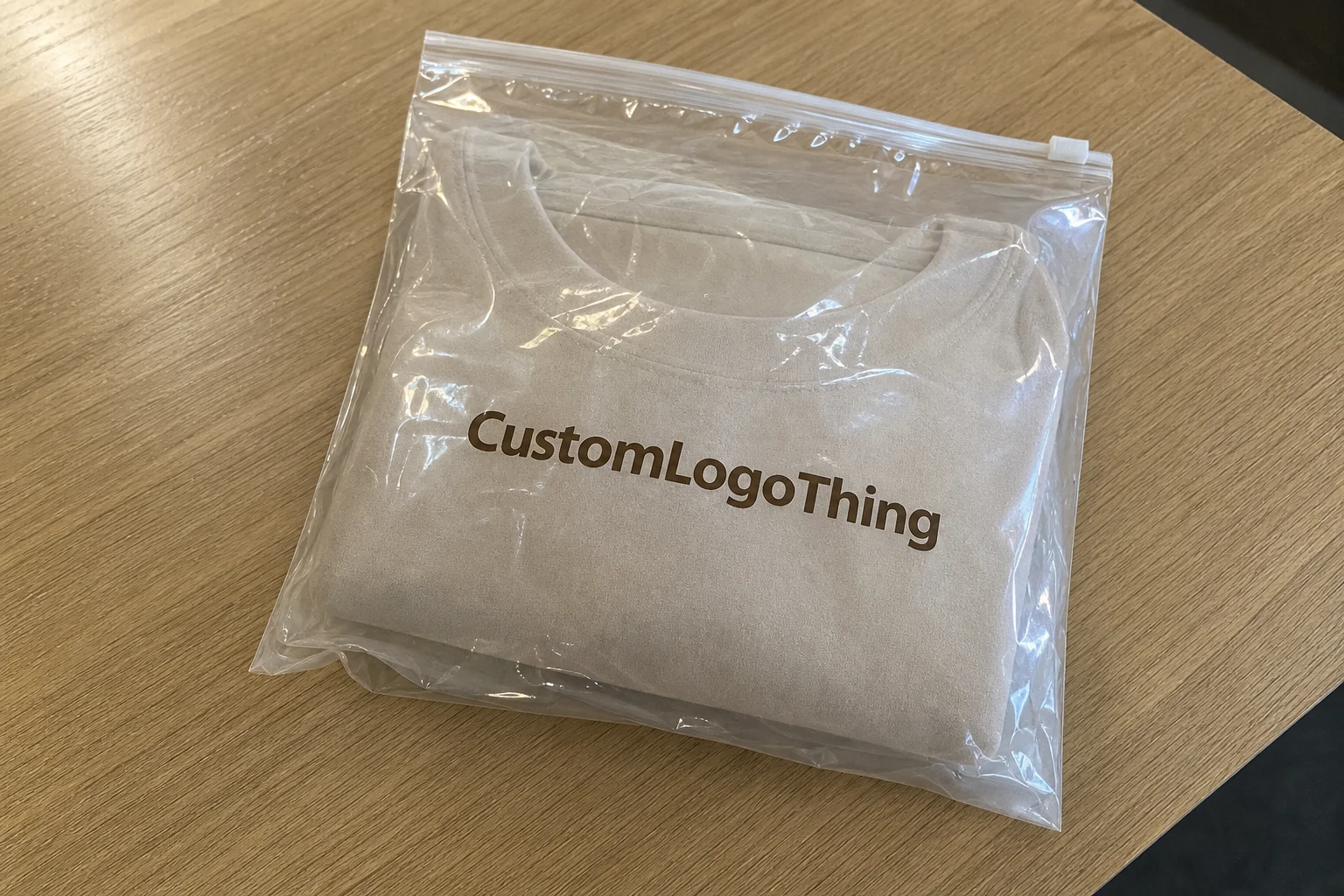
The PDF proof looks polished. Then the bulk order arrives, and the logo is cloudy, cracked near a fold, or sitting 12 mm closer to the zipper than anyone expected. A Printed PVC Zipper Garment Bags Logo Print Specification is the set of measurable rules that prevents that expensive little mess.
It is not just a logo file. It covers PVC thickness, bag dimensions, zipper type, print method, ink color, logo size, placement tolerance, handle style, hanger opening, pocket position, packing method, and approval checkpoints. If one of those variables is vague, the supplier has to guess. Sometimes the guess is fine. Often, it is merely “within normal production,” which may not be good enough for premium apparel packaging.
A garment bag has two jobs. It protects a suit, gown, uniform, coat, costume, or sample from dust and handling marks. It also presents the brand before the garment is touched. A weak spec can hurt that presentation faster than a loose thread on the garment itself.
Apparel brands, bridal boutiques, dry cleaners, hotels, uniform suppliers, costume departments, and promotional buyers all run into the same issue: soft plastic is not paper. It bends, shifts, reflects light, holds static, and reacts differently to ink. A clean spec gives the finished bag a fighting chance to look intentional, not improvised.
How Logo Printing Works on PVC Garment Bags
Most PVC garment bag logos are produced with one of three decoration approaches. Silk screen printing is the usual workhorse for bold one-color or two-color marks. It gives strong coverage, handles spot color logos well, and is usually economical once the screen is made. Heat transfer can suit sharper multi-color artwork, small text, or detailed crests, although adhesion should be tested on the exact PVC chosen. Some suppliers also offer digital-style decoration for complex graphics, but availability depends heavily on the material, order size, and equipment.
PVC behaves differently from paperboard, cotton, or nonwoven fabric. It is flexible, slightly slick, and sensitive to heat. Ink adhesion, curing temperature, pressure, and drying time matter more than many first-time buyers expect. A logo that prints beautifully on a kraft mailer may scuff or stretch on a flexible garment cover if the ink system is wrong.
The workflow looks simple: review the vector logo, confirm the print area, match the color, issue a proof, prepare the screen or transfer, print the bags, cure or set the ink, inspect, then pack. The risk hides between those steps. Large solid ink areas can look premium in a mockup, but on PVC they may reveal uneven pressure, dust specks, scuffing, or slight curing differences.
Common logo zones include the centered front panel, lower right corner, full-width brand block, or an imprint above a document pocket. Avoid seams, zippers, hanger slits, handle stitching, and fold lines unless the design has been planned around them. A 180 mm wide logo may look balanced on a flat proof, then wrinkle across a soft bag once the shoulder area fills out.
Practical rule: approve the printable zone, not just the logo. A useful proof shows the zipper, seam, handle, pocket, hanger opening, and fold relationship around the artwork.
Key Specification Factors: PVC Gauge, Zipper, Logo Size, and Placement
PVC gauge is a performance decision, not a decoration footnote. Lighter clear PVC, often around 0.08 mm to 0.12 mm, can work for short-term dust covers, retail sample movement, or dry-cleaning return bags. Mid-weight material around 0.15 mm to 0.20 mm feels more substantial and resists tearing better during repeated closet use. Heavier PVC, sometimes 0.25 mm and above, has a premium hand feel but increases unit cost, carton weight, and freight.
Material finish changes the logo. Clear PVC keeps the garment visible and usually supports strong contrast for white, black, navy, or metallic-style brand marks. Frosted PVC feels softer and more boutique, but low-contrast ink can disappear under warm store lighting. Tinted PVC adds brand character, yet it complicates CMYK and spot color decisions because the base color affects how ink is perceived. Opaque PVC hides garments and can support bolder graphics, but it turns the bag into a stronger advertising surface rather than a visibility-first cover.
Zippers deserve the same attention. Nylon coil zippers are common because they are flexible, light, and cost-effective. Metal sliders feel sturdier, but they can add cost and may scratch surrounding material if poorly specified. Branded pulls look polished for retail or hotel garment services. Bottom openings, side openings, and full-length openings affect how quickly staff can insert garments. For long gowns, uniforms, and coats, zipper length can affect labor time more than buyers expect.
Logo size should be legible without fighting the bag. Tiny text below 5 mm high often fills in or loses crispness on flexible PVC. Very large logos can wrinkle, especially across gussets or folds. For many retail garment bags, a front logo between 120 mm and 220 mm wide is a practical range, but the right size depends on bag dimensions, viewing distance, and how much of the garment should remain visible.
Placement tolerance needs to be written down. Soft plastic can shift during cutting, printing, stitching, and folding. A realistic tolerance might be plus or minus 3 mm to 5 mm for many printed panels, while more complex constructions may need a wider allowance. The spec should also confirm ventilation holes, gussets, handles, hanger openings, pockets, reinforced edges, and whether the bag is packed flat or folded.
Do not ignore odor and hand feel. PVC can have a noticeable smell, especially when packed tightly soon after production. Some odor may dissipate after airing, but a strong smell can damage the presentation of bridalwear, premium uniforms, or showroom samples. If low odor matters, say so before quotation. That requirement can affect material choice, lead time, and cost.
Process and Timeline from Artwork Proof to Packed Cartons
A well-run order follows a predictable sequence: collect requirements, confirm size, select material, check artwork, quote, proof, decide on sampling, produce bulk bags, inspect, and pack cartons. Routine on paper. Messy when details are scattered across six emails and two old logo files.
Typical custom garment bag projects may take 12 to 20 business days from proof approval for standard materials and simple one-color printing. Quantity, sampling, factory load, holidays, and freight method can change that quickly. A physical sample can add 5 to 10 business days. A custom PVC tint, unusual zipper, multiple bag sizes, reinforced handle construction, or complex print finishing can stretch the schedule further.
A good proof should show the full bag dimensions, zipper direction, logo size, print color, print location, seam location, handle position, hanger opening, pocket dimensions, carton count, and carton labeling. If the proof only shows a floating logo on a rectangle, ask for more. That is not being difficult. It is removing ambiguity before the order becomes material, labor, and freight.
Timeline risk often starts with approval delays, not machine speed. One missing Pantone reference, one low-resolution logo, or one unanswered question about zipper direction can freeze the job. Suppliers can move quickly only after the spec is complete enough to build from.
- Approve dimensions first: width, height, gusset, hanger slit, zipper length, and pocket size.
- Approve artwork second: file format, ink color, logo size, print method, and placement.
- Approve sample or photos third: especially for premium retail, bridal, or hotel use.
- Release the final run: only after the printed pvc zipper garment bags logo print specification is locked.
Inspection should not wait until cartons are loaded. Basic checks include bag size, PVC gauge, zipper operation, handle strength, logo position, ink coverage, color match, scuffing, odor, edge sealing, stitching, and packing count. Pulling random pieces from early production is better than discovering the problem after 2,000 bags are folded into cartons. Obvious, yes. Still skipped more often than it should be.
For transit testing of packed cartons, buyers can reference packaging test methods from ISTA. For broader packaging sustainability and waste considerations, the EPA sustainable materials management basics are a useful starting point, even though PVC garment bags have their own material tradeoffs.
Cost, Pricing, and MOQ Drivers Buyers Should Compare
Unit cost is driven by more than size. PVC gauge, zipper quality, print method, number of ink colors, logo coverage, packing style, sampling, inspection, and freight can all move the price. A 60 x 100 cm clear PVC garment bag with one-color screen printing sits in a different price band than a 70 x 180 cm bridal gown bag with a gusset, reinforced handles, document pocket, and multi-color heat transfer logo.
MOQs exist for practical reasons: setup labor, screen preparation, transfer production, material purchasing, machine scheduling, and inspection time. Very small custom runs can be surprisingly expensive because the same setup work is spread across fewer bags. Larger runs usually reduce the unit price, but they also increase storage and cash tied up in inventory.
| Spec Choice | Typical Cost Effect | Buyer Watchpoint |
|---|---|---|
| Standard clear PVC, one-color screen print | Often the most economical custom option | Check ink opacity and logo placement tolerance |
| Frosted or tinted PVC | Usually higher than standard clear PVC | Confirm logo contrast before bulk production |
| Heavy-gauge PVC with upgraded zipper | Higher material, packing, and freight cost | Best for repeated use or premium garments |
| Multi-color heat transfer or digital-style printing | Higher setup or decoration cost | Test adhesion, flexibility, and color accuracy |
| Individual polybag or barcode packing | Adds labor and packing material | Useful for retail distribution and inventory control |
As a rough buying comparison, a simple standard-size custom PVC Zipper Garment bag might quote around $0.60 to $1.20 per unit at higher quantities. Heavier or longer bags with upgraded construction may move into the $1.50 to $3.50 range or more. These figures can shift sharply with freight, PVC thickness, exchange rates, print coverage, and order quantity, so treat them as directional rather than universal.
Design choices matter. One-color silk screen printing is usually more economical than multi-color artwork. Standard clear PVC is usually cheaper than custom-tinted material. A common nylon zipper costs less than a branded pull. Offset and flexographic printing are useful in many packaging categories, but for flexible PVC garment covers, screen print and transfer methods are more commonly discussed because of surface behavior and production setup.
Ask every supplier to quote the same assumptions: identical size, thickness, transparency, logo colors, zipper style, packing count, incoterms, and destination. If one quote is 18% lower but uses thinner PVC, bulk packing, and a looser defect policy, it is not the same bag. Lowest unit cost can become the most expensive option if the zipper jams, the logo scuffs, or the carton crushes in transit. Funny how “savings” do that.
Step-by-Step Guide to Building a Clean Logo Print Spec
Start with the garment, not the bag. Suits, gowns, uniforms, coats, costumes, retail samples, and laundry returns all need different lengths, gussets, openings, and durability levels. A bridal gown bag may need a 180 cm height and a 10 cm gusset. A suit bag may work at 60 x 100 cm. A hotel laundry return bag may prioritize fast handling over premium print detail.
Then define measurements. Include width, height, gusset depth, hanger hole location, zipper length, pocket size, handle position, and acceptable tolerance. A tolerance of plus or minus 5 mm on soft sewn PVC may be realistic, while a rigid printed carton would be held differently. Different materials require different expectations.
Specify the PVC. State the gauge, transparency level, color tint, softness, odor expectations, and any safety or compliance documentation required by the buyer. If the bags will be used around children’s apparel, uniforms, hospitality garments, or regulated retail programs, confirm documentation needs before production. Do not bolt compliance requirements onto the order after the bags are finished.
Prepare artwork properly. A vector AI, EPS, or editable PDF file is preferred. Fonts should be outlined. Colors should be specified as Pantone spot color, CMYK reference, or approved supplier ink match. Minimum line thickness should be confirmed; many buyers use 0.3 mm to 0.5 mm as a safer lower range for simple marks, but the supplier should confirm based on method.
Choose the print method based on the artwork. A clean one-color logo may be perfect for silk screen printing. A crest with gradients, small details, or tonal effects may need heat transfer or another decoration method. Do not choose digital-style printing just because it sounds modern, and do not choose screen printing just because it is familiar. Match the method to the logo and the expected use.
Lock the placement with measurements, not adjectives. “Centered” is not enough if the bag has an offset zipper, a document pocket, a shoulder curve, or a reinforced handle panel. State the distance from the top edge, side edge, zipper line, pocket edge, or another fixed reference point. Include a visual proof with dimensions.
Finally, document finishing and packing. Will bags be individually polybagged? Folded into cartons or packed flat? Labeled with barcodes? Shipped with care cards? Photographed before dispatch? A clean spec connects those details so the quote, proof, production, and inspection are based on the same reality.
Common Mistakes That Make PVC Garment Bag Logos Look Cheap
The first mistake is vague instruction. “Print logo on front” leaves too much room for interpretation. Front where? Centered to the full bag, the visible garment area, the zipper panel, or the lower pocket? Should the logo be 90 mm or 190 mm wide? Is the ink white, warm white, silver, black, or Pantone-matched navy?
The second mistake is ignoring interference. Zippers, seams, handles, hanger slits, pockets, ventilation holes, and fold lines all compete with the logo. A centered mark can look off-balance if the zipper runs slightly to one side. A logo near the shoulder zone can wrinkle after the bag is filled. A large brand block may crack if it sits across a hard fold.
Artwork causes plenty of trouble too. Thin lines, tiny text, gradients, shadows, and low-resolution PNG files often fail on flexible PVC. Clean vector marks usually survive better. If the logo must include small text, ask the supplier for the minimum printable height and request a sample or close-up pre-production photo.
Color planning is another quiet failure point. White ink may lose impact on frosted PVC. Black can feel too harsh for bridal packaging. Metallic effects may require special ink or transfer handling. A pale gold mark on champagne-tinted PVC might sound elegant but become unreadable under warm lighting.
Over-branding is common. Too much print reduces garment visibility and can make a protective cover feel like a disposable ad sheet. The best garment bag logos often leave space around the mark. That negative space is not wasted; it tells the buyer the brand understands restraint.
The final mistake is skipping approval evidence. For low-risk repeat orders, a digital proof may be enough. For first runs, premium bags, or multi-color decoration, pre-production photos or a physical sample can catch issues before hundreds or thousands of bags are produced. A specification is only useful if someone checks production against it.
Expert Next Steps Before You Request a Final Quote
Before asking for a final price, pull the essentials into one clean spec sheet. Scattered email notes create quoting errors. A supplier may read the first message for bag size, the second for logo color, and miss the third message changing the zipper. Consolidation saves time.
- Confirm garment length, including hanger height and extra clearance at the bottom.
- Choose PVC gauge, transparency, color tint, and softness expectations.
- Select zipper style, slider type, opening direction, and pull detail.
- Define print area, logo size, ink color, and placement tolerance.
- Prepare vector artwork with outlined fonts and approved color references.
- Decide whether a sample, pre-production photo, or inspection report is required.
If the order is for premium retail, bridalwear, uniforms, or hotel garment services, ask for photos or short videos of similar bag constructions. Not generic catalog pictures. Similar gauge, similar zipper, similar handle, similar print size. Small visual checks can reveal whether the supplier understands the finish level you expect.
When budget is uncertain, request two options: a value version using standard clear PVC and one-color spot color printing, plus a premium version with heavier gauge material, upgraded zipper, reinforced handles, or a sharper transfer logo. That comparison is more useful than asking five suppliers for five loosely described bags.
Before production begins, treat the Printed PVC Zipper Garment Bags logo print specification as the control document for price, timeline, approval, and final quality. The bag may be flexible. The spec should not be.
FAQ
What should be included in a PVC zipper garment bag logo print spec?
Include bag size, PVC gauge, transparency or color, zipper style, logo file type, print method, ink colors, logo dimensions, placement measurements, packing method, and approval requirements. Add tolerance notes for size and print placement because soft PVC can shift slightly during cutting, sewing, folding, and printing.
Which logo print method is best for printed PVC zipper garment bags?
Silk screen printing is usually best for simple one- or two-color logos with strong coverage. Heat transfer may be better for detailed, multi-color, or gradient artwork, but it should be tested for adhesion and flexibility on the selected PVC.
How does PVC thickness affect logo print quality and bag cost?
Thicker PVC generally feels more durable and premium, but it increases material cost, carton weight, and shipping cost. Very thin PVC can wrinkle more easily, which may make large logos harder to keep flat and visually consistent.
What artwork file is needed for custom PVC garment bag printing?
A vector file such as AI, EPS, or editable PDF is preferred because it keeps edges sharp and allows accurate resizing. Fonts should be outlined, colors should be specified, and low-resolution JPG or PNG files should be avoided for production approval.
How can I reduce the unit cost of printed PVC garment bags?
Use a standard bag size, standard clear PVC, one-color logo printing, and a common zipper style where possible. Increase order quantity, simplify artwork, approve proofs quickly, and compare quotes using identical specifications so pricing differences are real.


