Buy Printed PVC Zipper Garment Bags: Landed Cost Guide
Use this Printed PVC Zipper Garment Bags landed cost guide to compare specs, MOQ, freight, duties, carton volume, and quote details before ordering.
Why Landed Cost Matters Before You Approve a Garment Bag Order
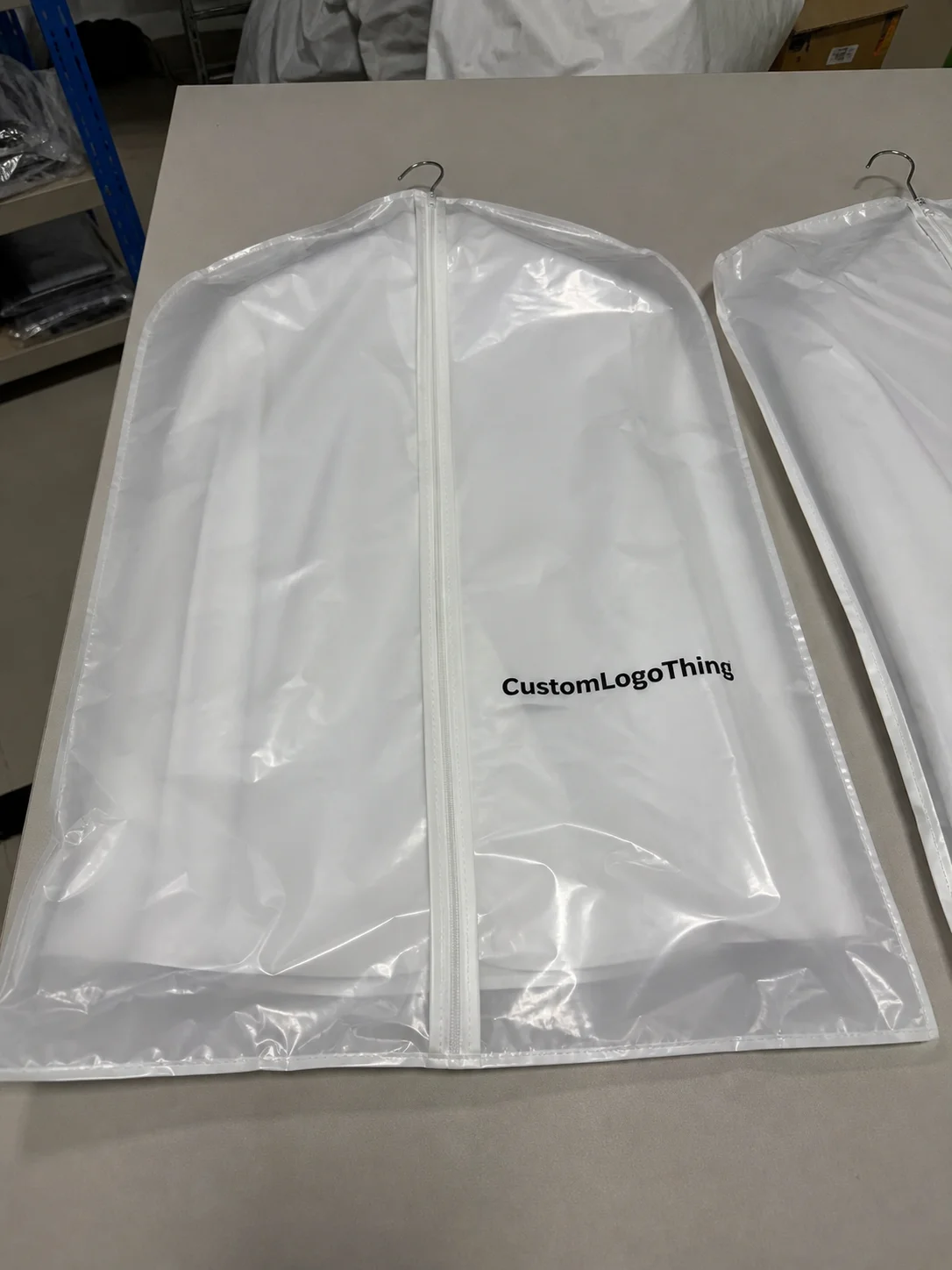
A $0.64 garment bag can turn into an $0.82 garment bag faster than most apparel buyers expect. That is why this Printed PVC Zipper Garment Bags landed cost guide treats the bag as a procurement decision, not a logo-placement exercise.
The usual failure is simple. A buyer approves the lowest factory unit price. Later, freight, carton volume, zipper upgrades, print setup, customs clearance, and domestic delivery push the real cost up by double digits. On a 10,000-piece order, a $0.10 miss is not a rounding error. It is $1,000 pulled out of margin before the garment reaches the rack.
PVC Zipper Garment Bags look uncomplicated from a distance: clear cover, zipper, logo, hanger opening. The costing is not that tidy. Thickness changes material weight. Gusset depth changes folded size. Zipper tape and pull style affect both unit cost and packing density. A larger hanger opening may need reinforcement. Full-front printing can slow production and increase ink usage. Even carton count becomes a cost driver because garment bags are often light but bulky.
The target is not the cheapest bag on a quote sheet. It is the bag that protects the garment, presents the brand cleanly, ships efficiently, and repeats without drama on reorders. A slightly higher factory price can land cheaper if the bag folds flatter, packs 100 pieces per carton instead of 60, avoids decorative hardware that adds no value, or reduces cubic volume.
Practical buying rule: compare delivered cost, not factory unit price. A quote without carton dimensions, freight terms, and destination assumptions is only half a number.
These bags are used for suits, dresses, uniforms, bridalwear, dry-cleaner programs, retail apparel, sample rooms, and promotional garment packaging. Each use case has a different tolerance for scuffing, zipper failure, print visibility, and handling abuse. Landed cost matters because it turns a vague purchase into a controlled one.
Printed PVC Zipper Garment Bag Details Buyers Should Confirm
A printed PVC zipper garment bag is usually a transparent or tinted PVC garment cover with a zipper closure, branded print, hanger opening, heat-sealed or stitched edges, and optional gusset, handles, snaps, or document pocket. It protects hanging apparel while keeping the product visible.
Buyers choose PVC because it has structure. Compared with thin PE garment covers, PVC gives better shelf presentation, stronger water resistance, wipe-clean handling, and a more retail-ready feel. For formalwear, uniforms, showroom samples, event apparel, and longer-term storage, that visual difference matters. Clear PVC also lets staff confirm color, style, and size without opening the package repeatedly. Small thing. Big time saver.
Zippers deserve more scrutiny than they usually get. Nylon coil zippers are common for standard use because they balance cost and reliability. Metal-look pulls add presentation value without requiring a full metal zipper. Reinforced zipper ends make sense for repeated handling, especially on longer bags. Color-matched zipper tape can improve the finished look, but it may raise MOQ if the color is not already stocked.
Printing has limits. A one-color logo on clear PVC is the simplest custom option. Multi-color screen printing, opaque ink, matte effects, gloss effects, and larger print areas all need cleaner proofing. Artwork placed too close to zipper stress points, sealed edges, fold lines, or hanger openings can distort. On clear PVC, white ink may be needed as an underbase if the brand color must stay solid against dark garments.
- Common thickness mistake: choosing a very light PVC gauge for heavy coats or bridal gowns.
- Common sizing mistake: adding several unnecessary inches, then paying freight on empty space.
- Common print mistake: placing fine text across folds or beside zipper tape.
- Common compliance mistake: skipping warning text or labeling requirements for the destination market.
Structure should be reviewed before the order is costed. If a handle, gusset, tinted material, premium puller, or second print position does not improve retail performance, it should be questioned before it becomes part of the approved cost per piece. Buyers rarely regret removing unnecessary features. They do regret approving them at scale.
Material, Size, Print, and Closure Specifications That Drive Performance
A useful quote request includes the fields that actually move price and performance: width, height, gusset depth, PVC thickness, zipper length, hanger hole style, print colors, print area, quantity, and delivery ZIP code or destination port. If one is missing, the quote may still arrive, but it will contain assumptions. Assumptions are where later cost changes hide.
PVC thickness is usually discussed in millimeters or microns. Lighter gauges, around 0.08 mm to 0.10 mm, can work for short-term apparel protection or light promotional use. Mid-range gauges around 0.12 mm to 0.16 mm are more common for retail, showroom, and sample-room handling. Heavier gauges, often 0.18 mm to 0.25 mm or more, are better suited for coats, bridal gowns, uniforms, and repeated transport. The right choice depends on garment weight and how often the bag will be opened.
Size should start with the garment, not a catalog template. Measure the longest garment from hanger top to hem, then allow clearance for shoulder width and hanger height. A suit bag may need a different profile than a gown bag even if both are called “full length.” Excess space looks harmless, but it increases material usage and can expand carton dimensions. Freight forwarders do not forgive empty air.
Gussets solve one problem and create two more. They help bulky garments sit cleanly, especially coats, uniforms, layered dresses, and bridalwear. They also use more PVC and make folding less compact. A 3-inch gusset may be justified for a heavy coat program. It may be wasteful for flat retail dresses.
| Specification Choice | Best Use | Cost Impact | Buyer Watchpoint |
|---|---|---|---|
| 0.08-0.10 mm PVC | Short-term garment cover or light apparel | Lower material cost | May tear under repeated zipper use |
| 0.12-0.16 mm PVC | Retail, showroom, sample-room use | Balanced unit cost | Confirm zipper strength and folding method |
| 0.18-0.25 mm PVC | Coats, bridalwear, uniforms, formalwear | Higher material and freight cost | Carton weight and cubic volume can rise |
| Gusseted construction | Bulky or layered garments | Higher material use | Can reduce carton packing efficiency |
Branding specifications need the same discipline. Send vector artwork, Pantone references, target print size, placement dimensions, and any brand spacing rules. Ask for expected print tolerance. A small shift may be acceptable for a large logo, but not for fine retail text. Ink adhesion should be confirmed for the chosen PVC surface, especially for opaque inks on clear material.
Closure details affect use more than buyers expect. A full-length zipper gives easier garment access but adds cost and potential failure points. A shorter zipper can be enough for basic storage bags. Zipper direction matters too. Some retail teams prefer top-down access; some warehouse programs need faster bottom access. Neither choice is glamorous. Both can annoy people if ignored.
There are practical handling details as well. Ventilation holes may be needed for some storage conditions. Warning text may be required for certain destination markets, especially where plastic bag suffocation warnings apply. PVC should be stored away from high heat because deformation, blocking, or surface tack can occur. For general packaging performance testing language, standards bodies such as ISTA provide useful context on distribution handling, even though every garment bag program still needs its own fit and handling test.
Printed PVC Zipper Garment Bags Landed Cost Guide: Pricing and MOQ
The cost stack is the part buyers need to see clearly. Product unit cost is only the first line. Add print setup, sample fees, possible tooling fees for unusual openings or hardware, export cartons, freight, duties, customs clearance, domestic delivery, inspection, and payment terms.
MOQ depends on bag size, PVC thickness, print method, zipper type, and material color. Standard clear PVC with a one-color logo usually supports a lower MOQ than tinted PVC, specialty zipper tape, oversized printing, or an uncommon puller. A buyer asking for custom blue-tinted PVC, a two-color logo, and a metal-look pull should expect a different minimum than a buyer ordering clear bags with a black one-color mark.
For standard custom work, pricing often improves as quantity rises because setup charges spread across more bags and material purchasing becomes more efficient. A small launch order may protect cash flow, but it can carry a higher cost per piece. Bulk pricing makes sense once the spec is proven, storage is available, and the garment program repeats.
| Order Scenario | Typical Buying Purpose | Cost Behavior | Landed Cost Risk |
|---|---|---|---|
| 1,000-2,500 pieces | Launch order, event program, sample-room test | Higher unit cost because setup is spread over fewer bags | Air freight or small shipment fees can dominate |
| 5,000-10,000 pieces | Retail rollout or uniform program | Better balance of setup, material use, and carton planning | Incorrect carton dimensions can still raise freight |
| 25,000+ pieces | Annual reorder or multi-store distribution | Stronger bulk pricing and improved production efficiency | Storage, cash flow, and specification lock-in matter more |
Exact pricing varies by specification, but the pattern is consistent. A simple clear PVC zipper garment bag with one-color printing does not cost like a heavier gusseted bridal bag with reinforced zipper ends and two-position branding. A 0.12 mm bag and a 0.18 mm bag can look similar in a spreadsheet. In use, they are different products.
Freight logic catches a lot of buyers. Garment bags are often light, but they do not always pack densely. Ocean freight, courier, truck delivery, and warehouse receiving can all be influenced by carton dimensions. Cubic meters may matter as much as gross weight. A quote that saves $0.03 on production but adds $0.08 in freight is not a saving. It is just a cost moved to a later line.
Ask for two or three quantity breaks: a launch quantity, a reorder quantity, and an annual forecast quantity. That exposes the real cost curve before a purchase order is issued. It also shows whether the best route is a standard spec, a durability upgrade, or a freight-optimized construction.
Sampling, Production Steps, and Lead Time Expectations
A clean order process reduces cost surprises. The usual sequence is: confirm specifications, review artwork, prepare the quote, approve the digital proof, produce a pre-production sample if required, begin mass production, inspect, pack, and ship. Skip a step and the risk moves somewhere else.
Quote preparation is fastest when the buyer sends complete details. “We need suit bags with a logo” can start a conversation, but it cannot produce a tight landed estimate. “24 inches wide, 40 inches high, 0.14 mm clear PVC, black nylon zipper, one-color logo, 5,000 pieces, delivered to a New Jersey ZIP code” is far stronger. It lets the supplier estimate material, printing, carton plan, and freight with fewer assumptions.
Sampling adds time, but it can be cheap insurance. It is especially useful for new sizing, first-time zipper structures, large retail launches, strict color matching, or high-value garments such as bridalwear and formalwear. Buyers often underestimate the value of a physical sample on any order where garment fit is uncertain. A digital proof confirms artwork. A sample confirms the object.
Proofing should check artwork size, logo placement, zipper color, PVC thickness, bag dimensions, hanger opening, warning text, carton marks, and closure function. For repeat orders, the checkpoint should include matching the previous approved sample. Small changes in zipper tape, puller shape, or PVC stiffness can be noticed by retail staff if the program is replenished over time.
Quality control should not stop at “logo looks fine.” Pull the zipper several times. Check whether the slider catches near the sealed edge. Confirm the hanger opening does not split when the bag is loaded. Rub the print lightly after curing. Fold the bag as it will be packed and check whether the print crosses a hard crease. Measure finished dimensions, not just cut material. A half-inch difference may not matter for a short jacket bag. It can matter for long gowns.
Production timing depends on order quantity, material availability, print complexity, and customization level. Sampling can add several business days or more depending on shipping method and approval speed. Mass production for straightforward custom garment bags often runs in the range of a couple of weeks after proof approval, but larger or more specialized jobs can take longer. Material color, factory queue, inspection requirements, and freight booking can shift the schedule. Annoying, yes. Also normal.
Timeline is tied directly to landed cost. Rushed production can increase labor pressure. Air freight can wipe out the savings from a low unit cost. Earlier approval gives procurement more options: better carton planning, consolidated freight, and calmer customs paperwork.
Quote Comparison Mistakes That Raise Unit Cost After Approval
The biggest quote traps are predictable: missing freight terms, vague PVC thickness, unspecified zipper quality, no carton dimensions, unclear print coverage, and no destination-based landed estimate. If a supplier only gives a per-piece number, the buyer still does not know the delivered cost.
Incoterms change responsibility. EXW usually means the buyer takes responsibility from the factory door. FOB generally moves responsibility after goods are loaded at the origin port. CIF includes cost, insurance, and freight to the destination port, but not necessarily customs clearance or final delivery. DDP is closer to a delivered-duty-paid number. These terms shift risk, paperwork, and cash timing. The lowest quoted unit price may not represent the lowest delivered cost.
Artwork can create surprises after approval. Extra colors, oversized logos, opaque white underbase, multi-position printing, or tighter registration can all increase setup charges or production time. A small chest-position logo and a large full-panel print are not the same quote, even if both are described as “one logo.” Procurement spreadsheets love that kind of vague wording. Reality does not.
Cartons matter too. Weak cartons can create damage claims, especially if bags are shipped in heavy stacks or handled through multiple warehouses. Oversized cartons raise freight cost and can create receiving inefficiency. If the quote does not list pieces per carton, carton dimensions, gross weight, and estimated volume, the buyer cannot model landed cost properly.
- Match the same material gauge before comparing unit cost.
- Match the same bag dimensions, gusset depth, and zipper style.
- Match the same print method, colors, print area, and proofing standard.
- Match the same quantity, carton plan, delivery point, and incoterm.
- Match the same inspection expectations before mass production ships.
Here is the part many buyers get wrong: the goal is not to make every garment bag cheaper. The goal is to make the approved bag predictable, repeatable, and profitable. A landed cost review separates real savings from numbers that only look attractive before freight and duties are added. For broader packaging and environmental compliance context, buyers can also review resources from the U.S. Environmental Protection Agency, especially if the program has internal sustainability reporting requirements.
How to Request a Precise Custom Garment Bag Quote
A precise quote starts with precise inputs. Send the garment type, target bag dimensions, PVC thickness preference, zipper color, print artwork, order quantity, target delivery date, and ship-to location. If you already have a current bag, include photos and measurements. If the current bag failed, say how it failed: tearing near the zipper, cloudy material, weak hanger opening, poor print adhesion, crushed cartons, or excessive freight cost.
If you are unsure about the spec, send garment photos, hanger type, storage method, and handling conditions. Will the bag hang in retail? Sit in a warehouse? Travel with a sales rep? Protect a bridal gown for months? Move through a dry-cleaner program every week? Those details change the recommended thickness, zipper, gusset, and carton plan.
Ask for multiple quote scenarios rather than one flat answer. A standard spec may be right for retail apparel. An upgraded durability spec may be better for uniforms or coats. A freight-optimized spec may use the same visual branding but adjust folding, carton count, or hardware to reduce landed cost. Then procurement can compare value instead of only comparing factory unit price.
A useful response should include specification review, print feasibility feedback, MOQ guidance, production timeline, and landed-cost variables that may affect the final decision. That may include notes on print area, zipper tape availability, PVC gauge, carton efficiency, setup charges, and destination-based freight assumptions.
Before requesting a quote, gather exact measurements, artwork files, quantity targets, and delivery location. Use this checklist to define the bag you actually need to receive, not the vague version that looks cheaper until the invoice, freight bill, and warehouse feedback arrive.
FAQ
What affects the landed cost of printed PVC zipper garment bags most?
The largest variables are PVC thickness, bag size, gusset depth, zipper type, print coverage, order quantity, carton dimensions, freight method, duties, and final delivery location. Freight can change the economics quickly because garment bags may be light but bulky, so carton efficiency matters almost as much as factory unit price.
What MOQ should I expect for custom printed PVC garment bags with zippers?
MOQ depends on material availability, print method, zipper selection, and size. Standard clear PVC and one-color logos usually support lower minimums than tinted PVC, specialty zipper tape, or complex printing. Request two or three quantity breaks to see how setup cost, material purchasing, and freight efficiency affect the final unit cost.
How do I prepare artwork for printed zipper garment bags?
Send vector artwork, preferred Pantone colors, logo dimensions, print placement, and any brand spacing rules. Avoid placing critical text near zipper seams, heat-sealed edges, fold lines, or hanger openings because those areas can distort or reduce print clarity.
How long does production take for PVC zipper garment bags?
Lead time depends on sample approval, material selection, order quantity, print complexity, and shipping method. The fastest projects start with complete specifications, approved artwork, a confirmed delivery address, and a realistic decision window for proof approval.
Can this printed PVC zipper garment bags landed cost guide help compare supplier quotes?
Yes. This printed PVC zipper garment bags landed cost guide gives buyers a framework to compare quotes using matched specifications, freight terms, carton details, MOQ, print method, and delivery assumptions. A quote is only comparable when the material gauge, dimensions, zipper, print coverage, quantity, and shipping destination are the same.


