If you are pricing packaging for a launch, refill line, or sample program, a beauty Frosted Zipper Bags unit cost review should do more than produce a single quote number. The better question is what that number buys: a cleaner shelf appearance, a bag that closes repeatedly, a finish that hides scuffs, and a pouch that still looks intentional after shipping, handling, and retail display.
That distinction matters because packaging budgets are often judged on the wrong line item. Buyers tend to compare bag material first, then get surprised by zipper hardware, print coverage, and setup fees. In reality, frosted film is only one part of the equation. The zipper profile, film gauge, and decoration method usually move unit cost more than the frosted appearance itself.
Beauty packaging has to do three things at once. Protect the product. Present the product. Survive the trip between those two points. If a pouch fails one of those jobs, the cheap quote stops being cheap.
Why frosted zip bags beat plain clear pouches for beauty
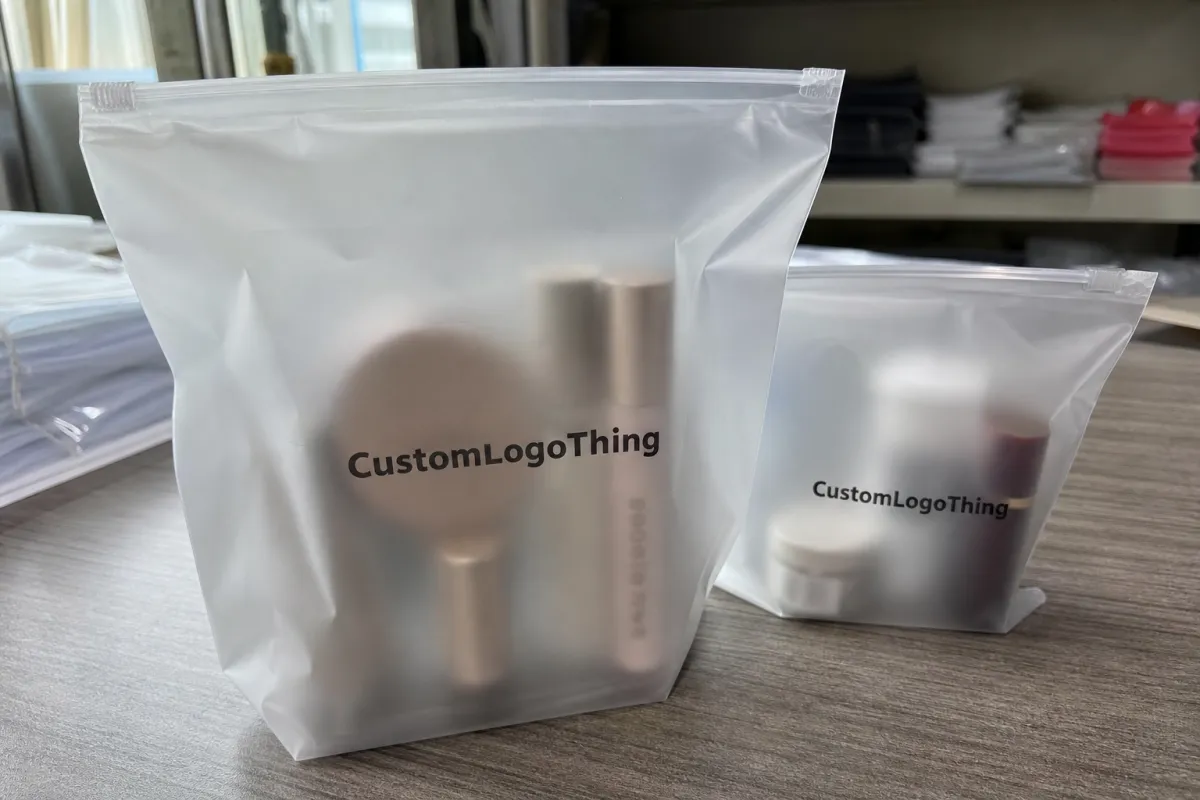
Frosted pouches sit in a useful middle ground. They are softer visually than rigid boxes, but they look more deliberate than plain clear bags. The matte surface cuts glare, hides fingerprints, and gives a small package more presence on a shelf or in a mailer. For skincare minis, beauty samples, and travel sets, that extra control over appearance is often the difference between "functional" and "finished."
Clear pouches can be fine for utility-first packaging, but they reveal every scuff, dust mark, and uneven fold. They also make it harder to control how colors read under store lighting. Frosted film solves some of that without adding much weight or bulk, which is why it has become a common choice for brands that want a premium feel without moving into fully rigid packaging.
That tradeoff is especially useful in a few situations:
- Sample kits that need to look polished without adding shipping weight.
- Retail sets where one premium touchpoint is enough.
- Subscription inserts that must stay compact and light.
- Travel or refill items where portability matters more than structure.
The mistake is assuming frosted film is a styling choice only. In practice, it changes how the contents read through the pouch, how the logo prints, and how well the bag hides wear during packing. A lightly frosted finish can feel refined and modern. A heavier frost can improve privacy and reduce visual clutter, but it can also soften fine print detail if the artwork is too delicate.
That is why buyers who only compare material thickness are usually comparing the wrong thing. A pouch can use the same film gauge as a competitor and still cost more or less depending on the zipper, print method, and finishing requirements. A simple bag with a small logo may fall into a comfortable budget range. The same structure with double-sided print, a custom zipper color, and tighter visual tolerances can move into a very different bracket.
If a bag looks premium but opens badly after two uses, the cost per piece no longer matters much.
That is the real test: does the package still work after it has been touched, opened, stacked, and shipped? A low price does not rescue a pouch that dents easily, cracks at the seal, or looks tired before the product is even sold.
Beauty Frosted Zipper Bags Unit Cost Review: What Drives Price
A practical beauty Frosted Zipper Bags unit cost review starts with the spec sheet, not the opening quote. Once size, closure, and decoration are fixed, the rest of the pricing becomes much easier to interpret. The main drivers are predictable, and they show up across most packaging programs.
- Bag size - Larger pouches consume more film and need more stable sealing.
- Film thickness - Heavier gauges improve feel and puncture resistance, but they cost more.
- Frost level - Light frost keeps the contents visible; stronger frost increases privacy and softens glare.
- Zipper type - Standard press-to-close, slide zipper, and specialty closures price differently.
- Print coverage - One-color logos are cheaper than full-coverage or double-sided decoration.
- Secondary packaging - Cartons, pack counts, and export requirements can change the landed number quickly.
MOQ matters because fixed setup costs have to be spread over the run. A small order can look reasonable until tooling, color matching, and machine changeover are added back in. On the other hand, larger orders usually reduce the unit price because those fixed costs are diluted across more pieces. The shape of the curve is familiar: expensive at the low end, then noticeably flatter once the run reaches a standard production scale.
For planning purposes, buyers often see something like this for custom frosted zipper pouches, depending on size and decoration complexity:
| Order type | Typical MOQ | Unit cost range | Tooling / setup | Best use case |
|---|---|---|---|---|
| Stock-size frosted pouch, no print | 1,000-3,000 pcs | $0.10-$0.22 | Low or none | Simple inserts, quick market tests |
| Standard size, one-color logo | 3,000-5,000 pcs | $0.18-$0.35 | $60-$180 | Retail samples, beauty kits, launch runs |
| Custom size, double-sided print | 5,000-10,000 pcs | $0.28-$0.55 | $120-$350 | Premium cosmetics, branded sets, repeat SKUs |
These are working ranges, not promises. Film gauge, zipper construction, artwork coverage, and freight can push the final number in either direction. A quote that looks low on the factory line can become expensive once shipping, cartons, sample fees, and duties are added. That is why buyers need the landed cost, not just the manufacturing cost.
One useful habit is to ask whether the quote includes registration setup, color matching, packing into master cartons, and any warehouse-friendly carton sizing. Those details are often left out of first-pass pricing, then reappear later as extra charges. The most misleading quotes are not always the highest ones. They are the ones that look complete while quietly leaving out the work that keeps production moving.
Film, zipper, and finish specs that change performance
Packaging specs sound dry until a bag arrives that feels too flimsy, closes unevenly, or turns cloudy once the product is inside. The line between a decent pouch and a weak one is often a few small decisions made early: material gauge, zipper quality, seal width, and how much opacity the frost actually creates.
For beauty packaging, the spec checkpoints that matter most are straightforward:
- Dimensions - Width, height, gusset depth, and usable fill volume.
- Closure style - Press-to-close for basic convenience, slide zipper for a more controlled feel.
- Thickness - Often measured in mil or microns; heavier film usually holds shape better.
- Opacity - Light frost versus stronger matte frost changes both privacy and print behavior.
- Extras - Hang holes, tear notches, rounded corners, or reinforced seals.
Thickness affects more than durability. A thin pouch may be acceptable for sachets or very light samples, but once the contents include a jar, vial set, or anything with sharper edges, the material needs more body. Extra gauge can improve the way the zipper sits too, because the top edge has more stability and is less likely to warp after opening.
The finish creates its own set of tradeoffs. A light frosted surface reads clean and modern, while a stronger matte frost can hide the contents and make the brand mark stand out more clearly. That can be a real advantage for colorful formulas, mixed sample sets, or products with visually busy labels. The downside is that small type, pale colors, and thin lines can disappear if the artwork is not built with enough contrast.
The zipper deserves more scrutiny than it usually gets. A closure that feels smooth in samples but weak in production is a common failure point. If the pouch is meant for repeated use, the closure quality should justify part of the unit cost. If it is a one-time insert, the requirement may be lower. That is not a moral question; it is a usage question.
There is also the issue of transit abuse. Beauty packaging often looks fine on a flat proof and fails the moment it is packed with product, boxed, and moved through a normal shipping chain. External testing references like the International Safe Transit Association are useful if you want a practical framework for thinking about drop and vibration exposure. The point is not to overengineer the pouch. It is to avoid paying for a premium look that collapses under ordinary handling.
Repeatability matters just as much as initial appearance. A good spec is one a supplier can reproduce without guesswork. If the film, zipper, and print setup are too vague, the run will drift. In packaging, "close enough" has a way of becoming expensive.
Pricing, MOQ, and quote inputs buyers should compare
Most bad pricing comparisons happen because the buyer asks for a quote with half the information missing. The supplier responds with an estimate, and that estimate gets treated like a final number. By the time the order is ready, the real cost has changed because the original request left out something material.
A useful quote request should include these items:
- Exact bag size with width, height, and gusset if needed.
- Target quantity for the first run and any planned reorder volume.
- Artwork files in editable vector format if possible.
- Ink count and whether the design prints on one side or both.
- Shipping destination so freight can be estimated realistically.
- Special features such as hang holes, tear notches, or custom zipper color.
MOQ usually rises when the pouch becomes more custom. Nonstandard dimensions, more colors, specialty zipper parts, or unusual finishing all add complexity. That is normal. The supplier is paying for material loss, machine setup, and production changeover. What buyers need to know is whether the added cost is a one-time charge or part of the ongoing unit price.
For any beauty Frosted Zipper Bags unit cost review, compare the full cost stack instead of the headline price:
- Unit price
- Tooling fees
- Setup charges
- Sample cost
- Freight and duties
- Carton and pack-out costs
That comparison often changes the decision. A lower factory quote can lose once shipping and packaging are included, while a slightly higher quote can be easier to land if the supplier packs efficiently or uses a standard pouch structure. Some buyers save money not by pushing for the lowest material spec, but by simplifying the decoration and directing the brand budget toward cleaner print execution.
If the packaging is for a first launch, asking for two versions helps: one optimized for lower cost and one optimized for presentation. The difference is often small enough that the premium version earns its place, especially if the pouch is part of a beauty line that depends on visual consistency.
Process, lead time, and production steps from art to cartons
Packaging schedules slip for familiar reasons: missing artwork, late dimension changes, or a proof that gets approved before anyone has checked the finished fill. The production path itself is not complicated, but it rewards discipline. Once a spec is approved, every change costs time.
The usual flow looks like this:
- Inquiry - Share size, quantity, artwork, and target delivery date.
- Spec confirmation - Lock material, finish, zipper, and print method.
- Dieline check - Confirm the artwork fits the pouch structure.
- Artwork proof - Review layout, color, and logo placement.
- Sampling - Check zipper action, seal strength, and print alignment.
- Mass production - Run the approved spec at the confirmed quantity.
- Inspection and packing - Verify counts, seal quality, and carton consistency.
Lead time depends on how clean the process is. For a repeat order, proof approval might take 1-3 business days, sampling 5-10 business days, and production 10-18 business days after sign-off. If the order is new, the art needs revisions, or the zipper or size changes late in the process, the timeline stretches. That is usually not a factory problem; it is an approval problem.
Sampling is where most budget mistakes can be avoided. The sample lets buyers judge closure feel, seal strength, frosting level, and how the print reads under light. If the pouch will carry a product inside a kit, the sample should be tested with the product loaded, not empty. A logo that looks crisp on a flat pouch can disappear once a jar is placed inside and the material stretches.
Material decisions also affect schedule. Heavier films may require tighter machine control. Custom zipper colors can add sourcing time. Full-coverage artwork may need more careful registration. Each of those steps is manageable on its own, but they should be planned rather than discovered late.
For brands that care about secondary packaging, carton sourcing can matter as well. Recycled board or FSC-certified carton options may be available if the order includes outer packaging. For terminology and sourcing context, the FSC reference is a practical place to check the language before writing claims into packaging copy. That avoids vague sustainability language that sounds polished but cannot be defended.
Why repeat beauty orders need tighter quality control
Repeat orders show whether the supplier actually saved the approved spec. The first run can be forgiving because everyone is watching closely. The second and third run reveal whether the file was preserved correctly, the zipper spec stayed the same, and the film finish matched the original sample.
For beauty packaging, the most useful checks are concrete:
- Seal integrity - No weak seams or inconsistent welds.
- Zipper closure - Smooth opening, clean lock, no snagging.
- Print registration - Logos and text stay aligned.
- Film consistency - Frost level, clarity, and hand feel do not drift.
- Carton packing - Counts, stack pattern, and compression resistance remain stable.
Good recordkeeping matters here. If the supplier keeps the approved dieline, ink formula, zipper spec, and carton count, a reorder becomes much easier to manage. That is not glamorous work, but it is where time is saved. Packaging programs break down when people rely on memory instead of documented specs.
Color control is another repeat-order issue that gets underestimated. A slight logo shift may not matter in a warehouse, but it can stand out immediately next to premium skincare or fragrance samples. If Pantone matching is part of the brand standard, the tolerance needs to be discussed before production begins. A supplier should be able to explain how they control color consistency across runs, and if they cannot, that is a warning sign.
Not every pouch needs the same level of scrutiny. A sample insert for a one-off campaign can tolerate simpler QC than a recurring SKU that ships monthly. But the rule stays the same: the closer the packaging is to a core brand asset, the tighter the control should be.
Packaging comparison resources like packaging.org can also help when teams use different terms for the same structure. Internal buyers, brand managers, and production teams often talk past one another. A neutral reference reduces that friction and makes the spec sheet easier to maintain.
Next steps to request a quote and lock your spec sheet
A usable quote starts with a clean request. One message with the full spec beats a trail of screenshots and follow-up clarifications. The more complete the initial brief, the less likely the final number will shift later.
- Exact bag size and desired fill volume.
- Target quantity for the first order.
- Artwork files with any Pantone references.
- Product weight and how the pouch will be used.
- Ship-to location for landed cost.
- Special features such as hang holes, zipper style, or double-sided print.
Ask for a sample or a pre-production proof before mass production, especially if the design is logo-heavy or intended for a premium beauty line. The sample stage tells you what the sales deck cannot: whether the zipper feels stable, whether the frost level hides enough of the contents, and whether the artwork still reads once the bag is filled.
It also helps to ask for two quotes side by side. One can show the lowest acceptable spec, the other the presentation version you actually want. That makes the tradeoff visible. Sometimes the premium version costs only a few cents more per piece, which is easy to justify if the pouch is part of the product experience. Other times the upgrade is not worth the price. Either way, the decision becomes clearer when the comparison is explicit.
A practical beauty Frosted Zipper Bags unit cost review ends where the spec sheet begins: with dimensions, materials, closure style, decoration, and landed cost all aligned. Once those pieces are fixed, the order is easier to price, easier to approve, and easier to repeat.
What affects the beauty frosted zipper bag price most?
Bag size and film thickness usually move the price first. Zipper type, print coverage, and special finishing options add cost quickly. Freight can change the landed number more than buyers expect, especially on smaller orders.
What MOQ should I expect for custom frosted zipper bags?
MOQ depends on whether you choose a standard size or a fully custom pouch. More print colors and special hardware usually push MOQ higher. Repeat orders are often easier to scale because the setup work is already done.
Can these bags be printed on both sides?
Yes, but double-sided print usually raises setup and unit cost. The frosted finish can soften fine details, so artwork needs strong contrast. It helps to check how the logo reads when the bag is filled, not only when it is flat.
How long does production usually take?
Timing depends on proof approval, sample needs, and the production queue. Simple repeat orders move faster than new custom specs. Late artwork changes are one of the easiest ways to push back delivery.
What files do you need to get an accurate quote?
Send the bag dimensions, quantity, and artwork in a print-ready format. Include Pantone references, ship-to address, and any zipper or hanging-hole requirements. If you have a target budget, state it upfront so the quote lands in the right range.

