Beer ribbon handle paper bags Bulk Order Planning looks straightforward until one spec change starts pulling on everything else. A heavier board changes carton count. A different handle anchor changes top-fold strength. A wider gusset changes pallet stack height. That is the part buyers often miss: the bag is not just a print surface. It is a packaged, shipped, handled product with a lot of small structural decisions hiding under the artwork.
The smartest purchase brief starts with the bottle load, the carry distance, and the route the bag has to survive. A tasting-room carryout bag for one or two bottles needs a different build than a retail gift bag or a distributor pack that will be stacked, stored, and moved more than once. If the bag is going to cross a counter, that is one requirement. If it needs to survive a parking lot, a delivery van, and a customer’s kitchen floor, that is another.
One practical rule keeps surprises down: if the bag looks fine flat on a table but twists, bows, or creases badly when loaded, the spec is not done yet. Artwork approval is not the same thing as performance approval.
For repeat programs, the goal is simple. Lock the spec once, keep the proof trail clean, and make the reorder behave like the first run. That is where the real savings show up.
Beer Ribbon Handle Paper Bags: What Bulk Buyers Usually Miss
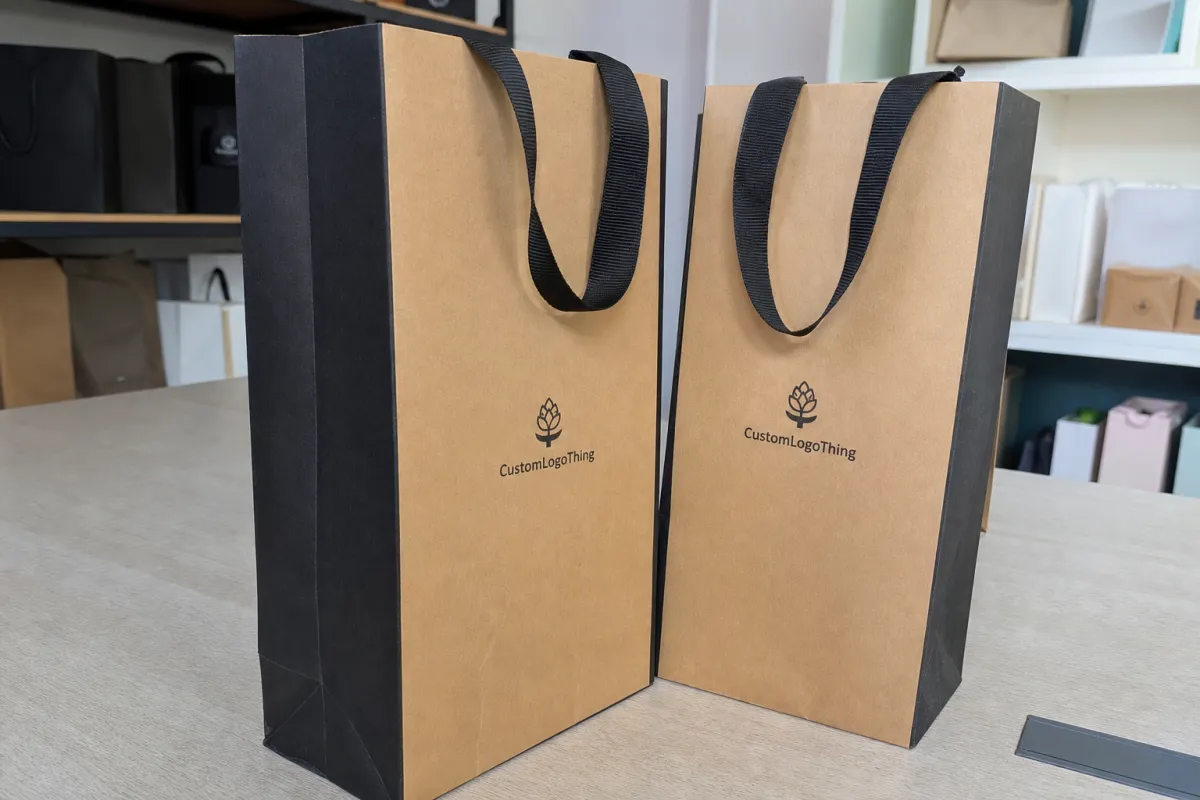
The first thing buyers usually underprice is the handle. Ribbon handles look polished, but the attachment method, top fold, and reinforcement can affect cost more than a small print change. A ribbon handle often needs tighter anchoring than a twisted paper handle, and that changes both production time and failure risk. The bag may also need a stronger shoulder or header area so the handle does not tear the top when the load shifts.
The second miss is assuming all beer bags behave the same. They do not. A slim 330 ml bottle with a light label sits differently from a thick craft bottle with a heavy base and condensation on the glass. Two bottles in a gift pack can be easier to balance than one oversized bottle, even though the total weight is similar. Load distribution matters. So does where the center of gravity lands inside the bag.
That is why the brief needs measurable details instead of vague descriptions. Include bottle count, bottle diameter, bottle height, label width, and whether the carry is meant for short handoff or longer travel. If the bag has to support chilled bottles, say so. Moisture changes the surface behavior of paper, especially on uncoated or lightly coated stock. A dry sample may pass a quick hand test and still fail in a cold retail environment.
Buyers also save time by being specific about the use case. Tasting room carryout, retail gifting, festival promos, and distributor packs all have different priorities. Retail gifting needs presentation. Festival promos need speed and durability. Distributor packs need repeatability and clean carton labeling. Same category. Different job.
The fastest way to waste money is to approve a beautiful sample before checking the load test. The fastest way to delay a launch is to discover the handle strength is fine for one bottle and weak for two. Build the order around the actual fill weight, not a rough estimate.
Practical rule: if the sample carries the product only when the bottles are centered perfectly, the design is too optimistic.
Paper Weight, Gusset, and Handle Construction Choices
Paper basis weight is the first real performance decision. For light carryout, 200-230 gsm kraft or coated paper may be enough. For heavier glass bottles, buyers usually move to 250-300 gsm and add bottom reinforcement. That does not automatically make the bag better. It makes it stiffer, bulkier, and usually more expensive. If the bag is meant to be reused, stronger material and cleaner reinforcement are worth the cost. If the bag is a one-time promo handoff, overbuilding it only adds waste.
Gusset depth is just as important. A narrow gusset can pinch labels or rub against the bottle shoulder. A wider gusset improves stability, but it also changes how the bag folds, packs, and ships. That matters in bulk ordering because a bag that packs flat efficiently can reduce carton count and freight cost. The same change can also make the top opening feel too loose if the load is light. There is no free adjustment. Every dimension moves something else.
Handle style should match weight and brand position. Ribbon handles feel refined and suit gift-oriented packaging. Rope handles usually read as stronger and more premium in a classic retail sense. Twisted paper handles are economical and often fit rustic or natural branding. Reinforced loop handles are the safer choice for heavier bottles because the pull force spreads more evenly across the top structure. The “best” handle is the one that holds the load without making the bag awkward to carry.
Construction details matter more than most branding decks admit. Top fold width, glue coverage, seam alignment, and bottom insert quality all affect real-world use. A cheap-looking seam can ruin an otherwise good design. A clean board insert can keep a bottle from punching through the base after repeated handling. If the bag may be reused, ask for stronger anchoring than a one-and-done gift bag would need.
For heavy glass, ask for a carry test with the actual fill weight. Lab samples often pass because they are centered, dry, and handled carefully. Real use is messier. The bag gets tilted. The handle gets yanked at an angle. A cold bottle sweats. That is where weak construction shows up.
Testing standards help separate a display sample from a shipment-ready bag. The ISTA testing framework is useful because it keeps the conversation focused on transit behavior, not just appearance. If the supplier cannot explain how they check load, drop, or pack integrity, ask for specifics. Packaging that only looks right is not enough for bulk programs.
Print Area, Coatings, and Retail-Ready Finishes
Print space is not just for logos. It is also where practical information lives. A front panel logo is the obvious move, but side panels can carry seasonal messaging, origin notes, a simple QR code, or a short product story. If the bag will be reused, keep the design strong enough that it still looks intentional after a few carries and a few scuffs. Overcrowded artwork ages badly.
Finish choice changes both appearance and handling. Matte coatings cut glare and make text easier to read under retail lighting. Gloss brings stronger color pop, but fingerprints and abrasion show faster. Soft-touch can feel premium, yet it adds cost and may not suit a rougher retail environment. Uncoated paper works well for natural or craft positioning, especially when the brand wants the bag to feel less promotional and more like part of the product experience.
Color management needs more discipline than many buyers give it. Ask for Pantone targets. Do not rely on vague descriptions like “deep red” or “warm black.” Kraft paper shifts color differently than white stock, and lighting changes how a printed bag reads on shelf. A black logo that looks crisp in daylight can look dull or brownish under warm store lights. If brand consistency matters, approve a physical proof and keep the reference sample on file for reorders.
Small production choices also influence how the bag arrives at the end of the chain. Barcode placement, carton labels, stack orientation, and count marks should all be set before the run starts. That speeds receiving and cuts down on repacking damage. It also makes the warehouse team happier, which is a nice side effect nobody lists in a spec sheet.
If the brand needs environmental documentation, request FSC-certified paper and verify the paperwork before production. The chain-of-custody claim is only useful if the supplier can support it. The same goes for recycled content claims. Ask for the actual stock specification, not a marketing line.
One more reality check: a bag that prints beautifully on a screen can still disappoint when loaded. The best sample is one that shows the final art, the final coating, and the final structure together. Beauty wins the first look. Structure protects the reorder.
Pricing, MOQ, and Quote Variables That Change Unit Cost
Bulk pricing on beer Ribbon Handle Paper Bags is driven by a handful of variables, and suppliers do not always list them in the same way. Size, paper weight, handle type, print colors, coating, and total quantity all move the quote. So does whether the job uses an existing dieline or needs new tooling. If two quotes do not match on those inputs, they are not really comparable.
MOQ tiers usually fall into a few rough bands. A pilot run often lands around 1,000 to 2,000 pieces. That usually carries a higher unit cost because setup, sampling, and waste are spread across fewer bags. A core production run in the 3,000 to 5,000 range tends to be more efficient. A larger reorder above 10,000 pieces can lower the per-unit price again, provided the spec stays fixed and the supplier can source the same materials without delay.
Typical pricing can move a lot, but these broad ranges are useful for planning: a pilot run may sit around $0.42-$0.78 per bag, a core run around $0.24-$0.48, and a larger scale reorder around $0.18-$0.36. Those are planning numbers, not promises. Freight, duties, finish choice, and stock availability can shift them quickly. A fancy handle or heavier board can erase the savings from a larger quantity faster than buyers expect.
Always separate the quote into visible and hidden cost buckets. Ask what is included: plates, dies, sampling, carton packing, export packaging, freight, duties, and any special inspection fees. A quote that looks cheap on paper may become the expensive one after shipping. Landed cost is the number that matters. Headline unit price is only one piece of it.
| Order Type | Typical Quantity | Indicative Unit Cost Pressure | Best Fit | Main Watch-Out |
|---|---|---|---|---|
| Pilot run | 1,000-2,000 | $0.42-$0.78 each | Artwork approval, seasonal test, small launch | Setup and sample waste push up the unit cost |
| Core production run | 3,000-5,000 | $0.24-$0.48 each | Tasting rooms, gift sets, standard retail | Specs need to be final before plates and dies are made |
| Scale reorder | 10,000+ | $0.18-$0.36 each | Distributor programs, chain retail, multi-site supply | Inventory, warehousing, and freight planning become critical |
One useful habit: compare only like-for-like quotes. Same size. Same paper. Same handle. Same proof stage. Same delivery term. If one supplier includes a print plate and another leaves it out, the lower line item is not the better deal. It is just the less complete one.
Production Steps, Lead Time, and Delivery Schedule
Good planning keeps the order from turning into a chain of rushed approvals. The usual flow is spec review, artwork proof, sample approval, production, quality check, packing, and shipment. If any step is vague, the schedule starts to wobble. That is why purchase orders should name the exact bag size, approved artwork version, finish, and delivery requirement. “Same as last time” is not a spec.
Lead time depends on how custom the bag is. A standard size with a simple one- or two-color print may move from proof approval to production in about 12-15 business days. More complex jobs with multiple colors, special coatings, new tooling, or unusual handle assemblies often need 18-30 business days before shipment. Overseas freight can add another 2-5 weeks depending on route, season, and port conditions. Those are planning ranges, not guarantees.
Seasonality is a real constraint. Beverage promotions, holiday gifting, trade events, and retailer resets can compress factory capacity and freight space at the same time. A bag that is easy to source in summer can be harder to secure in autumn. If the order supports a fixed launch date, build a buffer before artwork is signed off. Waiting until the last approval cycle is where schedules start slipping.
Late changes are expensive because they do not only affect print. A revised proof can also affect plate-making, sample timing, carton labels, and shipping booking. Ask the supplier whether a revision resets the full schedule or just one stage. That answer tells you how they manage production, and usually how well they manage expectations.
- Approve the final dieline and internal dimensions.
- Confirm artwork, print colors, and proof notes in writing.
- Sign off on the sample or production reference.
- Lock the ship date and receiving address.
- Tell the warehouse what carton count and stack orientation to expect.
Transit planning should reflect how the bags will actually move through the supply chain. A supplier that understands pack-out logic, outer carton strength, and basic transit testing usually causes fewer problems later. That matters more than polished sales language. Crushed corners, split handles, and damaged cartons are not glamorous problems, but they are the ones that cost money.
Supplier Checks That Protect Repeat Reorders
Repeat orders are where suppliers either prove themselves or fall apart. The first run might look fine. The second run is where color drift, handle variation, or carton count errors show up. For beer ribbon handle paper Bags Bulk Order Planning, consistency is the product. A supplier should be able to keep batch records, approved files, and spec notes organized enough that the reorder does not need to start from scratch.
Communication style tells you a lot. The useful supplier gives exact dimensions, proof steps, material options, and realistic timing. The vague supplier says “no problem” to everything until the calendar gets tight. That is not helpful. It is expensive. If the bags support a retail launch or distributor promise, you want clear answers early, not optimistic ones late.
Watch for these checks on every run:
- Color consistency: confirm how Pantone targets are held across reruns.
- Handle anchoring: verify the same reinforcement method is used each time.
- Seam alignment: inspect folds, bottom registration, and glue lines on the first carton sample.
- Saved files: keep the final dieline, approved art, and print notes in one folder.
- Material continuity: ask whether the same paper stock and handle components are still available for reorder.
If the program may grow, ask about capacity before the first order. A supplier that can move from a few thousand units to a much larger reorder without rebuilding the spec file saves time later. That matters when the product expands from a local tasting room to multiple stores, events, or distribution points. FSC documents, carton labels, and version control all help keep that growth orderly instead of messy.
Order-Ready Checklist Before You Request a Quote
The cleanest quote request removes guesswork before it starts. Send bottle count, bag dimensions, handle preference, paper type, print colors, quantity, and delivery address. Then add bottle diameter, label width, whether the bag will be carried briefly or traveled with, and whether moisture exposure is part of the use case. Those details usually improve the first quote more than a long back-and-forth ever will.
Artwork and reference photos should go together. A supplier can catch spacing problems, side-panel clutter, and awkward logo placement much faster when the visual brief arrives with the measurements. If there are two quantity targets, ask for both. A lower MOQ may help launch timing, while a larger volume may lower unit cost enough to justify inventory. That tradeoff deserves to be visible in the quote, not hidden in the fine print.
Before you release the order, keep the checklist practical:
- Confirm the bottle count and total fill weight.
- Approve internal dimensions before artwork sign-off.
- Request a sample if handle strength or balance is uncertain.
- Check whether the same paper stock and handle parts are available for reorders.
- Book freight only after the ship date and carton count are locked.
That is the real shape of beer ribbon handle paper bags Bulk Order Planning: get the structure right, get the proof trail right, and make the reorder boring. Boring is good. Boring means the bag shows up on time, holds the bottles, and looks the same next time.
What bottle count should I specify for beer ribbon handle paper bags bulk orders?
Start with the bottle count, then size the bag around the real bottle diameter, height, and label width. A one-bottle carryout bag, a two-bottle gift pack, and a four-bottle retail bundle all need different internal dimensions and different handle placement. Ask for a load test using the actual fill weight, not just a flat mockup.
How do MOQs affect beer ribbon handle paper bag pricing?
Lower MOQs usually raise unit cost because setup, proofing, and waste are spread across fewer bags. Higher quantities usually lower the per-unit price, but only if the spec stays stable. Ask for tiered quotes and confirm whether sampling, tooling, and freight are included before comparing suppliers.
What timeline should I expect for customized beer ribbon handle paper bags?
Standard specs may move from proof approval to production in roughly 12-15 business days, while more complex jobs often need 18-30 business days. Shipping can add several more weeks if freight is international. Holiday periods and retail launch windows can stretch the schedule, so a buffer helps.
Which specs matter most for heavy glass bottles in ribbon handle paper bags?
Paper weight, handle anchoring, bottom reinforcement, and gusset width matter most. Seam quality also matters because weak folds can split under load. If the bag is likely to be reused, ask for stronger reinforcement than a one-time gift bag would need.
Can I reorder the same beer ribbon handle paper bags without redoing artwork?
Usually yes, if the dieline, artwork file, and color proof were approved on the first run. Keep the final files and spec sheet together so the reorder moves faster. Confirm that the same paper stock and handle components are still available before placing the repeat order.

