Beer woven label beanies Bulk Order Planning looks easy until the first sample lands and the logo reads smaller than expected, the cuff eats the artwork, or the beanie color makes the label look muddy. That is usually where margin starts to leak. The blank matters, sure, but the label spec, placement, and approval process decide whether the final product feels intentional or rushed.
The goal is not the cheapest unit price. It is a spec that reproduces cleanly, arrives on time, and still leaves room to make money at retail or through event sales. That means fewer revisions, fewer surprise charges, and fewer boxes of dead stock sitting in the corner because the color or size was only “close enough.”
Beer woven label beanies bulk order planning checklist
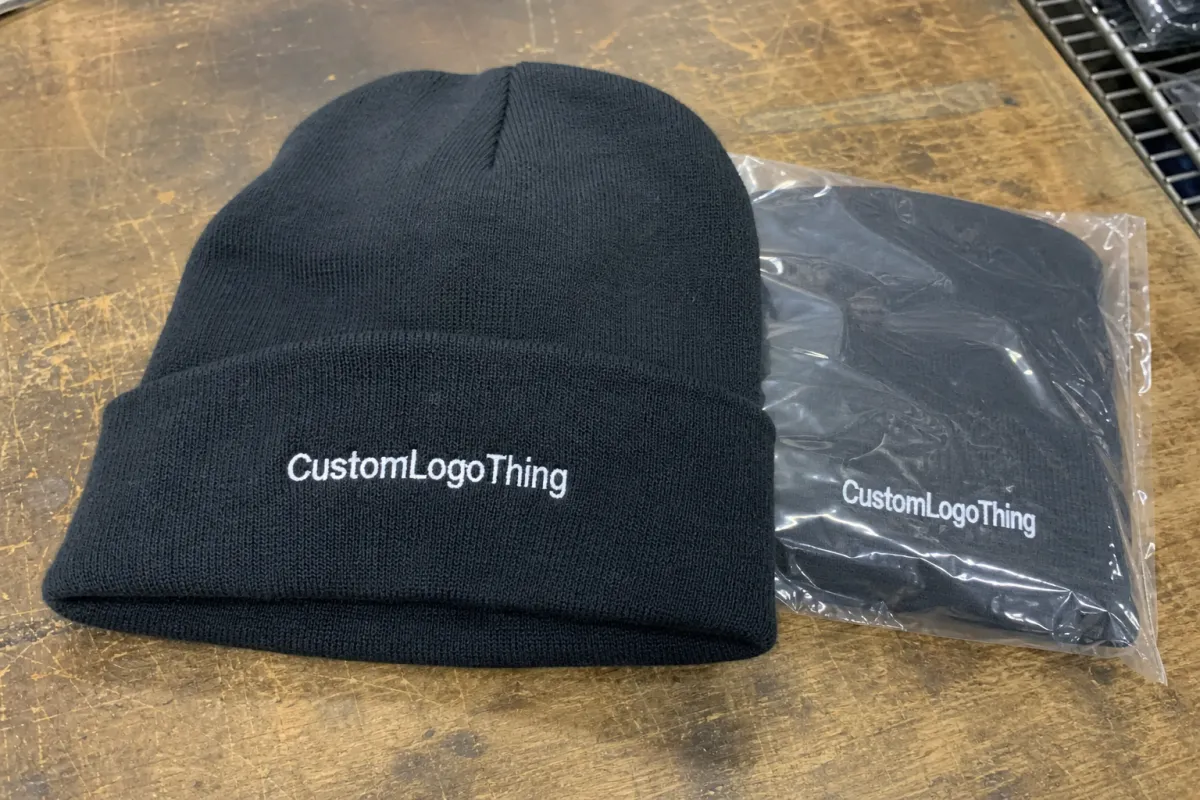
For breweries, taprooms, bars, retail drops, and seasonal promo runs, start with the business plan before you start arguing about thread colors. How many pieces do you really need? Which colors will move? What date cannot slip? The answer determines whether you should keep it to one clean colorway or split the order into multiple SKUs.
Most ordering mistakes happen before production starts. Buyers approve a woven label that looks fine on screen, then discover the logo disappears once it is woven down to 45 x 25 mm. Or the front cuff placement looks centered in the mockup, but the actual blank has a shorter cuff and the label ends up too close to the seam. Small changes in proportion can swing perceived value more than the beanie itself. That is just how tactile merch works.
Practical rule: if the label is hard to read at arm’s length in a proof, it will not magically improve on a knit beanie. Fix the art before thousands of units are cut and sewn.
The safest brief is blunt: define the blank, define the label size, define placement, and define the acceptable color range before anyone quotes the job. If you need a broader trim reference, the Custom Labels & Tags page is a useful starting point for understanding construction and finish options.
Why woven-label beanie orders go sideways before production starts
The problems usually start with assumptions. Buyers assume a label that looks crisp in a digital proof will look crisp at 50 mm wide. It will not, not if the artwork is crowded. Buyers assume one beanie fit works across every head size. It does not, especially when the knit is too tight or the stretch recovery is poor. Buyers assume “standard” means consistent. It often means whatever the factory had on hand that week.
Woven labels punish weak artwork and reward restraint. A logo with too much small text, thin linework, or multiple color transitions can get muddy fast. On knit accessories, the label sits on a textured surface, so the eye has less room to forgive detail that would survive on a flat garment tag. Simple marks usually win. Clear contrast usually wins. Tiny taglines usually lose.
The other failure point is timeline drift. A buyer changes the label width after the first proof, then tweaks thread color, then asks for a different packaging method, then wonders why the delivery date moved. It is not a mystery. Every “small” change restarts a piece of the process. If the launch date matters, freeze the spec early and treat revisions like exceptions, not a hobby.
Beanie construction choices that affect fit, feel, and resale
Cuffed or uncuffed is not just a style call. A cuffed beanie gives a cleaner branding zone and more structure, which helps a woven label sit flat. Uncuffed styles can look more modern or slouchy, but the branding area is less predictable. If the logo needs to be visible in a retail display, cuffed is usually the safer choice.
Knit gauge matters too. A tighter rib knit tends to look denser, hold shape better, and feel more premium. A looser knit may feel softer at first touch, but the surface can make the label look less crisp because the fabric moves more. Acrylic blanks are common because they are durable and affordable. Acrylic-poly blends usually improve drape and handfeel. Wool or wool blends sit higher on the price ladder and make sense when the buyer wants a colder-weather premium story or stronger resale perception.
| Beanie option | Typical use | Unit cost effect | Branding impact |
|---|---|---|---|
| Cuffed rib knit acrylic | Brewery merch, promo, event giveaways | Lowest | Best label visibility, easy to decorate |
| Uncuffed slouch knit | Fashion retail, lifestyle drops | Moderate | Less structured, label placement needs care |
| Blended yarn knit | Retail, ski shop, premium merch | Moderate to higher | Better handfeel, stronger resale appeal |
| Wool or wool blend | Premium seasonal programs | Highest | Strong value signal, but price pressure is real |
Placement should follow the use case. Front cuff placement is standard when the logo is the main brand statement. Side seam placement works if the brand wants a quieter look or the artwork is a small woven mark instead of a full logo treatment. Center fold can work on retail pieces, but only if cuff height and knit stretch are consistent enough to hold the line. Beer merch usually sells better when the branding is obvious, not mysterious.
Fit matters more than most buyers admit. Bulk beanies are usually one size fits most, but a softer stretch range around 20-24 inches in circumference tends to sell better across a wider audience. If the knit is too tight, the beanie feels cheap. Too loose, and it loses shape after a few wears. People wear these on cold mornings, at games, and while traveling. If the shape collapses after one wash, the label will not rescue it.
Artwork, color matching, and label specs that stay readable
Woven labels reward clean artwork and punish busy artwork. That is the short version. A simple logo with one to three strong thread colors will usually reproduce better than a detailed mark with tiny copy, thin strokes, and a tagline nobody can read at label size. If the brand depends on fine detail, the right answer may be a larger label or a different decoration method.
A usable spec starts with a vector file, an exact label size, and a finish callout. Folded, end-folded, center-folded, and cut-and-heat sealed are not interchangeable. Each one changes how the label sits, how the edges behave, and how much space the art actually gets. Thread count matters, but only in context. Four to six colors can work on a compact label, but every added color increases complexity and can make the edges look soft instead of sharp. High contrast usually beats complexity on knit accessories.
Color matching deserves more attention than most buyers give it. Screen mockups are not enough if the order needs brand consistency. Ask for thread references, a digital proof, and, when the presentation matters, a pre-production sample or strike-off. That is where the ugly little surprises show up: the background is too dark, the logo is too small, the border disappears against the yarn, or the edge finish feels stiffer than expected.
Good suppliers can usually tell you where the readable limit sits. If your logo has stacked text, ask them to show how it behaves at small size and whether the mark should be simplified. That is not a red flag. It is basic competence. If you are comparing broader sourcing options, the Wholesale Programs page can help frame how larger runs and repeat jobs are usually structured.
Packaging also affects how the product lands after shipment. If the beanies are moving through retail cartons or e-commerce packs, packaging standards matter. For transit damage, ISTA testing can be relevant. If hangtags, inserts, or branded wraps use paper stock, FSC options matter when buyers care about certified materials.
Pricing, MOQ, and quote drivers for bulk orders
Price is driven by more than the blank beanie. Yarn type, knit gauge, label size, stitch complexity, thread color count, placement, packaging, and SKU count all move the number. A plain cuffed acrylic beanie with a one-color woven label and bulk polybagging is one thing. A premium knit with a multi-color label, folded insert, custom tag, and several color splits is another. Comparing only unit price is how people end up buying the wrong thing.
For beer Woven Label Beanies Bulk Order planning, a practical MOQ often lands around 100-300 pieces, depending on the supplier, decoration method, and how many versions you want. At 100 units, setup cost still bites. At 300-500 units, the per-unit price usually starts to settle because label production and labor are spread across more pieces. At 1,000 units and up, the savings can be meaningful if the colorway is proven and sell-through is likely.
Realistic market ranges, not fantasy pricing, usually look something like this:
| Run size | Typical unit range | What usually happens | Best for |
|---|---|---|---|
| 100-199 pcs | $4.50-$7.50 | Setup cost is still visible; fewer color options make sense | Testing a new design or small taproom drop |
| 200-499 pcs | $3.40-$5.80 | Better spread on decoration and label cost | Seasonal retail, brewery merch, event sales |
| 500-999 pcs | $2.80-$4.90 | Quote becomes more efficient if artwork is simple | Core retail programs and multi-location inventory |
| 1,000+ pcs | $2.20-$4.20 | Lowest unit pricing, but mistakes are more expensive | National launch or repeat best-seller |
These are directional, not universal. They move with yarn type, labor market, packaging, and freight. But they are far more useful than “competitive” or “affordable,” which are empty words in a purchasing conversation. Also check whether the quote includes label application, folding, barcode stickers, and carton packing. A cheap base price can stop being cheap fast once the add-ons appear.
Ask for the quote in line-item form if possible: blank beanie, woven label, application labor, packaging, and shipping. That makes comparison easier and reveals whether one vendor is quietly hiding setup fees inside the decoration line. Honest pricing is usually boring. That is a good sign.
Production process, timeline, and turnaround checkpoints
The production path is predictable enough: request quote, confirm specs, approve artwork, produce sample or strike-off, run bulk production, inspect, pack, and ship. Simple on paper. Less simple in practice, because delays usually come from approvals, not sewing.
A typical timeline for beer woven label Beanies Bulk Order Planning might run like this: 1-3 business days for quoting if the brief is complete, 3-7 business days for proofing and revisions, 5-10 business days for a sample or strike-off if one is needed, 12-20 business days for bulk production, then shipping time on top. If the order includes multiple colorways or custom packaging, add buffer. If the launch date is fixed, add more buffer. That is not pessimism. That is how you avoid overnight freight charges.
Holiday periods, cold-weather spikes, and freight congestion can stretch that schedule quickly. The same thing happens when buyers keep changing the label size by a few millimeters or deciding the thread color “needs to be a little warmer.” A little warmer sounds harmless until the sample cycle starts over. If the delivery date matters, lock the art early and save revisions for actual mistakes.
Backward planning helps:
- Set the sell date or event date first.
- Subtract shipping time and a 1-2 week buffer.
- Subtract production time based on run size.
- Leave sample approval time untouched unless stress is part of the plan.
If the order is tied to a launch window, have the supplier quote a ship date they can defend, not a guess that sounds nice. If they can only promise “fast,” that is not a schedule. It is a shrug. A good partner will say exactly where the delay risk sits and whether a proof change, yarn switch, or packaging revision could push the run past the safe date.
How to judge a supplier before you place the order
The easiest way to judge a supplier is to see how they handle specificity. Can they tell you the MOQ by color? Can they explain placement tradeoffs without hiding behind vague language? Can they show a sample photo that actually matches the final build? If yes, they probably understand the job. If every answer sounds like a sales brochure, keep moving.
Reliable suppliers send clear spec sheets, ask about artwork dimensions up front, and flag when a logo will not read well at the chosen size. Weak suppliers hide setup fees, dodge questions about label construction, or change the spec after the deposit is paid. That is how buyers end up with a run that looks close, but not close enough to sell at the intended price point.
Ask these questions before approval:
- What is the MOQ per color and per design?
- What exact files do you need for the label artwork?
- Is the quoted price inclusive of application and packaging?
- How do you handle reorders so the next run matches the first?
- Can you keep label color, beanie shade, and placement consistent across future runs?
Repeatability matters more than people expect. A first run can sometimes survive a small flaw if it sells through. A reorder that comes back darker, looser, or with a shifted label position creates real brand damage. Ask how previous specs are stored, whether thread references are kept, and if the same build can be matched later without restarting from scratch. That is especially useful for brewery merchandise, because customers notice when the second batch feels different.
If you want a baseline for common buying questions and order prep, the FAQ page is a practical reference. The point is not to hunt for the lowest vendor. The point is to find the one who can repeat the job without surprises.
Next steps to lock quantities, samples, and launch timing
Before asking for quotes, finalize the quantity by color, the beanie style, the target label size, and the preferred placement. Send a vector logo, not a screenshot, and include the brand color references that actually matter. If the order is for retail, add packaging requirements. If it is for an event, give the launch date and the latest safe delivery date. Good briefs get better pricing. Bad briefs get slow replies.
If the order depends on exact logo placement, thread color, or a polished retail look, request a digital proof and sample before production approval. That small step costs time upfront, but it is cheaper than discovering the label sits too low after 500 units are already moving. For a bulk run, an extra week of proofing beats a month explaining why the shipment missed the window.
Keep the first order focused if possible. One strong colorway with clean decoration usually beats three weak variations. You can always expand the palette on the reorder once the product proves itself. That is the clean way to handle beer woven label beanies Bulk Order Planning: lock the spec, confirm the numbers, protect the margin, and let the product do its job.
What MOQ is typical for beer woven label beanies bulk orders?
Most bulk orders start in the 100-300 unit range, but the real threshold depends on the blank, label complexity, and how many colors or versions you need. Higher quantities usually lower unit cost because setup and label production get spread across more pieces. If you need several colorways, ask whether the MOQ applies per color or across the full order.
How much does a woven label add to the unit cost of beanies?
The label itself is only part of the cost; stitching labor, placement, and thread color count often matter more than the raw label material. Simple one- or two-color labels are usually cheaper than detailed multi-color logos with small text. Ask for the quote to separate blank beanie cost, label cost, and decoration cost so the margin picture stays clear.
What turnaround should I expect for a bulk woven-label beanie order?
A realistic timeline usually includes proofing time first, then production, then shipping, so the total is often longer than buyers expect. Artwork approval delays and color changes are the most common causes of missed dates. Build extra buffer if the order must arrive before a launch, holiday event, or retail drop.
Can I order different colors in the same beanie run?
Yes, but multi-color orders can raise the effective unit cost if each color needs its own setup or separate MOQ. Ask whether color splits affect pricing, lead time, and packing. If budget matters, it is usually smarter to keep the first order tight and expand colors on the reorder.
What should I prepare before requesting a quote?
Have your logo file, target quantity, preferred beanie style, label size, color preferences, and target delivery date ready. Include whether you need samples, retail packaging, or individual folding so the quote reflects the full job. The cleaner the brief, the faster the quote and the fewer surprises later.


