Electronics PVC garment bags Bulk Order Planning usually starts with the wrong question. Buyers ask for price first, then discover the real problem is size, closure, or pack-out. A bag that is 5 mm off can fold the corners, slow the packing line, or leave the product looking sloppy on shelf. That is not a small miss. It is the kind of miss that gets expensive after the quote has already looked “good.”
The order only makes sense once the use case is clear. A bag for a bundled accessory kit needs different clarity, stiffness, and closure behavior than a storage sleeve or a display cover. A retail-facing program may care more about surface appearance and print quality. A warehouse program usually cares more about durability and handling speed. Same material family. Different job. Different spec.
That is why the practical work happens before the first sample is approved. Lock the finished size, confirm the gauge, decide on the closure, define the print, and set the carton count. Do those things early and the quote becomes useful. Skip them and the “cheap” price turns into revision rounds, scrap, and delays.
“A bag that only looks right on the drawing is not finished. It still has to survive packing, transit, and the person who touches it six times before it reaches the customer.”
Electronics PVC garment bags bulk order planning: what actually drives the order
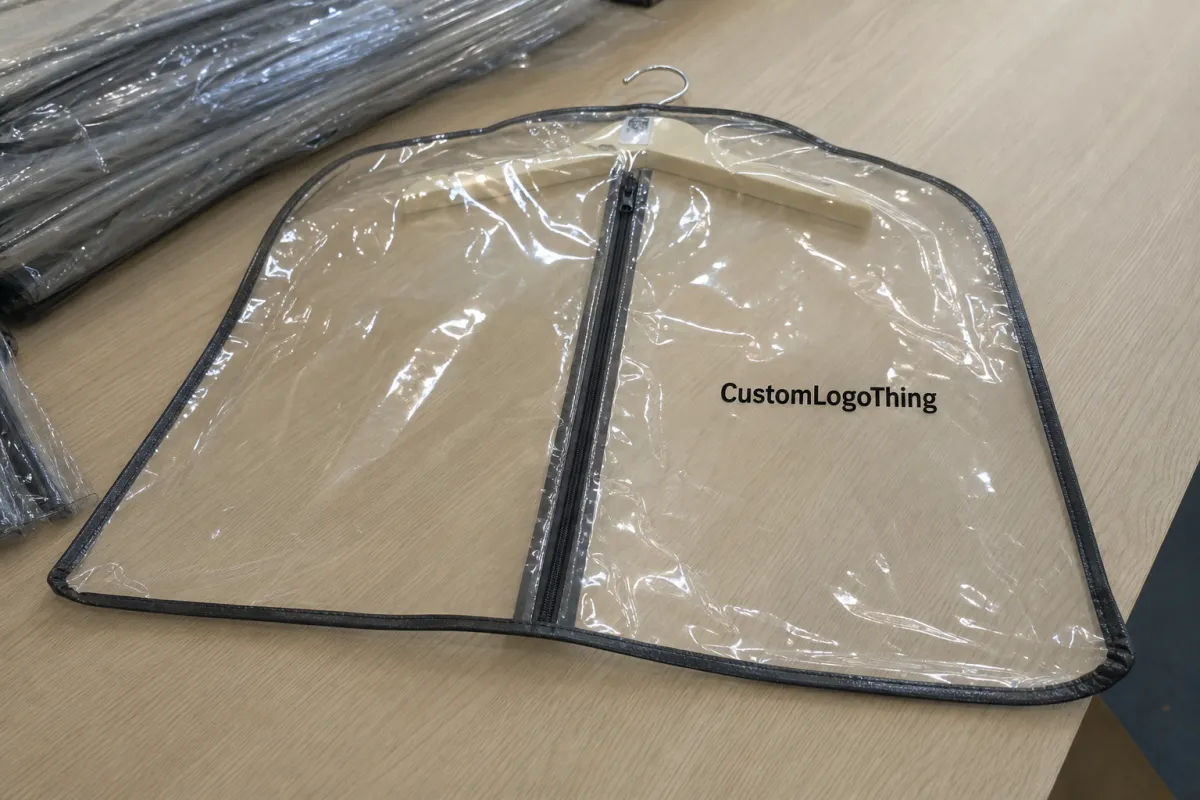
The first decision is not the material grade. It is the product flow. What happens to the bag between production and final use? If the bag slides into a shelf-ready kit, the opening and flexibility matter. If it hangs in storage, shape retention matters more. If it sits on a retail hook, the front face and hole placement matter. Once you know that, the rest of the order becomes much easier to organize.
That sounds obvious. It still gets missed all the time. Buyers often start with the assumption that one PVC bag can do everything. It cannot. A sleeve that works fine for a light cable bundle may look tired around a thicker accessory set. A stiffer film may hold shape beautifully, then create more friction during loading. A very soft film may pack fast and look messy. The right choice is usually in the middle.
Cost is not only the resin cost. Manual handling, pack speed, and approval cycles change the landed number just as much. I have seen a program lose its savings because every unit needed a quick hand adjustment before carton pack-out. Two seconds sounds harmless. Multiply that by 20,000 pieces and the labor is no longer invisible. That is what turns a simple bag into an operations problem.
For electronics PVC garment bags Bulk Order Planning, the most useful starting point is the product itself:
- What exactly goes inside the bag?
- How often will the bag be handled before use?
- Does it need to look retail-ready or just stay clean and protected?
- Will the bag be reused, stored, shipped, or displayed?
Those answers shape the order better than any generic “premium” label ever will. If the program is recurring, the first order should be treated as the master version. That is the sample that later reorders will live or die by. Loose notes and half-remembered approvals are not enough.
Material and construction details that affect protection and display
PVC is not one thing. Two clear bags can look close on a screen and behave very differently on the line. Clarity, stiffness, thickness, and surface finish all matter. So does the way the seams are made. If the film is too soft, the bag collapses and wrinkles. If it is too heavy, the bag can feel stiff or cloudy. That trade-off is normal. The mistake is pretending it is not there.
Construction is where the bag either works or becomes a nuisance. Heat-sealed edges can keep the profile clean. Gussets add room and help the bag stay usable around thicker bundles. Hang holes are helpful for merchandising, but they also need accurate placement. Closure style matters even more than many buyers expect. A zipper, snap, adhesive flap, or open-top sleeve changes both labor and the customer’s experience.
For electronics programs, surface behavior is also part of the spec. Clear film should stay visually clean after handling. Odor should be low enough that the package does not smell like it spent the week in a chemical drum. Trim should be clean. Sharp residue or cloudy film can make a finished kit look second-rate even when the dimensions are correct.
Here is a simple comparison that usually helps buyers narrow the field:
| Option | Typical Strength | Best Use | Trade-off |
|---|---|---|---|
| Thin clear PVC | High visibility, light weight | Light accessory kits, display sleeves | Less body, easier to distort |
| Mid-gauge PVC | Balanced clarity and structure | Most bulk electronics pouch programs | Slightly higher unit cost |
| Heavier PVC with gusset | Better shape retention and durability | Frequent handling, hung storage, larger bundles | More freight weight and higher setup impact |
| Printed PVC bag | Brand visibility and shelf presence | Retail-facing kits and promotional packs | Ink coverage can raise price and lead time |
That table does not solve the decision by itself. It does show the real trade-off, which is usually body versus clarity versus handling speed. Buyers who skip that conversation tend to come back later asking why the sample looks “different” from the email thread. Because the email thread was vague. That is the answer.
For packaging performance references, the International Safe Transit Association is a useful benchmark source: ISTA.
Size, gauge, closure, and print specs to lock before ordering
This is where quote revisions pile up. The buyer sends the outside size. The supplier samples to that size. Then the product does not fit because the usable opening, fold allowance, or hardware clearance was never written down. A bag that is technically the right size and practically the wrong size is still wrong. Measuring twice is fine. Writing the wrong thing twice is not.
Specify the finished dimensions in the same way every time. Include the usable opening, not only the outside width and height. If there is a gusset, define its depth. If there is a zipper or flap, allow for the area it occupies. If the bag needs to fit over a bundled item with inserts, leave room for the actual loaded product, not the flat product drawing. Drawings are useful. Reality is the thing that gets packed.
Gauge should be written in the same unit the factory uses. If one quote is in mil and another is in microns, convert them before comparing price. Otherwise, the “better” deal may just be the thinner film. Thin can be fine. It can also mean more deformation, more scrap, and a bag that feels flimsy in the hand.
Lock the closure, print side, and packing format before price comparison starts. A top zipper is not the same as a snap, and a printed front face is not the same as a two-sided print. Artwork coverage changes setup. Packing count changes carton size and freight density. Even a small shift in carton count can affect how the receiving team counts inventory and how quickly the goods move through the warehouse.
- Finished size: include usable opening and any gusset or fold allowance.
- Gauge: state the exact thickness target and unit.
- Closure: specify zipper, snap, flap, or open-top.
- Print: define side, color count, artwork status, and coverage.
- Packing: confirm units per carton and any retail-ready requirements.
One clean spec sheet saves more time than ten back-and-forth emails. It should hold the dimensions, tolerance, gauge, print file status, pack count, and approval contact. If those details are scattered across messages, the order can still be produced, but it will not be easy to control. Electronics PVC garment Bags Bulk Order Planning gets messy fast when nobody can point to the final version.
Pricing, MOQ, and quote inputs that change unit cost
PVC bag pricing is rarely driven by one thing. Film usage matters. Print coverage matters. Gauge matters. Carton configuration matters. A larger bag consumes more material. A printed bag takes more setup. A heavier film may lower damage risk, but it raises material and freight cost. The best quote is not the one with the lowest line number. It is the one built on the same spec from top to bottom.
MOQ is not a single universal number. It shifts by size, color, closure style, and print method. A 20,000-piece order can still have different minimums by SKU. Mixed programs can work, but only if the factory can batch similar structures efficiently. Otherwise, each changeover adds labor and the quote reflects that labor, whether the buyer likes it or not.
For planning purposes, buyers often use these rough bands for custom medium-volume runs:
| Run Size | Typical Unit Range | What Usually Drives the Cost |
|---|---|---|
| 1,000-3,000 pcs | $0.24-$0.42 | Setup spread over fewer pieces, more manual work |
| 5,000-10,000 pcs | $0.18-$0.31 | Better scale, moderate print or closure complexity |
| 20,000+ pcs | $0.13-$0.24 | Efficiency improves if the spec stays stable |
Those numbers are planning ranges, not promises. Resin markets move. Freight changes. Ink coverage changes. A quote for a plain clear sleeve should not be judged against a printed, heavier-gauge, retail-ready version. That comparison looks helpful and is usually nonsense.
Ask for quotes with the same input set every time:
- Quantity by size and color
- Delivery ZIP, port, or warehouse location
- Artwork status and print colors
- Sample or pre-production needs
- Target ship date
- Any compliance or documentation requirements
If the seller cannot quote the same spec twice, the issue is not price. It is control. That matters more than the first number on the page, because a low quote built on missing information usually grows legs later.
Production steps, lead time, and approval checkpoints
Good production control is not glamorous. It is a series of gates that keep mistakes from compounding. The sequence should be clear: spec review, proof, sample or pre-production approval, mass production, inspection, and shipment. Skip one gate and the risk moves straight to the buyer. Usually in the form of delay, rework, or a box full of something nobody wants to count twice.
Lead time is often 12-18 business days from proof approval on standard custom runs. Add time if the artwork is complex, the gauge is unusually heavy, or the program needs special packing. Repeat orders can move faster when the approved master sample is already on file. That is the value of keeping clean records. The factory is not guessing. Neither should the buyer.
There are a few delay points that show up over and over. Missing artwork files stall proofing. Unclear tolerances create sample disputes. Late feedback pushes the schedule back. If the buyer reviews the proof only after the inventory plan is already locked, the order calendar becomes a problem for everyone.
Ask for milestones, not vague promises. A useful schedule usually looks something like this:
- Proof issued within 1-3 business days
- Sample approval window of 2-5 business days
- Production window of 7-12 business days after sign-off
- Transit time based on destination and service level
That sequence gives electronics PVC garment Bags Bulk Order Planning a real calendar instead of a wish. For packaging standards and industry context, the Packaging & Processing Suppliers Association is a practical reference point: packaging.org.
A good program feels boring, and that is a compliment. The proof matches the spec. The sample matches the proof. The shipment matches the sample. Anything more dramatic than that usually means someone skipped a step.
Quality checks and compliance points buyers should verify
Quality control should be specific enough to measure. Start with clarity, seal strength, size tolerance, print placement, odor, and carton count accuracy. If the bag is visible on shelf, haze and surface distortion matter. If it is for storage, seam consistency and dimensional repeatability matter more. If it will be opened and closed repeatedly, then the closure has to survive real handling, not just a one-time test.
A documented inspection plan is better than “looks okay.” That sounds blunt because “looks okay” is how avoidable defects keep getting shipped. Ask for the criteria in writing. Ask how the factory checks dimensions. Ask how they confirm the print is aligned. Ask what happens if the seal drifts or the count comes up short. Those are normal procurement questions, not signs of distrust.
Compliance belongs at the quote stage. If the end customer needs material declarations, restricted-substance information, or destination-specific paperwork, say so early. Waiting until the goods are finished is the expensive way to handle a missing document. The supplier can only prepare what they were told to prepare.
Depending on the program, buyers may also want third-party testing or internal verification against a packaging standard. For some shipments, that means transit testing through ISTA methods. For others, it means checking the material against a retailer’s restricted-substance list or an internal packaging policy. If paper inserts or hang tags are part of the package, FSC-certified paper may matter too.
Keeping one approved master sample is one of the simplest controls in the whole process. Label it clearly. Keep the exact revision level with it. Keep the carton count with it. That makes reorders much easier to inspect and far less subjective. Memory is not a quality standard.
- Visual checks: clarity, print placement, surface finish
- Physical checks: seam strength, closure function, gauge consistency
- Count checks: units per carton, carton label accuracy
- Document checks: spec sheet, approved sample, compliance declarations
If the bag sits near sensitive electronics or accessory kits, low odor and clean trimming matter more than people admit. Nobody wants a package that smells harsh after storage. That is not a premium signal.
What separates a clean quote from a cheap one
A cheap quote can be real. It can also be missing half the information needed to produce the order correctly. The difference usually shows up in the details that do not fit neatly into a price table. Does the supplier understand the measurement method? Did they quote the same film thickness? Did they include print setup? Did they account for carton size and pack density? Those questions matter because they decide whether the number is useful.
Good quoting is more about discipline than persuasion. The supplier should be able to translate a rough concept into a production-ready spec without improvising the important parts. Tolerances should be stated. Artwork should be checked. Closure style should be defined. If the quote is silent on those points, the order is still unresolved even if the price looks tidy.
This is where experience shows up. A buyer who has seen enough packaging programs knows that a few small assumptions can create a lot of work later. A 2 mm variance can be fine on a loose sleeve and wrong on a fitted bag. A one-color print can be easy and a lightly tinted film can still change the look. A clean quote makes those differences visible before production starts.
For electronics PVC garment bags Bulk Order Planning, the smartest quote is the one that reduces surprises. Not the one that sounds impressive in an inbox. The one that matches the product, the packing method, and the reorder plan.
Next steps for a clean bulk order and faster reorders
If the spec is still loose, start with the product in hand. Measure the finished dimensions. Confirm the closure style. Decide whether print is required or unnecessary. Split the quantity by size or color if the assortment really needs it. That gives the factory enough information to quote accurately instead of guessing at what the bag is supposed to do.
Then gather the details that change cost and schedule:
- Target dimensions and tolerance
- Material preference and gauge
- Print files or artwork status
- Delivery location and transit method
- Sample expectations
- Compliance or documentation needs
If the program is strategic, do not rush straight to mass production. Approve the prototype first. Check the fit. Check the closure. Check the clarity under real lighting, not just a screen render. Once the sample works, the bulk run becomes much easier to control. That is the point of the process: fewer revisions, fewer surprises, and fewer conversations about why the shipment looks different from the sample everyone already approved.
For repeat orders, keep the approved master sample, PO history, and revision notes together. That one habit can cut days off the next run. It also stops the classic reorder problem where nobody remembers which version was “the good one.”
What should I prepare before asking for an electronics PVC garment bag bulk quote?
Have finished dimensions, closure style, quantity by size, and print files ready so the quote reflects the real build. Include the use case too, because storage, display, and kitting can point to different film weights and structures. If you need samples, split deliveries, or exact carton counts, say so before the quote is finalized.
How does MOQ affect electronics PVC garment bags pricing?
Higher runs usually lower unit cost because setup is spread across more pieces. MOQ can vary by size, color, and print method, so ask for a separate minimum by SKU. Mixed orders can work, but each variant still needs enough volume to stay efficient.
Which PVC thickness is best for bulk garment bag orders?
Choose thickness based on product weight, handling frequency, and how much structure the bag needs. Light items often do well with a lower gauge, while frequently handled or hung items may need more body. Ask for a sample test before committing to a full run so you can check fit and stiffness in real use.
What usually drives lead time for a bulk PVC garment bag order?
Artwork approval, sample sign-off, and material availability are the main schedule levers. Custom sizing or more complex print can add time before production starts. Reorders move faster when the approved spec and master sample are already on file.
Can electronics PVC garment bags be reordered without new setup?
Yes, if the prior run has approved specs, artwork, and measurements stored clearly. Keep one master sample and the exact PO history to reduce errors on repeat orders. Reorders are quickest when the previous revision level and delivery requirements are easy to reference.

