A book woven label beanies Unit Cost Review is really a spec review in disguise. The label matters, but only if the beanie build, artwork, placement, and packing are clear enough to compare quotes on equal terms. If those inputs are vague, every supplier is pricing a different product.
Woven labels usually make more sense than printed branding on knitwear because they hold detail, read cleanly after wear, and tend to look more finished on shelf and in photos. They are not a cure-all, though. The result depends on knit density, label size, cuff shape, and whether the artwork is simple enough to weave well. Buyers who define those details early get more useful pricing and fewer production surprises.
Why Woven Labels Change Beanie Sell-Through
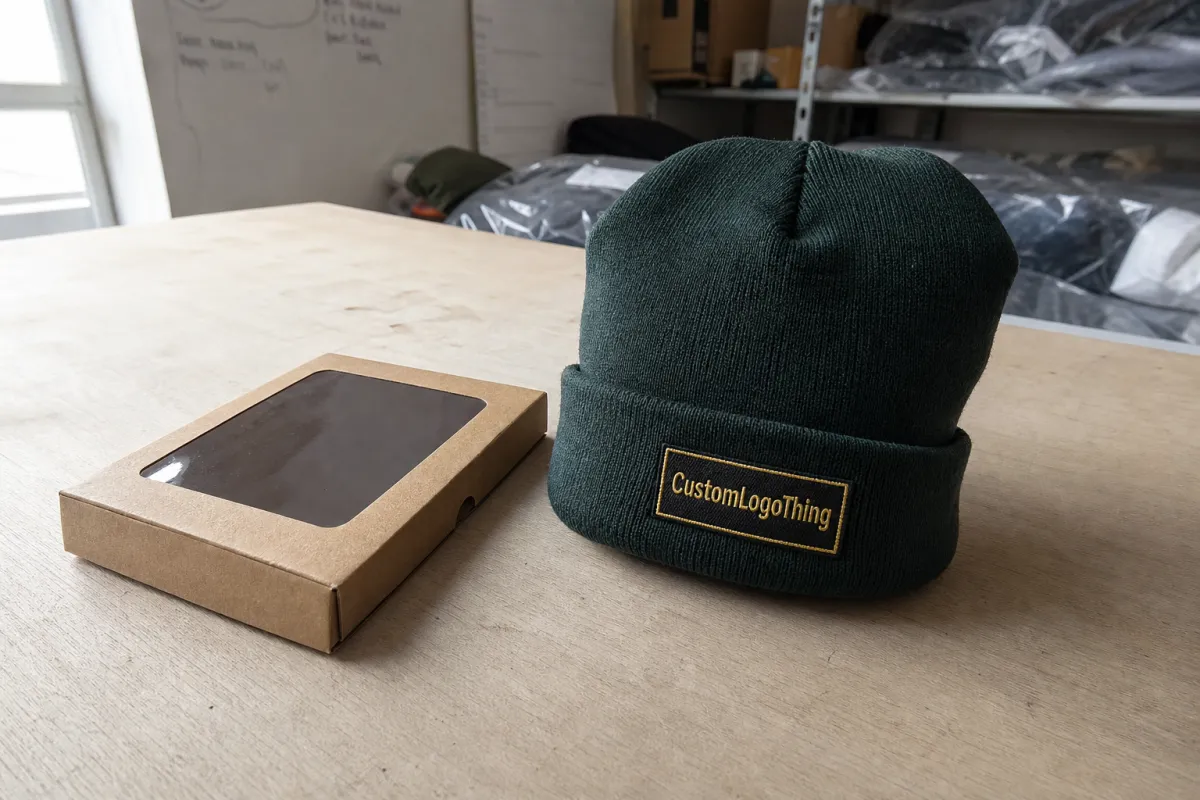
Woven labels do more than identify the brand. They make the beanie look intentional. On a retail rack or in a product image, that small difference can separate a finished item from something that feels promotional or temporary.
They also age better than many surface decoration methods. Because the artwork is built into the label, it usually survives folding, stretching, and repeated handling better than a print sitting on top of the knit. That matters for winter accessories, which get pulled, stuffed into bags, and worn hard.
The channel changes the priority, but not the logic:
- Apparel brands get a durable brand marker that supports reorders.
- Promo teams get cleaner presentation without expensive decoration.
- Retail buyers get a product that photographs and displays better.
- Private-label buyers get consistency across repeat orders.
There are limits. A woven label on a loose knit can look slightly detached. A label placed where the cuff folds can disappear. Fine artwork can soften in the weave. The label only adds value when the spec matches the garment.
A beanie sells on first impression, but it is judged on how well the branding survives use.
Beanie Build Details Buyers Should Confirm Before Quoting
Before asking for price, define the beanie itself. Cuffed or uncuffed, single-layer or double-layer, close-fit or slouchy: each choice changes knitting time, label placement, and how much visible branding space is available.
Cuffed styles usually give the cleanest label area and are easier to position. Uncuffed styles can look sleeker, but they leave less room for error. If the label sits on the fold, the buyer should confirm how it looks when worn, not only when laid flat.
The label spec should be specific enough to produce the same result twice. Useful quote details include:
- Artwork file in vector format, ideally AI, EPS, or a clean PDF.
- Label size in millimeters or inches.
- Thread count or color count for realistic weaving.
- Label finish, such as fold-over, straight cut, or sewn-on tab.
- Placement note with a sketch or reference photo.
Material choice changes both cost and feel. Acrylic is common because it is affordable and holds shape well. Acrylic-wool blends can feel warmer and more premium, but they usually cost more. Recycled polyester can support sustainability goals, although color matching and hand feel may vary. Add spandex and the fit improves, but placement and stretch behavior need more attention.
Knit density is another variable buyers often miss. A tighter knit usually frames the label better and looks more retail-ready. A looser knit may feel softer, but it can make the front panel less structured and the label less crisp. That is why a clear spec sheet is worth more than a vague style name.
If branding options are still open, the Custom Labels & Tags page is a useful comparison point for woven, printed, and sewn methods.
Book Woven Label Beanies Unit Cost Review: Pricing, MOQ, and Setup
The headline unit price is only part of the story. A proper book woven label beanies Unit Cost Review should separate the beanie body, woven label production, sewing or application labor, sampling, packaging, and freight. If those pieces are bundled differently from one supplier to the next, the quotes are not truly comparable.
MOQ has a direct effect on the final number. Setup work, artwork prep, loom programming, and sample approval all get spread across fewer units in a small run. That is why a 300-piece order can cost much more per piece than a 3,000-piece order even when the finished beanie looks nearly the same.
Indicative ranges help frame the market:
| Order profile | Typical MOQ | Indicative cost per piece | What usually pushes the number |
|---|---|---|---|
| Simple cuffed acrylic beanie with standard woven label | 250-500 pcs | $2.40-$3.60 | Higher setup share, light bulk pricing, basic packing |
| Mid-volume knit beanie with woven label and custom color match | 500-1,500 pcs | $1.60-$2.70 | Better labor spread, moderate yarn choice, standard sewing |
| Retail-focused beanie with denser knit and clean label finish | 1,500-3,000 pcs | $1.20-$2.10 | Improved production efficiency, more stable repeatability |
| High-volume private-label run | 3,000+ pcs | $0.95-$1.65 | Lower bulk cost, tighter process control, simpler packaging options |
Those figures are comparison frames, not a universal rate card. Some suppliers include artwork prep in setup. Others separate loom work, strike-off fees, and sewing. Packing may be included or quoted separately. The same beanie can look cheaper or more expensive depending on how line items are written.
To compare fairly, ask each supplier for the same breakdown:
- Beanie body price.
- Woven label production cost.
- Sew-on or application fee.
- Sample or strike-off cost.
- Packing and freight estimate.
Landed cost is the number that matters. A slightly higher quote may still be the better deal if it includes cleaner finishing, better sewing, and safer packing. That is especially true for retail orders, where damaged presentation creates hidden cost before the product reaches the buyer.
If the order is promotional and the brief is simple, buyers can often reduce cost by using standard packaging, fewer label colors, and a smaller label. The tradeoff is readability. Once the branding becomes hard to see, the savings are not worth much.
The cleanest comparison is the same build against the same build: same yarn blend, same label size, same placement, same shipping method. Anything else is not really a book Woven Label Beanies unit cost review; it is a comparison of different products.
Production Steps and Turnaround From Artwork to Packing
Most delays happen before bulk production starts. The usual sequence is inquiry, specification review, artwork confirmation, woven label proofing, sample approval if needed, bulk knitting, sewing, inspection, packing, and shipment. The bottleneck is usually not the knitting. It is the back-and-forth over details that should have been settled earlier.
When the first request is complete, standard orders often run about 12-18 business days after proof approval. If a physical sample is required, or if the order falls into a seasonal rush, the schedule is closer to 20-30 business days. Those are planning ranges, not promises, but they are realistic enough for budgeting and launch timing.
Cold-weather goods are especially timing-sensitive. Demand rises fast when the season shifts, and knitting capacity plus woven label production slots can tighten quickly. Recycled yarns, custom colors, and retail packaging can each add lead time. The more components involved, the more important a clean approval process becomes.
A practical production checklist looks like this:
- Quantity and size range confirmed.
- Artwork approved with label dimensions.
- Placement marked on the mockup.
- Color references set with acceptable tolerance.
- Delivery window and shipping address verified.
Packaging deserves attention because a perfect beanie can still arrive looking poor if cartons collapse, polybags tear, or folds shift in transit. For distribution-center deliveries and retail programs, it helps to ask whether the packing plan aligns with ISTA methods. That is a practical way to reduce avoidable damage.
Construction Specs That Affect Comfort, Warmth, and Readability
Comfort and branding do not live in separate worlds on a beanie. Knit gauge is one of the clearest examples. A tighter gauge usually gives the label a cleaner frame and a more structured look. A looser gauge may feel softer, but it can reduce sharpness in the front panel.
Cuff depth matters too. A deeper cuff gives more room for branding and usually keeps the label visible whether the cuff is worn high or low. Shorter cuffs look leaner, but they leave less margin for placement error. If the label is even slightly off-center, the problem is obvious quickly.
Some brands want a subtle marker, like a small side tab or low-profile cuff label. Others want the logo to lead the design. Either can work, but the knit and label size should match the intent. A tiny label can disappear on a busy texture, while an oversized one can overwhelm a soft casual knit.
Durability is where practical details matter. Labels sewn too close to a stretch point can pucker. Weak edge finishing can curl after washing. Loose stitching near the cuff may pull after repeated wear. Buyers often focus on art and forget the mechanics of use, which is a costly miss on a winter item.
Color matching should be handled realistically. Yarn lots vary. Woven labels vary. Screens vary even more. Exact perfection is not always practical, and chasing it can delay production without improving the finished product. What matters is whether the logo, knit, and label colors still read as one system in bulk.
If hang tags or insert cards are part of the package, a responsible paper stock can help complete the presentation. For that, FSC-certified stock is a sensible option to ask about.
For most buyers, the best beanie is not the most elaborate one. It is the one that stays comfortable, keeps its shape, and still reads clearly after shipping, folding, and real wear.
Why Buyers Stay With a Reliable Beanie Supplier
Reliability shows up in the basics. The proof matches the final spec. The sample reflects the approved art. The instructions are clear enough to repeat. The quote does not shift every time a clarification is needed. Those are simple things, but they matter more than a glossy pitch.
That is especially true when the delivery date is fixed. Winter launches, team programs, and event merchandise rarely leave room for redesign. A supplier who can explain cost drivers plainly and flag weak points early is usually more valuable than one that agrees to everything. If artwork is too fine for weaving, that should be said. If the label is too large for the cuff area, that should be caught before production starts.
The best suppliers usually work in a disciplined way:
- Written specs that match the proof.
- Saved measurements for future reorders.
- Clear notes on label size, placement, and thread colors.
- Packing instructions that keep cartons consistent.
- Direct feedback when the design is not suitable for woven production.
Lower risk often comes from fewer surprises, not from the lowest quote.
Reorders are easier when the first job is documented properly. Approved art, final measurements, and a breakdown of setup charges reduce the chance of re-litigating the same decisions. That matters for seasonal assortments, where a few weeks saved on the second order can mean missing or making the selling window.
If you are still choosing between branding methods, compare woven against printed or sewn options on the Custom Labels & Tags page before locking the spec.
Next Steps to Book the Right Custom Beanie Order
Before requesting quotes, gather the basics in one place: target quantity, beanie style, color direction, logo file, label placement, delivery window, and any packaging requirement. A supplier can only price accurately when the request is specific.
Ask for a line-by-line breakdown so you can see whether the cost is being driven by the body knit, the woven label, sewing labor, sample work, or freight. A low headline price is not very useful if the hidden costs appear after approval.
Request a proof whenever the woven detail matters. Fine lines, small text, and tight elements often look cleaner on screen than they do in actual yarn. A proof confirms dimensions and placement. A physical sample, when needed, confirms stretch, fit, and how the cuff sits once worn.
It also helps to be honest about the use case. Retail, teamwear, and promotional runs do not need the same balance of finish and cost. Retail usually rewards a tighter presentation. Promo work can justify a simpler build if the brand mark still reads well. Private-label orders usually sit in the middle and benefit most from a quote that reflects both durability and appearance.
The simplest decision path is this: define the finished look, confirm the build, check the MOQ, and compare landed cost instead of chasing the lowest unit price. Used that way, this book woven label beanies unit cost review becomes a practical buying tool rather than a pricing exercise with too many unknowns.
How do I estimate book woven label beanies unit cost before quoting?
Start with the beanie construction, label size, and quantity because those usually drive the biggest swings. Then add packaging, sampling, and freight so the estimate reflects landed cost instead of only the factory unit price.
What MOQ is typical for woven label beanie orders?
MOQ changes by style and label complexity, but smaller runs usually cost more per piece because setup is spread across fewer units. Ask for tiered pricing so you can see how unit cost changes as volume increases.
How long does production usually take after approval?
Timing depends on artwork approval, label development, knitting capacity, and whether a sample is required before bulk production. Clean specs and fast approvals usually shorten the schedule more than buyers expect.
Can I lower the cost by changing the woven label design?
Yes. Simpler artwork, standard sizing, and a common placement can reduce labor and keep the quote tighter. Just do not simplify it so much that readability drops or the brand looks unfinished.
What should I send to get an accurate beanie quote?
Send quantity, beanie style, color choices, label art, preferred placement, and any packaging or retail needs. Include your target delivery window so the quote reflects the right production plan and shipping method.


