Boutique Buyer Frosted Zipper Plastic Bags Logo Placement Guide: Why the panel matters
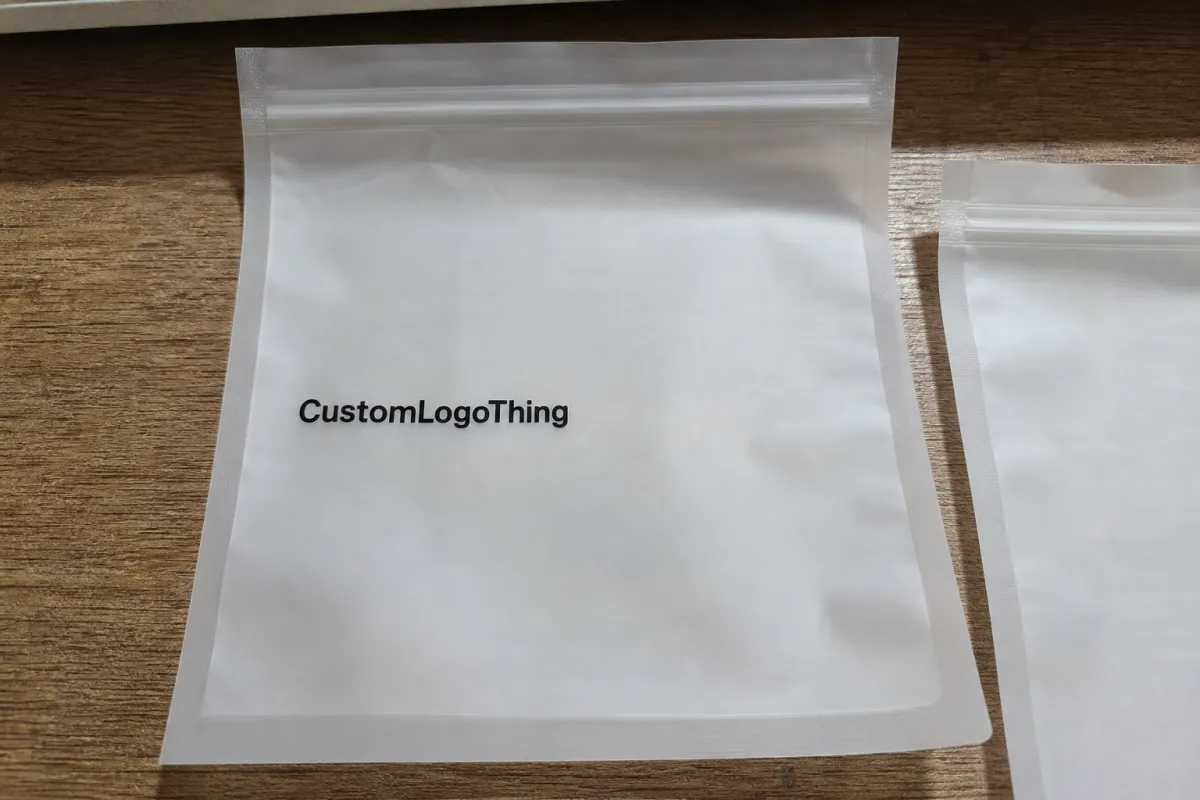
Most buyers start with the logo artwork and end up wrestling with the panel geometry. That is the real task behind a boutique buyer Frosted Zipper Plastic Bags logo placement guide: getting a mark to look intentional once the bag is filled, handled, stacked, and photographed under retail lighting. A logo that feels perfectly balanced on a blank mockup can drift once the zipper compresses the top edge or the contents push the front panel outward.
Frosted film changes the visual behavior of the package. The matte surface softens reflections, which helps the bag feel premium, but it also reduces the hard contrast that makes small text easy to read. Dark ink can look slightly muted. Light ink needs more discipline. A design that works on glossy poly often needs a different placement strategy on frosted PE or PP because the bag itself is doing part of the visual work.
The mistake I see most often is simple: the logo is placed where the mockup looks clean, not where the finished pouch will actually hold its shape. That is usually too close to the zipper track, too near the side seal, or too low into an area that gets distorted once the bag is packed. Boutique packaging does not reward optimistic assumptions. It rewards panel logic, print-safe margins, and a mark that still reads after the bag has been opened and closed a few times.
A clean proof is useful, but a proof that matches the filled bag is what keeps the order from going sideways.
How frosted film, zipper type, and bag size change the visible logo zone
Frosted film is not just a finish. It changes contrast, ink absorption behavior, and how the eye finds the logo at a glance. On PE and PP bags, the surface diffuses light enough that very thin strokes can lose authority. That is why a clean vector logo usually beats a decorative lockup with hairline elements. If the brand mark depends on delicate details, the print method matters even more because the ink edge needs enough body to survive the softer surface.
Zipper construction narrows the usable panel. A press-to-close zipper takes away height at the top and introduces a visual break that the logo should usually avoid. Slider zippers add hardware bulk, which can make the upper front panel look crowded even before product is added. On smaller boutique formats, that lost space is not theoretical. A 4 x 6 inch pouch and a 10 x 12 inch apparel bag behave like different products, even if the artwork file is the same.
Bag size also changes how the logo is read in motion. A small accessory pouch often looks best with the mark slightly above center, where it remains visible above the fill line. A taller retail bag can handle a larger centered logo, especially if the contents sit low and flat. For hanging display, the upper third often performs better because the shopper sees the mark before they ever touch the bag. For shelf presentation, the middle of the panel can be stronger because the eye lands there naturally once the bag is standing.
The most useful way to think about visible space is not “where can I print?” but “where will the logo still look straight after use?” Gussets, bottom seals, and product bulk all shift the apparent center. A placement that looks perfectly aligned on a flat layout can sit lower than expected once filled, and that visual drop is more obvious on frosted film because the panel lacks the crisp reflections that normally hide minor imperfections.
Logo sizing, margins, and print-safe placement rules for retail bags
Print-safe margins are not decoration. They are the difference between a design that survives production and one that gets reworked three times before press approval. Keep the artwork away from the zipper track, side seals, bottom seal, and any gusset fold. Those are the zones most likely to flex, compress, or pick up dimensional shift during sealing and packing. If the bag will be heat sealed, the clearance needs to be even more generous because heat and pressure can distort a nearby print edge.
There is no universal distance that fits every pouch, but a practical rule is to leave enough room that the logo still looks intentional if the panel shifts a few millimeters in either direction. That matters more than buyers expect. On frosted material, a logo crowded against a seal looks messy faster than it would on clear film because the soft surface already reduces sharp definition. A mark with breathing room reads as designed. A mark squeezed into the corner reads as solved for late.
Three placement patterns cover most retail bags:
- Centered logo: Good for symmetrical products, gift sets, and bags meant to stand upright on shelf.
- Upper-third placement: Useful when the product fills low or when the zipper should stay visually quiet.
- Lower-panel lockup: Works better on taller bags where the upper zone is busy with closure hardware or top-fold movement.
Logo size deserves the same discipline as location. Too small, and the frosted surface swallows the mark. Too large, and the logo fights the product inside the bag. For boutique buyers, the sweet spot is usually a mark large enough to read from a few feet away, but not so large that it turns the bag into a billboard. That balance shifts by category: jewelry bags need restraint, cosmetics samples need clarity, and apparel packaging can usually carry more presence.
One practical check is to print the proof at actual size and place it over the bag outline. If the mark feels awkward in that test, it will not improve in production. Real panel geometry beats optimistic artboards every time.
Artwork specs that keep frosted zipper bag printing sharp and consistent
The cleanest production jobs usually start with the least glamorous file: a proper vector logo. SVG, AI, EPS, or a production-ready PDF gives the printer stable edges and keeps lettering from softening when the bag size changes. High-resolution raster art can work for texture, gradients, or photographic elements, but it needs to be truly high resolution at final size. A file that looks fine on a screen often falls apart once it is separated into layers for print.
Thin type is the first thing to fail on frosted film. Hairline fonts, tiny taglines, and narrow icon strokes can fill in or break apart when the ink hits a matte or semi-translucent surface. This is not a theory. It shows up in proofing all the time. A design that looked elegant in a brand deck can become fragile in print because the surface, ink, and bag curvature work against it. Moderate stroke widths and open counters are safer, especially for small pouch sizes.
Color planning should be specific, not hopeful. Spot colors keep brand tones predictable. White ink is often necessary when the goal is crisp contrast on frosted film. Dark inks read well, but only if the design leaves enough negative space around the letters and symbols. If the artwork uses multiple colors, the proof should show each color relationship clearly, along with any underbase or overprint behavior. That is where a lot of misunderstandings begin: the buyer expects a simple logo, the printer sees a layered build, and the quote changes because the process changed.
Film thickness matters too. Common Frosted Zipper Bags often fall somewhere around 0.06-0.12 mm depending on format and supplier. Thinner film can feel lighter and more flexible, but it also tends to show deformation more easily once packed. Thicker film improves hand feel and keeps the front panel flatter, although it can raise unit cost. If the bag is being used for higher-end retail presentation, that flatter panel often helps the logo stay legible in photos and on shelf.
For buyers comparing specs across suppliers, transit and package performance standards are a useful reference point. ISTA test methods, along with common packaging quality practices, are not a substitute for a placement proof, but they do remind teams that the bag has to survive distribution, not just approval. A logo that looks good at the proof stage still needs to hold up once cartons are stacked, dropped, and opened repeatedly.
Cost, pricing, MOQ, and unit cost: what drives your quote
Pricing for custom Frosted Zipper Bags is driven by a small set of variables that tend to interact more than buyers expect: bag size, film thickness, zipper style, print colors, number of print sides, and whether white ink is needed. A straightforward one-color front print on a standard boutique pouch is not priced the same way as a two-sided, multi-color layout that needs a white underbase and tighter registration. The difference can be large enough to change the packaging plan, not just the budget line.
For a rough working range, a simple order at 5,000 pieces might land around $0.18-$0.35 per unit, depending on print method and structure. Smaller quantities usually cost more per bag because setup time, plate costs, proofing, and waste are spread over fewer units. Larger runs often push the unit price down, but inventory risk rises with them. Extra pallets of bags are not free, and over-ordering can trap cash in packaging that sits in storage for months.
MOQ matters because the fixed costs are real. Screens, cylinders, plates, setup tests, and first-article checks all require labor. That is why a 1,000-piece run can feel disproportionately expensive compared with 10,000 pieces. The buyer is paying for the same setup across fewer finished bags. There is a tradeoff, though. If the brand is seasonal, testing demand with a smaller MOQ may be smarter than tying up capital in a larger run that might need to be redesigned later.
Logo placement can influence price in indirect ways. A simpler, cleaner placement usually reduces the chance of registration issues, which shortens revision cycles and lowers the risk of remake costs. A logo pushed too close to a seam or zipper can trigger an extra proof round. That extra round costs time first, then money if the production slot has to be pushed. Clean placement is not only a visual decision; it is a production control decision.
Ask for quotes that separate the moving parts: tooling, printing, packing, freight terms, and revision charges. If those are bundled into one vague number, it becomes difficult to compare suppliers honestly. Two quotes can look similar and still represent different risk levels. One may include a full placement proof and a production check. The other may not.
| Option | Best For | Typical Setup | Indicative Unit Cost at 5,000 | Buyer Note |
|---|---|---|---|---|
| One-color front print | Simple boutique branding | Vector logo, standard panel placement | $0.18-$0.28 | Usually the easiest approval path |
| Two-color front print | Premium brand marks | Extra registration control, tighter proofing | $0.24-$0.38 | Better contrast on frosted film, but more setup sensitivity |
| Front and back print | Retail and gift packaging | Two print locations, more alignment checks | $0.30-$0.50 | Stronger visibility, higher production complexity |
| White ink underbase | Light logos or soft brand colors | Additional print layer | Adds cost depending on coverage | Often necessary for readability on frosted film |
Process, timeline, and lead time: from proof to finished bags
A clean order process usually runs in a fixed sequence: inquiry, size confirmation, artwork review, placement proof, approval, production, quality check, and shipment. Skip one step and the job tends to pay for it later. The fastest orders are rarely the ones with the most pressure. They are the ones with the fewest surprises.
Most delays come from familiar causes. Missing vector files slow artwork prep. Unclear placement instructions force new proofs. Last-minute color changes can reset press settings. Quantity changes after approval can alter the schedule or move the job out of the original production window. The simple truth is that a first-round proof with precise dimensions often saves more time than any expedite request.
A realistic lead time for standard runs is often 12-18 business days after artwork approval, although complex jobs can run longer. Print sides, special sizes, high color counts, and freight timing all change the calendar. That range is not a promise. It is a planning benchmark. Buyers who need packaging for a launch, seasonal drop, or retail reset should build in a buffer because freight delays are usually harder to absorb than production delays.
The better packaging teams think in stages, not promises. They confirm the die line, confirm the printable area, and confirm where the logo will sit relative to the zipper and seals before the order goes to press. That habit prevents the most expensive kind of delay: the one discovered after the whole run is finished.
What a packaging partner should verify before production
A useful packaging partner checks more than the logo file. They should review the dieline, zipper clearance, seal allowances, and exact print location before production starts. If the vendor only accepts the order and sends a generic mockup, the buyer carries more risk than necessary. A good proof should be specific enough to catch problems before they become printed inventory.
The proof needs to show the actual bag size, not a generic outline that hides the constraints. It should mark the distance from the logo to the zipper, side seals, and bottom seal. It should also show the filled appearance if the bag will be packed with product during retail use. That matters because a logo can look centered on a flat bag and still appear low once the contents settle. If the bag has a gusset, the proof should account for how the panel expands and bends when it stands up.
Quality control should not stop at artwork approval. Good factories check seal integrity, zipper alignment, print registration, color consistency, count accuracy, and surface defects such as scuffs or contamination. For frosted bags, a print rub check is also useful because matte films can show abrasion differently than glossy materials. If the bag will be handled heavily, folded, or stored in cartons for a long period, that extra check is not excessive. It is basic risk control.
For buyers working on sustainability-related programs, the broader package should also be reviewed. Recycled content, recyclable structure claims, paper inserts, and outer cartons can all affect the full packaging brief. If paper components are included, FSC certification can matter. The plastic bag itself is still the main item here, but the order often includes more than one material, and the brand promise has to survive the whole set.
Next steps to request a placement proof and lock the order
Start with the exact bag specs: size, frosted finish, zipper style, thickness, quantity, print colors, and shipping destination. That is enough for a real quote. If the bags are meant to sit in retail photos, say so. Photo-facing placement and shipping-only placement are not always the same, and the difference shows up most clearly on frosted bags because the front panel is doing all the work.
Send vector artwork whenever possible and include a note about the preferred logo position. Short directions help more than long ones: centered above the fill line, upper third, clear of zipper, or lower panel with margin on both sides. If the mark includes a fine tagline or a thin icon, mention that upfront. Those details often need to be thickened or simplified for clean printing on frosted film.
Request a placement proof that labels the safe area and the final print position relative to the actual bag dimensions. Approval should be based on the real pouch, not on a loose concept drawing. Once size, artwork, and location are all locked, the order is much less likely to drift. That is the practical heart of a boutique buyer Frosted Zipper Plastic Bags logo placement guide: fewer assumptions, fewer revisions, and a result that still looks right after packing, shipping, and shelf display.
Where should the logo go on boutique frosted zipper plastic bags?
Place it on the front panel where it stays visible when the bag is filled and standing upright. Keep it clear of the zipper track, side seams, and bottom seal so the mark does not distort. A proof using the actual bag size is more reliable than a flat artwork file alone.
Can I print a small logo on frosted zipper bags and still keep it readable?
Yes, but the type, line weight, and contrast need to match the frosted surface. Very fine details can soften on matte film, so simple shapes and slightly bolder text usually print better. A placement proof should show the logo at final size so readability can be judged before production.
How does MOQ affect pricing for custom frosted zipper plastic bags?
Lower MOQs usually raise the unit cost because setup and production costs are spread over fewer bags. Larger runs often reduce per-bag pricing, especially when the print method and artwork stay simple. Ask for pricing at several quantity breakpoints so inventory risk can be compared against savings.
What is the usual lead time after artwork approval?
For standard runs, a common range is 12-18 business days after artwork approval, although complex jobs can take longer. More print colors, special sizes, and repeated revisions add time. A clean first proof is still the fastest way to stay on schedule.
Can the logo sit near the zipper or seam on frosted zipper bags?
It can, but that is usually the riskiest choice because the closure and seam areas flex during use. A safe margin helps prevent distortion and keeps the brand mark readable after filling and closing. The artwork should always be checked over the dieline before approval.

