Fitness Studio Frosted Bag Factory Quote Guide
For studios that package apparel, welcome kits, socks, towels, or small retail add-ons, the bag is doing more work than most buyers give it credit for. It is protection, presentation, and storage all at once. If you need a fitness studio Frosted Zipper Plastic Bags factory quote checklist, the goal is not to collect a nice-looking number. The goal is to define a bag that fits the kit, survives handling, and does not create hidden costs when the order moves from proof to production.
Frosted Zipper Bags sit in a useful middle ground. They show the contents without exposing every fingerprint, crease, and label edge the way fully clear film does. That soft translucent look is one reason they work so well for branded membership packs and retail bundles. The bag looks deliberate. It makes a folded tee, a pair of leggings, or a stack of inserts feel organized rather than improvised. For studios that care about presentation, that difference shows up fast.
The common mistake is starting with the logo and skipping the structure. A factory can print almost anything onto almost any pouch, but the quote changes a lot once size, thickness, zipper style, and print coverage are fixed. Get those wrong and the final bag may be too flimsy, too cloudy, or too expensive for the role it actually needs to play.
Why frosted zipper bags work for fitness studio kits
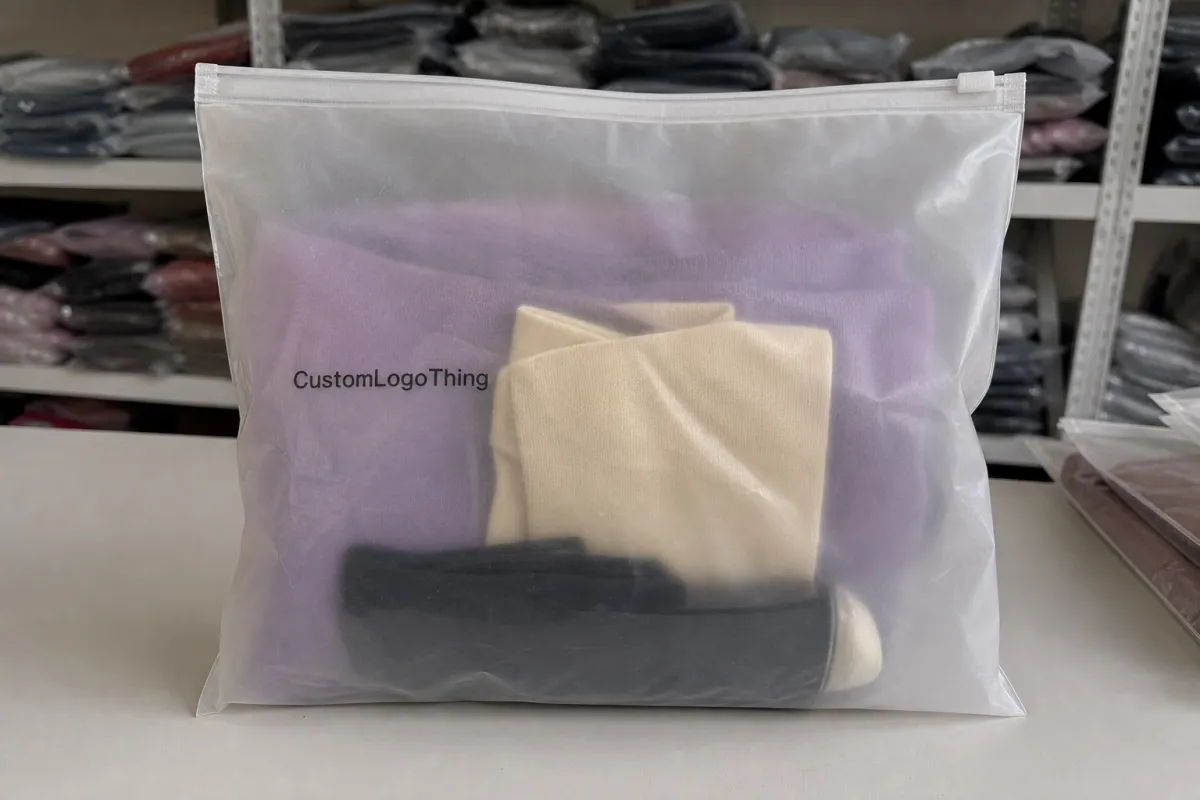
For studio use, the bag has to protect contents during handoff, look clean on a front desk or shelf, and hold up if the customer uses it again. Frosted PE and EVA bags keep getting chosen because they manage those three requirements without pushing the price into premium gift-box territory. They are practical, but not plain. That matters.
Clear bags are honest, but unforgiving. They show wrinkles and scuffs the moment a package is handled. Frosted film softens that visual noise, which is helpful if the contents are not perfectly uniform or if the bag will sit under harsh retail lighting. A matte or lightly frosted finish also photographs better than shiny clear film, which makes a difference for studios that post kit photos, run referral campaigns, or display bundled products near the checkout area.
There is a second reason these bags make sense: the bag itself becomes part of the brand experience. A membership launch pack or retail bundle feels more intentional when the pouch has structure, a tidy zipper line, and enough body to keep folded items from collapsing into a shapeless stack. That is not cosmetic fluff. It changes how premium the contents feel before anyone opens them.
If the bag is meant for resale, treat it like packaging that carries part of the product value. If it is only for internal handoff, the spec can be simpler, but it still needs to close properly and hold its shape.
Studio buyers also tend to underestimate repeated use. A welcome bag may get opened, refilled, and closed many times over the first few weeks. A thicker zipper track or slightly heavier film can be worth more than an extra print color because the customer experiences the closure every time they use it. Small details like that are why one bag feels cheap and another feels considered, even when the contents are identical.
Bag construction, zipper styles, and finish options
Material choice sets the tone. Frosted PE is the workhorse option: flexible, relatively low cost, and suitable for apparel, socks, towels, and lightweight kit items. Frosted EVA usually feels thicker and smoother, with more body and a slightly higher-end look. Laminated film adds stiffness and can improve print clarity, but it also raises the unit price and can make the bag feel less forgiving when folded, stacked, or packed flat for shipment.
The right answer depends on use. A studio sending out 500 membership kits may not need a rigid retail-style pouch. A studio selling curated wellness boxes probably does. A bag that needs to stand upright on a shelf has a different cost structure from one that lives inside a tote or locker bin.
Zipper style changes both the experience and the quote. A standard press-to-close zipper is the most common and usually the least expensive. It works well for dry goods and basic apparel kits. A slider zipper costs more, but it is easier to open and close repeatedly, which is useful if the bag will be reused often or handled by customers who expect a smoother closure. Tamper-evident styles are less common for studio kits, but they can make sense for sealed retail items, supplement bundles, or kits that need obvious first-open protection.
Finishing details matter more than buyers expect. A bottom gusset gives the bag volume and helps it stand when filled. A hang hole is useful for retail hooks or display walls. Seal width affects durability, and seam quality affects whether the bag survives a few openings or splits at the edge. A glossy frosted look reads differently from matte translucency; the latter usually feels softer and more premium, while the former can look brighter under store lighting. None of these choices is free.
| Option | Typical feel | Typical MOQ | Price range at 5,000 pcs | Best use |
|---|---|---|---|---|
| Frosted PE | Soft, flexible, lightweight | 3,000-5,000 pcs | $0.18-$0.32 each | Welcome kits, socks, light apparel |
| Frosted EVA | Thicker, smoother, more premium | 2,000-3,000 pcs | $0.28-$0.48 each | Retail kits, memberships, higher perceived value |
| Laminated film | Stiffer, cleaner structure | 2,000-3,000 pcs | $0.35-$0.65 each | Display use, heavier branding, premium resale |
| Slider zipper | Easy open-close, premium feel | 3,000 pcs and up | Add $0.03-$0.10 each | Reusable studio kits, retail add-ons |
Fitness Studio Frosted Zipper Plastic Bags Factory Quote Checklist
A usable quote starts with finished size, not with the product name. “For leggings” or “for kit packs” is too vague. The factory needs the folded dimensions, the expected clearance, and whether the bag needs a gusset or a hang hole. For folded apparel, leaving 15-25 mm of clearance on each side is usually practical. For thicker bundles, especially those that include a towel, card, or multiple items, the bag may need more room than a buyer first assumes.
Next, lock down the technical details that affect price and usability. Include material type, thickness, zipper style, print area, and whether the surface should be matte or glossy. If the bag needs to hold an insert card, state that clearly. If the bag is for retail resale, ask for usable internal width, not just outside size. A pouch can look right on a spec sheet and still be awkward to fill if the opening is too tight or the zipper line steals too much usable space.
Artwork should be sent in a format the factory can actually use. Vector files are best. Include exact logo placement, color references, and whether the print needs white underlay on frosted film. If one side is blank and the other carries the logo, say so. If both sides print, confirm whether the back is identical or simplified. A single-color logo on frosted PE is usually straightforward. Once the design moves into multiple colors, edge-to-edge coverage, or dense white ink, the quote changes quickly.
A practical spec list looks like this:
- Finished size: width, height, and gusset depth in millimeters.
- Material: frosted PE, frosted EVA, or laminated film.
- Thickness: usually 0.08 mm to 0.20 mm, depending on load and finish.
- Zipper: press-to-close, slider, or tamper-evident.
- Print: one side or two, and the exact number of colors.
- Extras: hang hole, matte finish, insert card space, retail packing.
That list is not paperwork for its own sake. It is the fastest way to separate an accurate quote from a placeholder estimate. If a supplier answers without those details, they are not quoting the job; they are guessing the risk.
Pricing, MOQ, and quote drivers buyers should compare
Packaging pricing is usually predictable once the spec is fixed. Larger bags use more film. Thicker film costs more. Slider zippers add cost. Double-sided print adds cost. Retail packing adds labor. Buyers run into trouble when they compare prices across different specs and expect the same unit cost to hold. It will not.
For a standard frosted zipper pouch in a 3,000- to 5,000-piece order, simple PE builds often land around $0.18-$0.32 per unit. Thicker EVA versions commonly sit in the $0.28-$0.48 range. Heavy print coverage, special finishes, or premium zipper hardware can push the number higher. Sample charges are often modest, and in some cases refundable against bulk volume, but setup, plate, or color-match fees may still appear. Ask for them directly rather than discovering them after approval.
MOQ is usually tied to structure. A stock size with one-color print is easier to produce than a custom size with a slider zipper, two-sided artwork, and a thicker body. If minimums are too high, ask what can be standardized without hurting the look. Sometimes the right compromise is a standard pouch size with custom print rather than a fully custom structure. For a studio testing a new membership tier, that often makes more financial sense than overbuilding the first run.
Compare quotes on the same basis:
- Ex-works unit price: factory price before freight.
- Sample cost: plain sample versus printed sample.
- Setup or plate fee: especially for multiple colors or custom art.
- Packing method: bulk packed, inner packs, or retail cartons.
- Shipping terms: EXW, FOB, or delivered pricing.
- Lead time: sample timing and production timing listed separately.
A quote without thickness, zipper style, print method, and packing detail is not really comparable. The low number often grows once the missing pieces are added back in.
That is why three complete quotes beat ten half-finished ones. If the bags are not quoted on the same size, same material, same closure, and same packing method, the comparison becomes noise. Serious buyers strip out the noise first.
Production steps and timeline from artwork to shipment
The usual flow is inquiry, spec confirmation, artwork proof, sample approval, mass production, packing, and shipment booking. The delay usually happens before production begins. A buyer sends a loose file, the supplier asks for a cleaner logo, someone revises the size, then another stakeholder wants the print moved, and the schedule slips. Simple jobs stay simple when one person owns the final decision and the spec stops changing.
A practical timeline is 2-5 business days for proofing, 3-7 business days for samples if a printed sample is needed, and 10-18 business days for mass production after approval. Freight sits on top of that. Air freight is faster and more expensive. Ocean freight is cheaper and slower. If the bags support a launch, event, or seasonal membership push, the shipping plan should be set early. Waiting until the artwork is approved to think about transit often turns a manageable timeline into a scramble.
Three choices usually save time:
- Send final artwork in vector format with clear placement notes.
- Use one approval contact so the factory is not waiting on multiple replies.
- Keep the material and zipper standard unless a premium finish is truly needed.
Also confirm what kind of sample is being produced. A plain structural sample checks size, feel, and closure. A printed proof sample checks color, opacity, and logo placement. If the bags are for customer-facing kits, the printed proof is the safer step, even though it takes longer. The extra days are usually cheaper than a full production run that misses the mark on color or layout.
Quality checks that matter for studio use and retail resale
Quality control should focus on failures the customer would actually see. The zipper must close smoothly and stay closed after repeated opening. The seams need enough strength at the side and bottom. The logo has to sit in the right place and stay centered. A pouch can be technically usable and still look careless if the print drifts or the top edge is uneven.
Material consistency matters, especially for repeat orders. A studio that reorders every season wants the second run to match the first. That means the approved sample, print reference, and thickness spec should be stored and reused. Without that record, small variations creep in: the film looks a little duller, the zipper feels different, or the clear opening width changes just enough to annoy the packing team.
Inspection should happen under real loading conditions, not only on a clean desk. Put in folded leggings, a towel, socks, or a card insert and see how the bag behaves. If the opening buckles, the zipper resists, or the sides bow outward, the bag may still pass a quick visual check but fail in use. That is the kind of issue that creates complaints later, when it is more expensive to fix.
Packaging method also affects cost and damage risk. Bulk packing lowers unit cost. Inner packs improve counting and sorting but add labor. Retail cartons improve presentation but need stronger master cartons and better moisture control. If the bags will move through parcel networks or multiple warehouse stops, ask for carton strength and transit testing guidance. Resources such as the ISTA transit testing standards are useful when you want packaging that survives more than a single careful transfer. For broader material and terminology reference, the Packaging School and Association resources can help sanity-check specs before an order is placed.
For repeat studio orders, ask whether cartons can be labeled by size or color, whether the factory can hold the approved spec on file, and whether reorders can use the same print setup without new plate work. Those are not glamorous questions. They save time and keep the bag program stable.
What makes a reliable factory partner for repeat studio orders
Reliability shows up in repeatability. If a second order drifts from the approved sample, the supplier did not really lock the job. A dependable factory partner can reproduce the same dimensions, film feel, zipper performance, and print placement without making the buyer rebuild the spec each time. That matters more than a polished quote template. Packaging is judged on what arrives, not on how the quote looked.
Useful suppliers also push back when needed. If the requested thickness is too thin for the bag size, or the print area is so busy that the frosted surface will look cluttered, they should say so. That kind of correction is a sign of production discipline. A factory that agrees to every weak spec without comment is often the one that creates avoidable problems later.
Another marker is how they document the job. A good supplier keeps the artwork, sample reference, and material notes on file so reorders are faster and less error-prone. If a studio runs seasonal campaigns, referral packs, or location-specific bundles, that record becomes valuable. It reduces rework and protects consistency across different stores or launch cycles.
Signs of a reliable repeat-order partner:
- They confirm specs in writing instead of relying on memory.
- They can quote the same bag in more than one material or thickness.
- They explain tradeoffs clearly rather than hiding them.
- They keep approved art and samples on file.
- They have a clean path for reprints and reorder timing.
Good factory communication is plain, not flashy. Fewer handoffs. Fewer missing details. Fewer surprises after approval.
How to request the fastest usable quote and next steps
The fastest usable quote comes from a complete request, not a short one. Send finished size, material, thickness, zipper style, print colors, artwork file, quantity, packing preference, delivery destination, and target date. If you need samples, say whether you want a plain structure sample or a printed proof sample. That one choice affects both cost and timing.
Ask for the quote in a format you can compare later: unit price, sample cost, MOQ, Lead Time, setup fee, and freight option. If the answer arrives as a single vague number, send it back. A useful quote should make it easy to compare landed cost and spot which details are driving price. The right bag is rarely the cheapest line on paper. It is the one that fits the product, the schedule, and the budget without creating avoidable corrections.
For studios that reorder regularly, keep one clean spec sheet and reuse it. That prevents drift between runs. If the first order worked, the second order should not become a new project. The best packaging programs are the boring ones: the same spec, the same finish, the same zipper, the same result. That consistency is what keeps a Frosted Zipper Bag from becoming a small but constant distraction in operations.
FAQs
What size frosted zipper plastic bags work best for fitness studio kits?
Start with the contents laid flat, then add room for the fold, the zipper zone, and any insert card. For apparel kits, extra width is usually safer than forcing a tight fit. Ask the factory to confirm usable internal size, not just the outer dimension.
What should I send for a factory quote on frosted zipper bags for a fitness studio?
Send finished size, material choice, thickness, zipper style, print colors, logo files, quantity, packing preference, and delivery destination. If you want samples, specify plain samples or printed proof samples. That detail changes the schedule.
What MOQ should I expect for custom fitness studio zipper bags?
MOQ depends on size, material, closure style, and print complexity. Simpler stock sizes with fewer print colors usually start lower. If the minimum is too high, ask what can be standardized to bring the order into range.
How long does production take after artwork approval?
A useful working range is often 10-18 business days for mass production after final approval, plus freight. Proofing and sampling add time before that. Jobs move faster when the spec stays fixed and one person handles approval.
Can I print a logo on both sides of frosted zipper bags?
Yes, but double-sided printing increases cost and can affect opacity needs. Confirm whether both sides should match or whether the reverse can be simpler. Have the factory confirm print area limits before final artwork is set.


