If you are pricing large Boutique Paper Bags Lead Time and MOQ for a retail launch, event, or gift program, the bag is not being judged by the render. It is being judged by whether it carries cleanly, prints sharply, and arrives before the calendar gets away from you. That is the real job.
From a packaging buyer’s point of view, the best order is usually the one with a realistic MOQ, a stable spec, and no mystery around setup charges. Fancy is fine. Fragile is not. The quickest quote usually goes to the buyer who knows the size, quantity, handle style, and finish before asking for numbers.
For buyers comparing suppliers, the useful question is not whether a bag looks premium on screen. It is whether the paper weight, handle attachment, and production schedule actually support the merchandise inside. A large bag can carry a lot of branding. It can also carry a lot of problems if the spec is loose.
Why Large Boutique Paper Bags Still Win on Shelf Impact
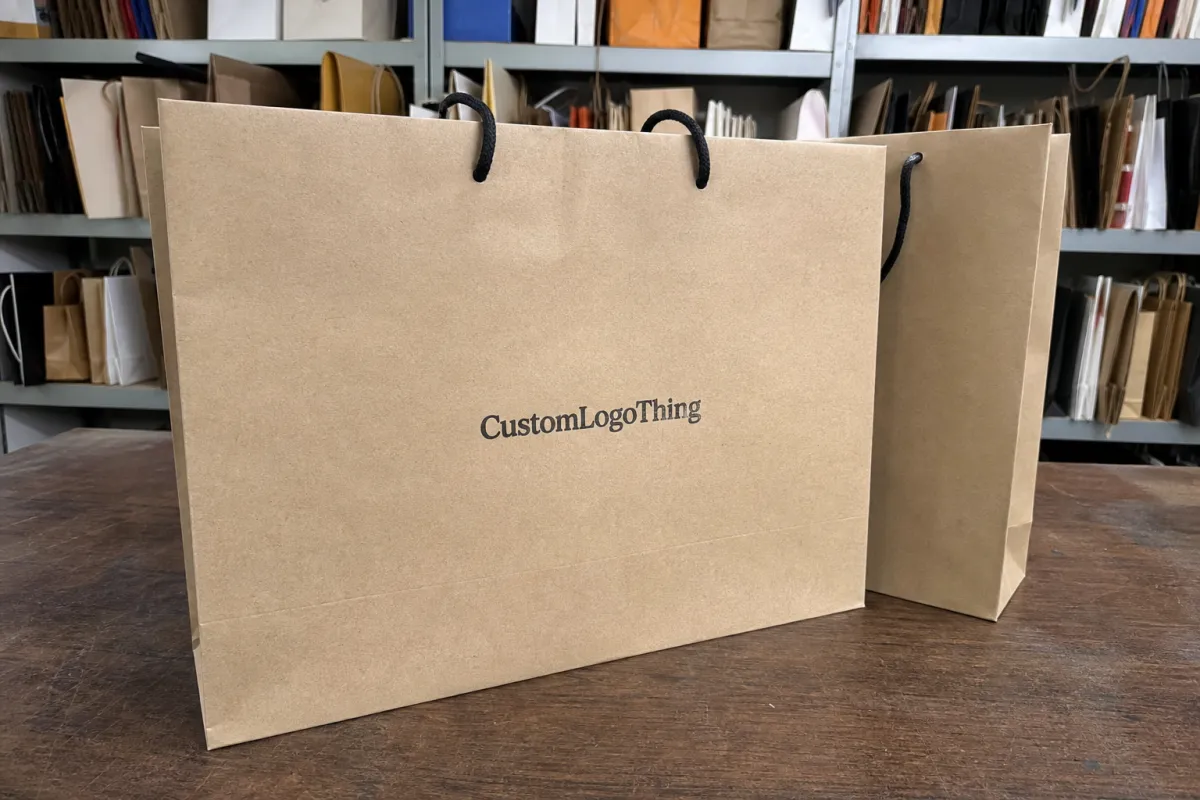
Large boutique bags do a job smaller bags cannot. They hold bigger merchandise, show more brand surface, and still look polished when a customer carries them out of a store or event. That matters for apparel, candle sets, gift bundles, cosmetics kits, and premium accessories. If the bag looks thin or collapses under weight, the whole purchase feels less considered. Pretty packaging that folds in half is not premium. It is an apology with handles.
There is also a practical retail reason these bags keep their place. A larger surface gives you more room for logo placement, pattern repetition, seasonal graphics, and a message panel without making the design feel crowded. A clean one-color logo on kraft can feel grounded and expensive in a quiet way. A full-coverage print on coated paper can feel sharper and more fashion-led. Neither is automatically better. The right choice depends on what is inside, how far the bag travels, and how much the buyer can spend without wrecking unit cost.
A large bag gets judged in use, not in a render. If it sags, tears, or arrives late, the brand image takes the hit.
That is why buyers care about large boutique paper bags Lead Time and MOQ before they care about decorative extras. A launch with 800 bags does not need the same factory setup as a holiday campaign with 20,000. And a storefront replenishment order should not be priced like a museum gift shop special run. Good sourcing is matching the bag build to the real volume.
One more thing: large does not have to mean flimsy. The best results usually come from simple construction choices made early, not from adding expensive decoration later. A properly reinforced bag often looks more premium than a heavily dressed-up one that has no structure once it is filled.
Paper, Handle, and Finish Choices That Change the Feel
Paper stock is the first decision that changes how the bag feels in hand. Kraft is the workhorse. It handles weight well, takes simple branding nicely, and tends to keep pricing sensible. Coated or art paper gives you cleaner color and sharper detail, which is useful if the logo relies on fine lines, photography, or high-contrast graphics. Heavier board-style constructions create a more boutique feel, but they also add cost and weight. That is the tradeoff. There is no free luxury.
Handle choice changes both the look and the unit cost. Twisted paper handles are common and efficient. Rope handles feel more premium and are usually better for heavier merchandise. Ribbon handles lean gift-oriented and softer. Die-cut handles can look clean on certain styles, but they are not the best choice if the bag has to support serious weight. If the customer is carrying boxed sets, candles, or glass, comfort and reinforcement matter more than a pretty handle photo.
Finishes are where buyers often overspend. Matte lamination can improve the feel and protect print. Soft-touch adds a richer surface but raises cost and can complicate production. Foil, embossing, and spot UV create visual impact, though they usually increase both setup charges and lead time. If the brand needs impact, use them on the logo or one focal area. Blanket coverage is expensive and often unnecessary.
Material choices also affect how the bag behaves in the carton and on the shelf. A satin rope handle may photograph better, but if the finish scratches easily or the lamination scuffs during packing, the bag arrives with a used look. Buyers often underestimate this. A sample that sits on a desk is not the same as a case-packed production run.
In practice, the best spec is the one that supports product weight and brand image without forcing the order into a premium tier just for the sake of it. A strong kraft bag with a reinforced top and rope handle often beats a flashier bag that costs more and ships slower.
Size, Strength, and Print Specs Buyers Should Lock In
The spec sheet drives almost everything that matters. Start with finished size, then lock in gusset depth, paper weight, handle type, reinforcement, and print coverage. For large boutique formats, a few millimeters of size change can affect layout, carton count, and freight efficiency. That is why “close enough” is usually not close enough.
Paper weight is not just a number. It tells you how the bag behaves. A lighter stock may be fine for apparel or paper goods, but a heavier build is safer for boxed merchandise. Common custom boutique runs often sit in the 170gsm to 300gsm range depending on the bag style. Kraft can live at the lower end and still perform well if the top fold, bottom board, and handle attachment are reinforced properly. If the bag is meant for a heavier item, ask where the extra strength actually comes from. Paper alone is not the whole story.
Print style also changes the build. A single-color logo on one panel is far easier than a bag wrapped in full-coverage color. More ink coverage usually means more setup and more risk of color drift. Spot colors, metallic inks, and complex artwork can all raise production time. The smarter buyer chooses a print method that matches the brand and the schedule, not the mood board.
For heavier products, ask about basic load testing and line strength. Packaging teams often reference standards and test methods such as ISTA for distribution testing, and that is not just paperwork theater. If the bag is meant to carry boxed goods, ask how handle attachment, side seam strength, and bottom reinforcement are verified before shipment.
If your sourcing brief includes recycled or certified fiber, ask for proof up front. FSC chain of custody is worth checking if the paper claim matters to your customer. That is cleaner than hand-waving about sustainability and hoping nobody asks for documents.
There is also a tolerance issue that gets missed. A bag can be correctly sized on paper and still feel wrong if the gusset depth, fold accuracy, or handle placement drifts outside a tight range. A few millimeters matter more than most non-technical buyers expect, especially when products are boxed or packed with tissue.
large boutique paper bags lead time and moq: Pricing, MOQ, and Quantity Breaks Without the Guessing
Pricing moves with five things: paper weight, bag size, print colors, handle style, and finish complexity. Add custom inserts, special coatings, or rigid boards and the quote climbs fast. The painful part is that buyers often compare only the printed bag price and ignore the quiet extras. Tooling fees, setup charges, proofing, carton packing, and freight can matter just as much as the unit quote.
MOQ is not a random factory preference. It is tied to how much setup the job requires and how much waste the line can absorb. If the run needs custom dies, special lamination, or multiple color passes, the minimum rises because the factory needs enough volume to cover setup and make the run efficient. If the spec is standard, the MOQ can stay lower. That is why a “cheap” complex bag can become expensive quickly. The work is hidden in the process.
Here is the practical range I would use as a starting point for large Boutique Paper Bags. These are common factory-side buying bands, not fixed rules. Final pricing depends on spec stability, print coverage, and the market your supplier is working in.
| Spec Level | Typical MOQ | Lead Time After Proof Approval | Approx. Cost Per Piece at 3,000 pcs | Best Fit |
|---|---|---|---|---|
| Simple kraft, 1-color print, twisted handle | 1,000-2,000 | 10-15 business days | $0.78-$1.25 | Retail basics, promotions, heavier everyday carry |
| Coated paper, 1-2 color print, rope handle | 2,000-3,000 | 12-18 business days | $1.05-$1.75 | Boutique retail, gift programs, premium branding |
| Art paper, matte lamination, foil or embossing | 3,000-5,000 | 15-25 business days | $1.55-$3.10 | Luxury presentation, launch kits, high-touch events |
That table is why MOQ matters so much. A cleaner spec can keep you near the low end of the range. A premium stack pushes you higher because the factory has more steps to manage and less room to absorb error. If a supplier promises a very low MOQ on a complex bag, ask what they are leaving out. Usually it is either finish quality, reinforcement, or both.
For buyers comparing bulk pricing, the real benefit comes when the spec stays stable enough for the setup cost to spread across more pieces. If you go from 1,000 to 5,000 units, unit cost usually drops. But if you also change the size, handle, and finish, you may erase the savings with new tooling fees and extra proof cycles. That is the trap.
A smart quote request asks for price breaks at three levels, not one. For example: 1,000, 3,000, and 5,000 pieces. That gives you a useful read on cost per piece, not just the cheapest-looking line item. It also shows whether the supplier is actually giving you a scale benefit or just padding the low-end number to win the order.
Freight should be included in the same comparison. Large paper bags are bulky before they are heavy, which means carton volume can shape landed cost as much as unit price. A lower factory quote with inefficient packing can lose to a slightly higher quote that fits more units per carton.
Production Steps and Lead Time From Proof to Shipment
The production path is usually straightforward, but only if the buyer keeps the inputs tight. First comes the quote. Then artwork review. Then proof approval. After that, the factory sources paper, prints, finishes, assembles, checks, packs, and ships. Each step is ordinary. The delays are not.
If your artwork is final, size is confirmed, and the material is standard, you can often keep the schedule inside 10-15 business days after proof approval for simpler bags. Mid-tier custom builds usually land around 12-18 business days. Premium finishes, special inserts, or multiple approval rounds can stretch that to 15-25 business days or more. That is why the phrase Large Boutique Paper Bags lead time and moq is really about planning, not just ordering.
The fastest orders usually share three traits:
- Artwork is editable and clean, so the proof stage is about layout instead of file repair.
- The buyer keeps to one main revision round instead of debating every color chip for a week.
- The bag uses standard paper and standard handle construction, which keeps sourcing simple.
Delays usually come from avoidable changes. Revised dimensions after the proof. A finish swap from matte to soft-touch. A color match that needs multiple samples. Or the classic move: increasing quantity after production has already started. That last one is especially expensive. It turns a quote into a negotiation the factory did not agree to have.
Freight matters too. Air shipping can deliver fast, often in a few business days once the cartons leave the plant, but it is costly. Ocean freight lowers the per-unit shipping burden, yet it adds weeks to the total timeline. Buyers who only ask for factory lead time end up surprised by the actual in-hand date. That is not a manufacturing problem. That is a planning problem.
For launch dates, count backward from the shelf date, not from the PO date. If the goods need customs clearance, domestic receiving, or relay to multiple stores, that extra cushion disappears faster than people expect. The order may be on time at the factory and still miss the event if transit and receiving were guessed instead of measured.
Quality Checks, Reorders, and Rush Planning That Save Time
A decent supplier does not just print bags. It keeps the approved spec on file. Size. Paper stock. Handle type. Print reference. Packing instructions. Carton count. All of it. That is what makes repeat orders efficient and keeps the next run from turning into a new sourcing project.
Quality checks should happen during production, not after the shipment lands on your dock. Look for print alignment, color consistency, handle bonding, crease sharpness, and carton counts. If the bag is destined for a busy store or event, ask for a basic pull check on handles and a quick inspection of the bottom board. Small failures become big complaints once bags reach customers.
For premium bags, a clean print is not enough. Buyers should also look at edge scuffing, adhesive visibility, and whether the handles sit evenly on both sides. These details are small until the bag is held in bright light or stacked near a checkout counter. That is where defects tend to show up.
Rush orders are possible, but they come with tradeoffs. Faster production usually means fewer finish options, tighter artwork rules, and little room for design tinkering. A rush run is not the moment to request foil, embossing, and a brand-new size on the same job. That is how schedules fall apart.
Reorders are where a stable spec pays off. If the paper, handle, and print setup stay the same, the factory does not need to rework the build from scratch. That can shorten the timeline by several days and make MOQ conversations easier because the production line already knows the job. For brands that reorder seasonally, consistency is the real savings.
One more practical point: if you are comparing vendors, ask how they handle pre-production samples versus production proofs. Some buyers want a physical sample for peace of mind. Fine. Just understand that it adds time and cost. If the design is simple, a digital proof and one tight approval cycle is often enough. If the bag has a special finish, a sample may be worth the delay because it exposes problems before the full run is locked in.
What to Send for a Fast Quote and Clean Approval
Good quoting starts with complete information. If you send half a spec, you get half an answer. That means more emails, more delays, and a higher chance of a pricing surprise later. The easiest way to keep the process moving is to send the actual production inputs from the start.
Use this checklist:
- Finished bag size: width, gusset, and height
- Quantity target and any backup quantity break you want priced
- Paper stock or at least the feel you want: kraft, coated, or heavier art board
- Handle type: twisted paper, rope, ribbon, or die-cut
- Print colors and print coverage
- Finish requirements: matte lamination, soft-touch, foil, embossing, spot UV
- Ship-to address and target in-hand date
- Editable artwork, ideally AI, EPS, or layered PDF
If you have artwork in a locked format, send that. If you have a deadline, say it plainly. If you are not sure about the finish stack, ask for two versions: a clean version and a premium version. That makes it easier to compare bulk pricing without guessing where the money is going.
It also helps to ask for a price ladder. Three quantities are enough for most buyers. For example, 1,000, 3,000, and 5,000 pieces. That gives you a real view of the unit cost, not just the cheapest pitch a supplier can throw at you to get the order. If the quote changes a lot between those points, you know the setup cost is doing real work in the pricing.
Keep the approval process simple. Conflicting notes buried in an email thread are a common reason for delays. One file, one spec, one set of dimensions. That is the cleanest path to a production ticket that matches the buyer’s intent.
The shortest path to a clean approval is not more email. It is fewer unknowns.
Next Steps to Order the Right Bag Size the First Time
Start with the bag size, not the decoration. Decide what the bag must carry, then build around that. A large boutique bag for folded apparel does not need the same reinforcement as one carrying boxed candles or ceramic items. Once the load is clear, the rest gets easier.
Then choose the paper weight, handle, and finish only after you know the use case. If the bag needs a premium feel, pay for the upgrade where it matters most. If the order is volume-driven, keep the spec efficient and let the brand graphics do the talking. That is usually smarter than spending money on a finish nobody notices.
Before you place the PO, compare total landed cost, not just factory price. Freight, cartons, proofing, and any tooling fees can move the real number fast. Buyers who only compare unit price often discover that the “cheaper” option is not actually cheaper once the cartons are on the dock.
For repeat orders, save the approved spec and keep it unchanged. That is how you get predictable lead times, cleaner reorders, and a less annoying MOQ conversation the next time you need the same bag. If the spec works once, do not get creative just because you have a fresh email thread.
Large boutique paper bags reward disciplined buying. The cleanest orders follow the same pattern: specific brief, ready artwork, realistic timing, and a quantity that fits the launch. Do that, and large boutique paper bags lead time and moq stops being a guessing game and becomes a normal sourcing decision.
How do large boutique paper bags lead time and MOQ change with premium finishes?
Foil, embossing, soft-touch lamination, and heavy print coverage usually raise both MOQ and production time. Standard kraft bags with simple printing are faster to run and easier to keep at a lower quantity. If you need a rush order, keep the finish stack simple and the artwork clean.
What is a realistic MOQ for large custom boutique paper bags?
MOQ depends on the bag size, paper stock, handle type, and print complexity. For a simple custom large bag, 1,000 to 2,000 pieces is a common starting point. Premium builds with special finishes or custom construction usually need 3,000 pieces or more.
What slows down the production timeline the most?
Artwork changes after proofing are the biggest delay. Color matching, revised dimensions, and finish changes also add time. If the spec is clear and the buyer approves quickly, the schedule usually stays much tighter.
What details should I send to get an accurate quote quickly?
Send finished size, quantity, paper weight, handle type, print colors, finish requirements, ship-to address, and your target in-hand date. Editable artwork helps a lot. If you also want price breaks, ask for three quantity levels so you can compare cost per piece properly.
Can I reorder the same large boutique paper bags with a shorter lead time?
Yes. Reorders are usually faster if the spec is saved and unchanged. Keeping the same paper, handle, and print setup avoids new tooling work and makes MOQ and pricing more predictable on future runs.


