Buyer Fit Snapshot
| Best fit | Branded Gable Boxes with Logo projects where brand print, material claims, artwork control, MOQ, and repeat-order consistency need to be specified before quoting. |
|---|---|
| Quote inputs | Share finished size, material target, print colors, finish, packing count, annual reorder estimate, ship-to region, and any compliance wording. |
| Proofing check | Approve dieline scale, logo placement, barcode or warning zones, color tolerance, closure strength, and carton packing before bulk production. |
| Main risk | Vague material claims, crowded artwork, missing packing details, or unclear freight terms can make a low unit price expensive after revisions. |
Fast answer: Branded Gable Boxes with Logo: Board, Finish, Dieline, and Unit Cost should be specified like a repeatable production item. The safest quote records material, print method, finish, artwork proof, packing count, and reorder notes in one written spec.
Production checks before approval
Compare the actual filled-product size with the drawing, then confirm tolerance on folds, seals, hang holes, label areas, and retail display edges. Reserve space for logos, QR codes, warning copy, and material claims before decorative graphics fill the panel.
Quote comparison points
Review material grade, print process, finish, sampling route, tooling charges, carton quantity, and freight assumptions side by side. A quote is only useful when the supplier can repeat the same color, closure quality, and packing count on the next order.
A gable box does more than carry a product from one place to another; it gives a brand a compact, highly visible surface that customers notice before the package is even opened. That is part of why branded gable Boxes with Logo keep showing up in bakery counters, gift programs, meal kits, and event packaging. The front panel, the peaked top, and the built-in handle all create places where a mark can be seen at a glance, even when the box is being held, stacked, or set down on a counter.
From a buyer's perspective, the appeal is practical as much as visual. A box that carries well, folds cleanly, and opens without fuss is already helping the brand, and branded gable Boxes With Logo tend to sit in that useful middle ground where presentation and function support one another. If two products are similar in price or quality, the one in a cleaner and more considered package often earns the first look, and that first look matters more than many teams admit.
The structure looks simple, yet the decisions behind it are not. Board type, print method, finish, inserts, proofing, and lead time all shape the final result, and branded gable boxes with logo can range from basic budget cartons to polished retail packaging with a distinctly premium feel. For teams comparing options, it helps to understand where the money goes and which choices actually change the customer experience rather than just the mockup.
Why Branded Gable Boxes with Logo Grab Attention Fast
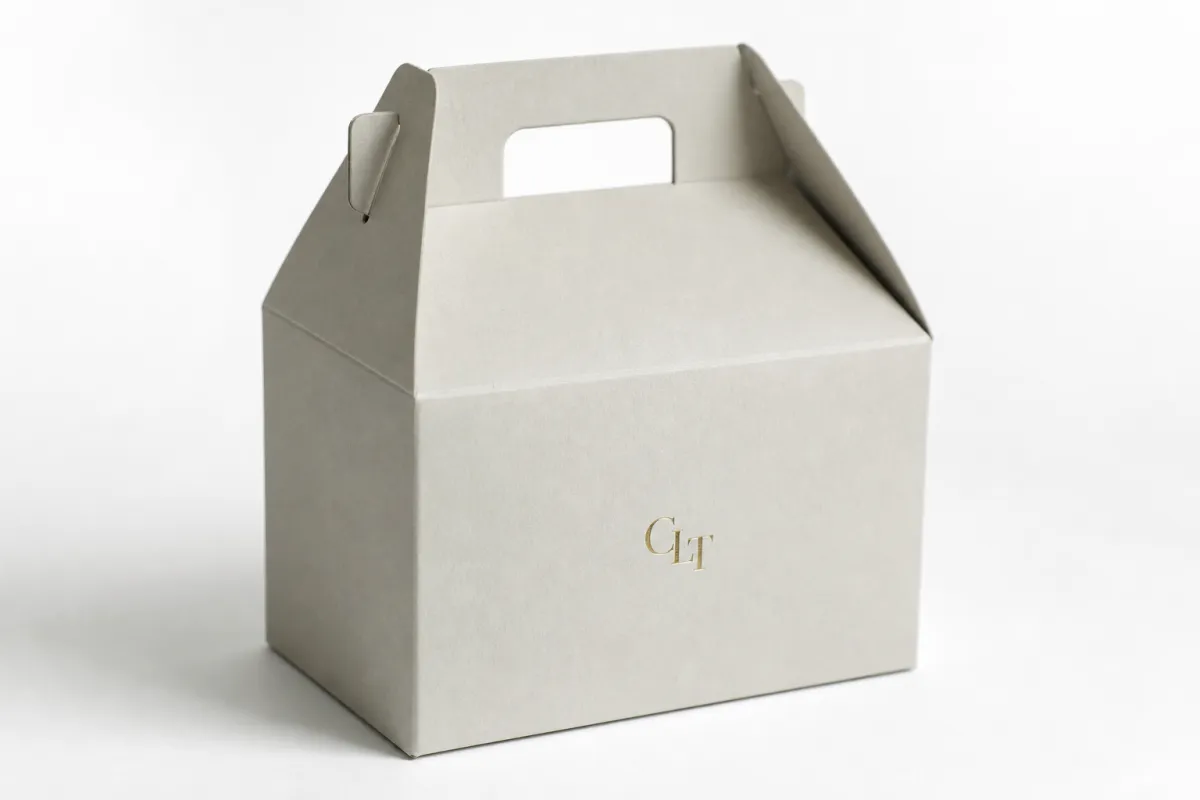
The shape does a lot of the work. A gable box naturally frames the logo on the front face, then repeats that branding across the sloped top and around the handle area, so branded gable boxes with logo can stay visible from several angles without needing a crowded layout. In a busy retail setting, that extra visibility is useful because the package may be seen from the side while it is being carried, from above while it is stacked, and from the front when it is placed on display.
People also respond to the way the package feels in the hand. A handled box suggests ease, and ease turns into memory. I have seen buyers focus on the product itself, only to realize later that the package became part of the purchase story, especially for bakery assortments, corporate gifts, and promotional sets. Branded gable boxes with logo do that kind of quiet work well, because they make the package feel deliberate even when the contents are straightforward.
For food service, the format is especially useful because it travels well over short distances and usually closes with a tuck or tab style that keeps the contents contained during handoff. For retail and events, the same shape creates a tidy presentation that feels more personal than a standard folding carton. Branded gable boxes with logo also fit subscription-style packs nicely, since the handle gives customers an easy carry option and the top panel gives the brand a clean place to live without crowding the rest of the design.
Comparison drives a lot of purchasing decisions. If the products inside are close in performance, price, or size, presentation often becomes the deciding factor. The box is not just a container; it sends a message about care, consistency, and value. When branded gable boxes with logo are designed with that in mind, they can make an ordinary item feel ready for gifting, retail display, or a polished service handoff.
Strong packaging does not need to shout. It needs to be clear, easy to carry, and convincing in the hand.
That is one reason the structure keeps appearing across so many categories. The built-in handle is useful, the silhouette is easy to recognize, and there is enough printable surface area to carry a logo without turning the box into visual clutter. For teams that want a practical format with real shelf presence, branded gable boxes with logo remain one of the most dependable choices.
How Branded Gable Boxes with Logo Are Printed and Assembled
At the production level, the structure is straightforward, but the details matter. A typical gable box starts as paperboard or corrugated board that is printed, cut, scored, glued, and then shipped flat for folding at the packing line. Once formed, the top panels rise into the gable shape, and the handle or top closure locks the package into a carry-friendly format. That sequence sounds simple, but the details are where a box can kinda drift off spec if the scoring, registration, or glue pattern is even slightly off. Branded gable boxes with logo depend on clean folds and accurate alignment if you want the carton to stand up crisply instead of bowing at the seams.
The print method should match the order size and the artwork. Offset printing is usually the right choice for larger, more detailed runs because it gives tight color control and sharp image reproduction. Digital printing fits smaller orders, faster turnarounds, and artwork with variable elements. Flexographic printing can work well on corrugated styles and certain high-volume applications where speed and repeatability matter more than fine photographic detail. For many buyers, a one-color or two-color branding approach is enough, especially when branded gable boxes with logo are meant to look clean, functional, and cost-aware.
Artwork placement deserves careful thought. The front panel is the obvious space, but the side panels and top areas can carry secondary marks, website text, a short message, or a product name without crowding the logo. If the box is used for a gift set or a premium retail launch, inside printing can create a memorable opening moment, and that effect is strongest when the outside stays restrained while the inside reveals the surprise. Branded gable boxes with logo do not need full coverage to feel branded; they need smart placement and enough contrast to read quickly.
Before production begins, die lines and fold logic should be reviewed with care. A logo that sits too close to a crease may distort when the board bends. A barcode placed on a seam can scan poorly. Even handle alignment matters, because a logo that looks centered in flat artwork may shift once the box is formed. Proofing is where those problems are caught, and for custom work I always recommend a folding test or at least a production-style proof, because a clean PDF does not always become a clean carton once the structure is assembled.
If you are comparing packaging formats, our Custom Packaging Products page is a useful place to look at other structures, and the Case Studies page can help you think through what works for different channels and product types.
Materials, Inserts, and Finishes That Change the Experience
The board choice affects nearly everything people notice in hand. SBS paperboard gives a smooth, print-friendly surface and usually feels more refined for retail or gift use. Kraft stock gives a warmer, more natural look and often fits brands that want an earthy or handmade impression. Corrugated board, especially when more strength is needed, is better for heavier contents or for packages that will face more handling. In practical terms, branded gable boxes with logo made from lighter paperboard are usually ideal for baked goods, apparel accessories, sample kits, and light gifting, while corrugated versions make more sense for heavier sets, transport-focused applications, or products that need extra protection.
Finishes change both appearance and wear resistance. Matte aqueous coating gives a softer look and helps reduce scuffing. Gloss coating makes color pop and can strengthen the sense of saturation on bright artwork. Soft-touch lamination adds a velvety feel that reads as upscale, though it usually costs more and can soften very sharp color contrast if the design is not handled carefully. Spot UV can highlight a logo or pattern, and foil accents can add a premium touch when used sparingly. Branded gable boxes with logo usually look strongest when the finish supports the logo instead of competing with it. A highly reflective surface can be eye-catching, but if it makes the mark hard to read under store lighting, the package is working against itself.
Inserts matter more than many teams expect. A divider, tray, or partition keeps items from shifting in transit and makes multi-item kits look organized when opened. For food service, a grease-resistant liner or a coated insert may be the difference between a package that performs cleanly and one that stains too quickly. For cosmetics or small electronics, a custom insert helps the product sit at the right height so the opening experience feels intentional. Branded gable boxes with logo can be simple on the outside and still feel refined inside when the fit is controlled properly.
It also helps to choose based on handling conditions. If the box is going onto a boutique shelf and then directly into a customer’s hands, surface finish and print quality matter most. If it will be stacked in storage, carried by staff, and moved through a cooler or delivery environment, structural strength and moisture resistance move to the top of the list. A lot of packaging teams try to save money in the wrong place: they choose a lighter board because the spec sheet looks fine, then discover the box sags, rubs, or scuffs once it enters real use. Branded gable boxes with logo should be chosen for the conditions they will actually face, not the nicest possible scenario.
| Material | Typical Use | Print Feel | Strength Profile | Best Fit |
|---|---|---|---|---|
| SBS paperboard, 16pt-24pt | Retail gifts, light food, sample kits | Very sharp, smooth, color-friendly | Good for light to medium loads | Clean branded gable boxes with logo where appearance matters most |
| Kraft stock, 18pt-28pt | Natural, eco-forward presentation | Warm, muted, slightly rustic | Moderate strength depending on build | Brands that want a natural look and simple branding |
| Corrugated board, E-flute or B-flute | Heavier kits, transport, protective packaging | Good, though less refined than SBS | High crush resistance and better stacking | Branded gable boxes with logo that must hold up in handling and delivery |
| Specialty coated board | Premium retail and gift programs | Enhanced color depth and texture control | Depends on base board and coating | Premium presentations where finish carries brand feel |
If sustainability claims are part of the brief, keep the language precise and back it with the correct certification or sourcing path. The FSC program is the reference many teams use for responsible forest sourcing, while the EPA recycling guidance is a reliable public resource when you are checking how a package should be described for end-of-life handling. That kind of discipline matters, because branded gable boxes with logo can be positioned responsibly without making claims that are vague or hard to verify.
Branded Gable Boxes with Logo: Process, Timeline, and Turnaround
The production sequence usually starts with a brief, not with artwork. A good brief tells the converter the product dimensions, target quantity, board preference, print method, finish, and whether the box is for food, retail, gifting, or shipping. From there, dielines are created or matched to the structure, and the artwork is mapped onto the flat layout. Branded gable boxes with logo move more predictably through production when the dimensions are already final and the team is not still adjusting product fit after the artwork has started.
Once the file is submitted, prepress checks become important. The team will review bleed, safe zones, barcode placement, resolution, and color mode before the proof is issued. That review may sound tedious, but it saves time later, especially with branded gable boxes with logo where fold lines and handle folds can affect how text reads in the finished form. If the logo sits too close to a panel edge or a small line crosses a crease, the box may still function, but it can look slightly off in a way that customers notice immediately.
Timing depends on construction and print complexity. A simple one-color run with clear artwork and standard board can move faster than a full-coverage, coated, multi-component order. For many straightforward projects, 12-15 business days after proof approval is a common planning window, while more detailed work can stretch beyond that if inserts, specialty finishes, or extra revisions are involved. Rush jobs are possible sometimes, but the queue at the press and converting line matters, and branded gable boxes with logo that need custom coatings or tight registration may not be candidates for the shortest schedule.
There is also a real difference between proof approval and production readiness. A buyer may approve the layout quickly, but if the final logo file is low resolution or the copy is still changing, the schedule can slip. Teams that stay organized about file prep usually save days, because the handoff from art to production is cleaner. From experience, the fastest orders are the ones where the customer knows the dimensions, sends a vector logo, confirms the color targets, and responds to the proof without delay. Branded gable boxes with logo reward that kind of discipline.
For packaging that must survive shipping or more demanding transport, it is worth asking whether the structure should be checked against testing protocols such as ISTA procedures or comparable distribution standards. That is not necessary for every order, but it becomes relevant if the box will move through parcel networks, cooler environments, or multiple handling points before it reaches the customer. Good packaging planning is not only about how branded gable boxes with logo look on day one; it is also about whether they still look right after the trip.
Cost, Pricing, and MOQ for Branded Gable Boxes with Logo
Price depends on a few clear levers: box size, board grade, print coverage, color count, finish, insert complexity, and order volume. A small box with simple one-color branding on standard board will usually cost less than a large, full-color package with foil accents, soft-touch lamination, and a custom insert. That may sound obvious, but branded gable boxes with logo are often quoted too loosely, which makes comparison difficult. A quote for a 6 x 4 x 4 carton is not comparable to a quote for a 10 x 6 x 6 carton, even if both use the same print style.
MOQ changes the math. Smaller runs are usually more expensive per unit because setup, plate, and machine time are spread across fewer boxes. Larger runs lower the unit cost, sometimes sharply, especially once the press is already tuned and the conversion line is running efficiently. For many custom programs, a minimum of 500 to 1,000 units is common, though digital or short-run production may go below that in some cases. Branded gable boxes with logo bought in higher quantities often land in a more workable price band for recurring programs, seasonal campaigns, or retail replenishment.
As a rough planning range, a simple custom gable box run might sit around $0.22-$0.45 per unit at moderate volume, while more elaborate versions with premium finishes or inserts can climb toward $0.60-$1.20 per unit, depending on size and board. Those numbers are not fixed, and they should not be treated as a promise, but they are useful when you are building a realistic budget. Branded gable boxes with logo are sensitive to the details, so two projects that look similar on the surface may have very different landed costs.
Freight, samples, and reorders also belong in the budget. A prototype may cost extra, but that cost is often easy to justify when the contents are high value or when the box will be seen by customers at a premium touchpoint. Freight can shift the total quite a bit if the cartons are bulky or if the destination is far from the converter. Reorders are usually more efficient if the original specs are locked and archived cleanly, because branded gable boxes with logo are easier to repeat when the dieline, material code, and finish notes are already documented.
One more caution: compare quotes on the same assumptions. A similar-looking price can hide different board weights, different coating systems, or different print methods. If one vendor is quoting a glued, flat-packed carton and another is quoting a pre-assembled specialty build, the numbers are not really competing with each other. That is why strong buying teams ask for the same dimensions, same quantity, same print coverage, and same finish before they compare. Branded gable boxes with logo should be priced like-for-like, not guessed from a similar photo.
Step-by-Step Guide to Ordering the Right Box Structure
Start with the product, not the decoration. Measure the item carefully, then add clearance for wrapping, cushioning, or hand insertion. If the product is going to sit in a liner or an insert, account for that thickness too. A box that is too tight will crush the contents or distort the gable top, while a box that is too loose can make the package feel unfinished. Branded gable boxes with logo perform best when the fit is intentional, because the handle and closure areas stay aligned and the product does not rattle around inside.
Next, define the use case. Retail display, food service, gift packaging, event kits, and shipping all create different needs. Food service may call for grease resistance and an easy closure. Retail gift packaging may need a cleaner print finish and a stronger first impression. Shipping may require heavier board or an outer shipper. Branded gable boxes with logo can serve several of those uses, but the material and finishing choices should match the actual environment, not the nicest-looking mockup.
Prepare the artwork assets before the quote moves too far. Vector logo files are best because they keep edge sharpness at any scale. Include brand colors, short copy, barcode requirements, and any legal or regulatory text early. If there is a sustainability claim, ingredient list, or handling icon, decide where it belongs before layout begins. The smoother the artwork package, the fewer proof revisions you usually need, and that helps branded gable boxes with logo stay on schedule.
Once the dieline arrives, review it carefully. Check the fold lines, panel orientation, handle placement, barcode window, and any safe margins around the logo. If the box has a top closure tab, make sure the artwork does not get interrupted in a way that looks awkward once the carton is folded. A proof should be judged as a formed object, not just as a flat file. That mindset is one of the simplest ways to avoid disappointment later. Many packaging issues are not design failures; they are file-placement issues that were never caught on the proof.
For higher-value products, or for launches where presentation really matters, order a sample or prototype. It can show whether the opening feel is right, whether the structure holds the load, and whether the logo is visible at the right angle. If the package will be used in a market where presentation and consistency are part of the purchase decision, branded gable boxes with logo are worth testing before a full roll-out. That small step often protects the larger budget.
- Measure the product and define the clearance you actually need.
- Choose the use case first, then match board and finish to that use.
- Send vector artwork, color references, and any compliance copy early.
- Review the dieline with fold lines, logo placement, and barcode space in mind.
- Approve a sample when the fit, value, or launch risk is high.
Common Mistakes, Expert Tips, and Next Steps
The most common mistake is choosing a size before the product is measured. That seems minor, but it creates a long chain of problems, from poor fit to wasted board to awkward closure tension. The second mistake is overdesigning the package. Branded gable boxes with logo do not need every panel crowded with copy, icons, and claims. A strong logo, a clear product name, and one or two supporting details often read better than a busy surface full of competing messages.
Finish selection causes trouble too. A glossy or specialty coating can look excellent on screen, but if it makes the logo hard to read under retail lighting, the finish is doing too much. The same thing happens when soft-touch material is chosen without considering scuffing, fingerprints, or the need for a bright, crisp color result. Branded gable boxes with logo usually work best when the finish serves readability first and decoration second.
Handle strength and closure style deserve a real check as well. If the carton will carry a heavier item, the handle area needs enough reinforcement to feel solid in the hand. If the top closure is too loose, the package can open before it should; if it is too stiff, staff will struggle with packing speed. The best branded gable boxes with logo feel easy in production and reliable in the customer’s hand, which is the balance every packaging buyer wants but not every spec sheet delivers.
Here is the part I would keep in mind as you move forward: be specific, ask for the dieline, compare like for like, and do not skip the proof. If you are ordering branded gable boxes with logo for a launch, a seasonal run, or a repeat program, the extra care up front usually pays back in fewer defects, cleaner presentation, and less rework. That is the difference between packaging that merely exists and Packaging That Actually supports the product.
For teams building out a broader packaging program, branded gable boxes with logo often sit nicely alongside other Custom Folding Cartons, inserts, and carry-out formats. If you need to widen the conversation, the best next steps are simple: measure the item, define the use case, request a quote, inspect the dieline, approve the proof, and schedule the run. Do that, and branded gable boxes with logo become a practical tool for presentation, protection, and repeat ordering instead of just another box on the checklist.
What products work best in branded gable boxes with logo?
They work especially well for bakery assortments, meal kits, gift sets, promotional packs, and retail items that benefit from both presentation and easy carrying. If the product is heavy or fragile, choose a stronger board grade or add inserts so branded gable boxes with logo perform well in real handling, not just on a shelf.
How much do custom gable boxes with logo usually cost?
Pricing depends on size, material, print coverage, finishes, inserts, and quantity, so the same-looking box can vary a lot in unit cost. Higher quantities usually lower the per-box price because setup costs are spread across more units, while specialty finishes or small runs raise the quote for branded gable boxes with logo.
What is the typical lead time for branded gable boxes with logo?
Lead time usually depends on artwork approval speed, print method, finishing complexity, and the current production queue. Fast approvals and simple specifications shorten turnaround, while samples, revisions, and premium finishes add time to the schedule for branded gable boxes with logo.
Can branded gable boxes with logo be used for food packaging?
Yes, many gable boxes are used for food when the board, coating, and any liner or insert are chosen for the product type. If the packaging will touch food directly or handle grease, moisture, or heat, confirm the correct material and food-safe construction first before ordering branded gable boxes with logo.
What files should I send for a logo on custom gable boxes?
Send vector files when possible, such as AI, EPS, or PDF, so the logo stays sharp at any print size. Include brand color references and any placement notes, and ask for a proof so you can confirm alignment before production begins on branded gable boxes with logo.
For buyers who want a package that carries well, presents well, and reorders cleanly, branded gable boxes with logo remain one of the most useful formats in custom packaging because they balance structure, print impact, and everyday practicality in a way that very few other cartons can match. The best next move is to lock the dimensions, choose the board for the real handling environment, and approve a sample before the full run, because that is the point where good packaging decisions turn into packaging that actually performs.


