Buyer Fit Snapshot
| Best fit | Branded Hang Tags for Apparel projects where brand print, material claims, artwork control, MOQ, and repeat-order consistency need to be specified before quoting. |
|---|---|
| Quote inputs | Share finished size, material target, print colors, finish, packing count, annual reorder estimate, ship-to region, and any compliance wording. |
| Proofing check | Approve dieline scale, logo placement, barcode or warning zones, color tolerance, closure strength, and carton packing before bulk production. |
| Main risk | Vague material claims, crowded artwork, missing packing details, or unclear freight terms can make a low unit price expensive after revisions. |
Fast answer: Branded Hang Tags for Apparel: Design, Cost, and Timing should be specified like a repeatable production item. The safest quote records material, print method, finish, artwork proof, packing count, and reorder notes in one written spec.
Production checks before approval
Compare the actual filled-product size with the drawing, then confirm tolerance on folds, seals, hang holes, label areas, and retail display edges. Reserve space for logos, QR codes, warning copy, and material claims before decorative graphics fill the panel.
Quote comparison points
Review material grade, print process, finish, sampling route, tooling charges, carton quantity, and freight assumptions side by side. A quote is only useful when the supplier can repeat the same color, closure quality, and packing count on the next order.
Branded Hang Tags for apparel do a lot more than carry a price. They are usually the first printed piece a shopper touches, and that tiny rectangle or folded card is already shaping how the garment feels before anyone has checked the stitching, the hand feel, or the drape. If the tag feels flimsy, the product can feel cheap in a hurry. That is not dramatic. It is just how retail perception works.
For apparel brands, designers, and production teams, Branded Hang Tags for apparel belong in the same conversation as the garment itself. The right tag makes a line look organized, deliberate, and worth the money. The wrong one creates doubt right when the customer is deciding whether the item deserves a place in the cart. Even in DTC, where no one is standing in a crowded aisle, people still notice the small signals that say whether a brand is serious.
What Branded Hang Tags for Apparel Actually Do
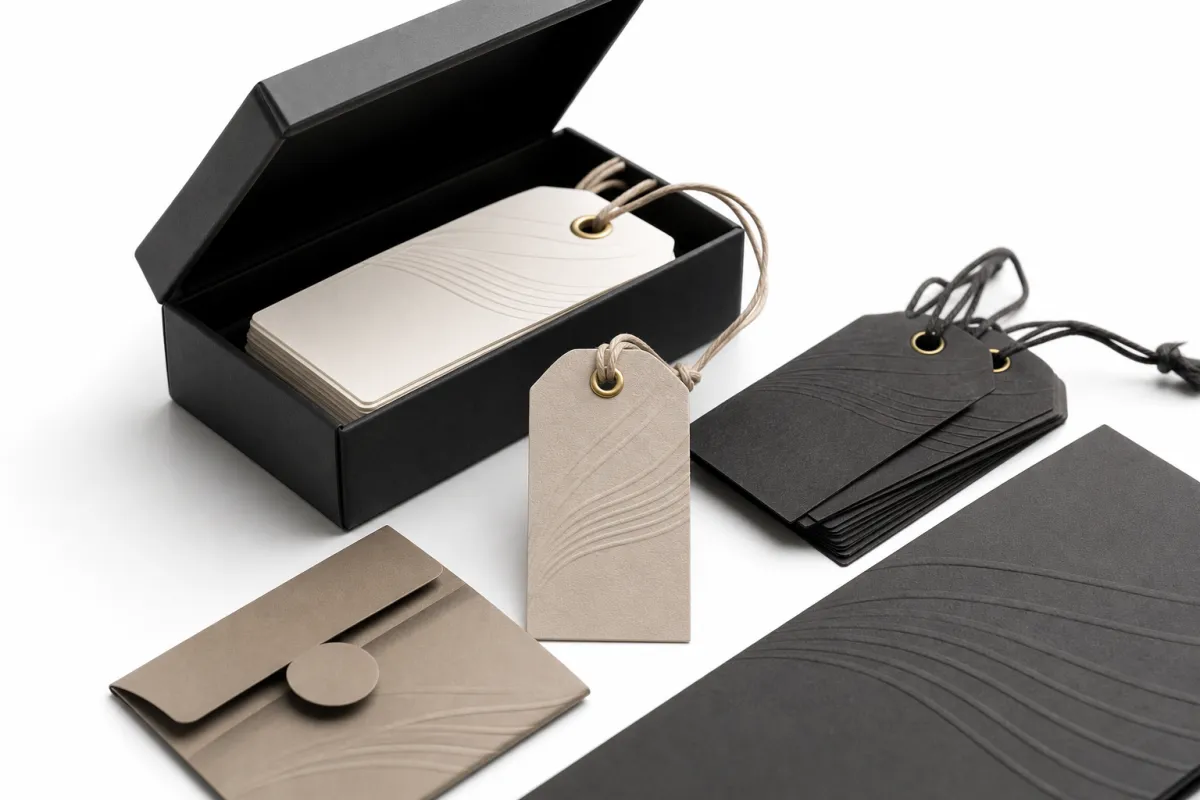
Most shoppers decide whether a garment feels premium before they ever study the details, and Branded Hang Tags for apparel do a surprising amount of that work in the first few seconds. The tag frames the product. It tells the buyer, in just a few square inches of print, whether the brand is intentional or just hoping the shirt sells itself. That is a lot of pressure for paper or board, but that is the job.
On the practical side, Branded Hang Tags for apparel carry the information people need right away: brand name, style name, size, price, SKU, barcode, fiber content, care notes, sustainability claims, and sometimes a social handle or QR code. In retail, they keep the product easy to scan and easy to organize. In wholesale, they help assortments and line presentations stay clean. In boutique and DTC settings, they reinforce the feeling that the brand has thought through the presentation from the start.
They also solve a basic merchandising problem. A sewn-in label is small and heavily regulated. A hang tag gives you space to explain what makes the product worth paying for. That might be organic cotton, a heavier knit, a limited drop, or simply a clean design that feels better made than the usual cluttered alternative. Branded hang tags for apparel can communicate all of that without cramming the inside label full of legal text.
That is the part people miss most often: the tag is not decoration. It is packaging for apparel. It needs to protect the brand story, survive transit, hang well on the rack, and still look intentional in a flat lay, a shipping photo, or a store fixture. A well-made tag gives a line more structure. A sloppy one makes even a strong product feel unfinished.
From a buyer's point of view, branded hang tags for apparel should answer three questions quickly:
- What brand is this?
- Why does it cost this much?
- What do I need to know before I buy it?
If the tag answers those clearly, it is doing its job. If it is crowded, hard to read, or trying too hard with five finishes and tiny type, it is not helping. I have seen plenty of tags that look expensive in a mockup and then feel clumsy in the hand. Paper is not magic. It still has to read well once it is printed, cut, and attached.
Branded hang tags for apparel can also support sustainability messaging, but only when the claim is real and specific. FSC-certified paper, recycled stock, and lower-coverage ink choices make sense when they match the product and the supply chain. If you need a reference point on chain-of-custody paper options, the Forest Stewardship Council has clear certification guidance at fsc.org. Use the claim carefully. Nobody wants a green label that overpromises and leaves the brand with nothing solid behind it.
For brands comparing tag formats, it helps to look at the wider packaging system too. Our Custom Labels & Tags page is a useful reference if you are deciding whether a woven label, printed label, or hang tag should carry the main message. Sometimes the smartest move is not one perfect tag. It is one tag doing the right job and nothing more.
Branded Hang Tags for Apparel Process and Timeline
The production path for branded hang tags for apparel is not complicated, but it absolutely punishes sloppy planning. Start with the basics: dimensions, stock, print method, finishing, attachment style, quantity, and how the tag will be used. If those details are fuzzy, the quote will be fuzzy too. Nobody likes a vague quote that looks friendly on paper and gets expensive everywhere else.
Usually, the process starts with a spec sheet or a short brief. A useful brief for branded hang tags for apparel should include trim size, any fold lines, the exact hole location, whether you need matte or gloss, and whether there is room for a barcode or QR code. If you are selling across channels, say so up front. Retail tags and e-commerce presentation tags are not always identical, and pretending they are often leads to a reprint later.
Proofing comes next. A digital proof is helpful for layout, spelling, and basic alignment. It is not enough for every job. If the design depends on a specific paper tone, foil, embossing, or soft-touch coating, ask for a physical sample. Color and texture are where people get surprised, and surprise is a poor production strategy. In my own proofing work, the biggest issues rarely showed up in the clean PDF preview; they showed up when the sample came back and the paper suddenly looked warmer, cooler, or much more reflective than anyone expected.
A realistic timeline for branded hang tags for apparel often looks like this:
- Artwork prep and final copy: 1-3 business days
- Proofing and revisions: 1-4 business days
- Printing: 2-5 business days
- Finishing and die cutting: 1-3 business days
- Packaging and freight: 2-7 business days depending on destination
That means standard runs often land in the 8-15 business day range after proof approval, while specialty finishes or more complex die cuts can push closer to 15-25 business days. If a launch, photoshoot, retail delivery, or buyer appointment depends on the tags, build in buffer time. Do not schedule a product drop around the fastest possible promise. That is how teams end up staring at tracking numbers like they owe them money.
Delays tend to show up in the same places: missing artwork, late copy changes, barcode data that has not been tested, or a finish request added after the proof has already gone around twice. Shipping delays have a way of appearing right when the calendar is tightest. If the tags need to arrive before packing starts, use a shipping method that leaves some margin.
For brands that want to study how other teams handle launch packaging and production coordination, our Case Studies page can help you see how different material and timing choices play out in real projects. It is easier to spot a good workflow after you have seen a few that went sideways.
If the tags are moving through warehouse operations or fulfillment, transit durability matters too. The International Safe Transit Association publishes packaging test standards at ista.org, and while hang tags are small, the same thinking applies: package the parts so they arrive flat, clean, and usable. A crushed stack of tags is not a crisis, but it is still a waste of time you probably did not budget for.
"The fastest quote is not always the cheapest order. A clean proof and a realistic schedule usually save more money than squeezing a rush through a stressed production window."
Branded Hang Tags for Apparel Cost: Pricing, MOQ, and Unit Cost
Pricing for branded hang tags for apparel is driven by a handful of predictable factors: paper or board type, size, print coverage, number of sides, specialty finishes, die cutting, and attachment method. Add foil, embossing, spot UV, or soft-touch lamination, and the price moves fast. Not wildly. Just fast enough to annoy anyone who assumed a tag was basically paper.
For simple branded hang tags for apparel, a modest run on standard board can stay in a lower price band, often somewhere around $0.06-$0.14 per unit at 5,000 pieces, depending on the exact spec. Add premium stock, a second print side, foil, or a custom shape, and you can land more like $0.18-$0.45 per tag, sometimes more if the job is highly decorative or the quantity is low. Those are not universal numbers. They are directional ranges, and they only mean something if the specs actually match.
MOQ matters because it changes both unit cost and cash flow. Smaller runs usually cost more per piece, but they reduce inventory risk. Larger runs bring the per-tag cost down, but now you are storing more tags and betting that the design, price, and product line will stay stable long enough to use them. That is fine for core products. It is less fine for a trend-driven capsule that might be gone in six weeks.
Here is a simple comparison that usually helps brands think straight:
| Tag Type | Typical Look | Common Use | Relative Cost | Best For |
|---|---|---|---|---|
| Uncoated kraft | Natural, matte, earthy | Basics, eco-leaning brands | Low to moderate | Simple branding, recycled positioning |
| Coated artboard | Crisp, bright, sharp print | DTC, fashion, retail | Low to moderate | Strong color and fine detail |
| Soft-touch stock | Velvety, premium feel | Higher-end apparel | Moderate to high | Luxury cues and tactile branding |
| Foil or emboss added | High contrast, decorative | Premium collections | High | Hero SKUs and special drops |
Compare quotes carefully. Same size. Same stock. Same finish. Same attachment. Same shipping terms. Otherwise you are comparing one supplier's base tag to another supplier's fully decorated version, which is a great way to make the wrong decision with confidence. I have seen brands celebrate the lower quote and then discover it does not include the die, the string, or the packaging format they actually needed.
Watch for hidden costs too. Artwork cleanup may be extra. Die charges may be one-time or amortized. Sample fees, rush fees, and freight can make the real spend feel very different from the headline price. If you want a better sense of how the numbers shift by project complexity, look at several comparable quotes instead of one enthusiastic sales pitch. Three quotes beat one polished promise every time.
My practical buying advice: if a brand is testing a new style or a new collection name, a moderate run is usually smarter than chasing the absolute lowest unit cost on a giant order. The smallest cost per tag is not always the smartest cost per launch. If the product changes, the tags become dead inventory. That is not savings. That is paper in a box.
Design Choices That Make Hang Tags Work Harder
Good branded hang tags for apparel are built around hierarchy. The brand name should be obvious. The product name or style should be easy to scan. Price, size, and a key selling point should not be buried under decoration. If the customer has to hunt for the basic information, the tag is failing its first job. Pretty is not enough.
Material choice matters more than many teams expect. Kraft stock gives a natural, understated feel. Coated board prints cleaner and usually handles tight type better. Soft-touch stock adds a premium tactile note, but it is not the right fit for every line. Recycled stock can support an eco-forward story, especially when the claim is backed up properly. If the brand message is clean and modern, a matte-coated tag with restrained color often works better than a pile of special effects.
Designers sometimes overcomplicate branded hang tags for apparel because they want the tag to say more. That usually backfires. A tag with one strong message, one clear callout, and a solid layout tends to outperform a tag with six ideas fighting for attention. Use finishes with intent. Foil can highlight a logo. Debossing can add quiet depth. Spot UV can create contrast. Put all three on the same tag and it starts looking like a sample board that got into a fight with itself.
Contrast is a functional decision, not just a visual one. Dark type on light stock is usually safer for readability and barcode legibility. Pale type on textured kraft can look stylish, but only if the text is large enough and the finish supports clean printing. Tiny copy near the edge of a die cut is asking for trouble. So is placing a QR code too close to a fold or hole.
Layout details are the unglamorous part, and they matter. Hole placement affects how the tag hangs on a neck label or security pin. String length affects whether the tag dangles awkwardly or sits neatly against the garment. Fold style changes how much information you can fit without overwhelming the front. If the tag must scan at retail, leave adequate quiet space around the barcode and test it on the actual board, not just on a monitor.
For brands that want to keep the apparel system consistent, branded hang tags for apparel should match the tone of woven labels, printed care labels, and outer packaging. They do not all need to look identical. They do need to look like they belong to the same brand. That is the difference between a collection and a pile of parts.
A useful rule of thumb: if the garment is basic, the tag can still look deliberate without becoming busy. If the garment is premium, the tag should feel refined rather than loud. The product tier should shape the paper choice, finish choice, and typography. Otherwise you end up spending luxury money on a tag for a $24 tee, which is a quick way to make the margins complain.
Step-by-Step: Ordering Branded Hang Tags for Apparel Without Mistakes
Ordering branded hang tags for apparel gets much easier once you stop treating it like a generic print job. Step one is gathering your specs before you start shopping. Decide the quantity, dimensions, stock, finish, attachment method, and whether there are retail or compliance requirements. If you know the product is headed to wholesale accounts, say that. If the tags need to support a scan at checkout, say that too.
Step two is artwork. Clean files save time and money. Logos should be vector. Photos should be high resolution. Barcodes should be tested from real data, not placeholder numbers you plan to fix later. Copy should be final before proofing starts. Every extra revision increases the odds that somebody misses a small but expensive mistake.
Step three is the proof check. Do not skim it. Read every line. Confirm spelling, SKU numbers, price, units, and any care or content claims. Look closely at alignment around the fold, the hole, trim edges, and any area with white type or metallic ink. If a brand name sits too close to the edge, it can get visually cramped after cutting. That is not the printer's fault. It is a layout problem.
Step four is the sample decision. For standard uncoated or coated stock, a digital proof may be enough if the artwork is straightforward. For soft-touch, foil, embossing, or textured papers, ask for a physical sample. Screen previews leave out the parts that matter most. They cannot show how a tag catches light or how a paper feels in the hand. Those details matter in branded hang tags for apparel because the tag is part of the product experience, not just a carrier for data.
Step five is logistics. Confirm how the tags will be packed, whether strings or pins are included, and where they are shipping. If you are receiving them at a warehouse, make sure the team knows the delivery date and storage needs. If you are receiving them at an office, make sure there is actually room for the cartons. A great tag arriving at the wrong place is still a problem.
There is one workflow detail worth keeping in mind for branded hang tags for apparel: test the final tag on the garment before locking a full run. A tag can look right as a proof and still hang poorly on a ribbed collar, a thick hoodie, or a lightweight satin top. Product weight changes the feel of the hang. A small change in hole position can fix that. A careless one can make the whole line look less polished than it should.
If you are trying to compare options across custom packaging and apparel branding, the packaging side of the business can be very useful. The same discipline that goes into cartons and insert cards applies here: define the use, define the limits, then design around them. That is how branded hang tags for apparel stop being a line-item surprise and start being a controlled part of the brand system.
Common Mistakes With Branded Hang Tags for Apparel
Mistake one is designing for looks only. A tag that looks beautiful in a mockup can fail in a store if the type is too small, the barcode does not scan, or the hole placement makes it hang crooked. Branded hang tags for apparel need to survive real use, not just presentation slides.
Mistake two is stacking too many finishes. Foil, embossing, spot UV, soft-touch, and custom shapes all have their place. All of them on one tag usually means the brand is trying too hard. The result can feel more expensive in concept than in execution. Once the production budget gets stretched, someone ends up cutting corners on stock or print quality, which is the exact opposite of what the extra finishes were supposed to solve.
Mistake three is ignoring MOQ and reorder behavior. A startup might order too many branded hang tags for apparel because the unit cost looked better at a higher quantity. Then the product changes, the price changes, or the logo gets updated, and the leftovers become obsolete. On the other side, a fast-growing brand may order too few and spend too much on repeat runs. Neither is smart. The sweet spot is the quantity you will actually use before the next change.
Mistake four is skipping a physical sample when the material matters. Texture changes perception. So does color shift. A brand can think it ordered a warm kraft brown and receive a cooler, flatter tone that makes the whole line look less intentional. A sample is a small cost compared with reprinting hundreds or thousands of tags because the finish was not what the team expected.
Mistake five is leaving pricing and legal copy until the end. That is how last-minute edits happen. It is also how people forget country of origin language, fiber content, care instructions, or barcode formatting. Branded hang tags for apparel should be checked with the same care you would give to any retail-facing asset. If it is going to sit on a garment in front of a buyer, it deserves a final legal and content review.
There is one more mistake worth calling out: treating the tag as separate from the rest of the packaging. A smart apparel system keeps branded hang tags for apparel aligned with labels, mailers, inserts, and outer cartons. The goal is not sameness. The goal is consistency. That is what makes a product line feel built, not assembled.
And if you want a reality check on how packaging choices affect the finished brand impression, the broader packaging industry has long treated material selection and transit performance as part of the same conversation. For practical guidance on material stewardship and packaging efficiency, the Packaging Consortium is a useful place to start. Not glamorous. Useful. There is a difference.
Expert Tips and Next Steps for Your Next Run
Start with one hero format for your core line, then create simple variations for seasonal drops. That approach keeps branded hang tags for apparel consistent without making every collection a custom production science project. A stable base spec saves time, lowers reorder confusion, and makes it easier to spot what actually needs changing.
Match the tag to the product tier. Premium apparel can support heavier stock, refined typography, and a cleaner finish. Basics often do better with straightforward materials and a disciplined layout. Do not force a luxury-looking tag onto a low-margin item unless the numbers truly support it. Packaging should fit the business model, not just the mood board.
Use the tag to reinforce the sale. A strong message, clear price presentation, or a concise product story often beats extra decoration. If the product is made from organic cotton, say that plainly. If the style is limited, keep the message sharp. If the brand has a technical benefit, make it easy to scan. Branded hang tags for apparel work best when the copy is practical and the design clears space for the point.
Build a reusable spec sheet for future orders. Include size, stock, finish, attachment, barcode needs, approved copy, and the vendor notes that matter most. Once you have a spec that works, future reorders get faster and less stressful. That is where the real savings live. Not in pretending every run is brand new.
For eco-conscious brands, keep sustainability claims specific and support them with actual material choices. Recycled content, FSC-certified paper, and right-sized packaging are all credible moves when they fit the brand. If you need general guidance on waste reduction and material stewardship, the EPA has useful packaging and recycling resources at epa.gov. The claim has to match the process. Otherwise it is just green ink.
Next steps are simple. Audit your current tags. Collect two or three comparable quotes. Order one sample if the finish matters. Then lock a repeatable spec before placing your branded hang tags for apparel order. That sequence saves time, cuts rework, and usually results in a tag that looks like it belongs on the garment instead of sitting near it like an afterthought.
Branded hang tags for apparel are small, but they carry a surprising amount of responsibility. If you get the Design, Cost, and Timing right, they help the product feel finished, retail-ready, and worth the price. If you get them wrong, they create noise. For a brand that wants to look organized and credible, branded hang tags for apparel are worth the planning.
FAQ
How much do branded hang tags for apparel usually cost per tag?
Pricing depends on size, stock, print coverage, finishes, and quantity, but the unit cost usually drops as the run gets larger. Simple branded hang tags for apparel can stay in a lower cost band, while foil, embossing, or custom shapes push the price up fast. Compare quotes with the same specs or the numbers are meaningless.
What is the typical turnaround for branded hang tags for apparel?
Standard turnaround usually includes proofing, printing, finishing, and shipping, so the full timeline is longer than the press time alone. For branded hang tags for apparel, a straightforward job often lands in the 8-15 business day range after proof approval, while specialty finishes can take longer. Rush orders are possible, but they usually cost more and leave less room for revisions.
What information should branded hang tags for apparel include?
At minimum, include the brand name and product name or style number. Many brands also add price, size, fabric details, care notes, barcode, and sustainability messaging. For branded hang tags for apparel, keep the most important information visible first, then support it with secondary details.
How do I choose the right material for branded hang tags for apparel?
Use heavier or textured stock when you want a premium feel, and cleaner coated stock when you want crisp print detail. Kraft stock works well for natural or eco-focused positioning, but it is not the best choice for every brand. Pick the material that matches the garment price point and the brand story, not just the design trend.
What is the best MOQ for branded hang tags for apparel?
The best MOQ is the one that balances unit cost with how fast you will actually use the tags. For new styles, a smaller run can reduce risk even if the per-tag cost is a little higher. For core products, a larger run usually makes sense if storage is not a problem. The right MOQ for branded hang tags for apparel is the one that does not leave you with dead inventory or a panic reorder.