Buyer Fit Snapshot
| Best fit | Branded Hang Tags Price projects where brand print, material claims, artwork control, MOQ, and repeat-order consistency need to be specified before quoting. |
|---|---|
| Quote inputs | Share finished size, material target, print colors, finish, packing count, annual reorder estimate, ship-to region, and any compliance wording. |
| Proofing check | Approve dieline scale, logo placement, barcode or warning zones, color tolerance, closure strength, and carton packing before bulk production. |
| Main risk | Vague material claims, crowded artwork, missing packing details, or unclear freight terms can make a low unit price expensive after revisions. |
Fast answer: Branded Hang Tags Price: What Affects Your Final Quote should be specified like a repeatable production item. The safest quote records material, print method, finish, artwork proof, packing count, and reorder notes in one written spec.
Production checks before approval
Compare the actual filled-product size with the drawing, then confirm tolerance on folds, seals, hang holes, label areas, and retail display edges. Reserve space for logos, QR codes, warning copy, and material claims before decorative graphics fill the panel.
Quote comparison points
Review material grade, print process, finish, sampling route, tooling charges, carton quantity, and freight assumptions side by side. A quote is only useful when the supplier can repeat the same color, closure quality, and packing count on the next order.
Branded Hang Tags Price: What Affects Your Final Quote is rarely one clean number, because stock, size, finish, and attachment choices can shift the quote far more than the logo itself. A tag that looks simple on a sales sheet can stay economical with standard card stock, then climb quickly once a buyer adds foil, soft-touch coating, specialty die cuts, or custom stringing. That is usually where the sticker shock starts.
For a buyer, the real task is not only finding a low number; it is understanding what sits inside that Branded Hang Tags price so the finished piece still fits the product, the shelf, and the budget. Two quotes can look similar at a glance and still be built on very different assumptions, which is why a clear spec sheet matters more than a short email request. The strongest quotes spell out what is included, where the price changes, and which upgrades move the needle before production starts.
Paper tags, clothing tags, and product hang tags all follow the same basic logic, yet the actual production path changes quickly once a project moves from a plain printed card to a more finished retail piece. Material choice, print method, finishing, minimum order quantity, and timing all play a role. If you are comparing supplier offers for apparel, accessories, gift packaging, or private-label products, the goal is to read the quote line by line and understand which version of branded hang tags price matches the job in front of you.
To keep the process practical, this article stays focused on real production details: common paper stocks, typical sizes, quantity breaks, finishing costs, and the add-ons that make a tag feel more premium. You will also see how to ask for a cleaner quote, how to compare suppliers on equal terms, and how to decide whether a higher spec is worth the extra spend for the product you are selling. That kind of clarity matters, because branded hang tags price should reflect the real build, not a vague idea of what the tag might become.
Branded hang tags price: why the first quote often surprises buyers
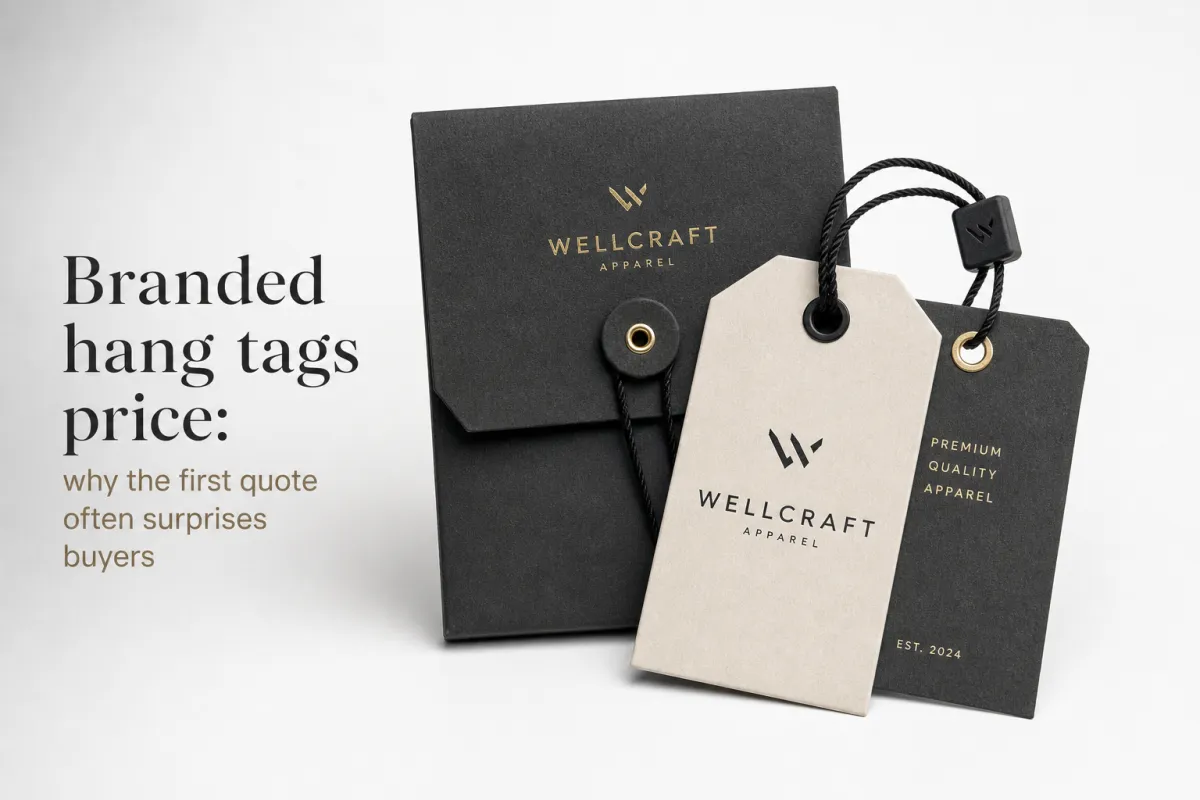
The first quote often surprises buyers because the sample they picture in their head is usually a plain printed card, while the actual order may include several production steps that carry separate setup or finishing costs. A standard 2 x 3.5 inch tag on 16pt cover stock with clean four-color printing sits in a very different price band from the same tag with soft-touch lamination, foil, rounded corners, and pre-threaded cotton string. That is why branded hang tags price is driven less by the word "tag" and more by the exact build behind it.
Most pricing confusion starts with assumptions. One person is thinking about appearance, another is thinking about shelf readiness, and a third is thinking about what can be produced efficiently in the plant. When those views are not aligned, branded hang tags price can seem inconsistent across suppliers, even when every quote is technically accurate based on the information provided. A quote is only as useful as the brief that shaped it.
The simplest way to reduce that confusion is to treat the hang tag as a configured product, not a generic accessory. Stock, thickness, size, print side, special finish, hole style, and attachment method all affect the final number. Once you see the quote that way, branded hang tags price becomes easier to compare, because you are no longer looking at a logo tag in the abstract; you are looking at a printed component with known production inputs.
A cleaner quote starts with a cleaner spec sheet. The more exact the stock, size, finish, and attachment method, the less guesswork sits inside the branded hang tags price.
Retail reality matters too. A simple tag can look perfectly fine on a basic apparel line, but if the product sits in a premium display, the hang tag often becomes part of the perceived value. In that case, branded hang tags price is not only a cost line; it is part of the product presentation budget, and a slightly higher spec can be a sensible investment if it helps the item feel more complete on shelf.
For buyers who need a broader view of related packaging components, our Custom Labels & Tags page is a helpful starting point, especially when you are deciding whether your branding needs a tag, a label, or both. If you want to see how different briefs change the production path, the Case Studies page shows the kind of spec variation that often drives branded hang tags price.
Product details that shape branded hang tags price
The biggest price swings usually come from the core build choices: paper or card stock, thickness, size, shape, print coverage, and whether the tag is single-sided or double-sided. A 14pt uncoated card with one-color black print is a very different manufacturing job from an 18pt coated stock with full-color imagery on both sides. That difference shows up directly in branded hang tags price, because each additional layer of complexity adds either material cost, setup cost, or press time.
Stock selection is one of the most important variables. Economy uncoated papers usually keep the cost down and give a natural, tactile look, while heavier cover stocks improve rigidity and feel more substantial in the hand. Coated stocks hold color better and keep small text cleaner, which matters if your art includes product copy, care details, or small QR codes. For teams that want a more sustainable angle, FSC guidance at fsc.org is a useful reference when you are checking certification language and chain-of-custody needs. I have seen buyers get tripped up here more than once, usually because the quote assumed a standard sheet and the brand later asked for a certified stock with paperwork to match.
Size and shape matter more than many buyers expect. A standard rectangle on a common die is usually easier to produce than a fully custom silhouette, and rounded corners are often cheaper than complex contour cuts. That does not mean custom shapes are off the table; it means the shape should serve the brand, not the other way around. In many cases, the right answer is still a clean rectangular hang tag with strong typography, because it keeps branded hang tags price under control while preserving a polished retail look.
Artwork complexity also changes the quote. A one-color logo on natural stock is straightforward. Full-color process printing is still very common, but once you add spot UV, foil stamping, embossing, debossing, or multiple ink passes, the shop may need extra setup, separate tooling, or additional finishing time. Those upgrades can be worth it for fashion or gift packaging, yet they should be chosen intentionally because they can move branded hang tags price faster than most buyers expect.
Retail category matters too. Apparel brands often want a matte or soft-touch tag that feels premium without stealing attention from the garment. Accessories buyers may prefer a slightly smaller tag with strong contrast and a durable hole area. Gift packaging often needs more visual punch, which makes foil or a special coating more attractive. The best branded hang tags price is not always the lowest one; it is the one that matches the product story without forcing the budget into features the customer will never notice.
Specifications that affect durability, print quality, and value
Thickness and rigidity matter because a hang tag is handled more than a lot of buyers realize. It is touched by picking teams, warehouse staff, shop associates, and customers on the sales floor. A flimsy tag can curl, bend, or scuff during that handling, and once that happens, the brand image drops quickly. Going from a thin stock to a sturdier 16pt or 18pt build can raise branded hang tags price, but it often improves the presentation enough to justify the extra spend.
Coating choices affect both appearance and durability. A UV coating or aqueous coating can help with scuff resistance and preserve color saturation, especially on rich backgrounds or dark artwork. Soft-touch lamination gives a more premium feel, but it usually adds cost and can slightly change the way small type and thin lines print. Buyers comparing branded hang tags price across suppliers should always check whether one quote includes coating and another quote leaves it out, because one missing line item can make the comparison misleading.
Attachment options also deserve attention. Cotton string is still a common choice because it feels natural and works well for apparel, gift items, and accessories. Elastic loops are useful when the tag must wrap around a handle or narrow attachment point. Plastic fasteners can be efficient for some retail environments, while direct insertion or printed integration methods can reduce assembly steps in specific applications. Each choice affects packing labor, and that labor can be part of branded hang tags price even when the printed face itself looks simple.
If the tag needs more than branding, plan for that early. Barcodes, SKU numbers, QR codes, size codes, pricing fields, and variable data all need clear placement and enough quiet space to scan cleanly. A tag that carries product information must be checked for contrast, font size, and scan performance, especially if the project uses dark ink over a colored sheet. For packaged goods that move through distribution, it helps to think about handling and transit stress the same way packaging teams do; the testing guidance available through ista.org is a solid reference when shipping durability becomes part of the conversation.
Here is the spec checklist I recommend before you ask for numbers:
- Stock: uncoated, matte coated, C1S, C2S, textured, or soft-touch laminated.
- Thickness: 14pt, 16pt, 18pt, or a specific gsm target if your vendor prefers that language.
- Size: standard rectangle or custom dimensions with bleed included.
- Print: one side, two sides, spot color, or full-color process.
- Finish: none, aqueous, UV, foil, emboss, deboss, or lamination.
- Attachment: hole only, hole plus string, elastic loop, fastener, or assembled pack-out.
- Data: barcode, QR code, SKU, pricing, variable fields, or serialized numbering.
That checklist does more than reduce confusion. It gives the production team enough detail to quote the real job instead of estimating a vague version of the job, and that usually improves branded hang tags price accuracy on the first pass.
Branded hang tags price, MOQ, and unit cost explained
MOQ is one of the main reasons small runs carry a higher per-tag cost. The press still needs setup, the cutter still needs setup, and the finishing department still needs time even if the order is only a few hundred pieces. That means a 500-piece order and a 5,000-piece order can have very different unit economics, even if the artwork is identical. When buyers ask about branded hang tags price, MOQ is often the quiet reason behind the numbers they see.
Setup charges, plates, die cutting, finishing, and assembly all contribute to the pricing structure. Some items are fixed costs that do not change much with quantity, while others scale with volume. That is why a slightly larger order can sometimes reduce the unit cost enough to improve total value. If you are already planning a launch, compare two or three quantity breaks rather than only looking at the smallest possible run, because the best branded hang tags price is often found one tier above the minimum.
To make quotes easier to compare, break the price into simple parts: stock, print method, finishing, attachment, pack-out, and freight. When suppliers present the quote in that order, you can see whether the number is being driven by a premium finish, a labor-heavy assembly step, or a shipping assumption. This matters because one vendor may offer a lower headline number but leave out assembly, while another may include complete pack-out and still deliver a better real-world branded hang tags price.
The table below gives practical planning ranges. These are not promises, and they will move with artwork, shipment method, and the complexity of the brief, but they do help set expectations.
| Build level | Typical spec | Approx. branded hang tags price at 1,000 pcs | Approx. branded hang tags price at 5,000 pcs | Best fit |
|---|---|---|---|---|
| Economy | 14pt uncoated or C1S, one-color or 4/0, standard rectangle, hole only | $0.26-$0.44 per tag | $0.10-$0.18 per tag | Basic apparel, entry-level accessories, simple brand ID |
| Standard | 16pt coated cover, full-color print, aqueous coating, standard stringing | $0.34-$0.58 per tag | $0.15-$0.26 per tag | Retail clothing, premium basics, gift packaging with stronger shelf appeal |
| Premium | 18pt stock, soft-touch lamination, foil or spot UV, custom die cut | $0.85-$1.60 per tag | $0.32-$0.68 per tag | Fashion launches, luxury accessories, high-visibility retail displays |
If you want to lower branded hang tags price without making the tag look cheap, keep the shape standard, reduce specialty finishes, and choose a stock that prints cleanly without a lot of correction. Standardizing the size across multiple SKUs can also help, because one common die usually costs less to maintain than several custom shapes. That kind of simplification often protects the brand better than a flashy finish that eats budget and adds little real value on shelf.
Another useful move is to ask for a side-by-side quote on three versions: standard, upgraded, and premium. That gives you a clean view of what each step up really costs. In many cases, the standard version carries the strongest value, while the premium version is best reserved for hero products or seasonal items. The point is not to force the cheapest branded hang tags price, but to make the tradeoff visible before the order is placed. Honestly, that little bit of structure saves a lot of back-and-forth later.
Process and timeline: from dieline to finished tags
A good hang tag job follows a simple path: request specs, confirm artwork, review the dieline, approve the proof, print, finish, inspect, and ship. That sounds basic, but each stage protects the final result. A clean dieline keeps critical text away from the trim edge, the proof catches copy errors before ink hits stock, and inspection verifies that hole placement, trimming, and finishing are consistent across the run. When any of those steps are rushed, branded hang tags price can rise later in the form of rework or delays.
Timeline usually depends on how much setup the job needs. A plain printed tag with standard stock and no special finish can often move faster once artwork is approved. A tag with foil, embossing, Custom Die Cutting, or multiple assembly steps takes longer because each part of the process needs its own setup and cure time. In practical terms, a simple run may finish in roughly 5-7 business days after proof approval, while a more complex build may sit closer to 10-15 business days, sometimes longer if the material or finishing sequence is unusual. That range should always be discussed openly, because a realistic lead time is part of the real branded hang tags price conversation.
What slows the job down most often is not the press itself; it is missing information. Artwork sent without bleed, low-resolution logos, unclear barcode placement, late copy changes, and special finishes that were not declared at quote stage can all add revision cycles. If you want to protect both timing and budget, send final copy-ready files whenever possible and make sure the dieline is approved before production starts. A correct file package does more to stabilize branded hang tags price than most buyers realize.
Communication also matters during production. You should know when the proof is ready, when approval is due, when the job moves into print, and when packing or freight details need confirmation. For orders that travel with merchandise through regional distribution, I also recommend thinking about shipment handling early, not after the tags are finished. Simple transit planning can reduce damage and repacking, which keeps the final branded hang tags price closer to the approved number instead of drifting because of avoidable logistics issues.
From a buyer's standpoint, the easiest way to keep the process moving is to treat the quote and the proof as one connected workflow. A strong quote should be based on the same specs that appear on the approved file, and a strong proof should show exactly what is being printed, cut, and assembled. That alignment is what prevents small misunderstandings from turning into a bigger branded hang tags price problem later.
Why choose us for branded hang tags
Custom Logo Things is set up to quote hang tags the way buyers actually buy them: by material, finish, assembly, and end use, not by vague promises. That matters because a useful branded hang tags price quote should help you make a decision, not just hand you a number with no context. Clear quoting gives you room to compare options, control budget, and choose the version that best supports the product on shelf.
We pay attention to the details that often separate a decent tag from a good one. Legibility, color consistency, trim accuracy, and hole placement all affect the way the piece reads in a store environment. If the tag is off by a few millimeters, the string can sit awkwardly, the edge can feel uneven, or the barcode area can become too tight. Those are small issues on paper, but they have a real effect on perceived value and on branded hang tags price because fixing them after the fact is always more expensive than getting them right during setup.
We also help buyers match spec to budget. That is especially useful when one brand is launching several product lines and needs different versions of the same visual language. A premium line may justify soft-touch and foil, while a core line may do better with a straightforward coated stock and clean print. That kind of split is common, and it is one of the best ways to keep branded hang tags price sensible across a whole catalog without making every product look identical.
Our quoting approach is direct: if a request can be simplified without weakening the brand, we say so. Sometimes that means suggesting a standard die instead of a custom shape. Sometimes it means choosing a stock that prints cleaner without requiring a more expensive finish. Sometimes it means warning that an effect looks great but will not read well at small size. Those recommendations are not about cutting corners; they are about making sure branded hang tags price stays connected to real presentation value.
Quality checks matter too. Before anything ships, we review print alignment, trim accuracy, hole placement, and finish consistency across the run. On larger orders, that consistency is a big part of the value, because one clean tag is not the same as a whole carton of clean tags. Buyers want confidence that the last piece looks like the first piece, and that confidence is baked into a dependable branded hang tags price.
If you want more examples of how spec decisions change the final result, our Case Studies page is a useful place to look. It shows the kind of production thinking that turns a rough idea into a practical retail component. For related products across paper tags and labeling work, our Custom Labels & Tags page gives a broader view of what can be paired with your hang tag program.
How to request a cleaner branded hang tags price quote
If you want a quote that is easy to trust, gather the basics before you send the request: size, shape, quantity, stock preference, print side, finish, attachment method, and any barcode or variable data needs. That list sounds simple, but it is the fastest way to remove guesswork from branded hang tags price. The more complete the brief, the more likely the first quote will be the one you can actually use.
Sending artwork or a rough concept early helps too, even if the file is not final. A design comp tells the estimator whether the tag is text-heavy, image-heavy, or packed with small product information. A simple placeholder estimate can be useful at the very start, but it should never be mistaken for the real number. Real branded hang tags price planning works best when the supplier sees the art direction before the order is locked in.
- Confirm the tag size and whether it must match an existing dieline.
- Decide if the print is one-sided or two-sided.
- Choose the stock level and finish that fit the shelf position.
- State the attachment method so assembly is included correctly.
- Share quantity breaks if you want to compare multiple budget levels.
- Include the ship date, delivery method, and any kitting or bundling need.
That kind of request usually leads to a cleaner conversation. It lets the supplier respond with actual options rather than guessing at the format, and it helps you compare proposals without apples-to-oranges confusion. In many cases, one quote will reveal that a modest spec change can improve the look while keeping branded hang tags price within the same budget band, which is exactly the kind of insight buyers need.
If you need a practical final rule, use this: compare specs first, then compare price. A lower number is not a better deal if it excludes finishing, uses a weaker stock, or assumes artwork changes that have not been approved. The right branded hang tags price is the one that reflects your real production plan, protects the product presentation, and lands on time without last-minute surprises.
For a cleaner starting point, send the full spec, ask for two or three options, and confirm what is included before you approve the run. That single habit saves time, reduces revision cycles, and usually gives you a more dependable branded hang tags price from the outset.
What drives branded hang tags price the most?
The biggest drivers are stock choice, size, print coverage, finishing, attachment method, and order quantity. Special effects like foil, embossing, or Custom Die Cuts usually raise both setup cost and unit cost, so those features should be reserved for cases where the presentation benefit is real.
How do I lower branded hang tags price without making the tag look cheap?
Use a standard size, keep the shape simple, and choose a common stock that prints cleanly. Reducing specialty finishes while keeping strong typography and good contrast often preserves the premium feel better than forcing an expensive effect into the design.
What is a typical MOQ for branded hang tags?
MOQ depends on the material, finishing, and production method, but it is usually set so the run stays efficient. Many custom jobs become more attractive at 1,000 pieces or above, while simpler printed tags can sometimes move at lower counts if the setup is straightforward.
How long does production usually take for branded hang tags?
Simple printed tags can move quickly once artwork is approved, often within 5-7 business days depending on the shop's schedule. Complex finishes, custom shapes, or variable data add setup and drying time, so the proof stage is the best place to protect the timeline.
What should I include when requesting a branded hang tags price quote?
Provide size, quantity, stock, print sides, finish, attachment method, artwork, and deadline. The more complete the brief, the more accurate the branded hang tags price and turnaround estimate will be, especially if you need assembly or direct-to-warehouse delivery.
If you only take one thing from this, make it this: the cleanest branded hang tags price comes from a clean brief. Lock the size, stock, finish, and attachment method before you compare suppliers, and you will get quotes that are easier to trust, easier to compare, and a lot less likely to change after proof approval. That is the practical way to keep the tag aligned with the product and the budget.