Buyer Fit Snapshot
| Best fit | Branded Hang Tags with Foil Stamping projects where brand print, material claims, artwork control, MOQ, and repeat-order consistency need to be specified before quoting. |
|---|---|
| Quote inputs | Share finished size, material target, print colors, finish, packing count, annual reorder estimate, ship-to region, and any compliance wording. |
| Proofing check | Approve dieline scale, logo placement, barcode or warning zones, color tolerance, closure strength, and carton packing before bulk production. |
| Main risk | Vague material claims, crowded artwork, missing packing details, or unclear freight terms can make a low unit price expensive after revisions. |
Fast answer: Branded Hang Tags with Foil Stamping: Material, Adhesive, Artwork, and MOQ should be specified like a repeatable production item. The safest quote records material, print method, finish, artwork proof, packing count, and reorder notes in one written spec.
Production checks before approval
Compare the actual filled-product size with the drawing, then confirm tolerance on folds, seals, hang holes, label areas, and retail display edges. Reserve space for logos, QR codes, warning copy, and material claims before decorative graphics fill the panel.
Quote comparison points
Review material grade, print process, finish, sampling route, tooling charges, carton quantity, and freight assumptions side by side. A quote is only useful when the supplier can repeat the same color, closure quality, and packing count on the next order.
Branded Hang Tags with Foil Stamping: What to Know
Branded Hang Tags with foil stamping can take a plain product tag and give it a sharper, more finished presence without turning the design into a spectacle. The first time a shopper catches a metallic logo on a matte card, the tag stops behaving like a simple information piece and starts doing real brand work. It feels deliberate. It feels like someone cared enough to slow down and get the details right.
That finish does not need a crowded layout to earn attention. A restrained foil logo, a narrow border, or a single line of copy usually carries more confidence than a tag packed with extra colors and three different typefaces. Strong packaging tends to be edited, not stuffed to the edges, and foil stamping rewards that discipline.
Fashion, cosmetics, candles, specialty food, and boutique retail all benefit from this kind of visual restraint. A product is often judged before anyone touches the fabric, lifts the lid, or opens the box, so the tag has to help the item feel right from the start. If you are comparing finish options, Case Studies can show how small production decisions affect the final look. If you are still building the broader packaging system, Custom Labels & Tags is a practical place to begin.
There is also a production side to this that gets overlooked. Branded Hang Tags with foil stamping are not just a visual choice; they are a process choice. Stock selection, die quality, foil color, layout scale, and turnaround all shape what the finished tag looks and feels like. Miss those details and the tag can end up scratched, soft around the edges, or late to the launch. Handle them well and the whole package feels calmer, cleaner, and more premium.
Branded Hang Tags with Foil Stamping: Why They Stand Out
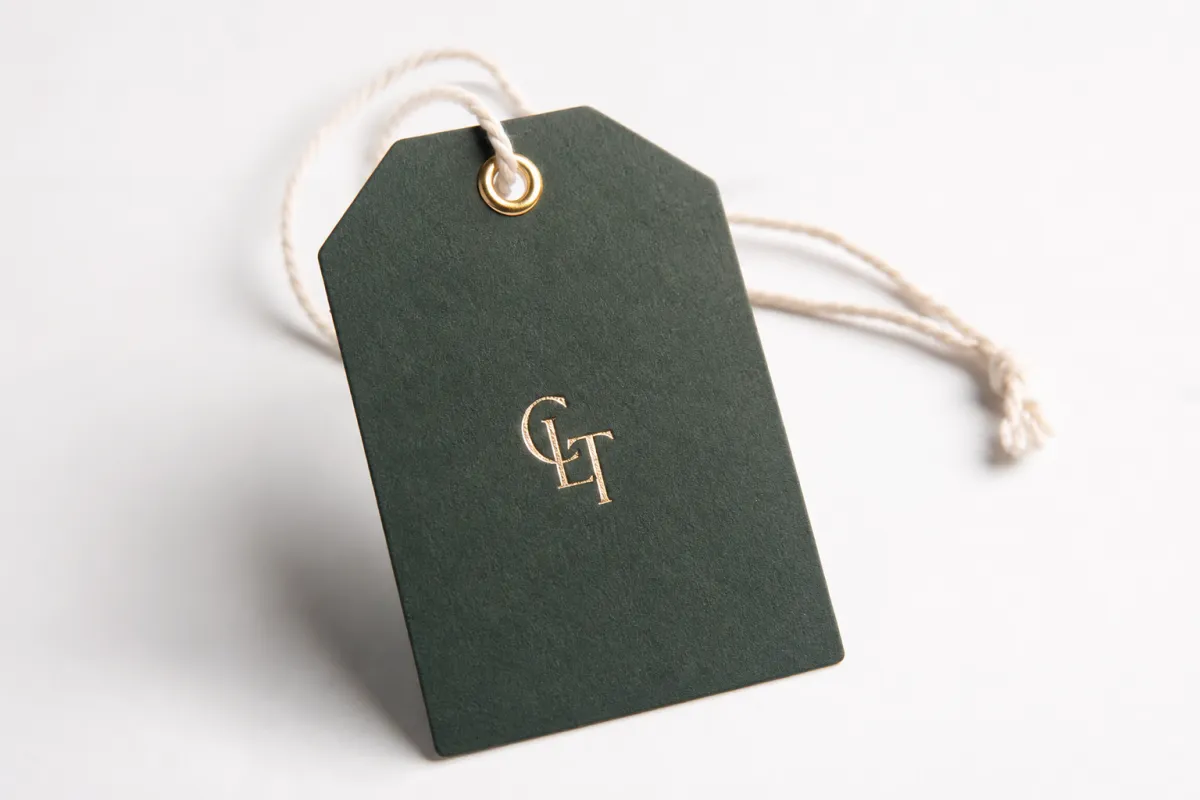
Put two tags side by side and the difference shows up fast. One is a standard white card with black type. The other uses branded hang tags with foil stamping: a crisp metallic mark, a heavier stock, and enough open space for the logo to breathe. Most people never sit down and explain why the second one feels better. They just feel it. That instinct is the point.
Foil stamping adds light, contrast, and a sense of finish without asking the design to become complicated. The artwork can stay quiet while the surface treatment does the heavy lifting. On a retail peg, that matters. A foil hit creates a small focal point that catches the eye from a distance, which is exactly what a hang tag should do.
Branded hang tags with foil stamping also work because the finish reads as premium even when the layout is simple. The tag does not need an elaborate illustration or a long brand statement to feel elevated. A small gold or silver logo can do more than a dense full-color card full of competing messages. Too many brands keep adding pieces until the tag stops feeling sharp and starts feeling noisy.
The finish also adapts well across categories. A matte black tag with copper foil suits candles and fragrance products. Kraft stock with gold foil fits jewelry or gourmet gifts with a warmer tone. Clean white card with silver foil works for cosmetics and apparel that need a crisp, modern edge. Branded hang tags with foil stamping can shift tone without forcing the rest of the package to become flashy.
One clean foil accent usually looks more expensive than three finishes fighting for attention on the same card.
The practical value is straightforward. Branded hang tags with foil stamping help a product feel intentional before a customer even touches it. That first impression is not a small matter. It shapes how the brand is judged almost immediately, and packaging usually gets only a narrow window to make its case.
That is why these tags show up in apparel, cosmetics, candles, specialty foods, and gift items that need a quick premium signal. A hang tag has very little space to work with, so every element has to earn its place. Branded hang tags with foil stamping do that by making one part of the design do real work instead of scattering attention across too many decorative details.
In my experience reviewing print proofs, the strongest tags are usually the ones that feel almost too restrained on a screen and then look just right once they are stamped, trimmed, and tied on. That kind of contrast is a little funny the first time you notice it, but it is real. Digital mockups can make a tag seem plain; production often gives it the weight it needed all along.
How Branded Hang Tags with Foil Stamping Work
The process is direct, though there are enough variables to cause trouble if the artwork is rushed. Branded hang tags with foil stamping begin with a file that separates print areas from foil areas. A heated die presses the foil onto the stock, and the metallic layer transfers only where the die touches. Shape, line weight, paper texture, and pressure all matter because the foil needs a stable surface and a clean path to read well.
Think of it as pressure, heat, and timing working together. Rough stock can make the foil break apart. A die with too much detail can cause tiny lines to fill in or lose definition. If pressure drifts, the foil can look patchy. The setup is not complicated in theory, yet it gets messy quickly when the artwork arrives late or the brand says “make it stand out” without explaining what that should actually mean.
For branded hang tags with foil stamping, printers usually want vector artwork, outlined fonts, clear safe margins, and a decision about whether the foil appears on one side or both. If the design includes a logo and short copy, the text needs to be sized for production, not for a zoomed-in screen view. Very small serif type, especially below about 6 pt, can become risky unless the stock and die are forgiving.
Many projects combine foil stamping with other finishing steps. Embossing raises the design. Debossing pushes it into the card. Lamination can protect the surface or shift the tactile feel. UV coating and spot UV can add gloss contrast, especially when the base stock is matte. Used well, those finishes can strengthen branded hang tags with foil stamping. Used carelessly, they end up looking like a sample board that never found its focus.
The biggest quality variable is how the design fits the stock. A smooth 16pt to 18pt cover stock often produces cleaner foil edges than a rough recycled sheet. Soft-touch lamination can make foil look richer, though it also changes the way the die lands on the surface. That is why proofing matters. On a screen, branded hang tags with foil stamping can look easy. In production, they behave more like a small engineering job.
If the tags will be packed in cartons and handled often, transit testing deserves attention too. ISTA publishes packaging test methods that many teams use to judge shipping stress, abrasion, and distribution risk: ISTA. For paper sourcing claims, the Forest Stewardship Council remains a clear reference point: FSC. Those references do not design the tag, but they help keep the packaging conversation grounded in real standards.
One more practical detail: foil is not a cure-all. It reflects light beautifully, but it also exposes weak artwork faster than plain ink does. If the logo is fuzzy, the line work is too thin, or the spacing is cramped, the metallic surface will not hide it. It will kinda announce it. That is why a good prepress review saves so much grief later.
Cost, Pricing, MOQ, and Quote Factors
Branded hang tags with foil stamping often make the most sense once setup costs are separated from unit costs. The finished tag itself is rarely the expensive part. Die creation, make-ready, proofing, and short-run waste usually carry most of the weight. That is why small orders can feel surprisingly costly while larger runs suddenly start to look practical.
The main pricing drivers are quantity, stock thickness, foil coverage, the number of foil colors, die complexity, and extra finishing. Rounded corners, drilled holes, grommets, string attachment, embossing, lamination, or spot UV all add steps and labor. Even the tag shape changes the quote. A basic rectangle is easier to cut and finish than a custom contour with a narrow neck or a delicate notch.
A realistic way to read branded hang tags with foil stamping is simple: short runs carry heavier setup cost, and larger runs spread that setup across more units. The press does not care about the launch calendar or the mood board. It cares about time, tooling, and the work required to get the job ready.
| Quantity | Typical Unit Price | Setup / Die Impact | Best Fit |
|---|---|---|---|
| 500-1,000 | $0.55-$1.20 | High | Samples, test drops, very small launches |
| 2,500 | $0.28-$0.55 | Moderate | Boutique runs, seasonal collections |
| 5,000 | $0.18-$0.32 | Spread out well | Stable product lines, apparel basics |
| 10,000+ | $0.11-$0.22 | Lowest per unit | Retail rollouts, repeat programs |
Those numbers are only a guide. Foil coverage, stock choice, and finishing can move them up or down. A simple one-color tag with a small logo will cost less than a large foil area on heavy stock with Custom Die Cutting and soft-touch lamination. Add a second foil color and the price rises again because the press has more steps to complete and the setup becomes more involved.
Die fees often land in the $60 to $180 range for a simple foil image, though detailed or oversized dies can cost more. That is one reason branded hang tags with foil stamping can feel expensive on tiny orders. If the run is only a few hundred pieces, setup is doing most of the work in the quote. Once the order reaches 5,000 or 10,000 units, the same setup becomes much easier to absorb.
MOQ rules vary by supplier. Some shops keep a minimum because foil stamping requires setup and they need enough volume to justify press time. Others will take a smaller run and price it accordingly. Neither approach is wrong. The useful move is to compare several quantities so you can see where the break point sits instead of guessing. Ask for pricing at 500, 1,000, 2,500, and 5,000 if the order is flexible. That usually shows the sweet spot quickly.
When you request a quote for branded hang tags with foil stamping, ask for more than a single number. Request stock options, foil color options, turnaround time, shipping cost, die fee, sample cost, and whether artwork revisions are included. If the supplier cannot give those details clearly, the quote is incomplete. It is a teaser, not a proper estimate.
For buyers comparing finish options, a simple breakdown helps:
- Foil stamping: Best for metallic shine, contrast, and a premium signal on logos or accents.
- Embossing: Best for texture and tactile depth, especially on quiet layouts.
- Spot UV: Best for targeted gloss on matte backgrounds when you want a subtle highlight.
- UV coating: Best for surface protection and gloss, though it reads differently than foil.
One thing I always tell brands: do not compare unit price alone. A slightly higher quote that includes cleaner proofing, better stock guidance, and a realistic timeline can save more money than the cheapest offer on paper. Printing errors have a way of getting expensive in a hurry, and nobody enjoys reordering because a tiny foil line filled in during production.
Process, Timeline, and Production Steps
Most branded hang tags with foil stamping move through the same sequence: quote, artwork check, proof, die prep, stamping, finishing, inspection, and packing. The order is straightforward. The delays usually come from approvals, file problems, or last-minute changes that should have been discussed earlier.
A standard timeline for branded hang tags with foil stamping is often 12 to 15 business days after proof approval if the stock is standard and the foil is common. That timeline can tighten when the vendor already has the die size, the stock is in house, and the layout is simple. It stretches when a job needs a custom die, a special foil color, embossing, or a fresh cut shape. Those extras are the usual reasons schedules drift.
Time gets lost in familiar places. The file arrives with live fonts instead of outlines. The logo is supplied as a low-resolution PNG. The foil area is too detailed for the size of the tag. A line gets changed after proof approval, and the brand still expects the original delivery date to hold. It does not. Branded hang tags with foil stamping reward clean decisions and punish casual edits.
That is why proofing matters. A digital proof catches layout issues, but a physical sample is worth the wait if the tag sits at the premium end of the line or if the foil is the main visual feature. A sample tells you more than a screen can. You can see the color balance, the edge sharpness, and whether the stock feels as good as it looked in the PDF.
Shipping time deserves the same attention as press time. If the tags are tied to a product launch, a seasonal drop, a trade show, or a retail reset, build in enough room for packing and transit. A lot of brands focus on production and forget that boxes still have to move. That is how branded hang tags with foil stamping show up after the product has already hit the shelf, which is the kind of mistake nobody wants to explain later.
A practical production checklist usually looks like this:
- Confirm final artwork in vector format.
- Approve the foil color and stock choice.
- Check hole placement, corner radius, and attachment method.
- Review the proof for font size and foil line thickness.
- Approve the sample if the tag is high visibility.
- Lock the delivery date before production starts.
Brands that keep the process tight usually get better results on repeat orders too. That is one quiet advantage of branded hang tags with foil stamping: once the system is set, future runs become easier to reproduce with fewer surprises.
Design and Material Factors That Change the Final Look
The final look of branded hang tags with foil stamping depends on much more than foil color. Stock weight, surface texture, design scale, attachment details, and even hole size all affect how premium the tag feels in hand. Two tags using the same artwork can end up looking completely different once they are printed, cut, and attached to a product.
Smoother, heavier paper usually gives the cleanest foil edge. A 14pt tag can work, but 16pt to 18pt often feels better for apparel and higher-end retail. Some buyers move into 350gsm or heavier cover stock when they want a firmer card. The trick is balance. Too thin and the tag feels flimsy. Too thick and the fold, hole punch, or string attachment can start to feel awkward.
Texture changes the result in a real way. Uncoated or lightly textured stock can create a softer, more organic look, but very rough surfaces can make the foil break up. Matte stock usually helps the foil stand out because the contrast is clean. Gloss stock reflects more light overall, which can blur the line between the printed areas and the metallic areas. Soft-touch lamination adds a velvet feel and can make branded hang tags with foil stamping feel expensive, but only if the layout stays disciplined.
Design scale matters just as much. Fine lines, tiny serif type, and tight spacing can cause trouble, especially on smaller tag sizes. A logo that looks perfect on a monitor may stamp poorly when reduced to 2 inches wide. Simpler forms often win here. Strong geometry, clean spacing, and one clear foil element usually read better than a crowded illustration or oversized copy. I would rather see one excellent foil logo than a tag that tries to hold a brand manifesto, a care note, and a promotional line all at once.
Foil color changes the message. Gold feels classic and warm. Silver reads cooler and more modern. Copper leans earthy and upscale. Rose gold can work well for beauty and gifting if the rest of the design stays restrained. Black foil is underrated on light stock because it gives shine without shouting. Holographic foil has its place, though it is easy to overuse. If the product is not playful, holographic shine can push the tag into novelty territory quickly.
Attachment details matter too. Hole size, string choice, and corner radius all shape the final impression. A tag with a rough hole punch and a limp cord can weaken the finish even if the foil is perfect. Cotton string, waxed cord, or a tidy fastener often does more for the overall look than another print embellishment. The same logic applies if the back side needs a barcode or price field. Leave space for practical information so the tag does not become decorative clutter.
Die cutting, embossing, and foil stamping can work very well together on some projects. The die-cut edge gives shape. The embossing adds depth. The foil provides the visual hit. That combination can look excellent on branded hang tags with foil stamping, but only when the design gives each finish a clear purpose. If every surface is trying to be the main event, the tag loses discipline.
People often ask whether UV coating or spot UV should be added on top of foil. Sometimes the answer is yes, sometimes no. Spot UV can work on a matte background if the goal is to build a subtle gloss contrast around the foil. Full UV coating can protect the surface in some applications, though it changes the tactile feel. The real question is not whether another finish can be added. The question is whether it improves the tag. That line of thinking prevents a lot of weak choices.
Material choices also affect sourcing language. If the brand wants to claim recycled content, FSC-certified paper, or lower-impact packaging, the claim needs to be supported properly. Loose wording invites trouble. Clear wording and documented sourcing are the better route. Branded hang tags with foil stamping can still fit sustainability goals, but the claims have to match what the paper mill or supplier can verify.
One more production detail that gets overlooked: the back side should not be treated like dead space. If there is room for sizing, a barcode, a QR code, or care instructions, plan for it early. Trying to squeeze that information in after the design is locked is where nice tags start to look crowded and kind of confused.
Common Mistakes With Branded Hang Tags
The biggest mistake is overdoing it. Too much foil can make branded hang tags with foil stamping feel less premium, not more. If every line shines, nothing stands out. The tag starts to read more like a souvenir than a brand asset, and that is a strange place for packaging to land.
Poor file prep causes a lot of avoidable friction. Raster logos, live fonts, missing outlines, and tiny foil details create delays and production risk. If the artwork was built in a hurry, the press will expose it. That is not the printer being difficult. It is the printer refusing to pretend a broken file is ready.
Contrast errors show up quickly too. If the foil color and the stock color are too close, the tag loses punch at a distance. Gold on warm beige can disappear. Silver on pale gray can soften too much. Black foil on a dark sheet can feel elegant or vanish almost entirely depending on the light. Branded hang tags with foil stamping depend on contrast more than many brands expect.
Timing mistakes do just as much damage. A brand will approve a concept, skip the schedule conversation, and then act surprised when the launch date arrives before setup, proofs, and shipping are done. That kind of scramble is expensive. It also pushes the project into ugly compromises, like downgrading the stock or removing a finish that was supposed to carry the design.
There is also a messaging problem that shows up often. A hang tag is not a brochure. It should support the product story, not cram every claim, care note, sustainability statement, and slogan onto one small card. Good branded hang tags with foil stamping leave room for the eye to rest. If the tag looks overloaded, the foil loses authority because it sits inside a mess.
Another miss is ignoring the back side. Many brands put all their energy into the front and forget that the reverse needs space for sizing, barcode placement, QR codes, legal copy, or care notes. A cluttered back makes the whole piece feel unplanned. A clean front and a useful back usually work better than a front doing too much and a back that feels like an afterthought.
Physical testing gets skipped more often than it should. Branded hang tags with foil stamping should be judged in hand, not just on a screen. The foil should look crisp at arm's length and stay tidy when the card moves under light. If a tag scratches too easily, bends too fast, or feels thin enough to curl in the box, the premium effect fades right away.
A useful shortcut is to compare the tag against the rest of the packaging line. If the carton, label, or insert is simple, the hang tag can carry more visual weight. If the rest of the packaging is already busy, the tag should probably calm down. Consistency usually matters more than one flashy piece trying to own the room.
In practice, the cleanest tags are rarely the most dramatic ones. They are the ones that have one job, one focal point, and enough breathing room to let the finish speak. That is a boring answer only if you think packaging is supposed to perform tricks. Usually it is supposed to make the product look credible and worth picking up.
Expert Tips and Next Steps for Better Results
Start with one strong foil accent. That advice stays useful because it keeps the design focused. Branded hang tags with foil stamping usually look better when the metallic hit is selective. A logo, a monogram, a border, or a short line of text can carry the finish without making the tag feel loud. Restraint is not dull. In packaging, it often separates elegant from overworked.
Compare two or three stock samples before placing the order. Paper feel changes the entire perception of the tag. A 16pt matte stock can feel sharper and more modern than a glossy sheet with more surface shine. Cotton or recycled paper can feel warmer, though it may soften the foil edge. If the brand cares about the tactile experience, that sample comparison is worth the extra day.
Request both a digital proof and, if the schedule allows, a physical sample. The proof checks layout. The sample checks reality. If branded hang tags with foil stamping are central to the brand look, the sample should not be treated like a luxury item. It is basic risk control. A label, a carton, and a hang tag should all be approved from the same standard, not from a guess.
Use a production checklist and follow it carefully. Confirm artwork, foil color, size, hole placement, attachment method, quantity, and delivery date before payment. Then make sure everyone on the brand side sees the same proof. A surprising amount of packaging chaos comes from different people approving different versions of the same idea. The press cannot repair internal confusion.
Here is the practical order of operations I recommend for branded hang tags with foil stamping:
- Choose the stock first, because the paper controls most of the look.
- Pick one foil color that fits the product, not just the trend cycle.
- Decide whether the tag needs embossing, lamination, UV coating, or spot UV.
- Approve the proof only after checking line thickness and safe margins.
- Ask for a sample if the tag is tied to a premium launch or trade deadline.
One more point matters here: treat the tag as part of a system. If the brand ships apparel, the hang tag should work with the sewn label, poly mailer, carton, and insert card. If the brand sells candles, the tag should fit the jar label and outer packaging. That is where branded hang tags with foil stamping stop feeling like a one-off decoration and start functioning as a repeatable brand language.
If you want to see how that plays out in real packaging decisions, revisit the Case Studies page and look at how finish choices change the final read. Then compare the options on Custom Labels & Tags so you can match the tag to the rest of the line instead of forcing one piece to carry everything.
The cleanest path is usually the least dramatic one: choose a stock, request a quote, review the proof, approve the sample, and repeat branded hang tags with foil stamping as a controlled brand system rather than a gamble. If you want the shortest possible takeaway, it is this: lock the paper, lock the foil, and lock the quantity before the artwork gets too clever. That one sequence prevents most of the headaches that turn a good tag into a rushed compromise.
Are branded hang tags with foil stamping worth it for small brands?
Yes, if the tag is part of the first impression and not just a throwaway label. The strongest value usually comes from a small foil accent on a clean layout, not a full-coverage shine effect. Small brands should compare sample cost against perceived value before ordering a large quantity of branded hang tags with foil stamping.
What stock works best for branded hang tags with foil stamping?
Smooth, heavier card stock usually gives the sharpest foil edges and the cleanest finish. Matte or uncoated stocks often create stronger contrast than glossy materials. Highly textured stock can work, but fine details will usually lose a little precision. That is why a sample matters more than a spec sheet for branded hang tags with foil stamping.
Does foil stamping raise the MOQ or unit cost for hang tags?
Usually yes, because setup and die costs make very small runs inefficient. Unit cost drops as quantity rises, so the per-tag price improves on larger orders. Ask for pricing at multiple quantities so you can see the break point instead of guessing. That is the clearest way to budget branded hang tags with foil stamping.
How long do branded hang tags with foil stamping usually take to produce?
The timeline depends on artwork approval, die creation, stock availability, and finishing complexity. Standard jobs move faster; custom shapes, sample requests, and rush changes add time. In many cases, 12 to 15 business days after proof approval is realistic, but branded hang tags with foil stamping tied to a launch should always have extra buffer for shipping.
Can branded hang tags with foil stamping include embossing or extra finishes?
Yes, foil stamping often pairs well with embossing, debossing, spot UV, or lamination. Each extra finish adds cost, setup time, and a higher chance of production delays if the file is messy. Keep the design intentional; stacking every finish usually hurts the premium look instead of helping it. Branded hang tags with foil stamping work best when each finish has a clear job.


