Branded Kraft Paper Bags for subscription brands do far more than carry a product from point A to point B. They frame the first impression, hold the packout together, and signal whether the brand has thought through the details or just dressed up a commodity. That matters because subscription packaging is repeated, not one-off. Any weak point gets multiplied month after month.
Kraft has staying power for a reason. It hides scuffs better than glossy stock, it feels more grounded than plastic laminates, and it often reads as more premium than the price suggests. Used well, it can make a recurring shipment feel deliberate rather than disposable. Used badly, it looks like a brown bag with a logo on it. The difference is usually in structure, print restraint, and fit.
Brands tend to focus on graphics first, then discover that the bag itself is doing the real work. A subscription box may be opened at home, but the bag is often seen at the door, on a counter, in an office lobby, or during a return visit to a retail counter. That makes the bag a public object, not just a protective layer. Public objects need cleaner lines, stronger handles, and fewer compromises.
What branded kraft paper bags do for subscription brands
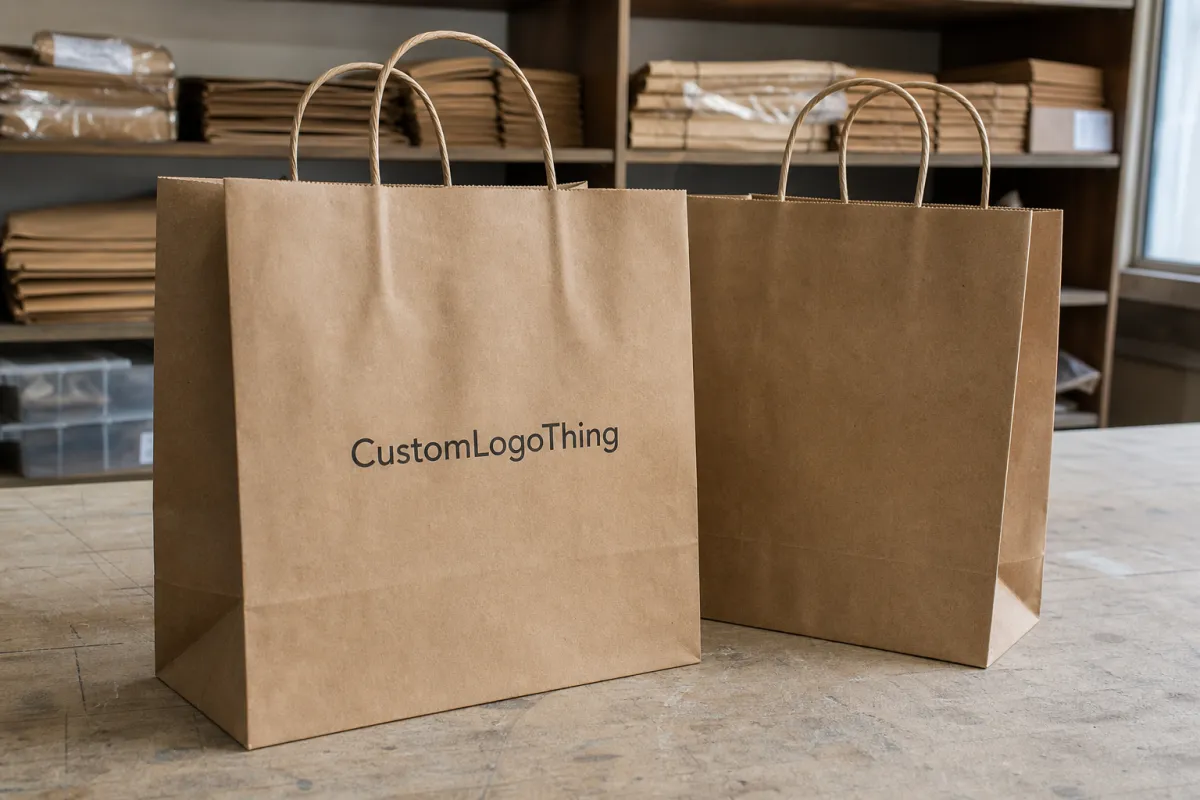
The best packaging choices are the ones customers notice without having to think about them. A kraft bag with a balanced logo, a sensible handle, and a structure that sits upright gives the impression of a brand that understands its own product. That impression is fragile. If the bag buckles, overfills, or tears at the top seam, the promise falls apart quickly.
Kraft is especially useful for subscriptions that ship natural products, wellness kits, apparel, snacks, refill packs, or curated gifts. The paper texture supports the story those brands already want to tell: practical, considered, and less synthetic. It also tolerates small transport marks better than coated stock. That is not a minor benefit. Subscription packaging spends time inside cartons, delivery networks, storage bins, and hands that may not be careful.
There is a common buyer mistake here. People often assume bigger graphics equal stronger branding. In reality, a single-color mark placed well can outperform a busy print that gets lost once the bag is folded, stacked, or carried. Good packaging does not need to shout. It needs to stay legible, hold its shape, and feel like it belongs to the product inside.
A subscription bag has to do three jobs at once: carry weight, survive transit, and make the brand look more disciplined than the packaging budget may actually be.
That combination is why branded Kraft Paper Bags for Subscription brands remain relevant even in a market full of mailers, boxes, wrap systems, and reusable containers. They work as a middle ground. More polished than a plain shipper, less costly than a fully bespoke rigid package, and flexible enough for retail handoff or direct fulfillment.
How the bag structure, handles, and print setup work
Structure drives most of the buying decision. Handle type, gusset depth, paper weight, and seam reinforcement are not cosmetic choices; they decide whether the bag feels sturdy or forgettable. Flat handles are usually the most economical. Twisted paper handles sit in the middle. Rope handles add cost, but they also add a better hand feel and usually make sense when the bag is meant to be seen outside the home.
Gusset depth deserves more attention than it usually gets. Too shallow, and the contents pinch the sides and strain the seams. Too deep, and the bag inflates without adding useful capacity. For subscription packs with bottles, jars, folded apparel, or mixed items, the gusset should match the actual fill geometry, not the idealized mockup. If the contents shift, the bag has to tolerate it.
Paper weight also matters. A lighter bag around 120gsm to 150gsm may be fine for compact kits or low-load contents. Heavier or more awkward packs often need 170gsm or more, plus a reinforced bottom patch and stronger handle attachment. If the load is uneven, strength at the base is as important as strength at the top. Many bag failures start below the branding area, which is inconvenient because that part never shows up in the render.
Print setup can make a practical bag feel expensive or cheap in a single pass. One-color flexographic printing is common because it is efficient and predictable. Multi-color print can work well if the artwork is disciplined and the registration tolerance is realistic. Full-coverage designs are possible, but they increase ink usage, setup time, and the risk of muddy color on brown kraft. Thin lines and tiny type are the first things to suffer. Strong shapes, generous spacing, and clear contrast hold up better.
| Handle style | Typical feel | Cost impact | Best use |
|---|---|---|---|
| Flat handle | Functional, simple | Lowest | Light monthly kits and high-volume utility packs |
| Twisted paper handle | Cleaner, more finished | Moderate | General subscription use where presentation matters |
| Rope handle | More premium, better hand feel | Highest | Giftable programs, retail carryout, heavier packouts |
Simple artwork usually ages better. A restrained logo placement, a short line of copy, or a quiet repeat pattern looks intentional on kraft because the substrate already has visual texture. Overworking the design rarely helps. It usually just fights the paper.
Cost, pricing, and MOQ: what drives the quote
Price is determined by the same handful of variables every time: size, paper weight, handle style, print count, finish, and order volume. The larger point is that setup costs are fixed, so small runs carry a heavier unit price. That is normal. The factory has to prepare tooling, materials, and print alignment whether the run is 1,000 units or 50,000.
For a practical benchmark, a simple kraft bag with one-color print and standard handles might land around $0.18 to $0.35 per unit at 5,000 pieces, depending on size, paper weight, and source. Add rope handles, custom dimensions, heavier board, or extra print colors, and the range can move into the $0.40 to $0.80 area quickly. Specialty work like foil, embossing, or spot UV pushes the number higher again. Freight can shift the total enough to matter, especially on bulky bags that ship in corrugated cardboard cartons.
MOQ should be treated as a planning tool, not just a factory rule. A lower MOQ reduces risk when a brand is testing a new subscription format, changing packout size, or running a seasonal edition. A higher MOQ often makes more sense when the bag spec is stable and the reorder cycle is predictable. For a monthly subscription that uses the same contents, paying more per unit just to avoid commitment can become a false economy.
It helps to ask for three quote levels rather than one:
- Lean spec for launch testing and conservative spending.
- Target spec for the real subscription packout.
- Premium spec for comparison against a higher-end finish.
That comparison usually exposes the real cost drivers. Sometimes the rope handle is only a small increase and worth taking. Sometimes a custom size adds more cost than the benefit justifies. Sometimes the money belongs in the outer carton or insert instead. Packaging budgets are finite, and the smartest spend is the one that improves the customer’s actual handling experience.
Production process and timeline: from dieline to delivery
Production starts with the spec, not the artwork. First comes the dieline, then the dimensions, then the artwork fit, then proof review, then sampling if the build is custom or the print setup needs validation. That sequence exists for a reason. Most delays come from trying to reverse it.
Artwork issues are usually less about creativity than about scale. A graphic that looks clean on screen can become crowded once the gusset is real and the handle holes take up space. Margins, seam allowances, and print tolerances are unforgiving. If the bag needs to contain jars, bottles, or folded apparel without bulging, the actual packout should be tested before final approval. A paper bag is not a flat canvas. It is a container that changes shape as soon as product enters it.
Timelines vary, but a simple printed bag can often move in about 12 to 18 business days after proof approval. Custom construction, additional color work, handle changes, or sample rounds can add several weeks. Freight should be added on top of that, not treated as a footnote. A launch can miss its window even when production is technically on schedule.
Quality control should cover more than color matching. Confirm seam strength, handle attachment, bottom reinforcement, fold consistency, and print alignment. Check a filled sample under the same conditions the customer will see it: stacked in cartons, carried by hand, and opened under normal lighting. A bag that looks perfect on a table can still fail once it is loaded. That is why practical QC beats optimistic approval.
Some buyers also want a way to talk about transport performance and packaging recovery without drifting into vague sustainability language. References from the ISTA and the EPA can help frame those conversations. They are not a substitute for testing, but they do make the brief more precise.
Key specs to lock before you approve artwork
Before anyone debates type size or logo placement, the physical spec has to be fixed. Internal dimensions, gusset width, paper weight, handle style, print area, and target load should all be settled first. If those details are loose, the artwork approval becomes a guessing exercise. The bag either fits the product or it does not.
Fit is often the deciding factor between a premium bag and one that looks budget. A bag that pinches at the top or collapses at the base will undermine the design no matter how strong the logo is. Subscription brands should base the spec on the real monthly packout, not on the smallest or neatest version of the contents. If the kit changes slightly from month to month, design for the heaviest and most awkward fill, then confirm the lighter packout still sits correctly.
Material claims need to be specific as well. Recycled content, FSC certified paper, and post-consumer waste percentages are credible only when the documentation exists. Minimal ink coverage can support a cleaner production profile. Claims about biodegradable packaging need care because disposal conditions vary, and not every paper product breaks down in the same way. Kraft helps here because the material already communicates a lower-frills, lower-lamination approach without extra explanation.
A useful supplier brief usually includes the following:
- Exact internal dimensions in millimeters or inches
- Paper weight and finish
- Handle style and attachment method
- Print count, ink colors, and placement
- Target load weight and product mix
- Destination, timeline, and carton pack count
When those items are documented, the quote gets sharper and the sample stage gets faster. When they are missing, the project tends to drift. Packaging does not reward vagueness.
Step-by-step ordering workflow for subscription brands
Start with the use case. Is the bag for direct shipment, retail handoff, or event distribution? A bag that only gets opened at home can be designed differently from one that is carried through a store or reused for errands. Public-facing bags need stronger handles, cleaner artwork, and a slightly higher tolerance for wear.
Write the spec sheet before asking for pricing. That single document should carry the dimensions, paper stock, handle type, artwork location, quantity, destination, and timeline. If more than one team is involved, include a visual reference and a short note on what qualifies as acceptable. Otherwise, everyone ends up interpreting the same bag differently, which wastes time and often money.
Approve samples against the actual contents. Load the bag with the real subscription set, not dummy objects of similar size. Carry it for a few minutes. Set it on the floor. Stack it with other units. Check whether the print still looks balanced once the bag is full and the gusset has expanded. A render can hide many problems. A loaded sample cannot.
Once the construction is approved, save the dieline, approved artwork, and production notes together. Reorders go wrong when someone assumes the previous order can be recreated from memory. Small changes in handle placement, paper weight, or print scale can alter the feel of the bag more than expected. A disciplined archive prevents that drift.
For subscription brands that reorder every month, the most valuable habit is consistency. Set the spec once, keep it stable, and only change it when the packout or brand position actually changes. Constant tweaking tends to create waste rather than improvement.
Common mistakes that make branded kraft bags look cheap
The fastest way to cheapen a kraft bag is to ignore proportion. Oversized logos, crowded side panels, and artwork that extends too close to the seams make the bag feel forced. Kraft already brings texture and color to the table. It does not need to be covered in noise.
Weak handles and thin paper are the next obvious problems. A design can look premium in a mockup and still fail once the product weight is added. Subscription kits often include items with uneven load distribution, and that puts real strain on the handle zone and bottom fold. If the bag is intended to be reused, the strength margin matters even more.
Too many print colors can also work against the material. Brown kraft reduces contrast faster than white stock, so delicate linework and pale colors can disappear. Strong, simple graphics usually survive production better and look more expensive in the hand. That is one of the odd truths of packaging: the less you try to prove, the more finished it often looks.
Another common error is designing for the image instead of the packing process. If the bag will ride inside a corrugated cardboard shipper, be stacked with other units, or be carried in bad weather, those conditions should shape the spec. A bag should look good after handling, not just before it leaves the press.
Finally, low cost does not automatically mean cheap-looking, and high cost does not automatically mean polished. The finish often comes down to alignment, edge treatment, handle feel, and print restraint. Cheap-looking packaging is usually the result of several small misses, not one dramatic failure.
Expert tips for a better supplier brief
Ask for a lean, target, and premium version of the quote. That gives a much clearer view of where the money moves and which upgrades are worth it. If the jump from flat handles to twisted handles is minimal, the better handle may be justified. If custom sizing adds a disproportionate amount, a standard size may be the smarter choice.
Compare samples under the same conditions. Same lighting. Same load. Same carry test. Otherwise one bag gets judged in a showroom and the other in a warehouse aisle, which tells you very little. Packaging decisions improve when the test conditions are stable.
Keep the brief short enough that it can be read in one pass, but complete enough that nobody has to guess. A one-page document with dimensions, artwork, quantity, timeline, load weight, and QC expectations is usually enough to move a supplier conversation forward. The goal is clarity, not length.
If the brand story includes sustainability, make the claims concrete. FSC certified paper, recycled content, post-consumer waste percentages, and reduced ink coverage are all legitimate when backed by documentation. The more specific the claim, the more usable it becomes in packaging planning and compliance review. Vagueness does not help the buying process. It only makes people nervous.
Branded Kraft Paper Bags for subscription brands work best when the bag matches the real packout, the print respects the substrate, and the spec is locked before artwork approval. That combination is unglamorous. It also happens to be what prevents rework.
What size branded kraft paper bags work best for subscription brands?
Choose the bag around the full packed product, not the product alone. Allow room for inserts, tissue, and easy loading so the top does not strain. If the bag is meant to be reused, a slightly larger format with stronger handle reinforcement usually performs better.
How much do branded kraft paper bags for subscription brands usually cost?
Pricing depends on size, paper weight, handle style, print count, and quantity. Simple bags in medium runs can fall around $0.18 to $0.35 per unit, while more complex builds can reach $0.40 to $0.80 or more. Freight, carton packing, and specialty finishes can move the total further.
What MOQ should a subscription brand expect for custom kraft bags?
MOQ varies with the factory setup and the complexity of the bag. Lower MOQs reduce launch risk but usually cost more per unit. Higher MOQs make more sense once the packout is stable and the reorder cycle is predictable.
How long does production take for branded kraft paper bags?
Simple printed bags can often be produced in about 12 to 18 business days after proof approval. Sampling, custom finishes, and artwork revisions add time. Freight should be planned separately so the bags arrive before the launch window closes.
Are branded kraft paper bags strong enough for monthly subscription shipments?
Yes, if the paper weight, handle style, and bottom reinforcement are matched to the actual load. Heavier or unevenly packed kits need stronger construction. Real packout testing matters more than a flat sample because the bag behaves differently once it is filled.
Branded Kraft Paper Bags for subscription brands are most effective when they are sized honestly, printed with restraint, and built for repeated handling. Get the structure right first, and the bag does the quiet brand work that good packaging is supposed to do.

