Branded Kraft Paper Bags for ecommerce orders do more than carry a product from warehouse to doorstep. They shape the first physical impression a customer has after clicking “buy,” and that impression can be surprisingly durable. A shipment may arrive on time and intact, yet still feel anonymous. A printed kraft bag changes that. It gives the order a face.
That matters because ecommerce packaging now does two jobs at once: it protects the contents and performs the brand. For apparel, beauty kits, accessories, and subscription inserts, the bag is often the only tactile brand element a customer handles before opening the product. If the goal is to make a small order feel considered, packaging carries more weight than many buyers expect.
There is also a practical reason these bags have stayed popular. Kraft paper is light, stackable, and easy to run through a pack line without special equipment. Printed properly, it can handle a logo, a short message, a return instruction, or a seasonal design without turning fulfillment into a bottleneck. That combination of speed and presentation is hard to beat.
The best packaging choices are rarely the fanciest. They are the ones that survive handling, fit the product cleanly, and stay within budget after freight, storage, and rejects are counted. Branded Kraft Paper Bags for ecommerce orders fit that brief better than many alternatives because they balance appearance with routine operational use.
“A package that is seen once is packaging. A package that is seen three times starts behaving like media.”
Why branded kraft paper bags for ecommerce orders beat plain mailers
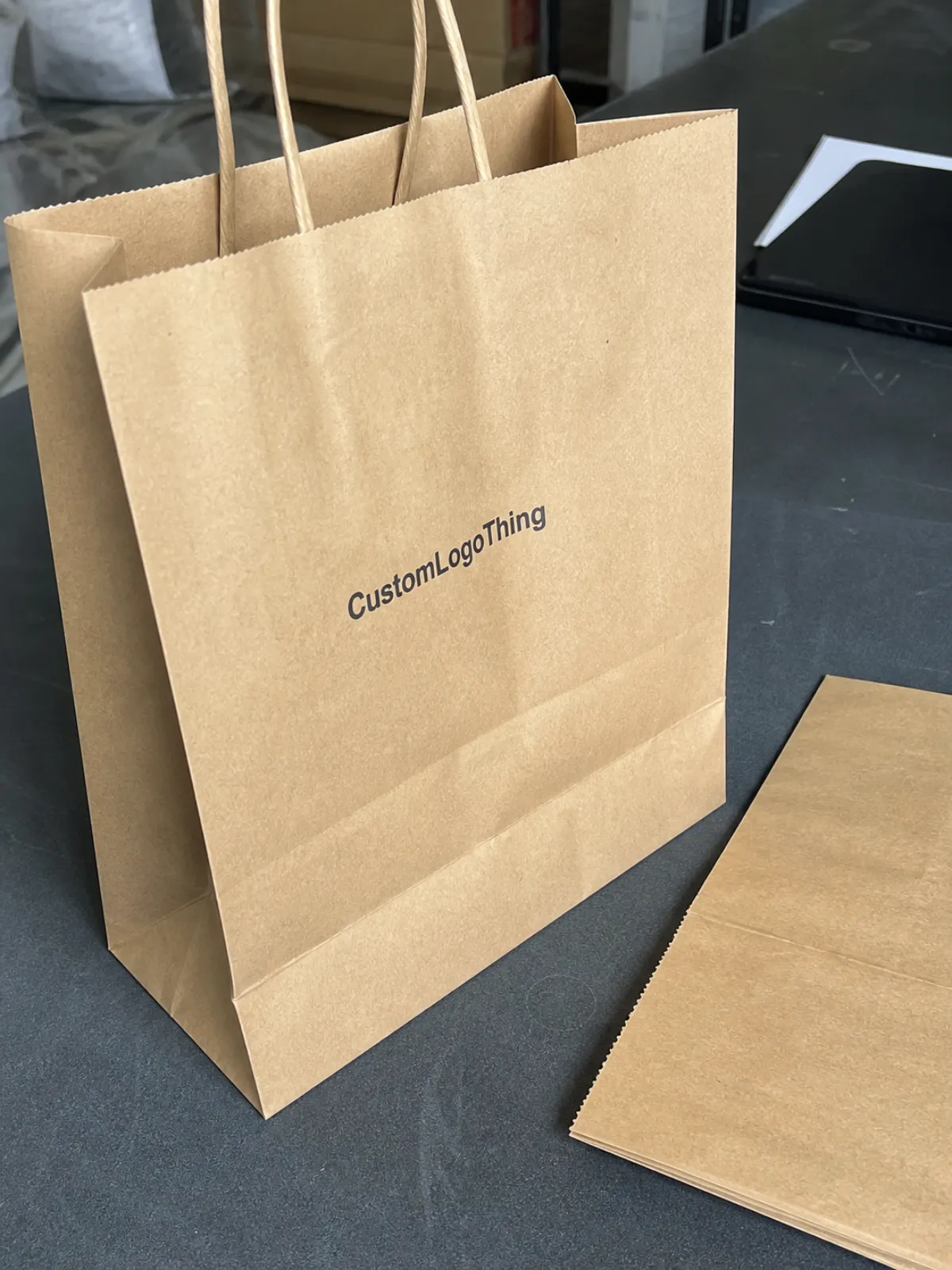
Plain mailers are efficient, but they are visually forgettable. The customer sees them at pickup or on the porch, then the memory disappears as soon as the order is opened. Printed kraft bags work differently. They keep the brand visible at handoff, during unpacking, and again if the bag is reused for storage or gifting.
That repeated exposure can affect how the order is perceived. A neat kraft bag makes a small item feel more deliberate. It can lift the perceived value of a scarf, candle, skincare set, or accessory without changing the product itself. In crowded categories, those tiny shifts matter more than they sound. Buyers judge value quickly, often before they have time to think about the product features.
There is a resale and sharing effect too. Better-presented orders tend to be photographed more often, and those photos are less likely to look like generic shipping content. Even if social sharing is not the main objective, a cleaner unboxing still improves the odds that the customer remembers the brand after the product is used.
For fulfillment teams, the appeal is simpler. Kraft bags store flat, do not take up much shelf depth, and can be packed quickly. That is useful in daily operations where a few extra seconds per order adds up fast. A format that looks premium but slows the line is usually a bad trade. A format that moves cleanly through packing and still feels finished is a much better one.
Material choice also influences how the packaging is read. Kraft paper signals something natural and straightforward, which is useful if the brand wants to suggest recyclable content, FSC certified paper, or recycled fibers. Those claims should always be verified, of course, but the visual language already supports them. The surface does some of the storytelling before the copy does.
Construction choices that change strength, print quality, and unboxing
The right bag starts with structure, not decoration. Buyers usually choose between flat kraft bags, gusseted bags, SOS-style bags, and handled versions adapted for ecommerce use. Each one behaves differently in storage and transit. A flat bag is space efficient. A gusseted bag holds more volume and keeps shape better. A handled bag improves carry comfort and often feels more premium when it reaches the customer.
Paper weight is one of the most important variables, and it is easy to get wrong by choosing only from appearance. Light bags can work for small inserts or soft accessories, but heavier apparel, boxed products, or dense bundles need more strength. In practical terms, 120gsm may be enough for lighter loads, while 150gsm to 180gsm is more common for sturdier ecommerce use. Some programs need reinforcement at the mouth or handle attachment points to avoid pull failure.
Print method changes both look and budget. A one-color logo is usually the safest choice for clean registration and predictable cost. Multi-color artwork adds visual energy but asks more of the press and increases the chance of variation. Full-panel printing can create stronger shelf presence and a more polished unboxing, but it also demands tighter file setup and better quality control. The design should be matched to the stock, not forced onto it.
Small construction details have outsized effects. Twisted paper handles tend to carry better than they look. Flat handles reduce bulk. Reinforced tops improve pull strength. Natural kraft produces a warmer, less processed appearance, while a smoother or lightly coated surface can sharpen ink and make fine text easier to read. A restrained design on the right paper often performs better than a crowded layout on the wrong one.
| Format | Best For | Typical Strength Profile | Common Print Use |
|---|---|---|---|
| Flat kraft bag | Light inserts, small accessories | Lowest bulk, moderate carry capacity | One-color logo, simple branding |
| Gusseted paper bag | Apparel, boxed sets, bulkier items | More internal volume, better shape retention | Logo front, side-panel copy |
| SOS-style bag | Retail-plus-ecommerce use | Good standing stability, easy fill | Panel branding, straightforward artwork |
| Handled kraft bag | Premium retail delivery, gifting | Better carry comfort, stronger perceived value | Front/back logo, inside-print message |
Specifications to confirm before you approve a sample
The spec sheet should be settled before art approval. Start with the finished width, gusset, height, handle style, paper weight, print area, and the filled weight the bag must support. Those details set the limits for everything else. If one dimension shifts after sampling, the order can drift out of tolerance and the packaging may no longer fit the pack-out you planned.
Tolerance sounds like a technical footnote until the bags reach a warehouse. A few millimeters off can change how the bag folds, whether it stacks neatly in cartons, and how quickly a picker can load it. In a busy fulfillment setting, those differences show up immediately. One bag sits cleanly. The next one sags or catches on the handle. That is not a design problem; it is a production problem.
Artwork inputs need to be specific as well. Give the supplier vector files, Pantone or CMYK targets, bleed requirements, and exact placement notes. If the bag will be printed on both sides, say so before proofing starts. If you want copy inside the bag, reserve that space early. Late edits are one of the fastest ways to add cost and push back lead time.
Sample testing should mimic real use, not best-case use. Put the actual product in the bag. Add tissue, inserts, cards, or a rigid box if those are part of the shipment. Shake the load. Check seam tension, handle pull, fold consistency, and whether the finished bag still looks clean once it is packed. A sample that only works on a desk is not much help.
It is also worth checking the paper surface under the light you expect in fulfillment and at the customer’s door. Some kraft stocks photograph more warmly than they look in production lights. Others show ink contrast better than expected. A sample review should include both visual inspection and hands-on stress testing. That is how weak seams, scuffed print, or poor line alignment tend to reveal themselves.
For buyers who want to compare testing discipline and material sourcing standards, the ISTA testing framework and the FSC certification program are useful reference points. They do not replace supplier checks, but they help separate process from marketing.
Cost, pricing, MOQ, and quote drivers buyers should compare
Pricing comes down to a handful of variables, and most of them are easy to predict once the spec is fixed. Bag size, paper weight, handle type, print coverage, finish, packaging format, and whether custom tooling is needed all move the number. A small unprinted bag may be inexpensive at volume. A larger handled bag with dual-sided print and a special finish sits in a very different cost bracket.
MOQ matters because setup costs are distributed across the run. Smaller quantities usually increase unit cost. Larger runs usually improve pricing, but they also require more cash tied up in stock and a better forecast. For a bag used across many SKUs, a larger MOQ can make sense. For a seasonal launch or a narrow product line, lower exposure may be worth the higher per-unit rate.
Buyers should compare landed cost, not just the factory quote. A low unit price can be misleading if the order arrives late, needs rework, or fails transit inspection. Freight, cartons, palletizing, customs handling, and receiving labor all belong in the comparison. The cheapest quote is often the one with the most hidden risk.
In real sourcing work, buyers usually see a few common price bands: a simple unprinted kraft bag at high volume can sit in the low cents range per piece, while branded handled bags with multiple print colors or specialty finishes rise quickly. That spread is normal. What matters is whether the extra cost changes the customer experience in a way that is visible and useful, not ornamental.
Useful quote drivers to compare include:
- Artwork complexity: one-color logos are easier to control than full-panel artwork.
- Material choice: heavier kraft stock improves strength, but adds paper cost and shipping weight.
- Finishing: matte coatings, special inks, and inside printing improve presentation, then extend lead time.
- Packing format: carton count and pallet arrangement can change freight cost more than buyers expect.
If the bag will be part of a repeat program, it helps to review Wholesale Programs early. That gives a clearer view of how quantity bands, storage, and reorder timing affect the real cost of keeping branded kraft paper Bags for Ecommerce orders in stock.
Process and lead time: how an order moves from proof to shipment
A solid order flow usually follows the same sequence: confirm the spec, submit artwork, review the digital proof, approve the sample, start production, complete inspection, and arrange shipment. That sounds ordinary, but it is where most delays are prevented. Once the run starts, small omissions become expensive to fix.
Lead time should be split into three parts: sampling, production, and transit. Buyers often focus only on the factory schedule and forget freight. That is a mistake. An order can be finished at the plant and still miss a launch date if shipping was not planned with enough buffer. For seasonal programs, the transport window matters as much as the print window.
Simple one-color orders with stocked materials can move quickly, while custom sizes, multi-color printing, or special finishes slow the schedule. A realistic planning range for a custom order is often 2 to 4 weeks after final approval, and more if sampling is extensive or freight is long-haul. If the bags are tied to a promotion or launch, the safer move is to count the calendar backward from the delivery date rather than forward from the quote date.
Most production delays come from the same few issues: missing artwork files, unclear color targets, late dimensional changes, or sample approval that arrives after the order window has already tightened. These are process problems, not surprises. Good suppliers usually flag them early, but the brief still has to be clean enough to prevent back-and-forth.
Packaging operations improve when there is a documented approval trail and a clear carton label system. That sounds administrative, but it saves time on the receiving side. If the outer cartons are labeled by size, style, and quantity, warehouse teams can move faster and verify counts without opening every box. In practice, that kind of orderliness reduces friction long after the print job is finished.
How to judge supplier consistency, compliance, and print control
A good sample proves only that one bag was made well. It does not prove the full run will match. Consistency is the real test. Ask how the supplier checks paper weight, die-cut accuracy, print registration, glue coverage, and handle attachment strength. Those are the areas where variation shows up first.
Reliable suppliers usually have a straightforward quality-control routine: incoming material checks, first-article review, in-process print inspection, and final carton sampling before shipment. If a supplier cannot explain that process without sounding vague, treat it as a warning. Ecommerce packaging does not need theatrics. It needs repeatability.
Compliance matters too, especially if the bag touches cosmetics, food-adjacent products, or channels with stricter material rules. Ask for documentation on paper source, inks, adhesives, and any relevant certifications. FSC certified paper or verified recycled content can help procurement teams support internal sustainability goals, but only if the evidence is current and traceable. A logo on a spec sheet is not enough.
Print control deserves separate attention because kraft paper can hide weak process management. Dense areas may feather, fine text can fill in, and darker inks can shift against a natural surface. A supplier with good process control will know how to avoid banding, misregistration, and over-inking. They should also know when a design is too ambitious for the paper grade being used.
Ecommerce buyers should think about use case, not just appearance. A supplier who understands warehouse packing will think about stackability, count accuracy, and how the bag opens under speed. A supplier focused only on shelf display may miss those details. That difference shows up in everyday operation more than it does in a render.
For broader reading on packaging standards, material behavior, and format comparisons, the packaging industry resources are a useful baseline. They help explain why kraft paper, corrugated board, and flexible mailers behave differently under load, moisture, and handling.
Common sizing and packaging mistakes that raise damage and waste
Choosing a bag by visual size alone is one of the most common mistakes. Product depth, inserts, tissue, and closure style all change the real space required. A bag that looks right on screen can be too shallow once the packing crew adds cards, fillers, or a rigid box. The result is a rushed pack-out and a sloppy finish.
Under-specifying paper weight causes a different kind of damage. If the stock is too light, the seams can split or the handle can pull out after repeated handling. That risk rises with heavier contents and longer transit routes. A small increase in paper weight usually costs less than the returns and replacements caused by failure in the field.
Another quiet mistake is overbuilding the design. Extra inks, coatings, and decorative effects can add cost and extend lead time without improving the customer’s experience. A restrained design often works better on kraft because the material already has texture and presence. Add too much, and the package starts to look busy rather than premium.
Packaging format also affects freight and storage efficiency. If bags are packed loosely in oversized cartons, shipping cost rises and the stack can shift in transit. If the cartons are sized well and the bags are nested properly, the product arrives flatter, cleaner, and easier to receive. That matters because the package is only useful if it survives the last mile in the same shape it left the plant.
Finally, avoid assuming that one sample means all sizes will behave the same. A small bag and a larger bag may use different paper weights, different handle attachments, or different glue patterns. That is why each size in a line should be checked on its own merits. Packaging families often fail not because the concept is wrong, but because one size was copied too casually from another.
Next steps to request samples, approve art, and place the order
Start with four decisions: confirm dimensions, choose print coverage, estimate monthly volume, and request a sample with the actual product weight. Those are the inputs that keep the rest of the process from drifting. If one of them is uncertain, say so before proof approval rather than after it.
Build a brief that includes logo files, color targets, pack-out method, and delivery deadline. A clean brief makes it easier to compare quotes on equal terms. That is especially useful if you are weighing Branded Kraft Paper Bags for ecommerce orders against a different format or a different supplier with another production setup.
If the bags will be used across several SKUs or fulfillment centers, a pilot run is often the most practical safeguard. It shows whether the size works, whether the print reads clearly, and whether the cartons arrive in a condition that warehouse staff can handle without rework. A pilot costs less than correcting a wide order after launch.
For repeat programs, lock the spec sheet before scaling the run. Once the dimensions, paper grade, print method, and packaging format are fixed, it becomes much easier to reorder without surprises. That is the real value of disciplined packaging procurement: fewer corrections, less waste, and a finished order that feels intentional from the first touch to the last.
FAQ
What size should I choose for custom kraft paper bags for ecommerce orders?
Choose the bag from the packed product, not the item alone. Tissue, inserts, return cards, and closure space all affect the fit. The safest approach is to sample with the heaviest expected load so the bag can be judged under real conditions. A bag that is too tight slows packing; one that is too loose looks unfinished.
What is the usual MOQ for branded kraft paper bags?
MOQ varies by size, paper weight, handle type, and print complexity. Simpler bags usually allow lower minimums, while larger or more customized bags often need higher quantities to absorb setup cost. If the design will be reordered regularly, a higher MOQ can reduce unit cost and improve supply stability.
How long does production take after artwork approval?
Simple runs can move fairly quickly after proof approval, while custom sizes, multiple colors, and special finishes add time. A practical planning window is often a few weeks for production, plus sampling and freight depending on destination. It is better to separate factory time from transit time when building the schedule.
Can branded kraft paper bags be printed on both sides?
Yes. Dual-sided printing is common, but it adds setup complexity and can increase cost and lead time. Both sides need clear placement notes and safe margins so the artwork does not shift during production. If budget is limited, prioritize the side the customer sees first during unboxing.
Are kraft paper bags strong enough for ecommerce shipping?
They are suitable for many lightweight to medium-weight ecommerce orders if the paper grade, seams, and handle attachment points are specified correctly. Heavier goods should be tested with the actual product before launch. For rough handling or long routes, a kraft bag is often best paired with a protective outer shipper.
What paper weight is typical for ecommerce use?
Many lighter programs start around 120gsm, while sturdier ecommerce bags often use 150gsm to 180gsm or reinforced construction. The right choice depends on product weight, handle style, and how many times the bag will be lifted before delivery. A slightly heavier stock usually performs better than a thin bag that fails in transit.
How can I reduce waste in a packaging program?
Match the bag size to the packed product, choose only the print coverage you need, and avoid over-specifying finishes that do not add value. Tight carton packing and accurate counts also reduce waste in freight and receiving. The most efficient packaging is usually the one that fits the product cleanly and stays simple enough to reorder without variation.

