Branded Padded Mailers for apparel retailers Unit Cost Breakdown starts with a plain fact: for tees, socks, and light knits, a padded mailer often ships cleaner and cheaper than a small carton. The decision is not about chasing the nicest-looking package. It is about the landed cost per order after size, print, minimums, freight, and packing labor all take their share.
Apparel buyers usually care about four things. Lower dimensional weight. Faster packing. A branded surface that looks intentional on delivery. Enough protection to survive normal parcel handling without adding void fill or a second box. That combination is hard to beat when the product is soft, flat, and predictable.
Fancy does not pay freight. A package has to look right, protect the product, and still leave room for margin.
The mistake most teams make is comparing package styles by appearance instead of by job. A mailer is not a luxury item. It is a shipping tool. If it fits the garment, closes reliably, and keeps the carrier bill under control, it earns its place. If it does none of those things, the print treatment does not matter much.
Why Padded Mailers Beat Boxes for Soft Apparel
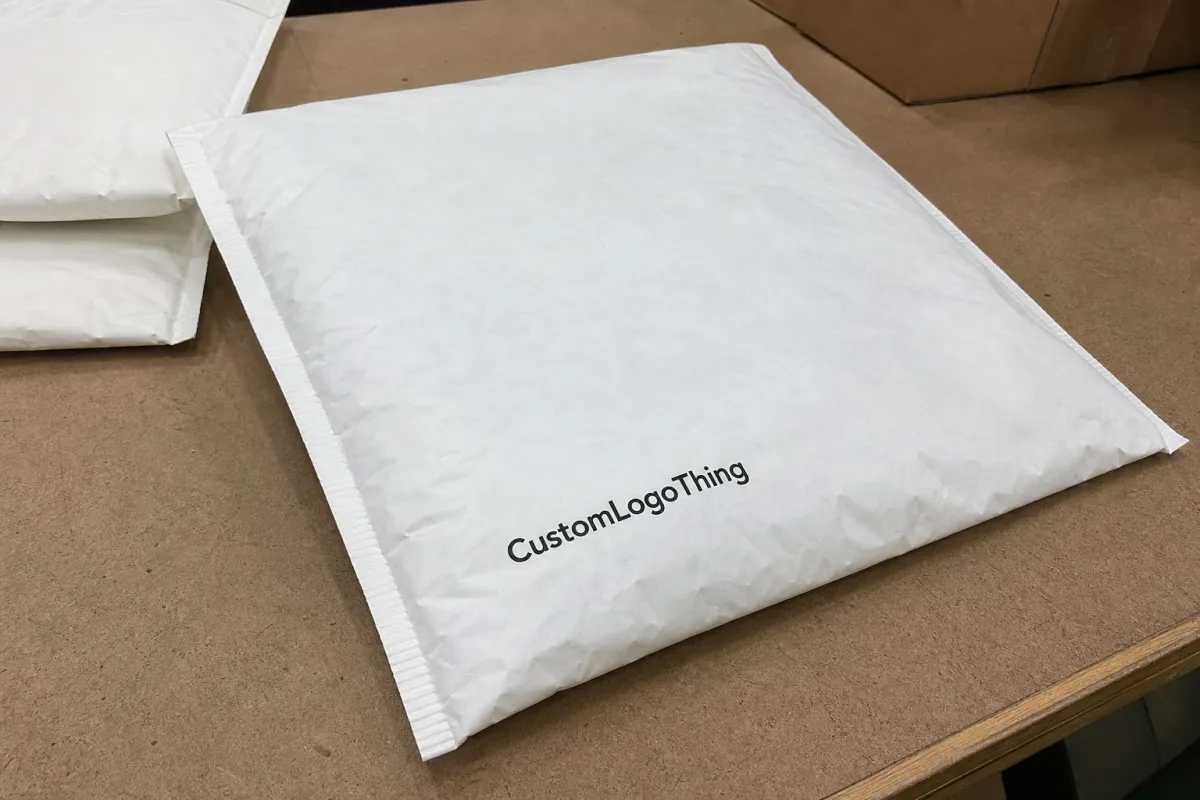
For flat apparel, small cartons are often overbuilt. A folded tee does not need corrugated walls, extra tape, and a pocket of empty space unless the item is unusually delicate or the route is unusually rough. Padded mailers trim material use, and they can reduce dimensional weight, which is where many ecommerce shipping bills quietly inflate.
That difference matters most at volume. A few cents per order sounds minor until a brand ships thousands of units a month. Then the difference becomes a line item worth watching. Box choice changes not only freight, but also receiving, storing, and carton handling on the packing floor. Even a small savings in each stage can add up faster than people expect.
There is a labor angle too. A mailer is faster to load, seal, and label. That may sound like a warehouse detail, but labor is one of the easiest places for packaging to hide its real cost. If a packer saves a few seconds on every order, the benefit shows up in throughput, shift planning, and overtime. A carton can feel sturdier in hand and still be the more expensive choice once labor is counted honestly.
For brands that want a cleaner arrival moment, a printed mailer gives a visible branded surface without turning the parcel into a presentation kit. That is the useful middle ground. Better-looking packaging does not have to weigh more. It just has to fit the product and move through the parcel network without drama.
That said, padded mailers are not the right answer for every SKU. Heavy denim, rigid accessories, boxed sets, and items with sharp edges can justify a different structure. Compare options across the actual product mix, not just the hero item. A package that works beautifully for a single tee may be the wrong call for a two-piece bundle or a textured knit that catches on rough surfaces.
Mailer Construction, Print, and Finish Options
Construction drives cost more than most buyers expect. Common builds include kraft paper padded mailers, poly bubble mailers, recycled-content mailers, and hybrid structures that add stiffness or moisture resistance. Kraft paper versions usually appeal to brands that want a natural look and a more premium tactile feel. Poly bubble mailers are lighter and better at resisting moisture. Hybrid builds sit between the two, but the pricing can move up quickly once the structure becomes more specialized.
The chosen structure also shapes how the customer perceives the brand. Kraft can read editorial and considered. Poly can read practical and efficient. Neither is automatically better. The right choice depends on the product, the shipping lane, and what the brand is trying to signal before the package is even opened.
Print changes the quote just as much as structure. A simple one-color logo is usually the least expensive route. Full-panel graphics, inside printing, metallic ink, and multiple spot colors raise setup charges and inspection time. If a buyer asks for a full-wrap design with a second message on the inside flap, that is not the same job as a single imprint on one side. The production line treats them differently, and the quote should too.
Finish details matter. Matte versus gloss changes the surface appearance and can affect ink behavior. Tear strips, self-seal adhesive, tamper-evident closures, and reinforced seams improve the user experience and reduce transit failures. Each of those choices adds something useful. Each one adds cost as well. The buyer has to decide whether the added function is worth the added spend.
Sustainability claims deserve more scrutiny than branding decks usually give them. Recycled content, fiber sourcing, and plastic reduction all sound clean on a slide. The practical question is whether the mailer still performs under real shipping conditions. If a supplier references responsible fiber, ask for documentation tied to FSC certification. If the package is meant for rougher lanes, ask for sample evidence that the seal, seam, and outer surface were checked beyond a tabletop review.
From a buyer’s point of view, the tradeoff is straightforward: more custom structure and more custom print usually improve presentation, but they also make the unit cost less forgiving at lower volumes. If the order is small and the design is still moving, keep the build simple. Fancy packaging only helps if it can be repeated without surprises.
Size, Gauge, and Performance Specs That Change Pricing
Size is where quote surprises begin. Flat tees, folded sweatshirts, bundled sets, and ecommerce kits all need different internal dimensions. A mailer that fits one folded shirt neatly may be too tight for a two-pack or too loose for a slim knit top. Oversizing costs money twice: first in material, then in shipping volume.
Before pricing anything, check the full spec stack. Internal usable dimensions. Outer dimensions. Material thickness. Bubble or padding weight. Seam strength. Seal performance. For poly bubble mailers, buyers often compare film gauge and bubble density. For paper padded mailers, paper caliper and liner weight matter more. The number printed in bold on a spec sheet is not always the useful number. The useful number is the one that still fits the real garment once someone folds it by hand.
One practical rule helps. Leave enough room for a clean fold, but not so much empty space that the shipment starts paying for dead air. That mistake shows up constantly. A team chooses a larger mailer because it feels safer, then finds the parcel looks sloppy, costs more to move, and consumes more shelf space than the actual item deserves. Bigger is not automatically safer. Sometimes it is just a more expensive way to store emptiness.
Use real samples during sizing. A spec sheet can tell you what a mailer is supposed to hold. The sample tells you what it actually holds. That is also where return-friendly seals and repeat-close designs show their value. If a retailer expects frequent exchanges, the closure has to remain usable after the first opening. A single-use seal on a return-heavy program is a predictable headache.
Performance specs also affect how forgiving the package is during transit. A mailer that survives one test drop on a clean floor is not necessarily ready for a conveyor system, pallet compression, or a route with temperature swings and moisture exposure. Buyers do not need laboratory theater. They need proof that the package can survive the way parcels are handled in the real world.
Branded Padded Mailers for Apparel Retailers Unit Cost Breakdown
For Branded Padded Mailers for apparel retailers unit cost breakdown, the final number usually comes from six parts: material, print, setup charges, finishing, packing, and freight. MOQ pressure sits on top of those. A low-volume run with heavy ink coverage can cost more per piece than a larger order with a simpler layout, even if the base material is nearly the same.
Tooling fees and setup charges are the quiet part of the price. Some production methods require plates or cylinders, and those fixed costs get spread across the run. Digital jobs can reduce or remove tooling fees, but the unit price often stays higher. That is why bulk pricing is not simply about buying more material. It is about spreading fixed work across more units.
For apparel buyers, the most useful way to compare quotes is to ask what changed the number. The answer is usually some combination of these variables: material grade, interior size, print coverage, packaging count, and freight destination. If a quote seems unusually low, one of those variables is probably not the same.
Here is a practical comparison for a standard apparel run. These are directional ranges, not promises, and they assume common sizes, one-color to multi-color branding, and normal commercial packaging.
| Mailer Type | Typical MOQ | Typical Unit Cost at 5,000 Pieces | Best Use | Main Tradeoff |
|---|---|---|---|---|
| Kraft paper padded mailer | 1,000-3,000 | $0.22-$0.38 | Basic apparel branding with a paper-forward look | Less moisture resistance than poly |
| Poly bubble mailer | 1,000-5,000 | $0.15-$0.30 | Lower shipping weight and solid seal performance | Less premium tactile feel |
| Recycled-content hybrid mailer | 3,000-5,000 | $0.25-$0.42 | Sustainability story with better stiffness | Higher setup charges and narrower supplier base |
| Full-print custom mailer | 5,000+ | $0.30-$0.55 | Stronger arrival presentation and brand recall | Tooling fees, more QC, tighter artwork rules |
Those numbers move with size, coverage, material grade, and shipping lane. A mailer for a small tee is not priced the same as one that fits a folded hoodie or a two-item bundle. If a supplier gives a quote without defining usable interior dimensions, print coverage, packaging count, and freight terms, the number is not useful. It is a guess with branding on top.
The cheapest quote is usually the one with the smallest usable size, the thinnest build, or the least print coverage. That may be fine. It may also be a trap. Ask for an apples-to-apples comparison and make the supplier show the assumptions behind the number. A real unit cost breakdown should expose the drivers, not hide them.
For practical review, compare these points on every quote:
- Same usable size, not just outer dimensions
- Same material structure and thickness
- Same print coverage and number of colors
- Same packaging count per carton
- Same freight terms and destination
Production Steps and Turnaround Expectations
A clean production flow usually runs in this order: brief intake, size confirmation, artwork prep, digital proof, sample approval, production, inspection, packing, and final shipment. Skip a step and the bill appears later, either in time or in waste. Usually both.
Simple orders move faster because there is less to resolve. A one-color logo on a standard mailer can move through proofing and production much faster than a full-wrap build with specialty finish. For straightforward runs, 12-15 business days after proof approval is a reasonable working assumption in many programs. More custom work, specialty materials, or larger quantities can push that to 15-25 business days or more. Shipping time sits on top of that.
Most delays happen before production begins. Missing dielines. Low-resolution logos. Late color approvals. Scope changes after the proof is already circulating. That is the usual source of delay, not the mailer itself. A buyer who builds extra time into artwork approval often saves more than a buyer who chases the absolute fastest factory slot.
Sampling deserves more attention than it often gets. A physical sample is not just a nice preview. It is the point where size, texture, seal strength, and loading behavior can be checked at once. If the folded tee catches on the adhesive flap or the closure creases badly, that will not improve at scale. It will only become more expensive to fix later.
If transit validation matters, ask whether the sample has been checked against parcel-style methods such as ISTA test protocols. The point is not to collect technical vocabulary. The point is to understand whether the package can handle compression, vibration, and drop exposure before you ship thousands of units through a carrier network that does not care about branding.
Ask for a written timeline that separates proofing, production, and shipping. That one request prevents a surprising number of launch delays. It also makes replenishment planning much easier when a style sells faster than forecast.
What Apparel Retailers Should Compare Before Ordering
Buyers should compare total landed cost, not just factory price. Freight, duties, carton counts, and handling can erase a cheap quote quickly. A low number in an email is not the same as a low cost at receiving. The real bill includes everything it took to get the mailers to the dock and into use.
There are a few classic quote traps. One supplier offers a lower number but gives a smaller usable size. Another uses thinner material or a weaker seal. A third includes fewer print colors and later explains why the artwork looks flatter than the approved sample. The quote may all be accurate. It is just not the same product.
Use a simple quality checklist before you commit:
- Print consistency from sample to mass run
- Seal integrity under normal packing pressure
- Load testing with actual folded garments
- Carton count and pack configuration
- Sample match against production output
Check the receiving side too. If cartons are packed too tightly, workers spend more time opening and sorting. If they are packed too loosely, more warehouse space gets consumed than expected. A packaging spec that looks efficient on paper can still create slowdowns at the dock if the carton count or pack configuration is awkward.
If the broader packaging mix is still under review, compare the mailer against other formats before locking the final spec. Some retailers keep padded mailers for core basics and use different packaging for gift sets or premium drops. That is a sensible split. The package should match the product class, not the mood board.
Apples-to-apples comparison sounds boring. It saves money. It also protects the launch from the kind of packaging mistake that is easy to miss in procurement and hard to ignore when the first orders arrive.
Why the Mailer Program Stays Consistent
Consistency is where a packaging partner earns repeat business. Apparel teams do not want a new surprise on every reorder. They want stable print color, predictable sizing, clean sealing, and packing standards that do not force the operation to re-learn the package every quarter.
The best programs start with fit, not art. Confirm the usable size first, then lock the artwork, then hold QC on print registration and seam performance. That sounds basic because it is basic. Basic done well is what keeps a mailer from turning into a problem six months into a replenishment cycle.
A stable mailer program should also answer practical questions quickly. What is the MOQ? How much does a second print color add? What happens to price if recycled stock is requested? Can the spec be matched to an existing supplier without redesigning the entire package? Those are the questions that shape buying decisions.
Honest guidance matters here. If a buyer wants a small run with full coverage, specialty finish, and layered materials, the quote should reflect that reality. If a requested spec adds cost without adding function, that should be said plainly. Pricing that hides the tradeoffs tends to show up later as disappointment.
I do not need packaging that sounds impressive. I need packaging that repeats the same way every time.
That is the real standard. Not a prettier mockup. Not a sharper pitch deck. Repeatability. A mailer that looks right on day one and still behaves the same on reorder three is usually the one that protects both brand perception and inventory planning.
Next Steps to Lock the Right Mailer Spec
The fastest way to get a useful quote is to send actual product data, not a vague idea. Include folded garment dimensions, a photo of the packed item, target order quantity, print file, and any retail display or freight requirements. If you have a launch date, include it. If you are comparing two sizes, say so. Guessing helps nobody.
From there, pick one primary size and one backup. That gives a clean comparison on fit, landed unit cost, and lead time. Ask for sample comparisons before signing off on a full run. It is far cheaper to catch a mismatch with two sample pieces than with a pallet of inventory that does not fit the line.
The decision order should stay simple: confirm fit, compare landed cost, approve artwork, then schedule production. That sequence keeps the launch from drifting and keeps the package aligned with the margin target instead of fighting it. It also makes internal approvals easier, because the tradeoffs stay visible in the right order.
If the goal is a Branded Padded Mailers for apparel retailers unit cost breakdown that actually supports buying decisions, the best move is to ask for a side-by-side quote that shows size, structure, print, and freight separately. The numbers should tell a story. If they do not, the quote is not ready.
Frequently Asked Questions
What affects branded padded mailers for apparel retailers unit cost the most?
Size, material build, and print coverage usually matter most because they change both raw material use and setup work. MOQ has a strong effect too; smaller runs carry a higher per-unit cost because fixed charges are spread across fewer pieces. Freight and carton configuration can quietly move the landed price, so buyers should compare total delivered cost, not only factory price.
How many padded mailers should apparel retailers order to get a better price?
There is no single threshold, but pricing usually improves once setup costs are spread over a larger repeat run. Many buyers start with a low-MOQ test order, then move into a higher replenishment volume after fit and print are approved. The cheapest unit price is not always the smartest choice if inventory risk is high or the artwork may still change.
Which size works best for branded padded mailers for t-shirts and light apparel?
Flat tees and light tops usually fit in smaller mailers, while hoodies, sweaters, and bundled items need larger internal dimensions. The right size should allow a clean fold without forcing the garment or wasting space that raises shipping cost. Always test with the actual folded product, not just a guessed size from a spec sheet.
Does print coverage change the price of custom padded mailers?
Yes. Simple logo printing is usually cheaper than full-coverage artwork or multi-color designs. Special finishes like metallic ink, inside print, or matte and gloss effects can add setup and production cost. If unit cost matters most, simplify the print area before changing the structure.
How long is the lead time for branded padded mailers after artwork approval?
Simple runs usually move faster than fully custom builds, but the exact lead time depends on quantity, print method, and finishing. Sampling, proof approvals, and material availability can add time before production even starts. Ask for a written timeline that separates proofing, production, and shipping so there are no surprises later.

