Buyer Fit Snapshot
| Best fit | branded paper bags price for packaging buyers comparing material specs, print proof, MOQ, unit cost, freight, and repeat-order risk where brand print, material, artwork control, and repeat-order consistency matter. |
|---|---|
| Quote inputs | Share finished size, material target, print colors, finish, packing count, annual reorder estimate, and delivery region. |
| Proofing check | Approve dieline scale, logo placement, barcode or warning zones, color tolerance, and any recyclable or compostable wording before bulk production. |
| Main risk | Vague material claims, crowded artwork, or missing packing details can create delays even when the unit price looks attractive. |
Fast answer: Branded Paper Bags Price: What Drives Your Total Cost should be specified like a repeatable production item. The safest quote includes material, print method, finish, artwork proof, carton packing, and reorder notes in one written spec.
What to confirm before approving the packaging proof
Check the product dimensions against the actual filled item, not only the sales mockup. Ask for tolerance on folds, seals, hang holes, label areas, and retail display edges. If the package carries a logo, QR code, warning copy, or legal claim, reserve that space before decorative graphics fill the panel.
How to compare quotes without losing quality
Compare board or film grade, print process, finish, sampling route, tooling charges, carton quantity, and freight assumptions side by side. A lower quote is only useful if the supplier can repeat the same color, closure quality, and packing count on the next order.
Branded Paper Bags Price: What Drives Your Total Cost
Ask for Branded Paper Bags price and the conversation usually starts with the logo, yet the logo is rarely the part that changes the quote the most. Paper grade, handle construction, print coverage, surface finish, and reinforcement all shape the final number, which is why two bags that look nearly identical on a shelf can sit in very different price bands once production begins.
The easiest way to miss cost is to focus only on appearance. A tidy kraft carrier with a single-color mark can look straightforward, then the Branded Paper Bags price climbs as soon as the brief calls for thicker stock, rope handles, foil accents, lamination, or a stronger base that can carry bottles, boxed goods, or takeaway meals without sagging.
Buyers rarely need the cheapest bag on paper. They need the right balance of presentation, strength, and spend, without paying for features that do not help the product or the customer journey. A folded apparel bag does not need the same build as a luxury gift bag. A bag used for heavier retail goods should be priced for that duty, not squeezed into a fragile spec just to win a lower quote.
After enough press checks, one pattern keeps showing up: the quote that looks simple on the front end is usually hiding the tradeoffs somewhere else. That is kinda the whole job here, really. Once those tradeoffs are clear, branded paper bags price becomes a planning tool instead of a surprise.
This piece walks through the variables that actually move the number, how to compare suppliers without comparing apples to oranges, and what to lock in before you ask for pricing. Once the spec is honest, the quote usually is too.
"A bag can look premium on a sample table and still be expensive for the wrong reasons. The smartest spend is the bag that carries well, prints cleanly, and survives the way customers really use it."
Branded Paper Bags Price: Why Small Choices Change the Quote
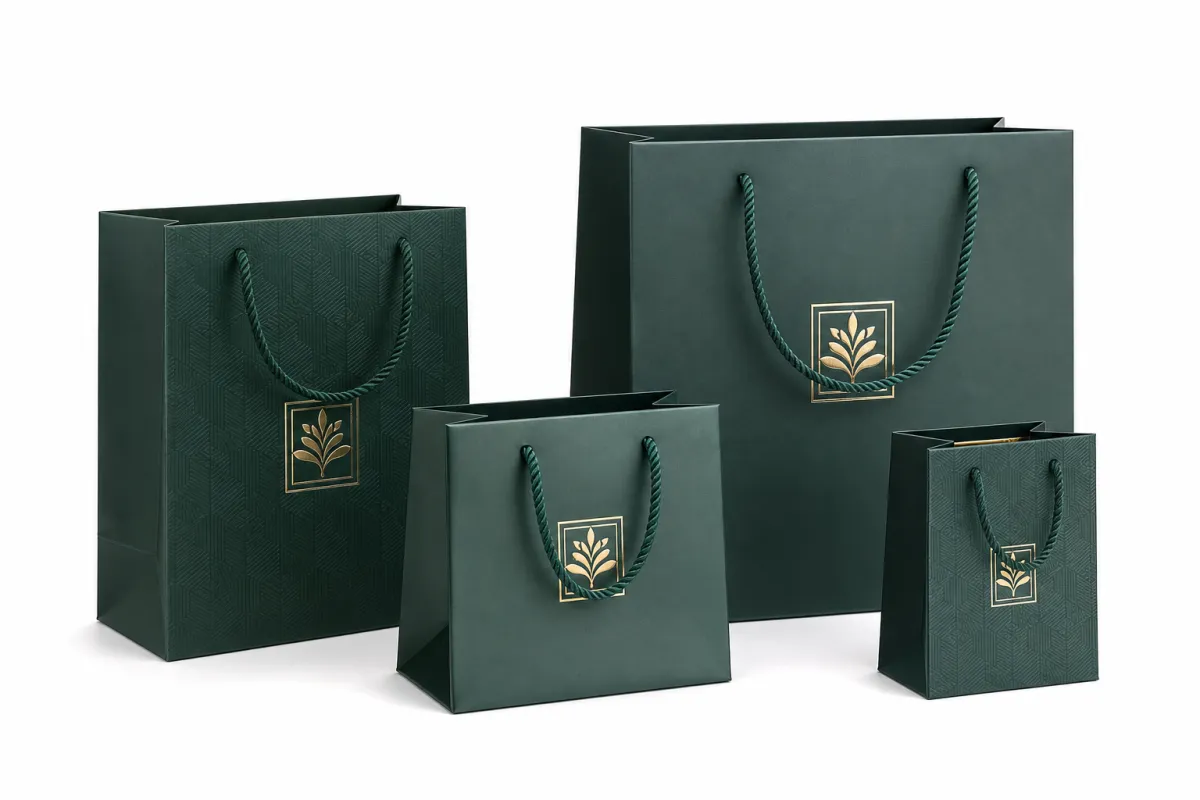
Branded paper bags price is shaped less by the logo than by everything built around it. A simple one-color mark on plain kraft paper can be economical, yet the same design on a coated bag with precise color matching, a reinforced fold, and rope handles can move into a higher cost tier very quickly.
Two bags can sit beside each other and seem almost identical to a shopper. One might use 150 gsm kraft stock with twisted handles and a single hit of black ink. The other might rely on heavier board, a laminated surface, and a glued base insert to improve stiffness. Those hidden choices affect labor, waste, setup, and yield, so branded paper bags price follows the production path more closely than the visual finish alone.
Smarter buying starts with the use case. A boutique that wants a polished handoff should spend on print accuracy and a handle that feels good in the hand. A food-service brand that needs grease resistance and dependable carry strength should put money into the right paper, the right coating, and the right structure. Paying for a luxury finish that does nothing for the product only pushes branded paper bags price upward without improving performance.
Brand perception matters too. A bag that buckles at the bottom or wrinkles badly under light load can make the whole purchase feel cheap, even if the artwork is sharp. A spec matched to the real workload gives a better impression and avoids wasted spend. That is the real lesson behind branded Paper Bags Price: the quote should fit the customer experience, not only the artwork file.
I have seen buyers get tripped up by a bag that was technically printable but practically awkward. The sample looked fine. The launch, less so. The difference usually comes down to paper body, handle attachment, or bottom construction, and those are the places where the money either earns its keep or disappears.
Product Details That Shape Branded Paper Bags Price
Break the bag into its core parts if you want a fair comparison between suppliers. Paper type, handle style, print method, and structural build do most of the heavy lifting. Once those pieces are fixed, branded paper bags price becomes much easier to read because each line in the quote has a clear reason.
Paper type usually sets the starting point. Kraft bags are often the most efficient option because kraft stock is familiar, durable, and widely recyclable in many programs. Coated paper bags, art paper gift bags, and laminated finishes cost more because they add surface treatment, a better print face, or a more refined feel. Luxury Gift Bags can rise still higher when they use thicker board, decorative wraps, and cleaner edge finishing. For retail carryout, a standard kraft or coated carrier may keep branded paper bags price in check. For gifting or events, a buyer may accept a higher price for a more polished result.
Handle style changes the quote more than many first-time buyers expect. Twisted paper handles are usually efficient for everyday retail use. Flat paper handles work well for takeaway bags or value-focused promotions. Rope handles, ribbon handles, and cord handles add assembly time and usually lift the overall price because they improve the look enough to justify the extra cost for premium packaging. Die-cut handles can look elegant and simple, but they need a design that supports the cut cleanly. The handle is not a small detail; it is part of branded paper bags price.
Print method affects both appearance and cost. One-color flexographic printing is often the more economical choice for simple graphics and larger runs. Offset printing helps when artwork needs finer detail or more involved color work. Full-bleed graphics, dense coverage, and exact brand matching add setup work and press attention. Foil stamping, embossing, debossing, spot UV, and soft-touch lamination move the bag into a more premium category, and each finish can raise branded paper bags price faster than buyers expect if the effect is not essential to the brief.
Structure is the quiet cost driver. Folded tops, gusset depth, reinforced bottoms, inserted cardboard bases, and side-wall reinforcement all improve how the bag carries weight and keeps its shape in use. A tote-style retail bag that has to hold a rigid box is not the same build as a light promotional bag for a trade show. If the bag must survive repeated handling, the structure should support that duty from the start, because weak seams and thin bases can create replacement costs that outweigh the original savings. That is why branded paper bags price should always be read with the end use in mind.
To make the difference easier to compare, here is a simple planning view buyers often use:
| Bag Type | Typical Use | Typical Unit Price Range | What Pushes the Price Up |
|---|---|---|---|
| Plain kraft carrier | Retail carryout, simple promotions, light apparel | $0.12-$0.28 | Heavier paper, more colors, reinforced handles |
| Printed retail shopping bag | Boutiques, gift shops, product launches | $0.22-$0.55 | Full-bleed graphics, coated stock, better finishing |
| Laminated luxury gift bag | Premium gifting, events, high-value merchandise | $0.65-$1.80 | Foil, embossing, rope handles, rigid board |
| Food-service or takeaway bag | Meal delivery, cafes, catering | $0.10-$0.35 | Grease resistance, moisture control, stronger bases |
Those numbers are planning ranges, not guarantees. Even so, they show how branded paper bags price can move when a bag shifts from a simple carrier to a more developed retail presentation piece. For a buyer comparing quotes, the most useful question is not "What is the cheapest bag?" It is "Which spec gives me the right result with the least waste?"
Specifications Buyers Should Lock In Before Requesting a Quote
Suppliers can only give a useful number once the spec is clear. If the details stay vague, branded paper bags price turns into a rough guess, and rough guesses often lead to surprise charges later. The fastest route to a solid quote is to send the dimensions, quantity, paper grade, handle style, print colors, finish requirements, and delivery location in one organized brief.
Size comes first because it affects sheet usage and carton packing. The three dimensions that matter are width, gusset, and height. A bag for folded apparel is a different build from a bottle bag or a takeaway carrier. A poor size choice can create wasted board, awkward folding, or weak shelf presence, all of which affect branded paper bags price and the usability of the finished bag.
Paper weight should be stated in gsm or basis weight so there is no confusion later. Heavier stock usually improves stiffness, print feel, and carry strength, but it also increases material cost and can change the way the bag folds. A 120 gsm kraft bag and a 180 gsm kraft bag are not interchangeable. If a buyer needs a bag that stands upright and keeps its shape under normal retail loading, that requirement belongs in the quote from the start. Otherwise branded paper bags price may look attractive until the bag is tested in real use.
Artwork quality is another common source of hidden cost. Clean vector files, correct color references, and clear brand standards help the printer match expectations with fewer revisions. Low-resolution files, unclear gradients, or unapproved spot colors can slow proofing and create extra prepress work. A buyer may never see that labor in the sample, but it still shows up in branded paper bags price if the project needs file cleanup, extra proofing, or color correction.
Structural details need to be specified as well. Does the bag need a reinforced top edge, a bottom insert, moisture resistance, or a design that stands upright on a counter? Will it carry one light item or several heavier items? If the answer involves heavier loads, ask for a test target or load expectation. For shipping-heavy programs, some teams also ask for ISTA-related handling methods or transit checks. For fiber sourcing questions, many buyers want FSC chain-of-custody support. You can review paper and packaging references through the FSC site at fsc.org and transit testing guidance through the ISTA organization.
Compliance and food-contact needs can change the material stack too. A bag that touches dry retail goods has a different requirement than one used for bakery items, prepared food, or greasy takeaway. Grease resistance, water resistance, and coatings suitable for food applications can all influence branded paper bags price. On the sustainability side, the U.S. EPA offers useful packaging and recycling context at epa.gov, especially for teams that want to keep the bag recyclable without adding unnecessary laminate layers.
Locking in these basics before requesting pricing is not paperwork for its own sake. It is the fastest path to a quote that reflects the real job rather than a generic carton of bags. Better specs produce a cleaner branded paper bags price, fewer revisions, and a smoother approval cycle.
Branded Paper Bags Price: MOQ, Setup, and Unit Cost
MOQ is usually where purchasing teams feel the gap between what a bag costs to make and what it costs to buy in a small run. Setup work, printing plates, die cutting, proofing, and packing all influence branded paper bags price even when the bag appears simple from the outside. The reason is straightforward: the press and finishing lines still need to be prepared whether the order is 500 pieces or 5,000.
Unit cost usually falls as volume rises. A setup charge spread across 1,000 bags has a much bigger impact than the same charge spread across 10,000. For a simple kraft carrier, branded paper bags price may look acceptable at a lower run, then drop noticeably when the order moves into the next volume tier. Seasonal retail programs, store openings, trade events, and product launches all benefit from that math because the schedule can be built around one larger run instead of several small ones.
For a buyer, the most useful comparison is not only the lowest quote. It is the quote structure. Ask for the bag cost, decoration cost, freight, and any one-time setup charges as separate lines. That shows whether a supplier is offering a truly competitive branded paper bags price or hiding the setup somewhere else. Once the quote is broken apart clearly, it is much easier to compare suppliers on equal terms.
Here is a practical way to read volume and cost movement:
- Small runs often carry a higher per-unit price because setup costs are spread over fewer bags.
- Mid-sized runs often give the best balance between flexibility and unit cost for retail and food-service programs.
- Larger runs can reduce branded paper bags price significantly if the spec stays stable and the artwork does not change.
- Complex finishes can flatten the savings curve because premium work adds labor even at higher volume.
Picture the difference between a straightforward 5,000-piece run with one or two print colors and standard handles, and a 5,000-piece run with foil, embossing, and laminated rope handles. The branded paper bags price in those two scenarios is not really about quantity alone. It is about how much labor and special handling each unit needs.
The cleanest way to think about the bag is the same way you would think about a carton conversion or a printed sleeve. There is a base structural cost, then a decoration layer, then packing and freight. The more the production line has to do, the more the quote rises. Teams looking for the best branded paper bags price usually standardize size, simplify finishes where possible, and order in a volume tier that matches the sales cycle rather than the smallest possible need on paper.
If the design does not need foil, embossing, or heavy lamination, do not pay for it just because the sample looks attractive. Premium effects should support the brand story, not inflate branded paper bags price without a business reason.
Reorder stability matters too. If the bag will be used repeatedly for stores or events, keep the spec consistent so the next batch matches the first. Consistency often saves money over time because the supplier can repeat the same print path and material plan instead of rebuilding the job. Stable specs are one of the quietest ways to improve branded paper bags price across a program, especially when the artwork stays fixed for months.
Process and Timeline: From Artwork to Delivery
A useful quote is only one part of the job. The production path matters just as much because a delay at proof stage can affect delivery more than a freight lane ever will. For branded paper bags price, buyers should think in two layers: manufacturing cost and time cost. A low number does not help if the bags arrive after the campaign starts.
The workflow usually begins with the specification review, then moves to artwork checking, proof approval, production, quality inspection, packing, and shipping. Each step carries its own risk. Artwork revisions can add days. Color matching can add more. Premium finishes can require extra setup. That is why a quote should include not only branded paper bags price, but also a clear note about what happens before the press starts.
For straightforward orders, lead time is often measured in business days after proof approval. A simple bag with standard handles and limited print coverage may move through production faster than a luxury gift bag with foil, lamination, or custom inserts. As a rough planning range, a clean retail run might finish in about 12-18 business days after proof sign-off, while a more complex build can stretch into the 20-30 business day range depending on quantity and finish. Those numbers are not universal, yet they are useful for planning around launches and replenishment cycles.
Proof approval deserves more attention than it often gets. Once the proof is signed off, the supplier has a clear target for print placement, color, and structure. That protects the schedule and helps prevent disputes later. If a buyer wants a specific shade, a crisp logo edge, or a particular handle color, those details should be confirmed before production starts. Otherwise the branded paper bags price can be reasonable while the finished bags still miss the brand standard, which is the wrong kind of savings.
Shipping is the last piece of the timeline, and it should not be treated as an afterthought. Freight method, destination, packaging volume, and seasonality can all affect arrival dates. A bag order that leaves the plant on time can still arrive late if the delivery method was not matched to the launch date. For that reason, teams should ask for the production schedule and the freight schedule separately, then combine them into one realistic delivery target. That approach keeps branded paper bags price tied to the actual project deadline instead of an optimistic assumption.
When comparing vendors, ask a simple question: "What does your timeline include?" Some suppliers quote only production, while others include proofing and shipping in the same window. A fair comparison of branded paper bags price should always use the same time basis, because the cheapest bag is not cheap if it arrives after the event.
Why Choose Us for Branded Paper Bags
Custom Logo Things is built for buyers who want packaging that looks right, carries well, and stays within a sensible budget. The right partner should not push the most expensive build by default. It should help you balance presentation, durability, and spend so branded paper bags price reflects the real value of the bag instead of a one-size-fits-all premium.
That means paying attention to paper selection, structural reinforcement, print compatibility, and finishing choices before the order is locked. A bag that is overbuilt for the product wastes budget. A bag that is underbuilt creates returns, damaged goods, and weak presentation. Practical experience matters here because the best branded paper bags price is usually the one that solves the job with the least unnecessary complexity.
Consistency is another reason buyers stay with one packaging partner. Retail chains, product launches, and seasonal campaigns need the same look every time, not a different shade or handle style on each reorder. Stable artwork handling and repeatable specs reduce the chance of variation, and that stability often improves branded paper bags price over the life of the program because fewer corrections and fewer spec changes are needed.
If you want to see how different packaging briefs translate into real-world work, review our Case Studies. They show how spec choices affect the look, carry feel, and production path of a project. You can also return to the Custom Logo Things homepage if you are still shaping the brief and want a simple starting point for the quote process.
There is a sustainability angle here as well, but it works best when it stays grounded in materials and waste reduction rather than slogans. Right-sizing the bag, choosing recyclable paper where appropriate, and avoiding decorative layers that do not add value all help keep the program efficient. The result is a better branded paper bags price because the design spends on what matters: material strength, clean print, and a finish that supports the brand.
For buyers who need a steady supply plan, that combination matters more than any flashy claim. A reliable spec, a readable quote, and a practical production path are what make the difference between a one-time order and a packaging program that keeps working. That is the standard Custom Logo Things aims to support.
Next Steps to Get an Accurate Quote
If you want a useful quote instead of a rough estimate, gather the essentials before you ask for pricing. That means the bag dimensions, quantity, paper type, handle style, print colors, finish, artwork file, delivery destination, and the date you actually need the goods in hand. With those details in place, branded paper bags price can be calculated with far less guesswork.
Send artwork early. Even a simple file review can uncover issues that affect production, such as low resolution, missing fonts, or color profiles that do not match the intended output. The sooner the file is checked, the less likely proof revisions are to push the schedule out. If the job is tied to a store opening or event date, that early review is one of the easiest ways to protect branded paper bags price from surprise rework.
It also helps to request two versions of the quote when possible: a standard spec and a premium spec. That comparison shows where branded paper bags price rises when you move from kraft to coated stock, or from flat handles to rope handles, or from a single-color logo to a more finished presentation bag. Once you see the difference line by line, the best option usually stands out on its own.
Ask for the timeline in writing as well. A clear schedule should show the proof stage, production window, quality check, packing, and freight plan. That makes it easier to compare vendors fairly and avoid misunderstandings later. The strongest quote is not just the lowest number. It is the one that shows how branded paper bags price relates to the spec, the MOQ, the lead time, and the final delivery plan.
The practical takeaway is simple: lock the bag spec before you compare prices. If the dimensions, paper weight, handle, print method, and freight assumptions are all fixed, the branded paper bags price you receive is far more trustworthy and much easier to act on. That is the quickest path to a purchase that feels deliberate instead of rushed.
What affects branded paper bags price the most?
Paper weight, bag size, and handle style usually have the biggest impact on cost. Print coverage and special finishes like foil, embossing, or lamination can raise branded paper bags price quickly, and higher quantities usually lower the price per bag because setup costs are spread across more units.
How can I get a lower branded paper bags price without losing quality?
Standardize the size and choose a proven paper stock instead of a fully custom structure. Limit print colors or simplify finishing if the design does not need premium effects, and order in a larger run when possible so the setup cost is diluted across more bags. That is the most reliable way to improve branded paper bags price while keeping the bag serviceable.
Is there usually a minimum order for branded paper bags?
Yes, MOQ is common because printing and setup work make very small runs inefficient. Simple bags can sometimes be produced in lower quantities than fully custom luxury bags, so ask for both the MOQ and the price break at the next volume tier before you approve the order. That gives you a better read on branded paper bags price across the order range.
How long does branded paper bag production usually take?
Timeline depends on proof approval, print complexity, and whether special finishes are involved. Straightforward bags move faster than orders with foil, embossing, or custom handles, and freight time should be added separately so the delivery date reflects both production and shipping. That way branded paper bags price and lead time are evaluated together, which is the only fair way to plan.
Can I compare branded paper bags price across suppliers fairly?
Yes, but only if the quotes use the same size, paper grade, print method, and quantity. Check whether setup fees, packaging, and freight are included in the price you are comparing, and confirm proofing, quality checks, and whether the quoted spec matches your artwork. A fair comparison keeps branded paper bags price tied to the same production assumptions on both sides.


