Buyer Fit Snapshot
| Best fit | Branded Tissue Paper Bulk projects where brand print, material claims, artwork control, MOQ, and repeat-order consistency need to be specified before quoting. |
|---|---|
| Quote inputs | Share finished size, material target, print colors, finish, packing count, annual reorder estimate, ship-to region, and any compliance wording. |
| Proofing check | Approve dieline scale, logo placement, barcode or warning zones, color tolerance, closure strength, and carton packing before bulk production. |
| Main risk | Vague material claims, crowded artwork, missing packing details, or unclear freight terms can make a low unit price expensive after revisions. |
Fast answer: Branded Tissue Paper Bulk: Pricing, Specs, and Ordering should be specified like a repeatable production item. The safest quote records material, print method, finish, artwork proof, packing count, and reorder notes in one written spec.
Production checks before approval
Compare the actual filled-product size with the drawing, then confirm tolerance on folds, seals, hang holes, label areas, and retail display edges. Reserve space for logos, QR codes, warning copy, and material claims before decorative graphics fill the panel.
Quote comparison points
Review material grade, print process, finish, sampling route, tooling charges, carton quantity, and freight assumptions side by side. A quote is only useful when the supplier can repeat the same color, closure quality, and packing count on the next order.
Branded Tissue Paper bulk does a lot more inside a parcel than most packaging add-ons ever will. I have watched a plain shipping box turn into something that feels considered the moment a printed sheet appears at the top. Those first five seconds matter because customers decide whether a package feels premium, ordinary, or hurried almost immediately. The price difference is usually modest. The perception difference is not, and that gap is exactly why tissue keeps showing up in serious packaging programs.
Buyers keep coming back to Branded Tissue Paper bulk for a simple reason: it is light, visible, and easy to scale. It lines apparel boxes, wraps gifts, separates fragile items, and gives subscription kits a clean interior finish without making fulfillment ugly or slow. Poorly specified tissue wrinkles, tears, or looks like a cheap afterthought. The right spec feels deliberate and keeps the same look across thousands of orders. Many teams compare it with Custom Printed Tissue paper, Gift Wrap Tissue, and tissue paper wholesale programs before they settle on a final spec.
For a packaging buyer, the biggest advantage is control. Bulk purchasing lets a team lock in sheet size, color, and print repeat across replenishment runs. That reduces the tiny failures that turn into expensive noise later: mismatched cartons, uneven tissue coverage, emergency reorders, and launch delays caused by stockouts. Packaging programs usually break in the details, not the headlines.
Why Branded Tissue Paper Bulk Beats Generic Fill
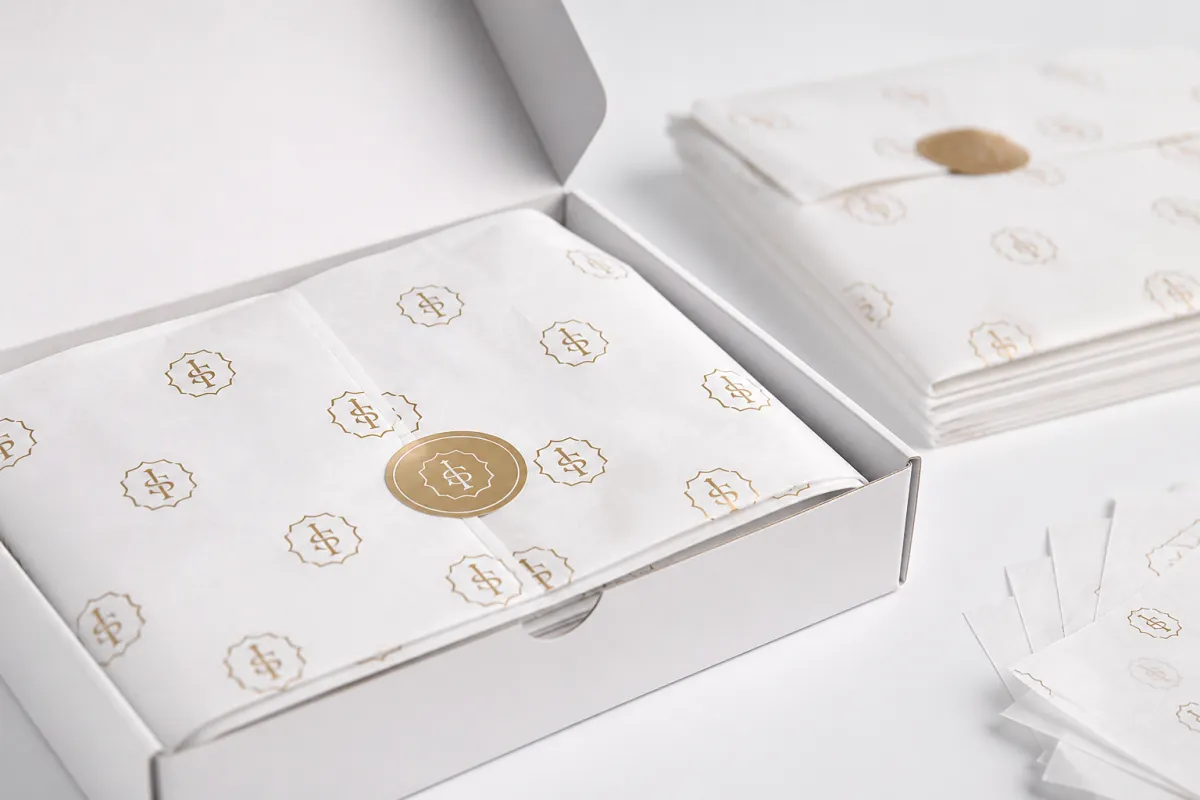
Generic tissue fills empty space. Branded tissue paper bulk fills space and sells the brand at the same time. That sounds obvious, but packaging budgets are full of line items that look minor until you compare cost per impression. A printed sheet inside a box is one of the cheapest ways to create a premium cue because the customer sees it immediately, often before the product. A ribbon, embossed carton, or custom insert card can cost far more per order. Tissue often delivers the best visible brand effect for the money.
Picture a basic ecommerce order: a sweatshirt folded into a plain mailer, no tissue, no interior print, no structure. It arrives intact. It also arrives forgettable. Add one sheet of printed tissue folded around the product or laid cleanly at the top of the box, and the parcel changes character. The product feels chosen instead of tossed in. That shift happens before the customer touches anything else, which is why unboxing is less mystique than sequence. The first physical layer sets the tone.
Branded tissue paper bulk also helps the operation itself. A consistent spec is easier to train around than a packaging mix that changes every few weeks. Same ream count, same sheet size, same carton format: the packing team moves faster and wastes less. During peak periods that matters a lot, especially in ecommerce, beauty, apparel, and gifting where the line is already handling labels, inserts, returns, and multiple SKUs at once.
Bulk buying also protects supply. Small orders cost more per sheet because the setup burden gets spread over fewer pieces. Larger runs usually pull the unit price down enough to justify keeping working inventory on hand. That buffer helps when a campaign runs long or a seasonal spike burns through the forecast faster than expected. A packaging program should not be held hostage by a logo sheet running out two days before launch.
Most buyers underestimate how much brand consistency lives in the background. The box may get the spotlight, but tissue is the layer customers actually handle. Crisp print, even sizing, and a repeat that lands in the same place tell a quiet story of discipline. Off-center patterns and color drift tell the opposite. Branded tissue paper bulk is not the flashiest item in the stack, but it is one of the fastest ways to make a small order feel considered.
For teams comparing packaging upgrades, the real questions are usually these:
- How visible is the item during the first opening?
- How much does it add to packing time and freight volume?
- How much brand value does it create per order?
Tissue scores well across those three points when the spec is handled properly. It is light enough to ship efficiently, flexible enough for many product categories, and affordable enough to make sense even when margins are tight. That is why branded tissue paper bulk keeps showing up in serious packaging programs instead of staying trapped in seasonal promos.
What Is Branded Tissue Paper Bulk Used For?
Branded tissue paper bulk is used anywhere a product needs a clean first impression and a layer of presentation that does not add much weight. Apparel brands use it to wrap folded garments. Beauty brands use it to separate items and soften the reveal. Gift sellers use it as gift wrap tissue that turns a simple carton into something that feels more intentional. Subscription boxes use it to keep the interior looking finished even before the customer reaches the product.
That use case matters because tissue does two jobs at once. It protects surfaces from scuffs and dust, and it makes the parcel feel more curated. Compared with heavier packaging components, the sheet is inexpensive to print and easy to store. Compared with a plain white wrap, it communicates the brand before the customer even lifts the product out of the box. That is a very short route from supplier to perception.
For many teams, the question is not whether to use tissue at all. It is whether to use plain tissue or branded tissue paper bulk. The second option usually wins when the brand wants repeat visibility, stronger unboxing, or a packaging system that feels consistent across channels. That is especially true for ecommerce packaging, retail kits, and launch boxes where the packaging itself is part of the offer.
I have also seen it solve a practical problem that marketing teams sometimes miss: a product can be well made and still look unfinished when it lands in a box with empty visual space. Tissue closes that gap without adding weight, and it does it for a fraction of the cost of a structural packaging upgrade. That is kinda the sweet spot.
Branded Tissue Paper Bulk Product Details and Print Options
Branded tissue paper bulk is printed wrap used for lining, wrapping, interleaving, and presentation inside boxes or mailers. It is usually made from lightweight tissue paper in common grammages like 17 gsm, 18 gsm, or 22 gsm. Lighter grades feel softer and cost less. Heavier tissue has more body, resists tearing better, and sits flatter in the carton. No single grade wins every time. The right one depends on the product, the packing method, and the presentation target.
Print style carries nearly as much weight as paper choice. A simple repeat logo is often the most practical option because it keeps the design flexible in packing and tolerates small shifts in fold placement. One-color repeat patterns are usually the least disruptive choice for high-volume orders. Two-color branding adds more depth, while full-sheet layouts can look more polished and are often reserved for brands that want a stronger unboxing statement. More coverage usually means more setup, more ink, and more cost. Fancy tends to cost fancy money.
There is a real split between visual effect and packing speed. Repeat patterns are easier to handle because the team can fold and place the sheet without chasing a perfect image position. Full-sheet or edge-to-edge layouts can look more refined, but they can slow packing if the design needs a strict orientation. In a manual line, that becomes a real operational choice. In a high-volume environment, even a few extra seconds per parcel multiply fast.
For brands shipping apparel, beauty products, gifts, or subscription kits, tissue is usually used in one of four ways:
- As a liner that sits under the product and creates a soft branded reveal.
- As a wrap that protects surfaces from scuffs, dust, and minor abrasion.
- As interleaving between folded garments, accessories, or sets.
- As a presentation layer that fills the top of the box neatly.
Some buyers ask whether tissue can protect fragile products. The honest answer is yes, within limits. Tissue is useful for surface separation, scratch prevention, and presentation. It is not a substitute for cushioning, inserts, molded pulp, or other protective components when the product is heavy or fragile. A glass item or dense ceramic needs a packaging system, not a single sheet with a logo.
Color choice also changes the feel. A black logo on white tissue is clean and direct. A one-color print in a brand accent can look more intentional. Two-color layouts can be sharp if the artwork supports that treatment. If the brand uses Pantone references, they should be defined early. Sloppy art files produce sloppy print. That is not a mystery; it is just cause and effect.
If your team cares about responsible sourcing, check whether the paper should be FSC-certified or FSC-matched through an approved supply chain. The Forest Stewardship Council documents the standards at fsc.org. For shipping and transit expectations, packaging teams also look at testing guidance from the International Safe Transit Association at ista.org. Those references are not decoration for a sales page. They help buyers build a more disciplined packaging program.
"A tissue sheet is small, but the customer sees it immediately. That makes the print quality more important than people think."
For brands already buying packaging in volume, branded tissue paper bulk fits naturally beside labels, mailers, and inserts. If you are comparing packaging programs, our Case Studies page is a useful place to see how different products fit different order profiles. The point is not to make tissue sound magical. The point is to make sure it earns its place in the box.
Branded Tissue Paper Bulk Specifications That Affect Cost
Buyers often start with price and move to spec later. That is backwards. With branded tissue paper bulk, the spec Drives the Price. If you want a useful quote, you need the sheet size, paper weight, print coverage, ink count, fold style, and pack format. Leave those vague and the quote becomes a guess. Guessing is not sourcing.
Sheet size is one of the largest cost levers. A 20 x 30 in sheet is common for apparel and gift packaging. Larger sheets like 25 x 30 in or 30 x 40 in can reduce the number of sheets needed per order, but they increase material usage and freight volume. Smaller sheets can be cheaper per piece, though they may add packing labor if the product needs multiple layers to look right. The best size is the one that fits the product with the least waste.
Paper weight affects handling and perception. At the lighter end, tissue feels airy and stays budget-friendly. At the heavier end, it folds more cleanly, sits flatter in cartons, and resists tearing when the packing team is moving quickly. If you want a stronger presentation without moving to a much larger sheet, a slightly heavier grade is often the smarter move.
Print coverage and color count also affect the number. A simple logo repeat across the sheet costs less than a heavy pattern or a full-sheet design. One ink color keeps setup simpler. Two colors add complexity. Full-coverage printing means more ink, more drying time, and tighter quality control. That does not mean a more basic layout is always better. It means every design choice should match the order volume and the way the tissue will actually be used.
Ream count and carton pack count matter more than many buyers expect. If tissue is packed in reams, those reams need to be easy for the warehouse to store and pull. If the carton count is awkward, the packing team wastes time opening and breaking down cases. For a repeat program, that is annoying. For a high-volume warehouse, it becomes a small tax on every shift.
Here is the practical checklist I would want before the first production run of branded tissue paper bulk:
- Final sheet size in inches or millimeters.
- Paper weight in gsm.
- Artwork format and print method.
- Number of ink colors and Pantone references.
- Ream count, case pack, and pallet preference.
- Target quantity for the first run and expected reorder cadence.
- Warehouse delivery address and receiving restrictions.
That list looks basic because it is. Most issues come from basic details getting skipped. A buyer approves a mockup without confirming fold direction, then the warehouse finds that the tissue does not sit cleanly in the carton insert. Or the quote looks attractive until the team notices the carton pack is awkward for storage and adds handling time. Small misses become expensive when they repeat across thousands of sheets.
Packaging buyers also need to think about how tissue behaves in automated or semi-automated environments. If the paper is too slippery, too large, or folded in an odd way, pick-and-pack teams lose speed. If the sheet size is consistent and the fold is predictable, the line moves cleaner. That becomes more visible during seasonal peaks, where a few seconds saved per order matter more than most people admit.
If the order sits inside a broader wholesale packaging program, it helps to align tissue with the items already on your replenishment schedule. Our Wholesale Programs page is a useful starting point for that kind of planning. Branded tissue paper bulk is easiest to manage when it is treated like part of a supply chain, not a last-minute decoration.
Branded Tissue Paper Bulk Pricing, MOQ, and Volume Breaks
Branded tissue paper bulk pricing comes down to a few plain facts: artwork setup, print complexity, sheet size, paper grade, pack format, and freight. That is the whole equation. If the quote feels high, one of those factors is probably more demanding than expected. If the quote feels unusually low, something is probably being left out. Either way, the answer is to compare the full landed cost, not just the factory number.
MOQ exists because production efficiency exists. Lower minimums usually cost more per sheet because the setup is spread across fewer pieces. Larger runs reduce the unit price, but they also increase storage needs and cash tied up in inventory. That is the tradeoff. The right order size is not always the biggest one. It is the one that fits your shipping pace, warehouse space, and reorder timing.
For a buyer trying to budget realistically, here is a practical way to think about tiers for branded tissue paper bulk. These are not promises. They are working ranges based on how printed tissue programs are typically quoted:
| Option | Typical Spec | Best For | Approx. Price Logic | Notes |
|---|---|---|---|---|
| Low MOQ run | 17 gsm, one-color repeat, standard sheet size | New brands, pilot launches, small seasonal drops | Highest per-sheet cost because setup is spread over fewer sheets | Good for testing artwork and pack flow |
| Mid-volume run | 18-22 gsm, one or two colors, common size | Growing ecommerce brands and recurring packaging programs | Better unit cost once volume starts to absorb setup | Usually the best balance of cost and flexibility |
| High-volume run | Larger sheets, full repeat, custom cartons or pallet packs | Established brands with steady reorder cycles | Lowest unit cost, but higher inventory commitment | Works best when forecast is reliable |
| Premium presentation run | Heavier tissue, tighter color matching, fuller coverage | Luxury goods, gift packaging, launch kits | Higher price because quality control and print demands are tighter | Worth it when unboxing is part of the sale |
For actual budgeting, many buyers request tiered quotes at 2,500, 5,000, and 10,000 sheets so they can see where the savings begin. That is better than asking for one number and pretending it explains everything. A run may drop sharply at a higher tier because setup cost is divided more efficiently. Or it may barely move because the paper size or print format is already carrying most of the expense. The only way to know is to compare the tiers.
Typical pricing for branded tissue paper bulk can vary a lot. A simple one-color repeat on standard tissue might land in a much lower range than a heavily printed premium sheet, especially once freight and carton volume are included. If someone gives you a quote without freight, duty, and warehouse handling, that is not a real quote. That is a starting point for a headache.
"The cheapest quote is the one that disappears fast once freight, waste, and reprints show up."
That is why landed cost matters. Tissue is light, but it is bulky. A warehouse may not pay much to lift it, but the freight line notices the volume. A low factory price can turn into a mediocre landed price once cartons are assigned across a pallet and routed to your receiving dock. A buyer who thinks like a logistics manager for five minutes often saves money for months.
The most useful pricing questions are straightforward:
- What is the unit price at each quantity break?
- What is the artwork or plate/setup charge?
- What carton pack format is included?
- Is freight included or quoted separately?
- What changes if the print covers more of the sheet?
Those answers show whether a quote is truly competitive or just dressed up to look that way. Branded tissue paper bulk is a commodity only if you ignore the details. Once the details matter, the spec and the freight do the real work.
Branded Tissue Paper Bulk Process, Proofs, and Lead Times
The ordering process for branded tissue paper bulk should be boring in the best sense of the word. Send the spec, review the proof, approve production, complete quality checks, then ship. Fewer surprises lead to better outcomes. When a job goes wrong, it usually traces back to a step that was rushed or skipped.
A normal workflow starts with a quote request that includes the artwork, sheet size, paper weight, quantity, and delivery location. Once the quote is confirmed, the supplier prepares a digital proof or layout mockup. That proof should show logo placement, repeat pattern spacing, and color direction. If the proof is unclear, stop and fix it before production begins. Paper is cheaper than reprinting paper.
Lead times change with design complexity, run size, and freight method. A simple one-color branded tissue paper bulk order can move faster than a full-coverage or color-matched job because it needs less setup and less scrutiny. In practical terms, simple jobs often sit in the 10 to 14 business day range after proof approval, while more complex jobs can stretch to 14 to 25 business days or more depending on the schedule and the delivery method. Shipping time sits on top of that. Ocean freight is slow. Air freight is faster, and the budget will show it.
There are a few things that slow orders down again and again:
- Artwork supplied in the wrong format.
- Missing Pantone references for brand colors.
- Unclear repeat spacing or logo scale.
- Late proof approvals.
- Rework after a sample is checked.
- Freight booking delays or receiving restrictions at the warehouse.
None of those problems is exotic. Every one is preventable. A clean order file saves time because it gives production a clear target. A messy file creates a chain reaction: proof corrections, more approvals, then a later ship date. If the tissue supports a seasonal launch, even a few extra days can decide whether the shipment lands on time or misses the moment.
Quality control matters too. A supplier should check print clarity, color consistency, sheet count, and package integrity before anything leaves the dock. For buyers with stricter shipping needs, it helps to treat the tissue as part of the wider packaging test plan. That does not mean every order needs a laboratory program. It means the tissue should fit the same thinking as the rest of the shipper-facing pack, especially if the products are fragile, premium, or part of a regulated retail chain.
In some programs, teams ask for a pilot run first. That is smart if the brand is new to tissue, if the sheet size is unusual, or if the packing method is still being refined. A small pilot gives you a chance to see how the paper folds, how the colors read in warehouse light, and whether the count per carton works in real life. After that, the spec can be locked and reordered with less risk.
It also helps to align production with your replenishment calendar. If you know your weekly burn rate, order before stock gets uncomfortably low. That sounds obvious, but many brands wait until the shelf looks empty. By then, the clock is already working against them. Branded tissue paper bulk should be ordered like any other consumable with a lead time, not like a novelty someone buys when they remember it.
Why Choose Us for Branded Tissue Paper Bulk Orders
At Custom Logo Things, the goal is simple: keep branded tissue paper bulk orders predictable, clear, and easy to reorder. That sounds dull. Good. Dull is what you want from a packaging supply chain. The excitement should come from the customer opening the box, not from procurement trying to decode a quote.
What buyers usually care about most is not hype. It is proof quality, color consistency, and repeat-order reliability. Those are the things that protect a packaging program. If the logo shifts around, if the ink tone drifts, or if the carton counts change every time, the tissue stops feeling like a system and starts feeling like a one-off problem. That is exactly what a bulk program should prevent.
Shipping matters too. Packed tissue needs to make sense for receiving, storage, and pick-and-pack operations. That means clear carton counts, sensible palletization, and a format that does not waste warehouse space. If the tissue is easy to store and easy to pull, the packing team will treat it like a useful tool instead of clutter on the line.
Transparency matters just as much. If a quote changes because the paper weight changes, say so. If the print coverage pushes the price higher, show it. If the order size is too small to unlock a better break, explain the tradeoff instead of forcing an oversized run just to make the quote look better. Buyers do not need smoke and mirrors. They need a realistic number and a realistic timeline.
That practical approach is where branded tissue paper bulk pays off. It is not about pushing the largest possible order. It is about matching quantity to shipping pace, warehouse space, and reorder rhythm. A good packaging supplier helps keep those pieces aligned. A weak one sends a number and disappears.
If you want to see how packaging decisions affect real projects, our Case Studies page shows the kind of thinking that makes a packaging program work over time. The pattern is usually the same: the clearer the spec, the fewer the problems, and the better the repeat order behaves. Nothing mystical there. Just planning.
For teams building a broader packaging program, tissue should sit alongside mailers, labels, and insert pieces as a repeatable item with a controlled spec. That is the reason wholesale buying exists. It reduces friction and keeps supply stable. If you are comparing options across multiple SKUs, branded tissue paper bulk is one of the easiest places to win consistency without blowing up the budget.
Branded tissue paper bulk also gives smaller brands room to look established without committing to a huge carton upgrade. That matters. Not every business needs luxury-grade packaging, but almost every business benefits from looking deliberate. Tissue gives you that edge without forcing a dramatic jump in materials or handling.
Next Steps for Ordering Branded Tissue Paper Bulk
If you are ready to order branded tissue paper bulk, start with the basics: logo files, sheet size, print colors, target quantity, and delivery location. If you already know the packaging use case, mention that too. A tissue sheet for apparel does not need the same treatment as one for cosmetics or a gift box. The more clearly you describe the application, the faster the quote will make sense.
The best next move is usually to request a tiered quote and a digital proof together. That lets you compare quantity breaks, review the layout, and check whether the art actually reads well at production scale. A design can look fine on screen and still fail in print if the repeat spacing is awkward or the logo is too small. The proof is where that gets caught.
If you are testing a new size or a new unboxing format, start with a pilot run. A few thousand sheets may be enough to confirm fit, packing speed, and customer presentation before you commit to a larger inventory position. Once the spec is locked, reorder becomes much easier. That is how a packaging item should behave: stable, repeatable, and not full of surprises.
Before you send the request, check these details one more time:
- Final logo artwork in vector format.
- Brand colors with Pantone or CMYK references.
- Exact sheet size and preferred paper weight.
- Print count and whether repeat pattern or full-sheet coverage is needed.
- Quantity target for the first order and the next reorder.
- Warehouse delivery address and any receiving notes.
That short checklist saves a lot of back-and-forth. It also keeps the quote honest. If you already know the numbers, you can compare options cleanly and see where the real value sits. For many buyers, the right answer is not the fanciest option or the cheapest option. It is the one that ships well, packs well, and holds the brand line without creating waste.
So yes, branded tissue paper bulk is a small part of the package. It is also one of the easiest parts to get right. Send the specs, the volume, and the timing, and you will get a quote that can actually be used instead of one that just looks good in an inbox.
Practical takeaway: lock the sheet size, gsm, print count, carton pack, and reorder cadence before you price anything. If those five pieces are clear, branded tissue paper bulk becomes a predictable part of your packaging system instead of a last-minute scramble.
Frequently Asked Questions
What is the usual MOQ for branded tissue paper bulk?
MOQ depends on sheet size, print coverage, and the number of ink colors, so there is no single standard number. Bulk pricing usually improves in tiers, so ask for quotes at a few quantity breakpoints instead of one fixed minimum. If storage space is tight, choose the smallest run that still gives a useful per-sheet price drop.
How much does branded tissue paper bulk cost per sheet?
Per-sheet cost is driven by paper grade, sheet dimensions, color count, and how much of the sheet is printed. Shipping can matter a lot because tissue is light but bulky, so ask for landed cost, not just factory price. The cheapest quote is not always the best value if it creates waste, poor print quality, or oversized cartons.
How long does branded tissue paper bulk take to produce?
Lead time usually includes proofing, production, drying or curing, quality checks, and final packing. Simple one-color designs generally move faster than full-coverage or color-matched jobs. Build in extra time for approvals and freight, especially if the tissue is tied to a product launch or seasonal shipping window.
Can branded tissue paper bulk protect fragile products?
Yes, but it should be treated as a wrap or presentation layer, not the only protective material. It works well for scratch prevention, surface separation, and premium presentation in apparel, cosmetics, and gift packaging. For heavier or fragile products, combine it with inserts, cushions, or void fill.
What artwork files do I need for branded tissue paper bulk?
Send vector artwork when possible, plus any Pantone or CMYK color references you want matched. A repeat pattern or approved layout helps avoid placement problems and keeps the print consistent across the sheet. Ask for a digital proof before production so you can check spacing, scale, and color expectations. That proof step is cheap insurance on branded tissue paper bulk.