Buyer Fit Snapshot
| Best fit | Branded Tissue Paper for Retail projects where brand print, material claims, artwork control, MOQ, and repeat-order consistency need to be specified before quoting. |
|---|---|
| Quote inputs | Share finished size, material target, print colors, finish, packing count, annual reorder estimate, ship-to region, and any compliance wording. |
| Proofing check | Approve dieline scale, logo placement, barcode or warning zones, color tolerance, closure strength, and carton packing before bulk production. |
| Main risk | Vague material claims, crowded artwork, missing packing details, or unclear freight terms can make a low unit price expensive after revisions. |
Fast answer: Branded Tissue Paper for Retail: Design, Cost, ROI should be specified like a repeatable production item. The safest quote records material, print method, finish, artwork proof, packing count, and reorder notes in one written spec.
Production checks before approval
Compare the actual filled-product size with the drawing, then confirm tolerance on folds, seals, hang holes, label areas, and retail display edges. Reserve space for logos, QR codes, warning copy, and material claims before decorative graphics fill the panel.
Quote comparison points
Review material grade, print process, finish, sampling route, tooling charges, carton quantity, and freight assumptions side by side. A quote is only useful when the supplier can repeat the same color, closure quality, and packing count on the next order.
Branded Tissue Paper for Retail: Design, Cost, ROI
Branded Tissue Paper for retail is small, but it is not subtle. A shopper notices it the second a bag opens or a box lid lifts, even if they cannot explain why. The brand feels finished. The package feels planned. That matters more than people in procurement like to admit.
I have seen a clean tissue sheet do more for a store presentation than a stack of expensive inserts ever could. That sounds dramatic, but it is usually true. Branded Tissue Paper for retail gives a product a visual landing pad, and it gives the customer a signal that somebody cared about the details. Not a miracle. Just a smart, cheap upgrade with a real payoff.
For retailers, the value is straightforward. Branded Tissue Paper for Retail can lift perceived value, tighten up the visual system, and make a routine purchase feel a little more giftable. It works in boutiques, chain stores, and DTC fulfillment alike. It is not there to steal attention from the product. It is there to make the product look like it belongs to a brand that knows what it is doing.
What Is Branded Tissue Paper for Retail?
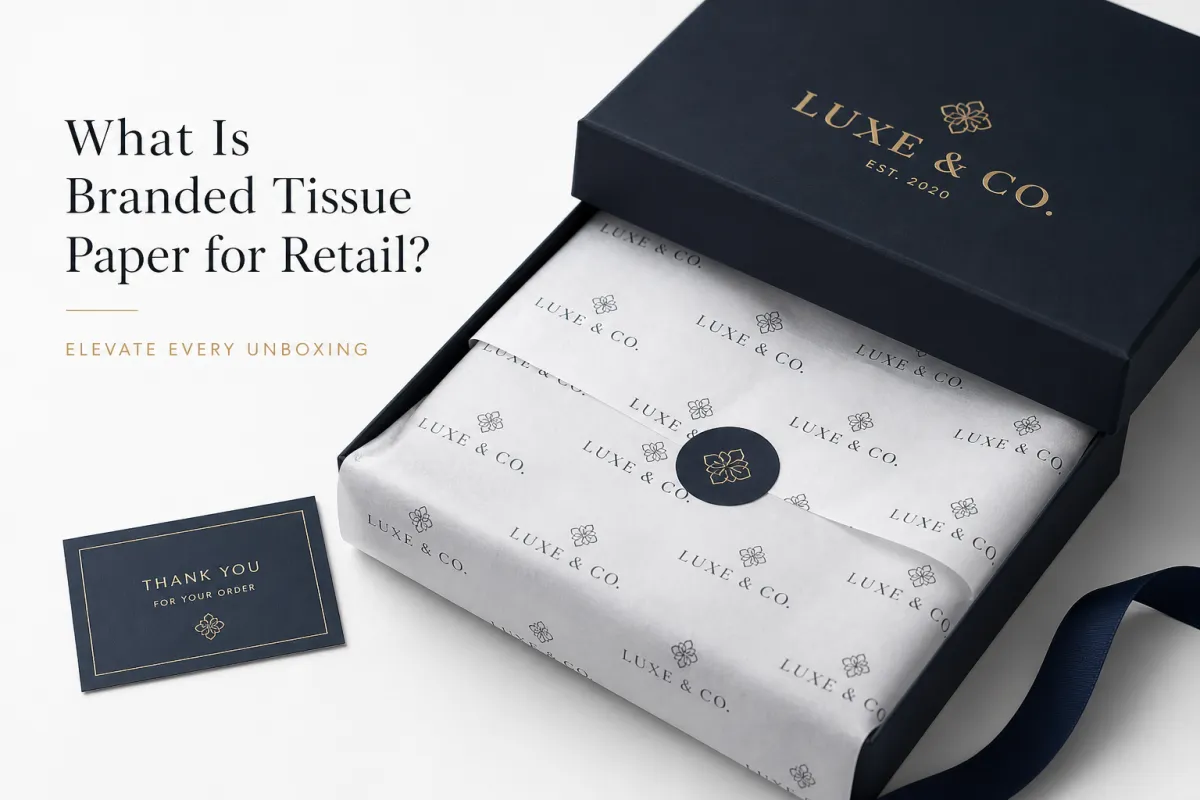
Branded tissue paper for retail is custom-printed or custom-colored tissue used to wrap products, line shopping bags, separate folded goods, cushion small items, and create a more deliberate reveal at checkout or during unboxing. The material is usually thin, often in the 17gsm to 22gsm range, though some programs go lighter or heavier depending on the use case. The print may be a repeating logo, a monogram, a pattern, an icon, or a brand color system that still reads after folding and handling.
The first branded surface a customer often touches is not the box. It is the tissue. That first touch can do a lot of work. It tells the shopper whether the brand is polished, rushed, or somewhere in between. And yes, people pick up on that faster than they should.
From a packaging perspective, branded tissue paper for retail earns its place because it does three jobs at once: it protects the item, supports the brand identity, and adds a giftable feel without changing the product itself. A sticker brands a carton. A ribbon dresses one up. Tissue does both jobs and helps the package handle better. That combination is why it shows up so often in apparel, beauty, jewelry, home goods, specialty food, books, candles, and other boutique retail categories.
It also fits different fulfillment setups. A brick-and-mortar shop might use branded tissue paper for retail to line shopping bags and keep garments folded cleanly. A DTC brand may place it inside a mailer or rigid box. A gift-focused retailer may wrap the item fully so the reveal slows down a little. The point is not decoration for decoration's sake. The point is consistency, which is the part most brands skip right before they wonder why their packaging looks scattered.
Honest version: branded tissue paper for retail is not a fix for weak product design or messy branding. It cannot rescue a bad logo, a clashing color system, or a store team that folds everything like it is trying to make a point. But if the rest of the package is solid, tissue is one of the most efficient ways to make the whole experience feel more intentional.
If you want to compare how different packaging formats support that same goal, our Case Studies page is a useful place to look.
Why this matters: brands do not usually lose shoppers because the tissue was missing. They lose them because the package felt random, underplanned, or inconsistent. Branded tissue paper for retail quietly closes that gap.
How Branded Tissue Paper for Retail Works
Branded tissue paper for retail works best when the design respects the material instead of fighting it. Tissue is thin, porous, and more translucent than paperboard, so a pattern that looks crisp on a screen can go muddy once it is printed, folded, and wrapped around a product. That is the first trap. The second is assuming the material will behave politely. It will not. Tissue wrinkles. It crinkles. It gets tucked, torn, and crumpled on purpose.
That means the artwork has to survive movement. Repeats, scattered icons, logo tiles, and low-coverage patterns usually perform better than a giant single mark dropped in the middle of the sheet. Why? Because the customer almost never sees the whole sheet flat. They see fragments of it under a fold, in a bag, or on a half-open box. If the design only works in one perfect pose, it is the wrong design.
Color behaves differently on tissue than it does on coated carton stock. Ink load matters. Contrast matters too. A pale gray logo on white tissue may look elegant in a mockup, then disappear under warm store lighting. A saturated print can flatten the paper texture and make the piece feel heavier than the brand intended. I have watched teams fall in love with a proof on screen and then backpedal hard once they saw the actual sheet. Paper is rude like that.
Branded tissue paper for retail also changes how the package feels in the hand. It can line a bag and reduce visible scuffing. It can separate stacked garments so the fold lines feel deliberate. It can keep jewelry, candles, or small gifts from rattling around during transit. And it can do all of that while reinforcing the same logo system the customer sees on the website, bag, tag, or insert.
That consistency is not a small detail. A shopper may not say, "This is coherent branding." They just feel it. A plain bag with plain tissue reads functional. A bag with branded tissue paper for retail reads organized. Add a matching label or insert and the package starts behaving like a system instead of a pile of parts.
For Brands That Ship, there is another reality check. Branded tissue paper for retail should be tested under actual conditions: in the bag, inside the mailer, under warehouse lights, and after a few passes through the packing table. Tissue that looks strong in a proof can wrinkle, tear, or go semi-transparent once it is handled all day. That is why transit and handling testing matter. The ISTA testing framework is useful here because it reminds teams that packaging has to perform in motion, not just in a mockup.
Seasonal use is another practical angle. A clean everyday pattern can be paired with a limited holiday colorway, or the logo can appear in one ink for day-to-day use and a different version can show up during promotional windows. That gives the brand some room to breathe without forcing a full redesign every few months. Good packaging programs do not need to reinvent themselves every time a calendar changes. That gets old fast.
What makes the best tissue work is simple: it still looks good when it is not perfect. Folded edges, partial coverage, and slight crinkling are normal retail life. If the design only works when it is flat on a table, it is too fragile for store use.
Cost Factors for Branded Tissue Paper for Retail
Branded tissue paper for retail is usually affordable compared with rigid boxes, foil stamping, or complex inserts, but the price is not one number. It changes with size, paper weight, print coverage, color count, quantity, and freight. The cheapest quote is not always the best value if the sheets tear too easily, print too faintly, or arrive late and force a rushed rollout.
The biggest cost drivers are pretty plain. Larger sheet sizes use more material. Heavier tissue tends to cost more, but it can feel better and resist tearing. One-color printing is usually simpler than two-color or four-color work. And a design with a simple repeating mark often costs less than a full-coverage pattern that needs tighter registration and more ink.
Order quantity matters a lot. A run of 2,500 sheets usually carries a higher unit price than 10,000 or 20,000 sheets because setup costs get spread across fewer pieces. That said, more inventory means more storage and more cash tied up in packaging. Branded tissue paper for retail should be bought at a quantity that matches actual sell-through, not just a hopeful forecast scribbled in a planning meeting and then forgotten.
From a practical budgeting angle, teams usually compare branded tissue paper for retail with other low-cost brand touches like stickers, ribbon, belly bands, and inserts. Tissue often wins because it covers more visible area and has a stronger tactile effect. A sticker is a point of branding. Tissue is a surface of branding. That is the difference.
Here is a realistic way to think about pricing. These ranges are approximate and vary by supplier, location, artwork complexity, and freight:
| Option | Typical Run | Approx. Unit Cost | Best For | Main Tradeoff |
|---|---|---|---|---|
| Plain custom-color tissue | 5,000+ sheets | $0.04-$0.10 | Simple bag lining and consistent brand color | Less logo visibility |
| One-color printed repeat | 5,000-10,000 sheets | $0.06-$0.12 | Most apparel, gift, and boutique retail use | Design must be clean and legible |
| Two-color or denser repeat | 10,000+ sheets | $0.08-$0.18 | Stronger shelf presence and richer branding | More setup and ink cost |
| Full-coverage or multi-color print | 10,000+ sheets | $0.14-$0.30 | Premium gifting, seasonal campaigns, high-impact reveals | Higher waste risk if design is too dense |
Those numbers only tell part of the story. Landed cost matters more than print cost alone. Shipping cartons of tissue can be surprisingly expensive relative to the product value because the sheets are light but bulky. Storage matters too. A retailer with limited backroom space may end up paying more in operational friction than in print dollars if the order is oversized.
There is also the sustainability question, which is where supplier documentation starts to matter. If the tissue is supposed to support responsible packaging claims, ask about FSC-certified paper and the exact ink system used. The FSC framework is not a style choice; it is a sourcing and chain-of-custody conversation. That distinction matters when a brand wants its packaging story to hold up under scrutiny.
One easy budgeting method is to work backward from the order. If a store uses three sheets per transaction and handles 1,200 giftable transactions a month, it will need 3,600 sheets monthly before waste or seasonal spikes. A 12,000-sheet order sounds large until you map it against real usage. Branded tissue paper for retail should be forecast from consumption, not from optimism.
ROI is where the conversation usually gets more interesting. Branded tissue paper for retail does not usually pay for itself through a simple direct-response formula. It pays off by supporting basket value, reducing the need for extra gift packaging, improving the perceived quality of the brand, and increasing the odds that a customer shares the unboxing or gift experience. Those effects are harder to model, but they are real in retail presentation.
Step-by-Step Timeline for Branded Tissue Paper for Retail
Branded tissue paper for retail should be planned like a packaging project, not a quick print order. The strongest results usually come from a sequence that starts with the use case, moves into artwork, and ends with proofing and rollout. If a team skips the early planning step, they usually discover the wrong sheet size or a pattern that only looks good on a screen. That is an expensive way to learn a basic lesson.
- Define the job. Decide whether branded tissue paper for retail will line a shopping bag, wrap a product, cushion a shipper, or support seasonal gifting. A sheet for jewelry is not the same as a sheet for apparel.
- Set the physical specs. Choose the sheet dimensions, paper weight, ink count, and print coverage. Common retail sizes are 15 x 20 inches, 20 x 30 inches, and 24 x 36 inches, but the right size depends on product depth and fold style.
- Build the artwork. Provide vector logo files, brand colors, repeat ideas, and examples of packaging that already fit your identity. Branded tissue paper for retail works better when the printer sees the design system, not just the logo.
- Review proofs carefully. Check spacing, contrast, registration, and how the logo looks after folding. A proof can be technically correct and still feel too busy once it is on thin tissue.
- Approve a sample if possible. Even a basic mockup can reveal problems with opacity, color density, or fold behavior.
- Schedule production and freight. Production for branded tissue paper for retail can move quickly when files are ready, but shipping and carton handling add lead time. Build extra time before promotions and holiday peaks.
- Roll out and train the team. Staff should know how many sheets to use, how to fold them, and how to present them consistently across locations.
From a timeline standpoint, the fastest projects are the ones where the brand already has clean artwork and a clear pattern direction. In that case, proofing can happen in a few days, production can take roughly 12 to 18 business days after approval, and freight adds the final layer. More complex artwork, multiple seasonal versions, or larger quantities can stretch that schedule.
Branded tissue paper for retail also benefits from a rollout plan. A few dozen cases arriving on time is not enough if the team has no instructions on storage or presentation. Sheets can arrive flat, but if they are stuffed into a humid backroom, the edges bend and the finish loses its crispness. That sounds minor. It is not. Presentation is cumulative.
For teams that want a sharper rollout, it helps to compare the tissue with other packaging elements already in use. The strongest systems usually align with shipping labels, garment bags, product inserts, and the outer carton. If one element is playful and another is stark, branded tissue paper for retail ends up carrying a visual burden it was never meant to carry. More on that kind of alignment shows up in our retail packaging case studies.
One operational detail gets overlooked constantly: storage format. Ask how many sheets come per carton, how large the carton is, and whether the pallets fit your receiving area. Branded tissue paper for retail should be easy to store, easy to count, and easy to retrieve. If staff need to fight the packaging before they can use it, the system is already too fragile.
There is a good reason experienced packaging teams treat proofing as risk reduction. Once a run is printed, the mistake repeats thousands of times. Branded tissue paper for retail is inexpensive per sheet, which means teams sometimes treat it casually. They should not. A thousand bad impressions are still a thousand bad impressions, even if each one cost only a few cents.
Common Mistakes That Hurt Retail Presentation
Branded tissue paper for retail can improve presentation quickly, but it can also expose weak decision-making just as fast. The mistakes are usually not dramatic. They are subtle. Dense prints, poor color choices, weak stock, and sloppy storage are the kinds of problems that quietly make the brand feel less intentional.
The first mistake is overdesigning the sheet. Brands sometimes try to cram a logo, a slogan, an icon, a border, and a seasonal motif into one repeat. The result looks busy when flat and chaotic when folded. Branded tissue paper for retail almost always looks better with more negative space than the brand team expects. It is funny how often restraint fixes what extra design only makes worse.
The second mistake is choosing tissue that is too flimsy for the use case. Ultra-light sheets can tear the moment a sales associate tries to wrap a hard-edge box or a customer pulls the tissue apart at checkout. That is especially risky in boutique retail, where the tactile experience matters as much as the visual one. If the tissue rips too easily, it stops feeling premium and starts feeling cheap.
The third mistake is ignoring storage. Tissue that arrives in a large run is easy to underestimate because it is light. It is still bulky. If cartons are stacked badly or stored in damp conditions, the sheets can bend, curl, or absorb odor. Branded tissue paper for retail should be stored like a presentation asset, not like packing filler shoved in a corner and forgotten until someone needs it yesterday.
The fourth mistake is lead-time denial. Retail calendars fill up fast. Seasonal color changes, new store openings, promotions, and holiday demand can all hit at once. If the brand waits until the last minute, the printer has less time to proof carefully and freight options get more expensive. Branded tissue paper for retail rewards teams that plan ahead by a few weeks, not a few hours.
The fifth mistake is color mismatch. A beautiful tissue pattern still fails if it clashes with the bag, box, label, or ribbon beside it. Packaging is a system. The best brands treat it that way. If the tissue is warm ivory and the bag is cold white, the whole package can feel off even if each item looks fine on its own.
The sixth mistake is isolation. Some teams treat branded tissue paper for retail as a standalone decoration and never consider how it interacts with the rest of the packaging stack. That is where the experience starts to split apart. Tissue, inserts, stickers, tape, and outer packaging should speak the same visual language. If they do not, the package starts sounding like three people talking at once.
"A tissue sheet should feel like part of the brand system, not a leftover from the supply closet."
That line sounds blunt because the reality is blunt. Branded tissue paper for retail works because it is a repeatable system, not a random add-on. If the design feels improvised, shoppers feel the improvisation. They might not say it out loud, but they know when something was put together in a hurry.
Brands that want to avoid these mistakes usually benefit from looking at real packaging examples instead of abstract style boards. Our Case Studies page can help teams compare what works in apparel, gifting, and shipping environments before they place a print order.
Expert Tips for Better Retail Tissue Design
Branded tissue paper for retail does not need to shout to work. In fact, the strongest designs usually whisper. They give the eye something structured to land on without overpowering the product. That is why negative space is one of the most useful tools in the category. If a tissue pattern feels airy on the mockup, there is a decent chance it will still feel readable once it is folded, stacked, and handled by actual humans doing actual retail work.
Use recognizable brand cues instead of forcing every asset into the print. A monogram, a symbol, a product silhouette, or a signature line can carry the design more cleanly than a giant logo repeat. Branded tissue paper for retail becomes more flexible when the artwork feels like a pattern language rather than a poster. Posters belong on walls. Tissue belongs in hands.
Test the tissue where it will actually live. Under warm retail LEDs, white tissue can shift. Inside a dark mailer, a pale pattern can disappear. In a photograph, a low-contrast print may look flat. Branded tissue paper for retail should be reviewed in store lighting, in a box, in a bag, and in a camera frame. Those are four different environments, and each one reveals something different.
Use the whole packaging system as the design brief. That means the tissue should make sense with the bag, the box, the sticker, the insert, and any seasonal campaign graphics. A strong system feels intentional because every element pulls in the same direction. A weak system feels like a stack of unrelated purchases that happened to arrive in the same week.
It also helps to pick one operational goal before you begin. Is the tissue meant to increase giftability, reduce product abrasion, add brand recognition, or improve social sharing? Branded tissue paper for retail can do all of those things a little, but it performs best when one objective is primary. That makes the design, quantity, and budget easier to judge.
A small pilot run is often smarter than a full-scale rollout. Retailers with multiple store formats, different product lines, or seasonal packaging schedules can learn a lot from one controlled launch. If the tissue performs well in a 90-day test, scale it. If it does not, the loss is manageable. That beats ordering a mountain of sheets and discovering the print is too dark or the sheet is too small.
Measuring impact matters too. Branded tissue paper for retail is easy to admire and easy to ignore if nobody tracks results. Watch customer comments, repeat orders on giftable items, social shares, and staff feedback. If the packaging improves the perceived quality of the product, that usually shows up in conversations long before it shows up in a dashboard.
One more note from a packaging standards angle: if your program has shipping stress, align tissue decisions with transit testing logic. Tissue is not a protective shipper component in the same sense as corrugated, but it still needs to survive movement. Thinking in terms of performance, not just design, separates a polished retail package from a fragile one.
And yes, brand teams sometimes get weird about this part. They want the tissue to look perfect and feel luxurious, but they do not want to hear that a slightly denser sheet or a simpler repeat would probably perform better. Packaging has a way of humbling people. That is part of the job.
Next Steps Before You Place an Order
Before ordering branded tissue paper for retail, audit the current packaging flow. Where does the customer see the first branded surface? Where does the team need speed? Where does the package most need a premium lift? If you answer those questions honestly, the tissue spec becomes much easier to choose.
Start with a simple brief. Include sheet size, estimated order quantity, preferred paper weight, print colors, brand colors, logo files, and a short note on the experience you want. Do not hand a supplier a vague mood and expect a good result every time. Branded tissue paper for retail works best when the spec is specific. Not fussy. Specific.
Ask for samples and a production timeline at the quoting stage. That is where you can catch weak opacity, poor fold behavior, or an unrealistic delivery date. If the supplier cannot tell you whether the run is 5,000 sheets or 20,000 sheets, or how freight affects the landed cost, the quote is not ready for decision-making.
Set a budget ceiling before you start comparing options. A brand that knows its target unit cost can choose between a simple one-color repeat and a more elaborate multi-color print with real clarity. Branded tissue paper for retail does not have to be expensive to work, but it does have to fit the economics of the product it supports.
If you are unsure whether to begin with one product line or a full rollout, choose one region, one store group, or one giftable category first. That gives the team a contained place to learn. The best packaging programs are usually built in layers, not all at once. Nobody needs a grand launch if the fold count is still a mess.
And if you want a quick way to pressure-test your assumptions, compare your chosen concept against real examples from our packaging case studies. That side-by-side view usually shows whether the tissue is doing real work or just adding another decorative layer.
My view is simple: branded tissue paper for retail should be treated like a planned brand asset, not an afterthought. When the design is clean, the cost is matched to usage, and the rollout is practical, branded tissue paper for retail can do more for presentation than packaging elements that cost several times as much.
The actionable takeaway is straightforward. Pick one retail use case, define the sheet size and paper weight around that use, keep the print design restrained, and test the tissue in real lighting and real handling before you place a large order. That one sequence saves money, saves time, and usually gives the customer a cleaner first impression.
Frequently Asked Questions
How much does branded tissue paper for retail usually cost?
Price depends on sheet size, paper weight, print coverage, and total order quantity. A simple one-color repeat is usually cheaper than a dense multi-color design, and the landed cost can change a lot once shipping and storage are included. For many retail programs, branded tissue paper for retail is inexpensive enough to use consistently without throwing the packaging budget off track.
What is the typical turnaround time for branded tissue paper for retail?
If the artwork is ready, proofing can move in a few days. Production time depends on quantity and print complexity, then freight adds another step. The safest approach is to build extra time before launches, seasonal resets, and holiday peaks so branded tissue paper for retail arrives before the product needs it.
What paper weight works best for branded tissue paper for retail?
Lighter tissue is usually better for soft wraps and bag lining because it folds easily. Heavier tissue can feel more substantial and resist tearing better, which helps for gift presentation or harder-edged products. The right choice depends on how branded tissue paper for retail will be handled in stores and during shipping.
Can branded tissue paper for retail be recycled?
Often yes, but it depends on the ink system, coatings, and local recycling rules. Low-ink designs and uncoated tissue are usually easier to recycle than heavily printed versions. If sustainability is part of the buying decision, confirm the exact material and ink structure before ordering branded tissue paper for retail.
How many colors should a retail tissue design use?
One or two colors usually keeps the design cleaner and the price more manageable. More colors can work, but only if the brand truly needs them and the pattern still reads clearly after folding. For branded tissue paper for retail, legibility and repeatability usually matter more than trying to print every brand asset at once.
Is branded tissue paper for retail actually worth the money?
Usually, yes, if presentation matters to your category. It is not a direct sales engine on its own, but it can improve perceived value, support repeatable brand presentation, and reduce the need for extra packaging components. If the product is already margin-sensitive and the team cannot maintain consistency, the value drops fast. Packaging only works when it is used well.