Buyer Fit Snapshot
| Best fit | Branded Tissue Paper for Ecommerce projects where brand print, material claims, artwork control, MOQ, and repeat-order consistency need to be specified before quoting. |
|---|---|
| Quote inputs | Share finished size, material target, print colors, finish, packing count, annual reorder estimate, ship-to region, and any compliance wording. |
| Proofing check | Approve dieline scale, logo placement, barcode or warning zones, color tolerance, closure strength, and carton packing before bulk production. |
| Main risk | Vague material claims, crowded artwork, missing packing details, or unclear freight terms can make a low unit price expensive after revisions. |
Fast answer: Branded Tissue Paper for Ecommerce: What Actually Matters should be specified like a repeatable production item. The safest quote records material, print method, finish, artwork proof, packing count, and reorder notes in one written spec.
Production checks before approval
Compare the actual filled-product size with the drawing, then confirm tolerance on folds, seals, hang holes, label areas, and retail display edges. Reserve space for logos, QR codes, warning copy, and material claims before decorative graphics fill the panel.
Quote comparison points
Review material grade, print process, finish, sampling route, tooling charges, carton quantity, and freight assumptions side by side. A quote is only useful when the supplier can repeat the same color, closure quality, and packing count on the next order.
Branded Tissue Paper for Ecommerce: What Actually Matters
Branded Tissue Paper for ecommerce changes the feel of a box before the customer even gets to the product. That tiny layer does more work than people give it credit for. One clean sheet can make a $25 order feel considered. One flimsy, badly printed sheet can make a premium item look rushed. Same box. Very different story.
The smart move is treating branded tissue paper for ecommerce as a packaging decision, not a decoration decision. It has to look right, fold right, print right, fit the packing line, and still make sense on the budget sheet. People skip those parts, then act surprised when the quote looks fine and the result does not. I have seen that movie enough times to know how it ends.
What Branded Tissue Paper for Ecommerce Actually Does
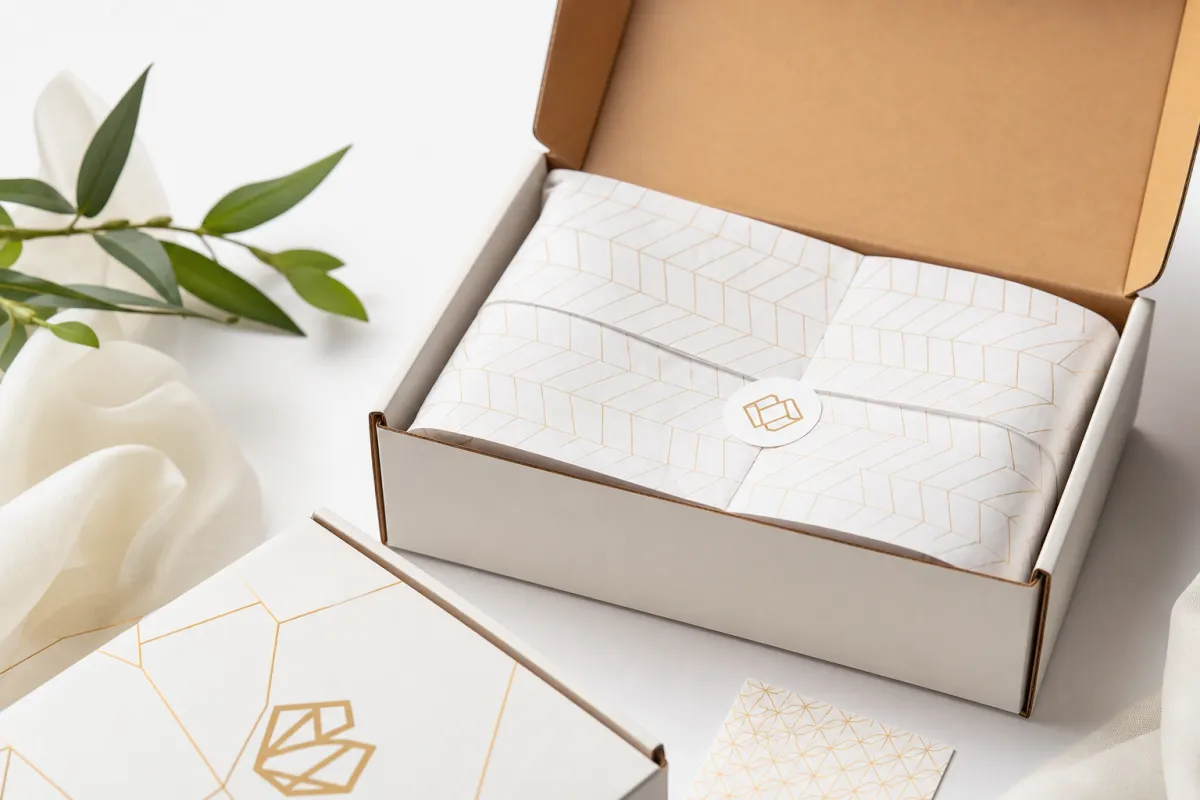
Branded tissue paper for ecommerce does four jobs at once. It presents the product, protects the surface, cuts down on dust and scuffing, and tells the customer they are dealing with a brand that pays attention. That is a lot for one lightweight sheet, which is exactly why it deserves the same scrutiny as any other packaging component.
Here is the blunt version: tissue is not there to impress other packaging people. It is there to make the product feel cared for the second the box opens. Apparel, beauty items, candles, accessories, and small giftable products all benefit from that ready-to-receive feeling, and branded tissue paper for ecommerce delivers it without much weight or bulk.
Plain filler and branded tissue paper for ecommerce are not the same thing. Plain tissue can keep a product from rattling around. Fine. But branded tissue paper for ecommerce creates recognition before the product is even in hand. That matters because the first physical interaction with a DTC brand is often the unboxing moment, not the website. The customer may not say it out loud, but they notice when the package feels intentional.
From a packaging buyer’s point of view, that puts tissue in the same conversation as mailers, inserts, thank-you cards, and tape. It is part of the unboxing system. A cheap-looking sheet with the wrong opacity can drag down an otherwise strong pack-out. A well-printed sheet can make a simple carton feel more premium than it has any right to feel.
The best tissue is almost invisible in a good way. It should feel like it belongs. Not loud. Not fussy. Clean, intentional, on-brand. That is the difference between “we packed an order” and “we built a branded experience.”
Pretty tissue is easy. Tissue that prints cleanly, folds fast, and survives real fulfillment work is the part that earns its keep.
If you want to see how different packaging details affect the final customer experience, our Case Studies page is a better starting point than generic inspiration boards. It shows how small print and layout choices affect the whole pack.
For brands trying to make a product feel gift-ready without overspending, branded tissue paper for ecommerce is often the first low-risk upgrade worth testing. It is cheaper than a rigid box change, lighter than most add-ons, and easier to scale than a lot of premium ideas that sound great in a meeting and fall apart in production.
How Branded Tissue Paper for Ecommerce Works in Practice
Branded tissue paper for ecommerce usually starts with a few technical decisions: sheet size, paper weight, print method, repeat pattern, and how the tissue is packed for the fulfillment team. Those choices sound tiny until you see them on the line. Then they stop being tiny real fast.
Most tissue runs use standard sheet formats such as 20 x 30 inches, 25 x 36 inches, or custom sizes that fit a specific box or product wrap. Paper weights often sit in the 17gsm to 28gsm range. Light tissue is easier to fold and cheaper to ship. Heavier tissue feels better in the hand and resists tearing, but it also adds cost and can slow packing if the sheet feels stiff.
Print method matters too. A simple one-color logo repeat gives you a clean, understated look. It is usually the easiest to pack and the easiest to keep consistent. Full coverage patterns, darker flood prints, or multi-color artwork create a louder unboxing moment, but they also increase ink usage, setup complexity, and the chance that the sheet feels heavy or less breathable.
In practice, branded tissue paper for ecommerce is rarely used alone. It sits alongside stickers, inserts, product sleeves, paper tape, or a thank-you card. That layering is what makes the pack feel deliberate. A product wrapped in printed tissue and sealed with a branded sticker reads very differently from a product tossed in a box with shredded fill. One looks planned. The other looks like somebody was late for lunch.
The pack-out flow is simple, which is part of the appeal:
- Open the carton or mailer.
- Pull one or two sheets of branded tissue paper for ecommerce.
- Place the product in the center or offset by the fold style.
- Wrap, fold, or layer the sheet based on the box size.
- Seal with a sticker, label, or tape if the design calls for it.
- Check that the same fold and orientation are used across the run.
The last step matters more than people think. Consistency is what makes branded tissue paper for ecommerce feel premium. If every pack has a different fold angle, different logo placement, or a random amount of overhang, the customer notices. Maybe not consciously, but they feel the difference. That little bit of inconsistency reads as sloppiness.
There is also a practical limit. Too-thick paper slows fulfillment, especially if the team is packing hundreds of orders per day. Too-thin paper tears, wrinkles badly, or turns see-through around darker products. The goal is not the heaviest sheet possible. The goal is the sheet that fits the product, the box, and the pack-out speed.
Packaging fundamentals like material choice, print quality, and end-use durability are covered well by industry references such as packaging.org, and that is useful because tissue should be judged as part of the overall packaging system, not as a decorative afterthought.
Key Factors That Change Look, Feel, and Quality
Three things decide whether branded tissue paper for ecommerce looks premium or cheap the second it is lifted: opacity, weight, and print quality. The paper can look beautiful on a screen and still fail in the hand if those three pieces are off.
Opacity is the first trap. If the tissue is too transparent, dark products or busy box interiors show through and make the sheet look thin. A 17gsm sheet can work fine for lighter items, but once you wrap darker products or want a cleaner layered look, a mid-weight sheet in the 22gsm range is often safer.
Weight affects both feel and usability. A 22gsm to 28gsm sheet usually has a more substantial hand feel and less tearing during fold-and-wrap steps. Go much heavier and the sheet starts acting less like tissue and more like soft paper. That may be fine for certain products, but it changes the whole pack-out behavior.
Print coverage changes the visual and cost story. A small logo repeat on a light background is usually the most cost-efficient format. If the design covers most of the sheet, expect more ink, more setup attention, and more variation if the printer is chasing dense color. Branded tissue paper for ecommerce can absolutely handle a full print, but the buyer should know that it is not the same job as a modest repeat.
Sheet size also matters. A logo that looks perfectly balanced on a flat mockup can disappear once the tissue is folded around a garment, tucked under a rigid insert, or wrapped into a smaller cube box. That is why sample folds matter. The flat proof is helpful. The folded mockup is the real test.
Color matching can get messy if the brand has strict packaging colors. A warm cream tissue with a cool logo print may not look wrong by itself, but next to a rigid mailer, insert card, or sticker in the wrong tone, the whole pack can drift. If the brand already uses a narrow palette, the tissue should be matched to that palette instead of treated like a separate design island.
Storage and handling are part of quality too. Flat-packed tissue saves space, which is great, but it must stay clean and dry. One bent corner, one damp carton, or one messy shelf near intake can ruin a stack fast. In fulfillment, tissue is usually dispensed by hand, so easy access matters. If staff fight with the stack, they start skipping steps or folding inconsistently. That is not a design problem anymore. That is an operations problem.
For brands that care about responsible sourcing, FSC-certified material is worth asking for. The claim should be real and documentable, not a vague green sticker slapped on a spec sheet. If you need to verify what the FSC label means, FSC is the authority I would check first.
Another practical detail: branded tissue paper for ecommerce should be chosen with the outer shipping system in mind. Tissue is not the thing that survives a bad carrier drop; the carton still has to do that job. If the outer pack needs transit validation, that is where standards like ISTA testing come in. Tissue protects presentation. The shipper protects the product.
Use this shorthand if you are comparing samples:
- 17gsm - light, affordable, good for soft presentation and low bulk.
- 22gsm - balanced, usually the safest all-rounder for most ecommerce brands.
- 28gsm - premium feel, stronger hand, better for darker or more delicate presentations.
Branded Tissue Paper for Ecommerce Pricing and MOQ
Branded tissue paper for ecommerce pricing comes down to four main levers: paper grade, sheet size, print colors, and how much of the sheet is covered. Add custom sizing, proofing, freight, and setup fees, and the quote can move faster than people expect. That is how a cheap-looking number turns into an expensive landed cost if nobody asks the right questions.
For smaller runs, the minimum order quantity matters almost as much as the unit price. A low MOQ makes testing easier, but the per-sheet cost is usually higher because setup and production overhead are spread across fewer pieces. A larger run brings the unit price down, but now you are committing more cash up front and more storage space in the warehouse. There is no magic shortcut here. The math is annoying because it is real.
Here is a practical comparison for branded tissue paper for ecommerce. These are broad market-style ranges, not promises, and freight can move them quite a bit:
| Option | Typical Spec | Best For | Approx. Unit Cost | Notes |
|---|---|---|---|---|
| Basic logo repeat | 17gsm, 1-color print, standard sheet size | Testing, apparel, lightweight accessories | $0.12-$0.22 per sheet at 5,000+ | Usually the easiest way to start branded tissue paper for ecommerce without overcommitting. |
| Mid-weight premium | 22gsm, 1-2 colors, balanced coverage | Most DTC brands | $0.18-$0.34 per sheet at 5,000+ | Better opacity and feel; often the best tradeoff between cost and presentation. |
| High-coverage print | 22gsm-28gsm, full repeat, heavier ink coverage | Giftable products, strong visual branding | $0.25-$0.48 per sheet at 5,000+ | Looks stronger on camera and in person, but costs more and can take more setup time. |
| Small pilot run | Custom size, limited quantity, simple design | Launches, seasonal tests, packaging refreshes | $0.45-$1.20 per sheet at 250-1,000 | Useful for proofing the look before placing a larger branded tissue paper for ecommerce order. |
The table helps, but the quote still needs a close read. Ask whether the price includes artwork setup, plates or screens, sampling, packing, cartons, and shipping. Ask whether the quote is ex-factory or landed. Ask what happens if the color needs one more proof pass. That is the difference between a real budget and a number that only looks good in an email.
In branded tissue paper for ecommerce, custom sheet size is one of the fastest ways to add cost. If the brand wants a nonstandard format, the printer may need different cutting or packing steps. The same goes for special inks, metallic accents, flood prints, or exact color matching against a demanding Pantone target. Those choices are not wrong. They just need to be paid for honestly.
As a practical buying rule, request three numbers: print price, packing price, and landed cost. Freight can add 10% to 30% on a modest domestic order, and a much larger share on small overseas runs. If nobody gives you the landed number, they are not really giving you the price. They are handing you part of it.
One more thing: a small pilot order is often the smartest way to buy branded tissue paper for ecommerce. A 500- to 1,000-sheet run will not be the cheapest per sheet, but it will tell you whether the weight, opacity, print contrast, and fold behavior are actually right. That saves money later, which is the whole point of test buying. Saving a few cents per sheet is pointless if the warehouse hates the product.
If you want a benchmark for how real packaging programs are judged, our Case Studies page is useful because it shows how spec choices affect the final result, not just the quote line.
Step-by-Step Process and Timeline for Ordering
Ordering branded tissue paper for ecommerce is not complicated, but it does reward preparation. If you show up with the wrong artwork, vague sizing, or no idea how many sheets you need per order, the timeline stretches. That is how a straightforward project turns into a calendar fight nobody asked for.
The cleanest process starts with a short spec sheet:
- Box size or mailer size.
- Product dimensions and weight.
- Desired look: subtle, premium, bold, giftable, or minimal.
- Estimated monthly volume.
- Target sheet size and paper weight.
- Brand colors and logo files.
Once that is set, the artwork stage gets easier. For branded tissue paper for ecommerce, the design should be checked in two ways: flat on screen and folded in the actual pack format. A logo repeat that looks balanced in a square proof may land too close to the edge once the sheet is wrapped around a folded garment. A thin line that looks elegant digitally can disappear once the ink hits the tissue fiber.
Proofing deserves more attention than it usually gets. A digital proof confirms layout, repeat, and basic placement. A physical sample tells you whether the sheet feels too thin, whether the logo reads clearly, and whether the color still holds up after folding. If the order matters or the branding is strict, I would rather see a sample than pretend the screen told me everything. Screen-only decisions are how people end up apologizing later.
Typical production timelines for branded tissue paper for ecommerce depend on complexity and location. Simple jobs can often move from proof approval to packing in about 10-15 business days. More complex jobs, custom sizing, or heavier print coverage can stretch that to 15-20 business days. If the order ships internationally, add freight time on top of that, often 7-14 days by air or much longer if the route uses slower ocean transit. That is the reality, not the brochure version.
Common bottlenecks are predictable:
- Logo files are low resolution or not set up for repeat printing.
- Brand colors are not clearly defined.
- The buyer changes the sheet size after proofing.
- The team waits too long to approve the sample.
- Freight is not booked early enough.
Last-minute artwork changes are the worst offender. They feel harmless in the moment, but they are exactly how a two-week project becomes a month-long headache. The printer is not being dramatic when they ask for final files. They are trying to keep the run from being rebuilt halfway through.
From a packaging operations view, branded tissue paper for ecommerce should also be tested in the actual fulfillment environment before volume buying. That means using it with the exact box, exact product, exact sticker, and exact packing method. A sheet that looks good in a sample kit can behave differently once the team is folding 300 orders before lunch. Real-world use is messier than a mockup, and that is kind of the point.
In practical terms, a solid order flow looks like this:
- Define the spec and budget.
- Send artwork and brand colors.
- Review a digital proof.
- Approve a physical sample if the run matters.
- Release production.
- Receive and check the first cartons.
- Run a small fulfillment test before scaling up.
Common Mistakes That Make Tissue Paper Look Cheap
The easiest way to make branded tissue paper for ecommerce look cheap is to try too hard. Oversized logos, crowded repeats, and too many colors turn the sheet into an ad instead of packaging. Customers do not want a newspaper in the box. They want a clean presentation that supports the product.
Another common mistake is choosing paper that is too thin for the product color. A white tissue with a pale print may look elegant on a sample board, then disappear completely around a black garment or dark beauty box. Weak contrast is one of those issues that gets ignored until the first round of unboxing photos comes back looking flat.
Glossy-looking tissue can also backfire. Tissue is usually expected to feel soft and light, not plasticky. If the finish is too slick, too shiny, or too stiff, it can feel off even if the logo is technically printed well. Branded tissue paper for ecommerce should support the product, not fight it.
People also make the mistake of ordering without folding the sheet into the real box size. A beautifully printed sheet that is too large may wrinkle awkwardly. A sheet that is too small can look stingy or unfinished. Fit matters. A lot. I know that sounds obvious, but obvious stuff is what gets missed when everyone is busy.
Then there is workflow. If the packing team has to wrestle with every sheet, they start improvising. That leads to crooked folds, torn corners, and inconsistent presentation. The design is not separate from operations. It is part of operations.
Here are the most common problems I see with branded tissue paper for ecommerce:
- Logo placement that disappears after folding.
- Too much coverage for the chosen paper weight.
- Poor contrast against darker products.
- Paper that tears during normal pack-out.
- Sheet sizes that do not match the box.
- Ignoring how the tissue looks in real unboxing photos.
That last one is quietly important. The packaging is not just seen in person anymore. It is photographed, clipped, posted, and compared. If the sheet has weak contrast or a cluttered repeat, it may look better in the render than in the feed. That is not a design win. That is a rendering win, which is less useful.
Expert Tips and Next Steps for Better Orders
If you want branded tissue paper for ecommerce to look premium without becoming a budget sink, keep the design simple. One strong brand color, one clean repeat, and one paper weight that handles the product well will beat a busy design most of the time. Minimal does not mean boring. It means the sheet is doing its job without shouting over the product.
My strongest advice is to ask for a sample or proof before placing a larger run. Do this especially if the design uses fine lines, pale colors, or small type. Tissue is not forgiving the way coated paper is. Small artwork mistakes get bigger once the sheet is folded, stacked, and handled by a real fulfillment team. You really do not want to discover that after 2,000 sheets land in the warehouse.
Match the tissue size to the box and product. That sounds obvious, which is probably why people ignore it. But a clean fit is what makes branded tissue paper for ecommerce feel intentional. A sheet that is too large looks stuffed. A sheet that is too small looks like the team ran out halfway through packing.
A smart buying path usually looks like this:
- Start with a short test order of branded tissue paper for ecommerce.
- Check fold behavior, opacity, and print contrast in the real box.
- Use the packing team’s feedback, not just the designer’s opinion.
- Adjust the sheet weight or coverage based on what slows the line down.
- Only scale once the sample run looks right and packs cleanly.
That test-first approach is not cautious for the sake of it. It is how you avoid buying a thousand sheets that look lovely in a proof and annoying in the warehouse. A low-risk pilot almost always teaches you more than a polished mockup ever will.
If you are still deciding whether branded tissue paper for ecommerce belongs in your current packaging setup, ask three blunt questions: Does it make the product feel better? Does it slow packing? Does it raise landed cost enough to hurt margin? If the answer to the first is yes and the other two are manageable, you probably have a good candidate.
From there, the next steps are straightforward: define the specs, gather the artwork, request a landed quote, and place a pilot run of branded tissue paper for ecommerce before you commit to volume. That is the cleanest way to get useful data Without Wasting Money on guesses.
And yes, if you want examples of how packaging details shape the finished customer experience, the Case Studies page is still a good reference point. Real packaging programs beat generic advice every time.
Branded tissue paper for ecommerce works best when it is treated as a production decision with design benefits, not a design idea that somehow has to survive production. Get the weight right. Get the repeat right. Get the fold right. Then it does exactly what it should: make the order feel considered the moment the box opens.
FAQ
How much does branded tissue paper for ecommerce usually cost?
Branded tissue paper for ecommerce usually lands in a wide range because paper weight, sheet size, print colors, and coverage all move the number. Smaller runs often come in around $0.45-$1.20 per sheet, while larger runs can fall closer to $0.12-$0.48 per sheet depending on the spec. Always compare landed cost, not just the print quote, because freight, setup, and proofing can change the real number fast.
What paper weight works best for branded tissue paper for ecommerce?
A mid-weight sheet in the 22gsm range is usually the safest place to start for branded tissue paper for ecommerce. It balances feel, foldability, and tear resistance better than very light tissue. Lightweight tissue can work for soft presentation, but it may look see-through around dark products. Heavier tissue feels more premium, though it can slow packing and raise the total cost.
How long does branded tissue paper for ecommerce take to produce?
Simple branded tissue paper for ecommerce jobs can often move from proof approval to production in about 10-15 business days. More complex designs, custom sizing, or sample revisions can stretch that timeline to 15-20 business days or more. Shipping time sits on top of that, and overseas freight adds the most delay. Most slowdowns happen before production starts, usually because artwork is not ready or the proof needs another round.
Can branded tissue paper for ecommerce protect fragile products?
Yes, but only as a light protective layer. Branded tissue paper for ecommerce helps prevent scuffs, dust, and surface scratches, especially on apparel, cosmetics, and small retail items. It should not be treated as the main cushioning material for fragile goods. Pair it with inserts, Paper Void Fill, or a rigid inner box if the product needs real transit protection.
What is the best print method for branded tissue paper for ecommerce?
The best print method depends on coverage, budget, and the sharpness of the artwork. Simple logos and repeating patterns often work well with spot-color printing, while more complex artwork may need a different setup and a sample proof before you commit. For branded tissue paper for ecommerce, the smartest move is usually to choose the method that keeps the design clean, consistent, and easy to pack at scale.