Custom Matte Laminated Paper Bags for fashion boutique openings do more than carry a purchase from the register to the sidewalk. They shape the first physical impression of the store, show up in launch photos, and influence how polished the entire opening feels. A bag that creases too easily, reflects too much light, or looks generic can quietly weaken a carefully planned debut. The right bag does the opposite: it gives the customer a clean, finished object that feels consistent with the clothing, the store design, and the price point of the merchandise.
That is why these bags deserve more attention than they often get. Buyers usually focus on print quality first, then paper weight, then handles, and only later notice the small details that make a bag feel expensive in hand. Matte lamination sits near the top of that list because it lowers glare, improves scuff resistance, and creates a softer visual finish that fits modern fashion retail especially well. It is not the only good choice, but for a boutique opening that wants restraint, polish, and a little visual quiet, it is often the most reliable one.
A launch bag also has to work under pressure. Staff are moving quickly, customers are holding phones and receipts, and the product inside may already be folded, boxed, or wrapped in tissue. The bag needs to survive that handling without collapsing at the top edge or pulling apart at the handle. That is the practical side of Custom Matte Laminated Paper Bags for fashion boutique openings, and it matters as much as the branding.
Why matte-laminated bags feel premium at the door
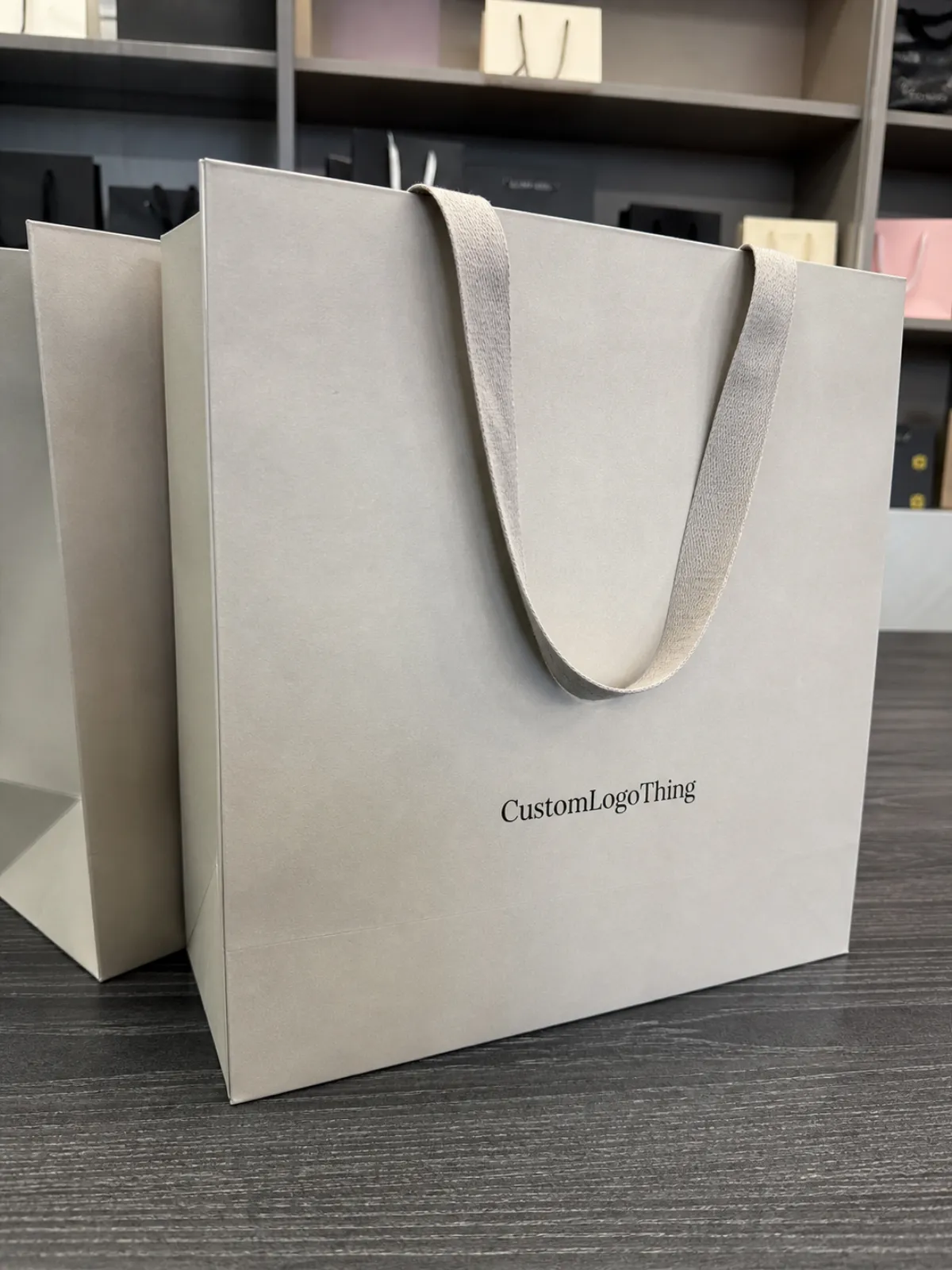
Matte lamination changes how a bag reads from the first glance. It cuts reflections from storefront lighting and cameras, so the logo and artwork stay visible without the shine that can make a print look busy or cheap. For fashion retail, that restrained surface usually feels more aligned with the product than gloss, especially if the boutique leans toward minimal tailoring, muted colors, or quiet luxury cues.
The tactile side matters too. A matte-laminated surface feels smoother and more deliberate than plain paper. It gives the customer a small sensory cue that the packaging was chosen, not grabbed at random. That feeling can be subtle, but it shapes how the purchase lands. If the bag feels stiff, sturdy, and finished, the garment inside seems better protected and the store feels more confident.
There is also a practical photo advantage. Opening day bags are often seen in mirrors, storefront shots, social posts, and candid photos held at arm's length. Matte finishes are easier to photograph because they do not bounce light across the logo or create hot spots on dark solids. For bags with narrow typography, fine linework, or small icon marks, that difference is easy to see.
Matte does not automatically mean better, though. A high-energy streetwear launch or a boutique with strong metallic branding may use gloss or a mixed finish more effectively. The key is to match the finish to the brand tone. Matte usually works best when the store wants the packaging to feel understated, controlled, and a little more expensive than the paper stock alone would suggest.
A strong boutique bag should support the product, not compete with it. The best versions make the merchandise feel more considered without trying to turn the bag into the main event.
That is why buyers who prioritize presentation often choose custom matte laminated paper bags for fashion boutique openings over basic kraft or uncoated stock. The difference is not just visual. It is structural, tactile, and photographic, which is exactly what a launch-day package should be.
How custom matte laminated paper bags are built
These bags are usually made from art paper or artboard, then printed, laminated, cut, folded, and assembled into a finished retail bag. The paper grade commonly falls somewhere between 157gsm and 350gsm, depending on the size, the load, and how premium the opening needs to feel. Lighter board works for accessories and soft apparel. Heavier board is better for shoes, boxed items, and any bag that needs to stand upright on display.
The matte film is not decoration only. It protects the printed surface from minor abrasion, helps reduce fingerprinting, and gives the bag a smoother, less reflective appearance. That said, matte can also make weak artwork more obvious. Low-resolution logos, muddy dark colors, and overcrowded layouts tend to look flatter on matte than they do in a screen mockup. A clean art file is not optional if the finish is meant to look expensive.
Most boutique buyers also want structural details that improve daily handling. A folded top edge gives the bag more stiffness and a cleaner finish. A base board helps the bag hold shape after the product is added. Handle reinforcement matters even when the bag is not carrying a large load, because the handles are the first place a customer notices failure. A bag that looks beautiful but tears at the handle knot does not finish the job.
Common upgrades include:
- Reinforced base boards for shoes, boxed sets, or heavier folded garments.
- Turned-over top edges for better stiffness and a more polished rim.
- Handle reinforcement patches for rope, ribbon, or die-cut styles.
- Interior inserts if the bag must stand neatly for photos or gift presentation.
Paper sourcing also deserves a quick check. FSC-certified paper can be a useful benchmark for buyers who want a documented sourcing standard, while ISTA methods are a practical reference for shipping and handling expectations. Neither one replaces a real sample test, but both give you a better basis for asking technical questions before production starts. See FSC and ISTA for the standards themselves.
Size, weight, and finish choices that affect performance
Size selection is where many boutique orders go sideways. Buyers often choose around the smallest item they sell, then discover on opening day that a shoe box, a folded coat, or a layered gift set no longer fits comfortably. The better approach is to start with the largest item that will be handed out during the event, then work back from there.
For fashion boutiques, three size groups cover most use cases:
- Small: jewelry boxes, fragrance, wallets, and compact accessories.
- Medium: folded tops, scarves, light apparel, and gift sets.
- Large: shoes, outerwear, bulky folded garments, and boxed purchases.
Paper weight changes how the bag behaves after it is filled. A 157gsm or 210gsm build can work for lighter loads, but it may feel too soft for a high-traffic opening where the bag is handed out repeatedly and carried longer than expected. Once the order includes heavier items, 250gsm to 350gsm artboard usually gives better body and fewer issues with edge collapse or visible creasing. That extra stiffness costs more, but it often saves the bag from looking tired before the customer leaves the block.
Handle choice affects both look and function. Rope handles usually feel the most premium and hold weight well. Ribbon handles can work beautifully for gift-driven or fashion-forward branding, though they are less forgiving under load than a good rope handle. Die-cut handles can reduce cost and simplify the silhouette, but they usually read as less upscale unless the rest of the bag is very carefully designed.
Finish details also change the result:
- Soft-touch matte adds a more tactile, velvet-like feel and can look richer than standard matte.
- Spot UV lifts a logo or graphic without making the whole bag shiny.
- Foil stamping works well in small amounts, especially for logos or accents.
- Colored interiors can add depth if the budget allows, though they are not essential.
The best way to judge these options is to view the bag in hand, not only as a flat mockup. Check the front, side, and top edge. Hold it under bright light. See whether the logo stays readable from a normal carrying distance. For custom matte laminated paper bags for fashion boutique openings, those practical checks matter more than a polished render on a screen.
Cost, pricing, MOQ, and quote inputs that move unit cost
Pricing is mostly a matter of variables, and the variables move in predictable ways. Bag size, board thickness, print coverage, handle type, laminate finish, and packaging method all affect the unit cost. A simple one-color logo on a medium bag is much cheaper than a full-coverage design with soft-touch matte, foil, and rope handles. That is normal manufacturing logic, not an upsell trick.
Minimum Order Quantity matters because setup costs have to be spread across the run. Smaller quantities usually carry a higher per-unit price. Larger quantities lower the unit cost, but only if the boutique can actually use and store the bags. Overordering is one of the quickest ways to turn packaging into dead inventory. Boxes and bags take up space, and launch calendars do not always move as quickly as planned.
For a mid-sized fashion order, a rough pricing structure might look like this:
| Bag type | Typical build | Approx. unit cost | Best fit |
|---|---|---|---|
| Entry matte bag | 157gsm-210gsm paper, matte laminate, twisted paper handle | $0.40-$0.75 | Light apparel and accessories |
| Mid-range boutique bag | 250gsm-300gsm board, matte laminate, rope handle | $0.78-$1.25 | Most opening-day retail packaging |
| Premium launch bag | 300gsm-350gsm board, soft-touch matte, foil or spot UV, rope or ribbon handle | $1.30-$2.20 | High-end boutique launches and gift-ready packaging |
Those figures shift with quantity breaks, shipping method, and artwork complexity. A small run can land 20 to 50 percent higher per unit than a larger run. Freight, customs, carton packing, and any extra insert materials can also move the number. The fastest way to get a usable quote is to send exact dimensions, target quantity tiers, artwork files, handle preference, and the delivery location. A quote built on those details is much more useful than a guess.
If you are comparing custom matte laminated paper bags for fashion boutique openings with boxes or other branded packaging pieces, ask for a package-level price comparison. Sometimes the bag appears expensive only because the buyer has not looked at the total packaging mix. In many launches, a simple, well-made bag is the most cost-effective item that still feels premium in photographs and in hand.
Process, timeline, and turnaround from proof to delivery
Most orders follow the same basic path: quote, spec confirmation, artwork submission, proof review, production, and shipment. The sequence sounds straightforward, but the schedule can slip if the details are not settled early. The most common delay is not machinery. It is revision churn. A logo file changes. The handle color changes. Someone notices that the product dimensions were estimated rather than measured. Small issues can quickly become scheduling problems.
- Quote and spec check - confirm size, material, finish, handle type, and quantity.
- Artwork submission - send vector files when possible, along with color targets.
- Digital proof - review placement, bleed, safe margins, and handle positioning.
- Sample or pre-production check - useful for launch bags that will be heavily photographed.
- Mass production - printing, lamination, cutting, assembly, and packing.
- Transit - shipment to the boutique, warehouse, or event site.
A straightforward order often takes 12 to 18 business days after proof approval, then shipping time on top of that. Special handles, internal printing, heavy board, or custom inserts can add days. Rush production may be possible, but it usually leaves less room for correction and increases the cost of mistakes. If the opening date is fixed, leave buffer time between production completion and actual use. Freight schedules, customs clearance, and receiving delays are all very real risks.
That is one reason launch planning should treat packaging as part of the opening schedule, not a separate task that can be handled later. The bag is not the most complicated element of the launch, but it is one of the easiest to get right if the timeline is managed early.
Artwork, branding, and structural details to lock before production
Artwork on matte laminate needs a little more discipline than many buyers expect. Fine type, dark solids, and very thin linework can lose clarity if the file is built loosely or the contrast is too low. A matte surface is less forgiving of weak artwork than a glossy surface, which means the file should be prepared for production rather than for presentation software.
Start by deciding what the bag is supposed to communicate. For most fashion boutiques, the logo should lead, the store name should be clear, and any website or social handle should stay secondary. The bag is not a brochure. It works best as a clean brand marker, not a crowded block of text. If the layout starts trying to say too much, the whole package feels less expensive.
Before approval, check these points carefully:
- Logo placement - visible at normal carrying distance and centered where intended.
- Safe margins - text and marks kept away from folds, edges, and handle anchors.
- Color matching - Pantone or CMYK targets confirmed before printing starts.
- Back panel content - add websites or social details only if they are useful.
- Internal extras - tissue, stickers, or inserts only if they support the customer experience.
If the boutique also uses Custom Printed Boxes or product sleeves, keep the typography, spacing, and color palette aligned. A bag can look elegant on its own and still clash with the rest of the package set. That kind of mismatch is common because packaging gets sourced in pieces, often by different people. Consistency takes a little more coordination, but it is what makes the launch feel intentional rather than assembled.
One practical production note: ask to see the bag from the front, side, and in-hand if sample images are available. Those views expose most structural and branding issues long before the full run is printed. They also help reveal whether the finish and paper weight actually match the boutique's expectations.
For buyers who are still mapping out the rest of the launch packaging, it can help to review the full custom packaging range before locking the bag spec. Matching materials early is usually easier than correcting a mismatch after the opening rush.
Common mistakes that make opening-day bags look cheap
The most obvious mistake is choosing a bag that is too small. A tight bag creases faster, looks rushed, and makes the purchase inside feel awkward. If the bag has to fight the product, the presentation already lost.
Another common error is selecting finish based only on the sample photo. A shiny render can hide the way a bag behaves in the hand. Some finishes scuff too easily. Some handles twist awkwardly. Some board weights collapse at the top after one use. A pretty sample is not enough if the bag is meant to be carried through a long launch day.
Overdesign causes its own problems. Too many colors, too many fonts, too many effects, and too much text can push a bag from refined to crowded. Matte finishes are especially unforgiving of clutter because the surface is quiet. That quiet works in your favor only if the design is restrained enough to benefit from it.
Skipping proof review is the other classic failure. If the logo sits too low, a handle anchor cuts too close to the edge, or the color comes back warmer than planned, the error becomes visible in every customer photo. That is expensive in a way that does not show up on the purchase order.
Common issues seen in custom matte laminated paper bags for fashion boutique openings include:
- Picking a size that cannot handle the largest item sold at the event.
- Using a board weight that is too light for the load.
- Filling the layout with too much copy or too many effects.
- Ignoring handle comfort and pull strength.
- Skipping samples for a bag that will be photographed heavily.
Most of those problems are avoidable with basic checks. They are not design mysteries. They are planning issues, and planning issues are usually cheaper to solve before production starts.
Expert tips and next steps before you place the order
If the boutique opening matters, order a sample or a small pilot run first. Paper weight, laminate texture, and handle feel are hard to judge accurately from a mockup alone. A sample tells you whether the bag feels too soft, too stiff, too glossy, or too flat. It also helps confirm whether the print holds up under real lighting.
Build the quantity plan around actual store needs instead of a single hoped-for number. Many boutiques need one bag size for accessories, another for apparel, and a larger option for boxes or premium purchases. A single compromise size usually ends up serving none of those jobs particularly well.
Ask for pricing at three quantity levels so you can see where the real break points sit. The cheapest unit price is not always the smartest buy if it leaves you with too much inventory or too much cash tied up before opening day. Storage, cash flow, and expected sell-through matter just as much as the printed quote.
Before approving production, confirm these points:
- Delivery timing - include transit, not only production days.
- Packing method - carton count, palletizing, or retail-ready packing.
- Artwork lock - no late logo, size, or color changes.
- Backup buffer - leave time for freight delays or rework.
- Receiving contact - make sure someone can accept the shipment.
For most fashion launches, custom matte laminated paper bags for fashion boutique openings strike a practical balance between durability, presentation, and cost control. They are polished without feeling flashy, sturdy without feeling bulky, and flexible enough to support accessories, apparel, or boxed goods. That balance is usually what a boutique opening needs: packaging that looks considered, performs well, and does not fight the clothing it carries.
FAQs
What makes custom matte laminated paper bags better for boutique openings?
Matte lamination reduces glare, so logos and artwork stay readable in retail lighting and photos. It also gives the bag a smoother, more refined feel than plain paper, which suits fashion launches well. The added surface protection helps too, especially when staff are handing out bags throughout the day.
What size custom matte laminated paper bags should a fashion boutique order?
Choose the size around your largest likely purchase, not your smallest accessory. Most boutiques do well with at least one small format for accessories, one medium format for folded apparel, and one larger format for boxed or bulkier items. If you want only one size, spec it around the most common purchase and leave enough room for tissue or inserts.
How much do custom matte laminated paper bags usually cost per unit?
Unit cost depends on paper weight, size, finish, handle type, and quantity. Smaller runs cost more per bag because setup is spread across fewer pieces, while larger runs lower the per-unit price. For a meaningful quote, send exact dimensions, artwork, quantity tiers, and the delivery location.
How long does production usually take?
A straightforward order often takes about 12 to 18 business days after proof approval, then shipping time on top of that. Custom handles, premium finishes, or inserts can extend the schedule. If the bags are tied to a fixed opening date, leave a buffer so freight or revision delays do not affect launch day.
Do matte laminated bags show fingerprints or scuffs?
They handle glare better than gloss, but dark colors and heavy handling can still show marks. A good laminate improves resistance, although it does not make the bag immune to wear. Storage, packing, and transport still matter, so it is smart to request a sample before committing to a full run.

