A soft dad hat can look right in a mockup and still fail in hand. It may slump after a few wears, wrinkle around the front logo, or feel too shallow once it is on a head. The wine club Unstructured Dad Hats material sample guide exists to catch those issues before a full order becomes expensive inventory.
Wine club merch is judged quickly. Buyers notice the brim curve, crown depth, fabric hand, and whether the cap still looks relaxed after handling. That makes the sample stage more important than the initial art proof. A fabric swatch shows the raw material. A proto sample shows how the material behaves once it is cut, sewn, and decorated.
For this product type, the sample needs to answer practical questions: does the cap hold shape, does the logo sit cleanly, does the closure feel finished, and does the hat still look good after wear. If those answers are clear early, the production order is much easier to approve.
Good samples prevent bad inventory. A hat that already feels wrong in the sample stage rarely improves in bulk production.
Wine club unstructured dad hats material sample guide: why it matters
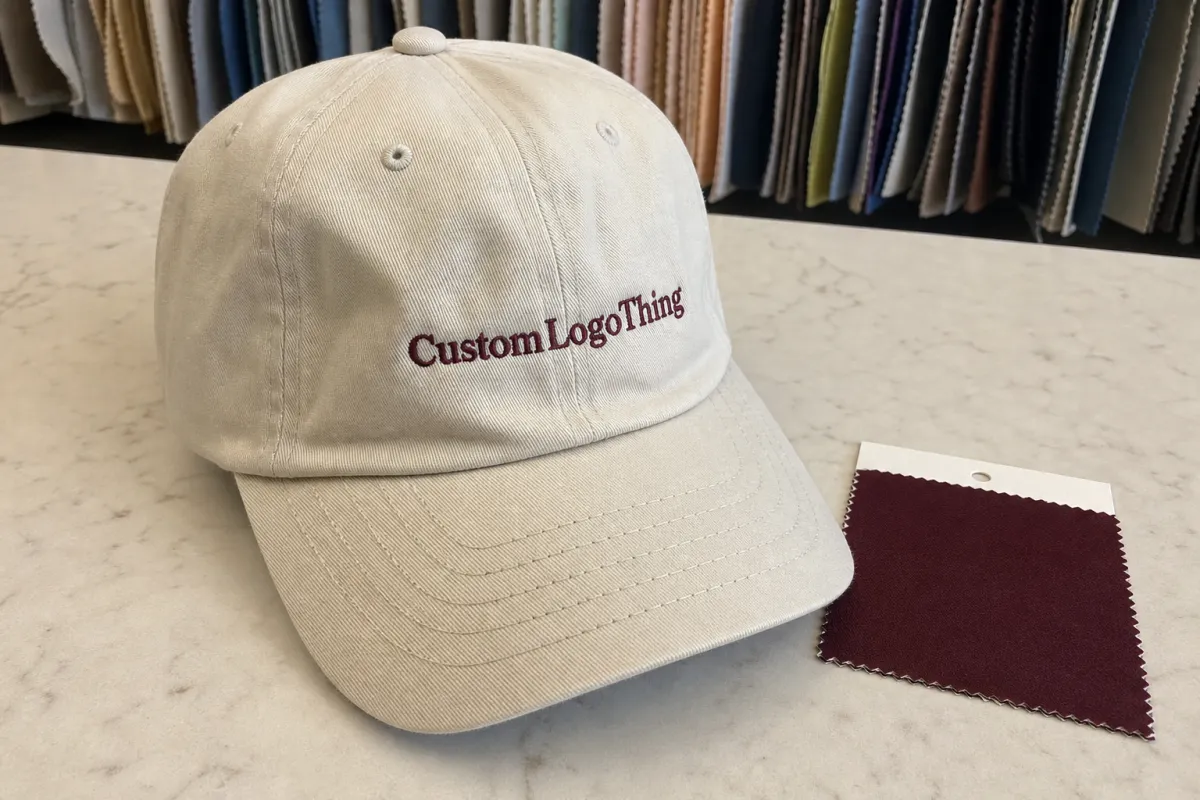
The same fabric can behave very differently after sewing, washing, and decoration. A brushed cotton swatch may feel ideal in the hand, then relax too much once embroidery is added. A lighter fabric may look refined, then collapse after a few hours of wear. The issue is usually the whole build: fabric weight, crown shape, sweatband, seam placement, and decoration load.
That is especially important for wine clubs because the hat has to feel casual but not cheap. It may be worn by staff, members, or event teams, so it needs to work in sun, heat, and repeated handling. A good sample checks comfort, color, shape retention, and logo placement in one pass.
Unstructured caps are sensitive to small spec changes because they rely on soft construction instead of internal stiffness. A crown that is too shallow can sit awkwardly high. A crown that is too deep can slump. A front panel that is too light can wrinkle under embroidery. These problems are easier to spot in a proto than in a production run.
Packaging also affects review quality. Samples shipped in corrugated cardboard with kraft paper inserts usually arrive in better shape and are easier to compare. If the pack-out uses FSC certified paper or other recycled materials, that supports the brand story without changing the product spec. For transit performance, ISTA is the reference worth checking. For paper sourcing, verify FSC.
The useful question is simple: does the hat still read like the brand after someone wears it, sets it down, and puts it back on later?
How material samples change the fit story
A flat swatch can confirm texture and color, but it cannot show how a cap sits on a real head. Unstructured hats depend on fabric memory, seam placement, and the balance between softness and support. A fabric that feels premium on a table can still collapse under a logo. A fabric that seems ordinary may wear better because it has enough body to hold a relaxed silhouette.
Fit should be tested in the context the hat will actually live in. Tasting-room staff need comfort across long shifts and repeated handling. Gift hats need to look polished out of the box and still feel good after being stuffed into a bag or car. Those are different use cases, so the sample should be worn, not just inspected.
Material choice shapes the result. Cotton twill gives a familiar hand feel and a stable base for embroidery. Brushed cotton feels softer and more relaxed, but it can slump if the crown is too tall or the fabric is too light. Pigment-dyed fabric gives a lived-in look with some shade variation. Cotton-poly blends usually hold shape well and are practical for repeat staff programs, though they can feel less natural.
Review the sample in daylight and under normal use. Wear it for an hour. Check forehead pressure, side-panel collapse, and how the front panel changes after handling. If the hat only looks good for a quick glance, the production run will expose the weakness faster.
Sturdy recyclable pack-out materials can help preserve the sample state, which makes the comparison cleaner. They also signal that the supplier understands the difference between a fabric memo and a finished retail item.
The spec factors that decide comfort and quality
Buyers often start with color, but fabric weight, weave, wash treatment, and crown shape matter more. For wine club Unstructured Dad Hats, a practical range is usually 8 to 10 oz cotton twill or a similar washed cotton. That range tends to keep enough body for shape without making the cap feel stiff. Lighter fabrics may look flimsy. Heavier fabrics can feel too workwear-oriented.
Here is a simple comparison of the most common material paths:
| Material | Feel | Shape retention | Typical use | Tradeoff |
|---|---|---|---|---|
| Cotton twill | Balanced, familiar | Good | General club merch | Can wrinkle if too light |
| Brushed cotton | Soft, broken-in | Moderate | Tasting-room friendly | May slump if crown is too deep |
| Pigment-dyed fabric | Washed, lived-in | Moderate to good | Retail or gift programs | Shade variation can happen |
| Cotton-poly blend | Smoother, slightly crisp | Good | Staff wear, repeat orders | Less natural hand feel |
Construction details matter just as much. A low-profile, six-panel crown usually reads more relaxed than a taller crown. A curved visor feels casual. A flatter visor leans a little more retail. Closure choice also changes the impression: a self-fabric strap with a metal slide feels more refined than a plastic snapback, while a metal clasp usually looks cleaner on a premium club item.
Stitch density is another deciding factor. Tight stitching can make the cap look neat, but too much topstitching can stiffen the crown and reduce the relaxed effect. Add embroidery, a woven label, or a patch, and the weight on the front panel increases again. If the logo is oversized or the patch is thick, the front can pucker or fold unevenly.
Decoration should match the fabric. Embroidery is usually the safest choice because it wears well and looks clean on a soft crown, as long as the logo stays modest in scale. Woven labels work when the brand wants a softer front. Patches can look strong on a retail wall, but they add structure and weight, so they need real sampling rather than approval from a mockup alone.
The reason experienced buyers ask for both a fabric swatch and a decorated proto is that they test different things. The swatch checks hand feel and shade. The proto checks behavior under stress. Together they show whether the product is likely to hold up in actual use.
Sample kit process, timeline, and approval steps
A clean sample process is mostly about sequence. First choose the fabric direction, then review decoration method, then approve crown shape and closure. Mixing those decisions creates resets. If the color is approved before the logo size changes, the sample no longer reflects the final spec.
Timing is usually predictable if the fabric is in stock and the decoration is straightforward. Fabric swatches often arrive in about 5 to 10 business days. A decorated preproduction sample usually takes longer, especially if the supplier is building a true proto instead of stitching a logo onto a stock cap. Thread matching, patch development, or custom labeling can add another week. After approval, production often lands in the 2 to 4 week range for simple runs, though custom trims or peak-season schedules can stretch that.
A useful approval checklist keeps the review focused:
- Try the hat on at least two different head shapes.
- Check color in daylight, not just warm indoor light.
- Wear it for at least an hour to judge sweatband feel and pressure points.
- View the logo from arm's length and from three feet away.
- Confirm crown depth, brim curve, and closure size before sign-off.
Packaging should be part of the review. Samples shipped in corrugated packaging with kraft inserts usually arrive in better shape than loose-packed hats. That matters because a crushed brim or distorted crown can make a good cap seem weak. It also tells you whether the supplier pays attention to transit damage.
Write down the approved version: fabric name, crown shape, closure type, thread colors, decoration size, and approval date. Once more than one person is involved, memory is not enough to keep versions aligned.
Pricing, MOQ, and unit cost tradeoffs
Pricing gets fuzzy if the spec is vague. For sample kits, a realistic range is often $15 to $40 for basic fabric pulls and $35 to $90 for decorated preproduction samples. Shipping usually adds $8 to $25 domestically, with more for international delivery. Some suppliers credit sample costs toward the final order, so that should be confirmed early.
Production pricing changes with order size, fabric quality, and decoration complexity. For a simple unstructured dad hat at a modest quantity, unit costs often fall around $4.20 to $6.50. Add better fabric, custom labels, or patch work, and $6.50 to $9.50 is a normal range. Premium materials, dense embroidery, or specialty finishing can push above that.
| Option | Sample cost | Production MOQ | Typical unit cost | Best for |
|---|---|---|---|---|
| Basic fabric swatch kit | $15-$40 | 100-300 pieces | $4.20-$6.50 | Early material screening |
| Decorated proto sample | $35-$90 | 100-300 pieces | $6.50-$9.50 | Final approval for club merch |
| Premium spec sample | $75-$140 | 300+ pieces | $9.50-$14+ | Higher-end retail or gift programs |
MOQ is usually shaped by fabric availability, decoration complexity, and custom trim. A stock cotton twill with standard embroidery can stay flexible. Custom dyeing, specialty closures, layered patches, or branded packaging can raise the floor or extend lead time. If the order includes FSC certified insert cards, recycled materials in the pack-out, or other sustainability details, confirm whether that changes the minimum or just the schedule.
For wine clubs, the lowest price is not always the best value. A slightly higher unit cost can make sense if the hat wears better, holds shape longer, and reflects the brand more convincingly. That matters most for member gifts, where perceived quality affects whether the item gets worn.
Common mistakes that waste sample rounds
The most common mistake is choosing fabric by image instead of touch. A washed cotton can look rich online and then feel too soft once sewn. The next mistake is approving color under the wrong lighting. Warm indoor light can flatten contrast and shift neutrals. Natural daylight usually reveals those issues fast.
Oversized artwork causes another problem. Unstructured Dad Hats do not always handle large logos gracefully. Heavy embroidery can pull the front panel forward and create a bent silhouette. Thick patches can do the same. For a wine club, compact embroidery, a small woven label, or a modest patch usually fits the relaxed profile better than a loud graphic.
Skipping the wear test is a costly shortcut. Put the sample on and actually live with it for a while. Walk, sit, look down, and wear it during normal movement. That is when the issues surface: an itchy sweatband, a brim that sits too flat, a crown that feels shallow, or a closure that digs into the back of the head.
Packaging mistakes can distort the review. If the sample arrives crushed or loosely packed, buyers sometimes blame the product instead of transit handling. Good packaging keeps the brim and crown intact and makes comparison easier.
The last mistake is overcomplicating the decision. Fabric, crown, visor, closure, and decoration are the core variables. If the review turns into a long debate over minor details before those basics are locked, sample rounds multiply.
Expert tips and next steps before you order
Compare a small set of fabrics side by side. Three is usually enough: one baseline, one lower-cost option, and one higher-end benchmark. More than that and the review gets noisy. The goal is to see how each fabric changes the look, hand feel, and crown behavior once the hat is built.
Lock the spec before approving production. Confirm crown depth, closure type, thread colors, and logo scale. If the hat uses a patch, verify seam placement so the front panel does not buckle. If it uses embroidery, keep the stitch count reasonable. Overbuilt decoration on a soft cap often looks less premium than a cleaner treatment.
Ask for both a plain sample and a decorated proof if the budget allows. The plain sample shows fabric and fit. The decorated proof shows how the final product behaves under production conditions. They are different tests.
For wine clubs, the workflow is straightforward:
- Shortlist three fabrics.
- Request swatches and one decorated sample.
- Test them in daylight and during real wear.
- Approve the final spec and move to production.
Handled that way, the wine club Unstructured Dad Hats Material Sample guide becomes a filter for fit, cost, and consistency instead of just a sourcing exercise.
What fabric weight works best for wine club unstructured dad hats?
A medium cotton twill or washed cotton around 8 to 10 oz usually gives the best balance of softness and shape. Heavier fabrics can feel premium, but they can also sit too stiff unless the goal is a more structured look. It is worth testing after a wash or steam pass because drape matters as much as the raw fabric spec.
How many material samples should I order before production?
Three to five samples is the practical range for most buyers. Include one budget option, one target option, and one premium benchmark so the differences are obvious. If decoration matters, request at least one decorated swatch or proto sample rather than only plain fabric.
How long does the sample and production process usually take?
Fabric samples are often ready in about 5 to 10 business days, depending on stock and shipping. Decorated preproduction samples can take longer, especially if they involve custom patches, labels, or thread matching. After approval, production commonly runs 2 to 4 weeks, although custom details and peak-season schedules can extend that timeline.
What MOQ and sample cost should I expect?
Sample kits are often low-cost or partially credited, while production MOQs commonly start around 100 to 300 pieces. More complex decoration, special dyeing, or custom packaging can raise both MOQ and unit cost. Confirm whether sample fees are credited back to the final order before comparing suppliers.
Which decoration method works best on unstructured dad hats?
Embroidery is usually the safest default for durability and a clean retail look. Woven labels or small patches can work well when the brand wants a softer front panel. Keep the design compact and check seam placement, because unstructured panels do not forgive oversized logos or heavy builds.


