A beauty twisted handle paper bags Unit Cost Review should start with the finished bag, not the paper sheet price. Buyers often compare material first, then discover that print coverage, handle reinforcement, carton packing, and freight change the real number. A quote that looks low on paper can become expensive once the full build is fixed.
For beauty brands, the bag is part of the retail experience. It carries the purchase, supports the gift moment, and helps the counter look organized. If the bag collapses, wrinkles early, or arrives with weak handles, the hidden cost shows up in staff time, customer complaints, and reorders. A useful review focuses on what the bag does in store and how it affects the total packaging budget.
Why a retail-ready beauty bag can change the shelf math
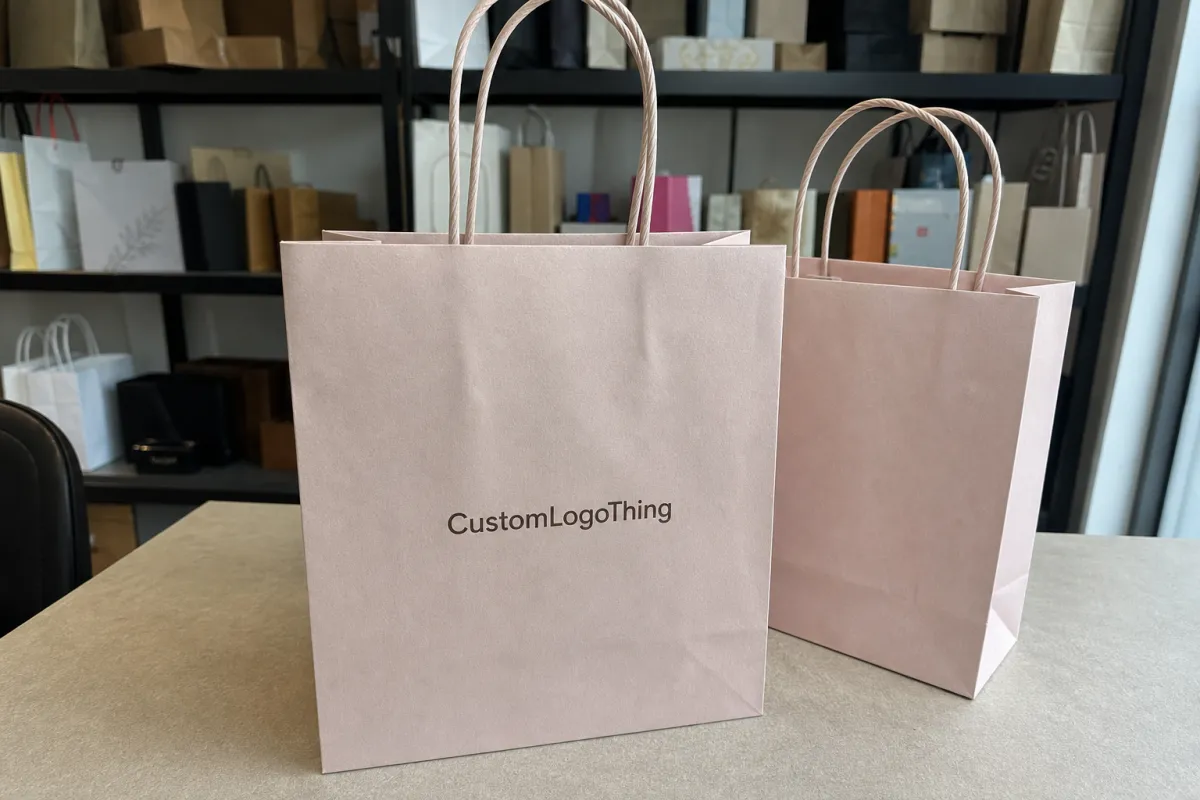
Beauty packaging has to do more than look neat. A twisted-Handle Paper Bag is often the fastest option for salons, skincare counters, fragrance boutiques, and cosmetics retailers because it packs quickly and stacks well. That operational speed matters during peak hours, seasonal launches, and gift-with-purchase campaigns when staff cannot afford slow or awkward packaging.
The construction makes a difference on the counter. A stable base and a reinforced mouth help the bag keep its shape while being filled, so staff spend less time adjusting product placement. Less handling also means fewer wrinkles, less tape, and fewer bags that need to be replaced before they leave the store.
The visual test is just as important. Buyers usually see the bag from several feet away, then again in the hand. Clean edges, even print, and handles that sit squarely on the top edge help the bag feel intentional. Kraft stock tends to support a natural, restrained brand story, while coated white stock gives sharper color and typography for more polished beauty programs.
The key question is not whether paper bags are cheap in the abstract. It is whether the bag supports the retail setting, protects the contents, and still fits the margin. If the answer is yes, a slightly higher unit price can still be the better buy. If the bag fails in use, the lower quote is not much of a saving.
What changes the shelf math most? Strength, presentation, and packing speed. A bag that handles all three can cost a little more and still reduce total system cost.
Material and construction choices that fit beauty packaging
Paper stock sets the first impression. Kraft paper usually signals a calm, natural, and eco-minded brand position. It fits clean beauty, wellness, spa retail, and other programs that benefit from an understated look. Coated board or art paper wrap creates a smoother print field and more controlled color, which is why it is common in fragrance, cosmetics, and premium skincare packaging.
Paper weight matters as much as surface. Light stock can work for samples or small purchases, but beauty products often include glass, sharp corners, or multiple items in one bag. Heavier paper or a reinforced board insert helps the bag stay upright and hold shape after repeated handling. That extra structure should be placed where the load lands, not added randomly.
Twisted handles are popular for a reason. They are practical, usually less expensive than rope or ribbon options, and easy to produce at scale. The difference between a usable handle and a weak one usually shows up at the attachment point and the reinforced mouth. If the top edge curls or softens too quickly, the bag looks tired before the customer even leaves the store.
Dimensions should follow the merchandise. A wider gusset helps with boxed creams and multi-item kits. A deeper base is better for bottle sets or products with a higher center of gravity. If the bag is too shallow, the contents push outward and strain the seams. If it is too tall, the pack-out becomes inefficient and the top can wrinkle. A square-bottom format with a reinforced mouth remains the most forgiving choice for many beauty programs.
Finishes are where costs can drift. Matte varnish gives a controlled appearance with modest added expense. Soft-touch lamination changes the feel more dramatically, but it adds a process step and can be less forgiving on dark artwork. Foil stamping, embossing, and spot UV can all work well on beauty packaging, but each one should serve the design rather than cover for weak branding.
A practical rule helps keep cost under control: spend on the finish people will actually notice under store lighting and in hand. A subtle surface upgrade often does more for the customer impression than stacking multiple effects. That keeps the bag closer to a sensible unit cost without losing the premium signal.
Specifications to lock before you request quotes
Quotes are only useful when suppliers are pricing the same bag. Before asking for numbers, lock the finished dimensions, paper weight, handle color, print coverage, color count, and any reinforcement or board inserts. One supplier may quote a 200 gsm coated bag while another prices a 250 gsm kraft bag with a stronger base. Those are not equivalent builds.
Artwork changes the production load. A one-color logo on a single panel is much easier to run than a full-bleed design with tight registration on multiple faces. PMS matching usually gives cleaner color control, but it can add setup cost. Metallic ink, foil, or a dark background may also require more proofing and a larger waste allowance during approval.
Be specific about use case. Is the bag carrying one boxed jar, a two-piece skincare kit, or several items with tissue? Will it sit upright on a shelf, or be handed across a counter? Does it need to survive a second trip in another shopping bag? Those answers affect handle choice, base reinforcement, and carton count per shipper.
A simple sample-approval step saves time later. Send a spec sheet or request a pre-production sample before the price is finalized. That gives the supplier fewer chances to guess and gives you a better basis for comparing offers. If a vendor cannot answer size, finish, and packing questions clearly, the order will likely need too much handholding later.
- Finished size: width, gusset, and height in millimeters or inches
- Paper stock: kraft, coated board, or art paper wrap with basis weight
- Print detail: one color, two color, PMS match, or full coverage
- Finish: matte, gloss, soft-touch, foil, emboss, or spot UV
- Structure: base board, mouth reinforcement, handle color, carton pack count
Beauty twisted handle paper bags unit cost review
This is where the buying decision becomes concrete. A useful beauty twisted handle paper bags Unit Cost Review weighs paper grade, bag size, print coverage, finishing steps, handle reinforcement, and the number of decorated panels. A plain logo on one face is cheaper than artwork that wraps every side. A natural handle is usually less expensive than a dyed or matched one. A reinforced mouth adds cost, but it also protects the area that carries the most stress.
MOQ affects price because setup work has to be spread across the run. Plates, prepress checks, machine adjustment, and QC sampling do not scale down neatly for a small order. A 3,000-piece run almost always costs more per bag than a 10,000-piece run, even if the material spec is identical. The factory is doing similar work either way, but fewer units are absorbing it.
The real question is not whether a lower MOQ is possible, but what it does to the piece price and total landed cost. A short run may be the right answer for a launch or seasonal test. A repeatable product line usually benefits from a larger batch if demand is stable. The price curve softens as volume rises, especially when the artwork and structure stay unchanged across reorders.
Comparison also has to happen on the same basis. One quote may be ex-works only. Another may include inner wrapping, carton labeling, inspection, and export packing. Freight can erase a small per-piece advantage quickly, especially if the bag is bulky relative to its value. A useful review should show the factory number, packing method, and destination cost together.
| Build type | Typical MOQ | Unit cost range | Best fit | Cost drivers |
|---|---|---|---|---|
| Natural kraft, 1-color logo | 3,000-5,000 pcs | $0.18-$0.30 | Salons, pickup bags, clean beauty programs | Simple print, lighter finish, lower setup load |
| Coated white board, 2-color print | 5,000 pcs | $0.26-$0.42 | Skincare kits, cosmetics, retail gift bags | Sharper print, better color control, moderate setup |
| Art paper wrap with matte lamination | 5,000-10,000 pcs | $0.38-$0.68 | Fragrance, premium gifting, boutique launches | More process steps, higher finish cost, tighter QC |
| Premium finish with foil or embossing | 10,000 pcs and up | $0.55-$0.95 | Luxury retail, seasonal promotions, high-value sets | Extra plates, slower production, more waste allowance |
These ranges are directional, not universal. Paper markets move, labor costs vary, and size changes can shift the price faster than expected. A compact bag with a complicated finish can cost more than a larger plain bag. A bigger run with simple artwork can also lower the unit rate enough to change the packaging budget.
Cost per piece rises fastest when several complexity points are added at once. Full-panel print, foil, embossing, and heavier board all stack together. Sometimes that is justified because the bag becomes part of the brand asset. If the packaging only needs to support a shopping moment, a restrained design often delivers more value.
Production steps and lead time from proof to shipment
A clean order follows a predictable path: inquiry, specification review, artwork preparation, proof approval, sampling if required, mass production, inspection, packing, and dispatch. When a supplier skips one of those steps or describes it vaguely, the schedule usually slips later. Clear process language is a good sign because it shows the factory understands where delays tend to appear.
The longest delays are often avoidable. Missing dielines slow the design team. Non-print-ready files create extra proof rounds. Fine type on dark backgrounds may need tighter inspection. If the bag uses multiple finishes, the line must stop and restart more often, which adds time and can increase waste. Heavier paper stock and reinforced structures can also slow throughput because they require more manual checks.
Sampling and bulk production should be treated as separate clocks. A pre-production sample can take several days to a week, depending on finish and custom work. Straightforward mass production may run about 12-18 business days after approval, though seasonal peaks or complex decoration can extend that window. Transit time is separate and should always be added before the launch date is confirmed.
Calculate the schedule from approval to receiving, not from factory promise to factory promise. Proof approval, production, export packing, freight, customs clearance, and warehouse receiving all affect the real arrival date. A bag can be ready at the factory and still miss the campaign if transit or inbound handling time is ignored.
For packaging claims and shipping discipline, two reference points are worth keeping in view: the testing guidance from ISTA and fiber sourcing information from FSC. They are useful when the bag program sits inside a larger shipping or sourcing policy, especially if the brand has measurable claims attached to packaging materials.
What a reliable supplier should prove before you buy
A serious supplier does more than quote a price. They should restate the spec clearly, ask follow-up questions before prepress begins, and confirm the structure before the first full run. The best vendors also keep sample quality close to the approved reference. That matters when a reorder arrives and color, handle placement, or carton count starts to drift.
The best quote is the one that leaves no hidden assumptions about size, finish, packing, or replacement terms.
Proof of workmanship matters. Production photos, dimensional checks, and a clear inspection sheet give a buyer a way to judge whether the factory is controlling the job or just moving boxes. For beauty packaging, the details worth checking are handle attachment, mouth reinforcement, bottom strength, print alignment, and how the bags are packed inside the master carton.
Communication speed matters too. Beauty launch windows are usually narrow, and packaging is often the last piece to lock. A supplier that needs days to answer a simple question about board weight or finish options may not be the best fit for a time-sensitive order. A good partner reduces uncertainty and answers clearly.
- Ask for proof: sample photos, spec confirmation, and carton count
- Check color control: PMS target, acceptable tolerance, and reprint policy
- Review structure: handle insertion, base strength, and reinforcement details
- Confirm pack-out: inner wrapping, carton size, and freight efficiency
Next steps to tighten your quote and place the order
If the goal is a cleaner quote, send the finished size, quantity, artwork, paper preference, finish preference, and target delivery window together. That removes most of the guessing and usually produces a more accurate first number. Fragmented requests create fragmented quotes, which makes comparison harder than it needs to be.
When the brief allows it, ask for two builds: one value option and one premium option. That split often shows the real trade-off. Sometimes a small change in paper weight improves stiffness enough to avoid a more expensive finish. Sometimes dropping one decorative process lowers the cost without weakening the brand impression.
If the bag is tied to exact color, a photographic campaign, or a store opening, request a pre-production sample or proof stage before bulk approval. That extra check is especially useful when the artwork uses dense solids, foil, or embossing. Fixing a visual issue after the run starts is always more expensive than approving a careful sample.
Keep the discussion factual. Quote the size, show the use case, compare the landed number, and confirm what is included. That approach makes the beauty twisted handle paper bags Unit Cost Review useful instead of decorative. It also keeps the order grounded in production reality, where paper, labor, packing, and time all have to fit together.
What affects beauty twisted handle paper bags unit cost the most?
Paper grade, bag size, print coverage, and finish complexity usually move the price the most. MOQ, handle reinforcement, and carton packing also affect the final unit cost because they change setup time and shipping efficiency.
What MOQ should I expect for custom beauty twisted handle paper bags?
MOQ depends on size, print method, and finishing steps, but custom runs are usually quoted in production-friendly batches. Higher quantities usually reduce unit cost because setup expenses are spread across more bags.
Which paper stock is best for beauty retail packaging?
Heavier kraft works well for a natural, durable look, while coated white board supports sharper print and a cleaner luxury feel. The best choice depends on product weight, brand style, and how much of the surface should carry the design.
How long does production usually take after artwork approval?
Timeline depends on print complexity, finishing, and order size, but production usually begins only after the proof is approved. Add sampling time and shipping time to the factory schedule so the launch date is realistic.
Can I compare quotes if one supplier includes freight and another does not?
Yes, but convert both quotes to the same basis before comparing. Check whether sampling, packaging, inspection, and delivery are included so the total landed cost is clear.