A chocolate pom pom Beanies Material Sample guide should do more than confirm that the hat looks cute. It needs to tell you whether the color behaves, whether the knit holds its shape, and whether the pom belongs on the hat or just on the idea of it. That sounds obvious. It still gets missed all the time.
Chocolate brown is a deceptively tricky color. On the right yarn, it looks rich and grounded. On the wrong one, it can turn dusty, reddish, or flat enough to lose its depth under store lighting. Put the same sample in daylight, under office LEDs, and beside packaging, and you will see three different versions of the same product.
For buyers, the sample is a decision tool. For suppliers, it is a proof point. It shows whether the brief was translated into something repeatable, whether the fit is realistic, and whether the finishing matches the channel. A giveaway beanie and a retail beanie can share the same color name and still need very different standards.
Chocolate Pom Pom Beanies Material Sample Guide Basics
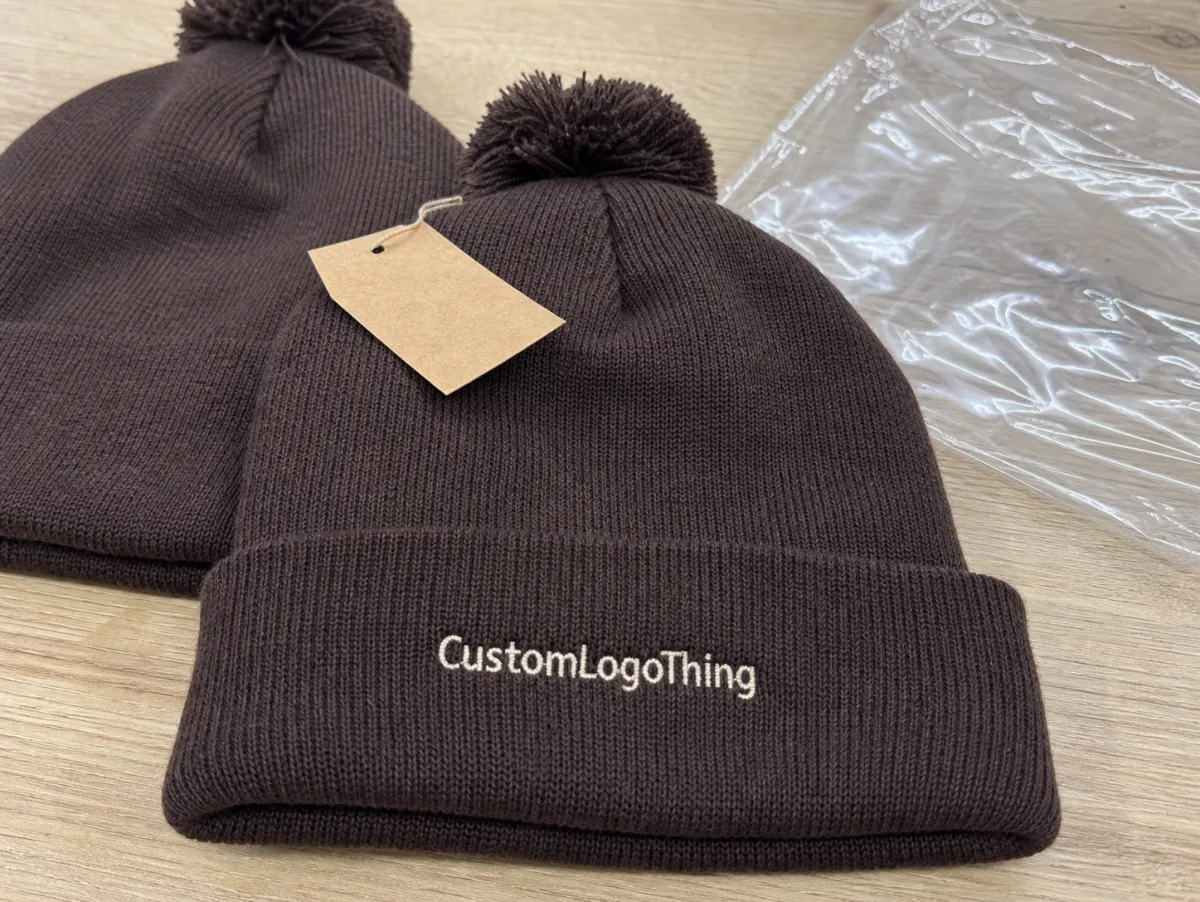
A material sample is the physical reference for the finished beanie before bulk production starts. In a chocolate Pom Pom Beanies material sample guide, that means checking yarn, knit structure, pom construction, fit, and finishing as one unit. If one piece is weak, the final order usually inherits that weakness.
Buyers often start with color because chocolate brown sounds simple. It rarely is. Acrylic can look cleaner and more uniform, wool blends can make the shade feel deeper, and brushed yarns soften the edges so the color reads warmer. I have seen the same Pantone-style target land differently across two yarn bases, even before the hat was worn.
That is why the sample needs to be reviewed in more than one setting. Natural light shows undertone. Cooler indoor light exposes flatness. Retail lighting can make a brown knit look either premium or muddy, depending on surface texture. If the beanie will sit beside kraft paper packaging, black hangtags, or white labels, those nearby colors matter too. Context changes the read.
- Yarn: confirms fiber feel, color behavior, and surface finish.
- Knit: shows stitch clarity, stretch, recovery, and density.
- Pom: reveals size, balance, trim quality, and attachment strength.
- Finish: checks labels, seams, crown shape, and final hand feel.
A good sample also reduces risk on the buying side. It tells you whether the supplier can repeat the product without drifting in shade, size, or build quality. If the sample feels controlled and specific, the bulk order usually has a better chance of staying inside tolerance. If the sample feels vague, production usually follows that lead.
A useful approval question is simple: if this exact hat showed up in bulk, would I be comfortable repeating it 500 times?
How Sample Cards Reveal Hand Feel, Loft, and Color
Sample cards and first prototypes are more honest than product photos. They show how the yarn behaves in hand, how the knit carries shape, and how the chocolate tone changes under real light. That matters because the same brown can look clean on a smooth acrylic yarn and much softer on a wool blend with more surface texture.
Hand feel is not just softness. Buyers should test stretch recovery, seam smoothness, cuff firmness, and whether the crown feels balanced once the beanie is on. A hat that stretches too easily can bag out after a few wears. One that feels dense and substantial in hand may still be too stiff for daily use. Those are common sample mistakes, not rare ones.
Loft changes the entire silhouette. A low-loft knit sits closer to the head and tends to look neat. A higher-loft knit adds body and warmth, but it can make the hat feel heavier or more casual. With a pom pom beanie, loft also affects the top line. If the crown is too soft, the pom can drag the profile down and make the hat look tired before it ships.
Color review needs the same discipline. Check the sample under daylight, then under the lighting that matches your sales environment. Chocolate shades can shift toward red, grey, or almost black depending on fiber, stitch density, and dye lot. Keep a physical master sample on file. Screens are useful for communication, but they are not a reliable final reference.
Merchandising and packaging teams should look at the same sample. If the beanie will ship in FSC-certified paper wraps, recycled mailers, or branded inserts, the full presentation should be approved together. A well-made hat can still feel off if the packaging looks rushed or inconsistent. The reverse is true too. Good packaging does not fix a weak beanie.
Transit deserves a quick check as well. Ask how the sample will be packed and whether the outer shipper protects against crushing. Suppliers that think through shipping usually use corrugated cardboard boxes with paper-based fillers. That is practical, not decorative. A crushed sample can still be informative, but it is a bad basis for sign-off.
If your team cares about consistency, compare the sample against the final carton, insert card, and shipping pack. Product approval and packaging approval should not live in separate silos. They affect the customer’s first impression together, especially for a brown beanie that depends on texture and presentation for its perceived value.
Fiber, Pom, and Knit Specs That Change Buyer Approval
Three decisions usually decide whether a sample gets approved: fiber, pom construction, and knit spec. The fiber sets the baseline feel. The pom changes the silhouette. The knit controls fit, recovery, and price. Buyers often review them separately. They are linked in production, so they should be reviewed that way.
| Option | Typical Hand Feel | Color Behavior | Price Impact | Best Use |
|---|---|---|---|---|
| Acrylic | Soft, consistent, easy to wear | Usually even and predictable | Lowest to moderate | Promotions, team wear, volume programs |
| Wool blend | Warmer, richer, sometimes more textured | Can deepen chocolate tones | Moderate to higher | Retail, cold-weather assortments |
| Recycled yarn mix | Varies by source, often slightly drier | Can look natural or muted | Moderate | Sustainability-led programs |
| Cotton blend | Breathable, lighter, less springy | Can appear flatter in dark shades | Moderate to higher | Milder climates, casual retail |
Acrylic is usually the easiest path for a stable chocolate shade. It tends to knit evenly, holds color well, and gives predictable results across larger runs. Wool blends can feel more premium and warmer, but they may show more tonal depth and slight shade variation. Recycled yarn mixes are useful for sustainability-led programs, though the hand feel can be less uniform depending on the feedstock. Cotton blends are breathable, but in a dark color they may look flatter than buyers expect.
The pom deserves its own review. Faux fur poms usually feel fuller and look more premium, but they add weight and can shed loose fibers if the trim is sloppy. Yarn poms are lighter and more controlled, though they may read smaller once attached to the crown. Stitched poms are practical for lower-cost programs and tend to stay closer to the hat, but they do not create the same visual lift.
Knit gauge and cuff depth also affect approval. A tighter gauge usually gives a cleaner logo area and better shape retention. A looser gauge can feel softer and warmer, but it may relax too much after wear. Cuff depth changes both fit and decoration space. A 2.5-inch cuff behaves differently from a 3.5-inch cuff, especially once the hat is stretched and worn repeatedly.
Fully fashioned construction usually looks cleaner around the crown and edges. Cut-and-sewn builds can be cheaper and more flexible, but the edge finish has to be watched closely. Neither method is wrong. The point is to match the build to the channel, the price target, and the level of polish the buyer expects.
Quality control should include a few physical checks before approval: measure the circumference, check the cuff recovery after stretching, inspect the crown seam for distortion, and look for pilling or loose fibers after handling. Those issues do not always show up in a flat lay photo. They show up when the hat is actually used.
Pom quality checks that matter
Check density, symmetry, attachment strength, and trim consistency. Shake the sample lightly. The pom should move, but not wobble so much that the hat loses shape. Then place the beanie on a head form or wear test it for a few minutes. A pom can look balanced on a table and awkward once the crown lifts.
If the beanie is intended for a premium retail set, inspect the pom from all angles. Loose ends, uneven trimming, or a weak attachment knot can downgrade the product instantly. On the other hand, a well-finished pom can hide a lot of modest knit structure. Buyers usually notice both. The trade-off is part of the price.
Sample Process and Timeline for Hat Sign-Off
The best sample process starts with a brief that is unglamorous in the best way: target audience, target price, size range, shade reference, logo placement, pom preference, and packaging needs. A supplier can only match what it understands. Vague notes create revisions, and revisions are where schedules slip.
- Share the brief and reference photos.
- Approve the yarn direction and chocolate shade.
- Review the knit trial for fit and stretch.
- Check pom construction and attachment.
- Approve finishing, labels, and presentation.
Simple yarn and color samples usually take about 7-10 business days. If the order needs a custom pom, special label set, or a more complex knit structure, the timeline often stretches to 12-20 business days. A second revision can push that longer. That is normal. What causes trouble is not the timeline itself; it is a fuzzy brief followed by feedback like “make it better” or “more premium.” Those comments do not help production make a specific change.
Approve one decision at a time. If the shade works, say so clearly. If the pom is wrong, isolate the problem. Too fluffy. Too small. Too heavy. Too warm in tone. Production teams can act on that. They cannot reliably act on general disappointment.
Do not treat packaging as an afterthought. If the beanie will arrive with swing tags, tissue, inserts, or outer protection, the sample review should include those pieces. A hat in a plain plastic bag tells a different story than a hat tucked into a folded paper sleeve or a neatly packed recyclable mailer. If the presentation is part of the selling point, it belongs in the approval round.
Shipping method matters too. Ask whether the sample will be packed in a way that protects the crown and pom from crush damage. Corrugated cardboard outer boxes with paper-based fill are usually safer than loose packing. If a supplier knows how to ship the sample well, it usually knows how to protect bulk goods too.
What to ask before the sample ships
Is the yarn lot final? Is the pom a final build or only a trial? Will the sample include the exact label, closure, and packaging? Can the package be updated after the beanie passes? Those questions keep the sample from turning into a moving target. They also make it easier to compare revision one against revision two without guesswork.
Cost, Pricing, and MOQ Questions to Ask Before You Quote
Sample pricing depends on how custom the request is. A straightforward knit-and-color prototype may cost about $35-$90. Add custom pom development, woven labels, embroidery, or a second revision and the fee can rise to $100-$180 or more. That is not inflated. Each change adds real labor and material handling.
Bulk pricing sits on a different scale. For a custom logo beanie order, unit cost may land anywhere from roughly $2.20 to $6.50, depending on fiber, decoration, quantity, and packaging. Higher MOQ usually lowers the unit price because setup costs are spread across more pieces. Smaller runs cost more per hat, but they can be the smarter move if the chocolate shade is new or if sell-through is uncertain.
Before you approve a quote, ask the basic questions that keep surprises out of the invoice:
- Is the sample fee credited against the bulk order?
- How many revision rounds are included?
- Does a color match or lab dip cost extra?
- What is the MOQ per color and per size?
- Are labels, hangtags, and packaging priced separately?
Those questions matter because sample cost is only one piece of landed cost. Freight, customs, packaging, and cartons can move the total quickly. A low-cost beanie that arrives in weak packaging is not low cost for long. If the order includes branded sets, the carton plan should be reviewed with the same care as the knit itself.
Sustainability claims need proof, not mood. If the package is supposed to use recycled materials, ask what percentage is verified. If the wrap is described as biodegradable packaging, ask under what conditions and according to which standard. The same applies to inks, inserts, and outer shippers. Retail buyers usually ask for documentation, and they should.
FSC is useful for paper-based components such as mailers, hangtags, and insert cards. That does not make the product premium by itself. It does make the claim legible. For many programs, clarity matters more than a louder label.
FSC remains a strong reference point for paper inputs if packaging is part of the buyer story. The point is not to decorate the product with certifications. The point is to make sure the materials behind the product are actually what the spec sheet says they are.
Common Mistakes in Beanie Sample Reviews
The biggest mistake is judging only the color. A chocolate tone can look excellent and still hide problems in stretch, seam strength, or pom balance. Buyers sometimes approve the shade because it photographs well, then discover the fit is loose or the crown collapses after a few wears. That is expensive learning.
Lighting errors create another avoidable problem. A sample checked under warm office LEDs may look richer than it really is. A sample reviewed only on a phone screen can appear glossier or duller than the physical knit. If possible, compare the beanie in daylight, then under the actual merchandising light. That is the only way to know whether the brown reads premium or muddy.
Wear testing is easy to skip, and that is a mistake. Put the beanie on. Leave it on for a few minutes. Pull it down, then push it back. Check whether the cuff rebounds, whether the pom pulls on the top seam, and whether the edges feel scratchy. A hat that looks neat flat may feel ordinary, or worse, uncomfortable on head.
Vague feedback causes another round of avoidable revisions. “Make it softer” does not tell production what to change. Better notes are specific: reduce cuff stiffness, increase loft by one step, trim the pom to a smaller diameter, or move the logo 5 mm higher. Specific corrections save time and keep the final order closer to the approved sample.
Precision usually beats enthusiasm in sample review. “Almost there” is not a production instruction.
Do not approve a sample without checking the presentation. A beanie sold as premium can lose value if the tissue, insert card, or outer shipper looks careless. If the business case depends on retail margin, the sample should reflect the final shelf story, not just the knit.
Expert Next Steps Before You Place the Bulk Order
Before production, build a final approval sheet and attach the approved sample to it. Include the color reference, yarn type, pom size, cuff depth, fit notes, label placement, packaging format, and any agreed shade tolerance. That becomes the control piece. Without it, later arguments about what was “supposed” to happen are almost guaranteed.
Then compare the sample against the real use case. Retail, gifting, events, and team wear all have different tolerances. Retail buyers usually care more about finish and consistency. Event programs often care more about price and speed. Premium gifting needs stronger presentation, which pulls packaging back into the decision. The beanie does not live by itself.
Write down the edges of the acceptable range. Maybe the chocolate shade can run slightly warmer, but not redder. Maybe the pom can vary a few millimeters, but not in density. Maybe the knit can be soft, but not loose. That kind of clarity gives the production team a target they can actually hit.
The strongest chocolate pom pom beanies material sample guide is the one that helps a buyer say yes for the right reasons and no for the right reasons. It keeps the discussion anchored in fit, feel, finish, and repeatability instead of guesswork. And if the packaging story matches the product story, the order feels deliberate from the first sample to the last carton.
What should a chocolate pom pom beanie material sample include?
It should show the exact yarn, knit structure, cuff depth, pom style, and finishing you expect in production. Ask for a sample that reflects the final color under natural and indoor light, not just a render. If the order is custom, request notes on fiber content, gauge, and finishing so the sample can be repeated consistently.
How many samples do I need before approving a beanie order?
Most buyers can start with one base sample plus one revision if the color or pom needs refinement. If you are choosing between materials, ask for side-by-side swatches or two physical prototypes instead of relying on photos. Use the final approved sample as the benchmark for bulk production so the next round stays aligned.
What affects the cost of a beanie material sample?
Custom yarn sourcing, pom construction, labels, embroidery, and revision rounds can all raise the sample fee. Shipping speed and international freight may cost as much as the sample itself on small orders. Ask whether the fee is credited against the bulk order so you can compare suppliers fairly.
How long does the sample process usually take?
Simple yarn and color checks can move quickly, while custom pom development or knit changes usually take longer. A clean brief speeds things up because the supplier does not need to guess about fit, finish, or placement. Revision cycles are the biggest timeline risk, so clear feedback matters more than generic approval comments.
How do I compare pom quality on two samples?
Check density, symmetry, attachment strength, and whether the pom keeps its shape after handling. Compare weight and balance on the beanie so the pom does not pull the crown out of shape. Look at the fiber finish under strong light because loose fibers or uneven trimming often show up there first.
If you are choosing a supplier, keep the chocolate pom pom Beanies Material Sample guide as the control document and compare every revision against it. That habit saves time, reduces guesswork, and gives you a cleaner path from sample approval to bulk order.


