A chocolate Pom Pom Beanies unit cost review usually goes off track in the first five minutes. Buyers fixate on the pom because it is visible, then get surprised when the yarn spec, cuff build, and decoration method move the number far more than the topper does. That is the annoying part of sourcing. The flashy detail rarely drives the bill.
Chocolate is still a smart color for winter headwear. It looks premium in photos, carries a warmer feel than gray, and fits gift sets, campus stores, outdoor events, and private-label assortments without trying too hard. It is also forgiving in a mixed lineup. Cream, black, olive, tan, burgundy. Chocolate plays well with all of them.
The real question is not whether the style looks seasonal. It is whether the beanie will sell through at a margin that makes sense. A clean, well-built basic often beats a more elaborate style with weak repeat demand. Chocolate tends to sit in that useful middle ground: neutral enough for broad appeal, distinctive enough to feel intentional. This review breaks down the build, the cost drivers, the approval points, and the ordering decisions that actually change the quote.
Why Chocolate Pom Pom Beanies Sell
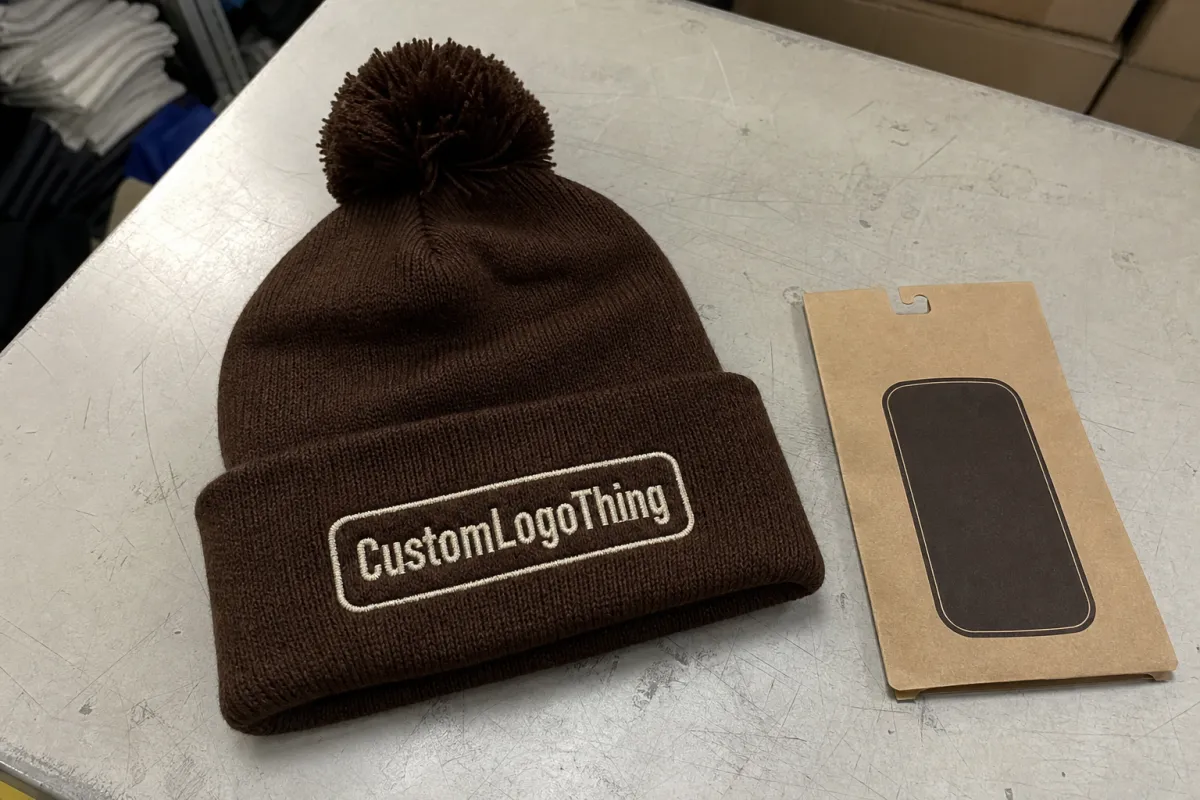
Chocolate works because it photographs well and still feels restrained. That sounds simple. It is. In merchandising, simple is often the point. On a rack, the color reads warmer than gray and less predictable than navy. On a product page, it holds shadow and texture better than many lighter neutrals, which helps knit detail show up without extra styling tricks.
The pom adds personality, but it is not the main value driver. A dense faux-fur pom, a yarn pom, or a larger oversized pom can change the feel of the product, yet the unit cost usually moves more because of yarn weight, knit density, cuff depth, and branding. A heavier knit consumes more material. A deeper cuff adds stitch time and structure. An embroidered logo can look inexpensive on paper and still change the finishing labor enough to matter in bulk.
That is why chocolate Pom Pom Beanies keep showing up in seasonal programs. They work for buyers who need a winter item that feels giftable without becoming a fashion gamble. Campus stores like the neutral palette. Corporate programs like the easy unisex fit. Resellers like the fact that chocolate can sit in a seasonal assortment without aging into a problem by next year.
There is a practical reason they stay popular: they are easy to merchandise. If the rest of the assortment includes cream scarves, black gloves, olive outerwear, or tan fleece, chocolate does not fight the rack. It anchors it. That makes the style easier to buy, easier to display, and usually easier to reorder.
"A winter basic does not need to be loud. It needs to look good in a stack, hold margin, and survive the season without becoming a clearance headache."
That is the bar. Not excitement. Reliability.
Materials, Pom Types, and Branding
The yarn spec decides more than most buyers expect. Standard acrylic remains the baseline for a reason: it is cost-effective, soft enough for everyday wear, and easy to source in repeatable shades. Recycled acrylic blends add a stronger story if the supplier can document the content cleanly. Wool blends improve hand feel and warmth, but they usually raise cost and tighten the approval window because color matching and shrink behavior become more sensitive.
Gauge matters too. A looser knit can feel lighter and cheaper, sometimes in a good way for promo use. A tighter knit creates a more substantial hand feel and usually better shape retention. Most buyers do not ask what gauge the factory is planning until the sample arrives and the hat feels too thin or too stiff. By then, the fix is not free.
Poms are mostly about finish. Tonal yarn poms are the safest option for broad retail. Faux-fur poms create a richer look and typically suit premium winter programs. Oversized poms increase shelf impact, but they can look gimmicky if the cuff is small or the body knit is too narrow. Detachable poms are available for some programs, though they add parts, assembly time, and more room for failure. Convenient? Sure. Cheap? Not usually.
Branding options should be matched to the channel, not to the buyer's wish list. A woven label on the cuff is clean, low-drama, and easy to scale. Small embroidery is direct and durable, but dense stitching can stiffen the cuff or distort the knit. Patches can create more presence, especially for lifestyle retail, though molded or custom-shaped patches can introduce tooling charges. Sewn-in side tags and folded cuff labels still work well for understated private-label programs.
For bulk comparison, the build options usually behave like this:
| Build option | Typical buyer fit | Cost effect | Practical note |
|---|---|---|---|
| Standard acrylic + tonal pom | Promo, campus, general retail | Lowest baseline | Fastest route to a workable quote |
| Recycled blend + woven label | Retail, corporate gifting | Moderate increase | Good balance of story and margin |
| Wool blend + embroidery | Premium seasonal programs | Higher cost per piece | Better hand feel, more controlled production |
| Fleece-lined + faux-fur pom | Cold-weather retail | Highest of the four | More material, more labor, more inspection |
That table is directional, not magical. If the buyer wants the lowest landed cost, the simplest build usually wins. If the program needs a stronger retail story, a better yarn and a fuller pom may be worth the increase. A cheap product that misses the channel is still expensive.
Fit, Gauge, and Specs to Confirm
Before any quote is useful, the technical basics need to be pinned down. Start with yarn gauge, stitch density, cuff depth, beanie height, and pom attachment method. Those details shape the hand feel, the silhouette, and the consistency of bulk production. Leave them vague and the factory will fill in the blanks for you. That is rarely a good deal.
Fit deserves more attention than it gets. A one-size beanie can still run shallow, tall, narrow, or oversized depending on the knit structure. That matters if the order is going into bundled retail, a uniform program, or multiple store regions with different customer profiles. Adult, youth, and unisex builds should be treated as separate fit profiles, not as one generic spec with a different label.
The cuff is another place where small changes create real consequences. A deeper cuff adds structure and gives more room for branding, but it also changes how the hat sits on the head. Too shallow and the piece looks flimsy. Too deep and it starts to feel heavy or top-out the fit. Buyers who skip this detail usually end up comparing samples that do not really match the intended use.
Color control is a bigger issue than it sounds. Chocolate is not one universal brown. One lab dip can lean cooler and more cocoa-toned, another can tilt red or almost black under low light. Ask for Pantone references or clear shade approvals for the body yarn, cuff trim, logo thread, and any label or patch accent. If the product will be photographed, test the color under daylight and warehouse lighting. Those two environments do not forgive sloppy shade decisions.
Basic performance checks are worth requesting even on a simple accessory. Stretch recovery tells you whether the beanie snaps back after wear. Wash behavior shows whether the cuff relaxes or pills too quickly. Stitch security around the pom attachment matters because a loose topper turns a small issue into a return. For repeat orders, that is not an edge case. It is the main risk.
A simple rule helps: if the spec cannot survive a written checklist, it is not ready for production. A buyer who confirms these points early usually gets cleaner pricing too, because the supplier is not forced to price in uncertainty.
Chocolate Pom Pom Beanies Unit Cost Review: MOQ and Quote Drivers for Bulk Orders
Here is where the chocolate pom pom beanies Unit Cost Review gets useful. Price is driven by order quantity, yarn blend, pom type, branding method, packaging, and whether the order needs custom labeling or color work. In bulk, the unit cost drops because setup time gets spread across more units. That is why a 300-piece order can look expensive next to a 5,000-piece run even if the product spec is nearly identical.
MOQ is not just a number on a quote sheet. It reflects the amount of setup the supplier has to absorb before the first finished beanie is packed. Stock acrylic with a standard pom may allow a lower minimum. Custom yarn colors, specialty poms, private-label tags, and molded patches can all push the minimum higher. Buyers should ask for MOQ by decoration method, not just by style, because the minimum often changes once the branding is locked in.
Sample pricing deserves its own line. A sample may include setup fees, one-off labor, or rush handling that never shows up in production pricing. That is normal. The sample is there to prove fit, color, branding placement, and finish. It is not supposed to be cheap. It is supposed to be informative.
Indicative bulk pricing for a few common configurations usually lands in these ranges:
| Configuration | Typical MOQ | Indicative unit cost | Pricing note |
|---|---|---|---|
| Basic acrylic, tonal pom, woven label | 300-500 pcs | $1.85-$2.60 | Common baseline for price-sensitive programs |
| Recycled blend, embroidered logo | 500-1,000 pcs | $2.20-$3.20 | Higher labor, stronger retail story |
| Wool blend, faux-fur pom, custom trim | 1,000+ pcs | $2.90-$4.20 | Better hand feel, tighter production control |
| Fleece-lined, detachable pom, private label pack | 1,000+ pcs | $3.40-$5.00 | More parts, more finishing time, more inspection |
Those ranges are directional. They are not a promise from a factory brochure. Freight, carton requirements, packaging, and finish specs can move landed cost quickly. A quote that looks lower may hide separate charges for digitizing, artwork setup, color matching, custom labels, or rush handling. That is why the cheapest line item can become the most expensive purchase.
Compare landed cost, not just factory price. Two quotes can look close until one includes retail folding, inner bagging, and carton marking while the other assumes loose pack and generic shipping. Same hat on paper. Different total.
Production Steps, Approvals, and Timelines
A dependable production path is usually straightforward: spec confirmation, sample, proof approval, bulk knitting, finishing, inspection, and shipment. The sequence sounds simple because it is. The problems come from the usual suspects: missing artwork, vague color references, slow sample sign-off, or packaging changes that show up too late.
Simple stock-based builds move faster than fully customized ones. If the body yarn is standard and the branding is a woven label, lead time can stay fairly compact. If the order requires custom yarn, a special pom, custom packaging, or multiple approval rounds, the calendar stretches. Buyers should plan backward from the delivery date, not forward from the quote. That sounds obvious until the season gets tight.
For seasonal orders, the approval window matters as much as the production window. A supplier can only hold a schedule if the sample is approved on time. Miss that milestone and the whole schedule starts to slip. Not because the factory is dramatic. Because knitting, finishing, and freight all need time, and none of them care about your calendar quarter.
Packaging decisions affect lead time more than people expect. Fold direction, polybag use, hang tags, carton counts, and size ratios all show up at the end of the process. Leave those open and the order slows for reasons that have nothing to do with the beanie itself.
For transit-sensitive shipments, packaging and testing deserve real attention. If the order is moving through distribution centers or being shipped retail-ready, it is worth checking whether the carton plan aligns with recognized transit testing methods. The ISTA site is a practical starting point for buyers who want a better handle on shipping risk.
Lead times vary by season, but a rough planning frame helps. Simple bulk orders may move in a few weeks after approval if the supplier has yarn on hand. Custom color work, fleece lining, or special packaging can stretch that timeline into the next production window. The real answer depends less on the product category than on how many variables the buyer decides to change at once.
Keeping Shade, Fit, and Finish Consistent
Repeat orders only work if the supplier controls the boring things. Yarn lot control. Stitch settings. Pom attachment standards. A final inspection checklist that is actually used, not just printed and forgotten. None of that is glamorous. It is the reason a reorder looks like the sample instead of like a different product with the same name.
Chocolate is especially sensitive to variation. Dark neutrals reveal shade drift faster than many buyers expect. A slight shift in tone can look harmless in a lab dip and obvious once the hats are stacked together under store lighting. The same is true for fit. If one production lot comes out a little shallower, the difference shows immediately because the cuff sits differently.
Documented specs reduce that risk. So does pre-production sign-off. When the sample is approved with clear notes on yarn, cuff depth, logo placement, and pom size, the factory has fewer ways to improvise. That is good for the buyer. It cuts down on back-and-forth and lowers the odds of a reject pile that no one budgeted for.
Inspection should focus on a few basics: even knitting, secure pom attachment, straight label placement, clean seam closure, and consistent fold depth. If the program is intended for retail, check presentation too. A sloppy fold can make a good product look cheap. That is not a materials problem. It is a packing problem, which means it is preventable.
Packaging discipline helps on the receiving side as well. Clear carton counts, labeled size breakdowns, and a repeatable folding method make warehouse handling easier. If the program includes sustainability claims, use verifiable language and check the source. For recycled content or responsible fiber claims, the FSC chain-of-custody framework is a better reference point than vague marketing copy.
Consistency protects resale value. A beanie that looks tidy, fits correctly, and arrives in predictable cartons is easier to replenish. That is what turns a winter accessory into a dependable line item instead of a one-season bet.
What to Send Before Requesting a Quote
If you want a fast, usable quote, send the core details first: quantity, target delivery date, decoration method, logo files, packaging needs, and any fit expectations. That gives the supplier enough context to price an actual production plan instead of a placeholder estimate.
Then ask for the details that usually hide in the fine print: sample cost, MOQ, setup charges, freight assumptions, and whether the quote includes artwork setup, woven labels, embroidery digitizing, thread changes, or special packaging. If a supplier cannot separate those pieces, the comparison is not ready yet.
Use the same references across every quote. One factory may assume a standard acrylic body with a tonal pom, while another quietly includes heavier yarn and a more expensive finish. Those are not the same product. A fair comparison needs a clean spec. Otherwise buyers end up comparing numbers that do not actually match.
Ask for one sample photo or approval image before bulk production. That is usually enough to catch shade problems, logo placement issues, or a pom that feels too small for the cuff profile. Corrections are cheap early. They are not cheap after a run starts.
For margin-sensitive programs, the last decision is simple: choose the finish level that the channel really needs. A reseller program may justify a richer build. A promo bundle may not. The right answer is the one that supports sell-through, not the one that looks nice in a quote table.
Bottom line: confirm the spec, request a line-item quote, approve the sample, and build the schedule backward from the delivery date. That is the cleanest way to turn a chocolate Pom Pom Beanies Unit Cost review into a buying decision that holds up under scrutiny.
What affects chocolate pom pom beanies unit cost the most?
Order quantity has the biggest impact because setup and labor get spread across more units. After that, yarn blend and decoration method matter most; embroidery, woven labels, and custom poms usually cost more than a basic build. Packaging, freight, and rush handling can change landed cost even when the factory unit price stays stable.
What is a typical MOQ for chocolate pom pom beanies?
MOQ depends on whether the beanie is stock-based or custom. A simple stock build may start lower, while custom yarn colors, special poms, and private-label branding usually raise the minimum. Ask for MOQ by style and by decoration method so you can compare options accurately.
Can I add a logo without changing the beanie's look too much?
Yes. A small woven label or tonal embroidery keeps the design understated. Cuff placement is usually the cleanest option for a discreet brand mark. Confirm thread color and label size before sampling so the final look stays balanced.
How long does production usually take after sample approval?
Lead time depends on customization level, quantity, and factory load. Simple orders move faster than builds that need custom yarn, special packaging, or extra approvals. Build the schedule backward from the delivery date and leave room for freight and sign-off delays.
What should I send to get an accurate quote fast?
Share quantity, target date, decoration type, and packaging needs first. Attach logo artwork, color references, and any size or fit notes. If you have a target landed cost, say so early; it helps narrow the right production options.

