Clear Poly Retail Bags Unit Cost Breakdown for Buyers
The phrase clear poly retail Bags Unit Cost Breakdown sounds simple, but pricing rarely is. Clear bags can look basic on the shelf, yet film gauge, bag format, size, sealing method, and order quantity can move the unit price faster than many buyers expect. The real question is not which bag is cheapest. It is which bag keeps the product visible, packs cleanly, and still lands at a sensible cost per piece.
A low quote can become expensive once you add oversized dimensions, stronger seals, special packing, or freight. The number on the quote is only part of the picture. The better buy is usually the one that balances shelf presentation, consistency, MOQ, and shipping without padding the spec for no reason.
"A bag that saves a fraction of a cent but slows packing is not a bargain. It is a headache with a price tag."
From a packaging buyer's point of view, a clear retail bag is part of the product display. If the film hazes, wrinkles badly, or seals unevenly, the item inside looks less polished even when the product is fine. That is why a useful clear poly retail bags Unit Cost Breakdown starts with the build, not the quote.
Why Clear Bags Look Cheap but Rarely Price Out Cheap
Clear poly bags are simple on paper: resin goes in, bag comes out. Production is less tidy. Film thickness, bag format, cut accuracy, seal quality, and packing method all affect cost. A basic flat sleeve can be economical. Add resealability, heavier gauge, punched holes, or tighter tolerances, and the price moves quickly.
One common mistake is over-specifying thickness. A buyer asks for "better quality," so the request jumps from 2 mil to 4 mil without a real need. That can materially raise cost on lightweight retail items that do not need extra stiffness. Another trap is oversizing the bag. Extra width or length seems harmless until you are paying for more resin, more carton space, and more freight for air.
Retail readiness matters more than chasing the lowest quote. A bag that stacks well, opens cleanly, and presents the product without visual noise usually earns its keep. For jewelry, accessories, stationery, and folded apparel, the bag needs to disappear on the shelf and let the item do the work. Cheap-looking packaging is still expensive if it weakens the brand.
There is also a difference between a commodity pouch and a retail-ready clear bag. The commodity version may work for internal packing. The retail version needs cleaner seals, better clarity, and less variation from batch to batch. That is why the lowest quote is often not the lowest landed cost.
Product Details That Change the Final Bag Build
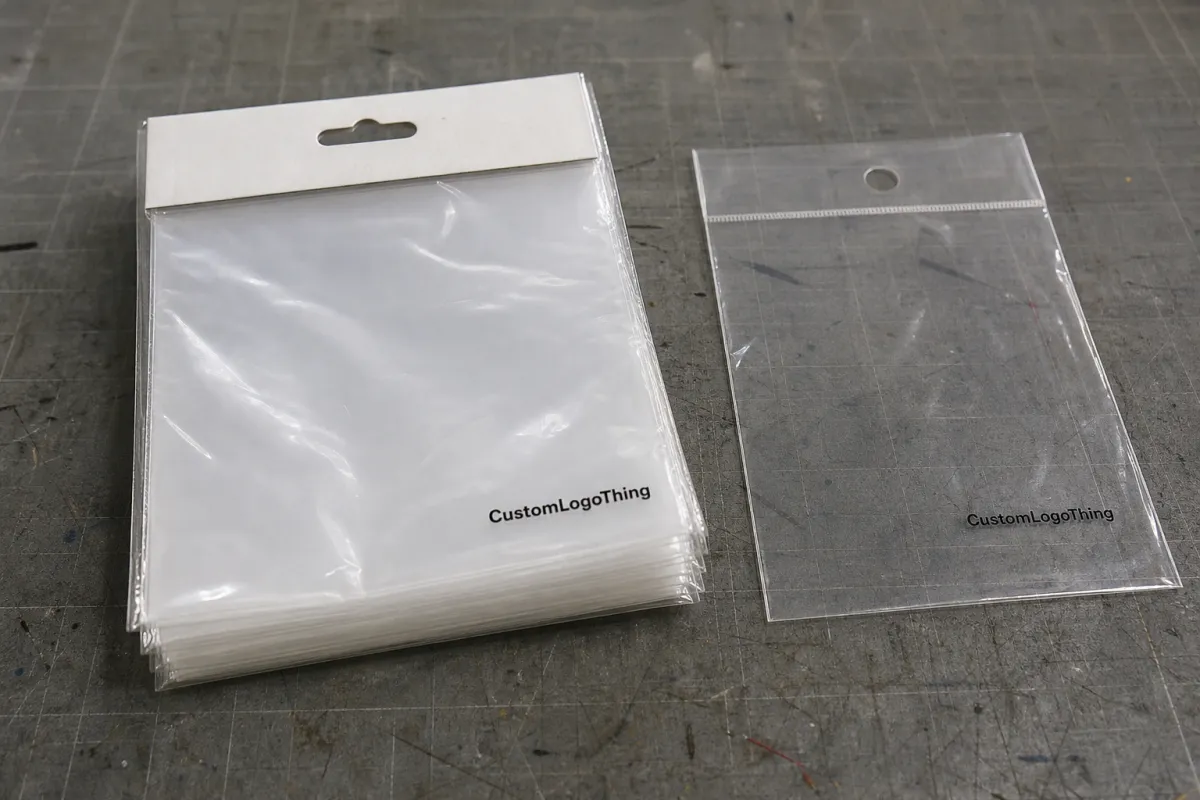
Buyers usually start with format, and that is the right place to begin. Flat poly bags are often the lowest-cost option for retail items. Side-gusset bags give more room for thicker goods or folded sets. Resealable styles add a zipper or adhesive closure. Wicketed bags help speed packing lines. Header bags and Bags with Hang Holes work better for peg displays and retail racks.
Material choice matters too. Virgin resin usually gives better clarity and more predictable performance than heavy recycled-content blends. That does not mean recycled content is a bad choice. It means the tradeoff should be deliberate. If the bag sits front and center in retail, optical clarity is often worth a small premium. If the bag is mainly functional, the premium may not pay back.
Other details show up on the final build sheet: opening style, seal type, vent holes, flap length, adhesive quality, and whether the bag needs a hang hole or euro slot. None of those sound dramatic. Together, they decide whether the bag is easy to use or irritating to handle.
- Flat poly bags for the lowest cost and simplest packing.
- Side-gusset bags for thicker retail items or folded sets.
- Resealable bags for repeat-open products and inventory handling.
- Wicketed bags for higher-speed packing operations.
- Header or hang-hole options for peg display and retail merchandising.
Printing is a separate decision. A plain unprinted bag is often the smartest choice for cost-sensitive retail programs. If the product label carries the brand, adding print to the film may only create setup charges without improving shelf impact. If the bag is the main display surface, a simple one-color logo can make sense. Full coverage print is where costs climb quickly, especially on smaller MOQs.
Specifications Buyers Should Lock Before Requesting Samples
Lock the spec sheet before requesting samples. Otherwise you are not reviewing a sample. You are reviewing a moving target. The minimum details should include width, length, gusset if needed, thickness in mil or microns, closure type, and the packaging count per carton.
Clarity and seal strength should be balanced, not maxed out blindly. Lightweight retail items usually do not need heavy film. Pushing thickness too far can make the bag stiff and awkward, while pushing it too low can lead to tearing or weak seals. The right spec protects the product without making the package feel overbuilt.
Compliance questions should be settled early, especially if the bags touch food, go into regulated retail channels, or ship through a strict distribution center. For buyers checking transit expectations, ISTA test standards are a useful reference point. For cartons or inserts, FSC-certified board may matter too, but that is separate from the poly film itself.
Here is the sample checklist I would use before approving a run:
- Size fit: product slides in without excess slack or binding.
- Clarity: film is transparent enough for shelf display.
- Seal integrity: no weak lines, open corners, or inconsistent sealing.
- Opening ease: line workers can open and pack without fighting the bag.
- Stackability: samples stack flat and stay tidy in cartons.
- Carton count: the count per carton matches packing expectations.
If the sample checks those boxes, the order is usually on the right track. If it misses on one of them, fix the spec before production starts. That is cheaper than finding the same issue after 40,000 bags are already in transit.
Clear Poly Retail Bags Unit Cost Breakdown and MOQ
The Clear Poly Retail Bags unit cost breakdown is not one number. It is a stack of costs. Raw film usually takes the biggest share, then converting, then closure or seal work, then packing, scrap allowance, and freight. For standard plain bags, the split is fairly predictable. For custom builds, setup charges and tooling fees matter more on smaller runs.
MOQ changes the math. A 5,000-piece run spreads setup across fewer bags, so the cost per piece is higher. At 20,000 pieces or more, the same tooling, handling, and QC work gets diluted. That is why buyers chasing the lowest unit cost usually do better with a standard size, standard gauge, and plain packaging rather than a custom stack of extras.
| Build | Typical MOQ | Cost per piece at 5,000 | Cost per piece at 20,000 | Main price driver |
|---|---|---|---|---|
| Flat clear bag, 2 mil, no print | 5,000-10,000 | $0.045-$0.085 | $0.025-$0.045 | Film thickness and bag size |
| Flat clear bag, 4 mil, no print | 5,000-10,000 | $0.075-$0.140 | $0.045-$0.085 | Heavier gauge and resin use |
| Resealable clear bag with zipper | 5,000-10,000 | $0.140-$0.240 | $0.090-$0.160 | Zipper material and extra converting |
| Wicketed or header-style retail bag | 10,000+ | $0.180-$0.320 | $0.120-$0.220 | Special packing and punch or header work |
| Printed clear bag, one-color logo | 10,000+ | Add $0.010-$0.040 | Add $0.006-$0.020 | Setup charges and print coverage |
Those ranges are useful because they show where the money goes. If a quote sits far below them, something is probably missing. Usually it is freight, packing details, or a downgraded spec. If a quote sits far above them, the bag may be overbuilt for the product or the supplier may be padding the order with high setup charges.
Here is the practical quoting framework I would send to a factory:
- Bag style and dimensions.
- Thickness target in mil or microns.
- Print or no print.
- Packaging count per carton.
- Annual forecast or repeat order potential.
- Destination city or postal code for freight.
That list saves time and usually produces a cleaner quote the first time. It also makes comparison easier. You can line up one supplier's bulk pricing against another without wondering whether the carton count, gauge, or closure type was quietly changed.
Process, Timeline, and Production Steps for a Clean Order
The order flow should be boring. Boring is good. Inquiry, spec confirmation, sample approval, production, QC, packing, shipment. If a supplier cannot walk you through that sequence clearly, expect trouble later.
In a normal run, a plain sample can take about 3-7 business days once the spec is confirmed. Production for a standard clear retail bag order often lands in the 12-15 business day range after approval. Add print, a custom closure, or a special pack-out, and the schedule can stretch to 15-20 business days. Repeat orders usually move faster because the spec is already locked and the factory is not guessing.
The most common delays are predictable: missing dimensions, unclear artwork, sample revisions, and last-minute changes to gauge or bag format. Buyers often create their own delay by changing the request after the sample is already approved. That is not a factory problem. That is a spec discipline problem.
If you want a clean launch, approve the build once and reorder the same build later. A lot of packaging pain comes from treating every order like a new experiment. New experiments cost more.
- Step 1: Send a complete spec sheet.
- Step 2: Confirm MOQ and written unit pricing.
- Step 3: Review and approve the sample.
- Step 4: Lock production and carton details.
- Step 5: Release the order and track the ship date.
For buyers comparing broader packaging programs, it helps to keep the bag spec aligned with the rest of the line. A clear retail bag should not fight the label, the insert card, or the shipper. If you are also comparing other package types, our Custom Packaging Products page is a useful place to compare formats, and Custom Poly Mailers matter if the project crosses into shipping packaging.
Why Clear-Bag Supply Stays Consistent on Reorders
Repeatability is where a supplier earns trust. A good reorder should look and perform like the last one, not like a distant cousin of it. That means stable material sourcing, documented specs, and QC checks that catch problems before cartons leave the building.
The controls that matter are straightforward: gauge consistency, seal testing, carton count accuracy, and clean packing. If those are weak, the retail program drifts. One batch is crystal clear, the next is hazier. One lot seals flat, the next has uneven edges. That kind of variation turns a simple bag into a supply-chain distraction.
Service matters too, but not in a vague way. Buyers need fast answers, honest MOQ guidance, and straight talk on tradeoffs. If a lower unit cost requires a compromise on clarity or packing format, say so. Most buyers can handle a tradeoff. They just do not want a surprise.
That consistency matters most for retailers with multiple locations or seasonal restocks. A chain store does not want one store getting a slightly different bag because someone changed the spec halfway through the year. The bag has to hold its shape, keep its clarity, and match the previous run.
A lot of packaging vendors miss there. They chase the order, not the reorder. A solid clear-bag program is built for both.
Next Steps to Get an Accurate Quote, Sample, and Order
If you want an accurate quote, send the spec first, not a vague request for "clear bags." Include dimensions, thickness target, quantity, destination, and whether you need a sample before production. If the bag needs food contact approval, retail display rules, or special packing, say that up front. The clearer the request, the faster the quote.
My preferred order is simple: lock the spec, confirm unit cost at the target MOQ, request a sample, then approve production. That sequence keeps the numbers honest. It also keeps you from comparing one quote against another on different assumptions. A low price with missing freight or missing setup charges is not a real comparison.
If you are comparing suppliers, ask for three things in writing: the exact build, the MOQ that applies to that build, and the landed cost estimate. Then ask what changes if you raise quantity. That last question tells you whether the supplier understands bulk pricing or just throws out a number and hopes nobody checks it.
For a buyer, the cleanest outcome is a bag that looks right, packs fast, and reorders without drama. That is the real Clear Poly Retail Bags unit cost breakdown: not just the unit price, but the full path from spec to shelf to repeat order. Start with the spec sheet, not the guesswork.
What affects clear poly retail bags unit cost the most?
Film thickness and resin grade usually move price faster than most buyers expect. MOQ matters because setup costs hit smaller runs harder. Bag style, packing format, and freight can change landed cost more than the base unit price.
How can I lower the price without making the bags look cheap?
Use a standard size and standard gauge instead of a custom build when possible. Skip unnecessary extras like custom packing or oversized dimensions. Keep the clarity spec realistic for the product instead of overpaying for premium film.
What MOQ should I expect for clear poly retail bags?
MOQ depends on bag size, film spec, and whether the job is plain or custom. Lower MOQs are possible, but the unit price usually rises because setup is spread across fewer bags. A standard spec normally gives buyers the best balance of cost and flexibility.
How long is the turnaround after I approve the spec?
Timeline depends on sample approval, material availability, and the production queue. Repeat orders move faster because the spec is already locked. Changes after approval add time, so confirm dimensions and packaging before release.
What should I send to get an accurate quote fast?
Send bag dimensions, thickness, quantity, and destination first. Add closure type, packaging count, and any compliance requirements if they matter. If you want the best pricing, tell the supplier whether you can work from a standard spec.


