Clear Resealable Poly Bags for apparel brands moq planning sounds narrow until you put a real order behind it. Then the bag starts touching everything: shelf presentation, pack speed, freight efficiency, rework, and how much cash you want sitting in inventory. Packaging always starts as a small line item. Then it quietly gets a vote in every department.
For brands selling folded tees, socks, intimates, kidswear, or promotional apparel, the bag has three jobs. It needs to protect the garment, keep the pack orderly, and show enough of the product to make size, color, and print easy to identify. A clear resealable bag does that without turning the product into a mystery object.
For buyers who are trying to balance retail presentation against replenishment timing, clear resealable Poly Bags for Apparel brands moq planning is not just a sourcing issue. It is a working-capital issue. It is also a question of how much friction your team can tolerate across every drop, every reorder, and every SKU split.
That matters even more when the bag has to support inserts, size stickers, barcode labels, or retailer-specific warnings. Once those requirements are in play, the bag becomes part of the production system. Treat it like an afterthought and the result is usually the same: rushed revisions, odd-looking packs, and more waste than anyone budgeted for.
Why Clear Bags Change the Retail Packing Math
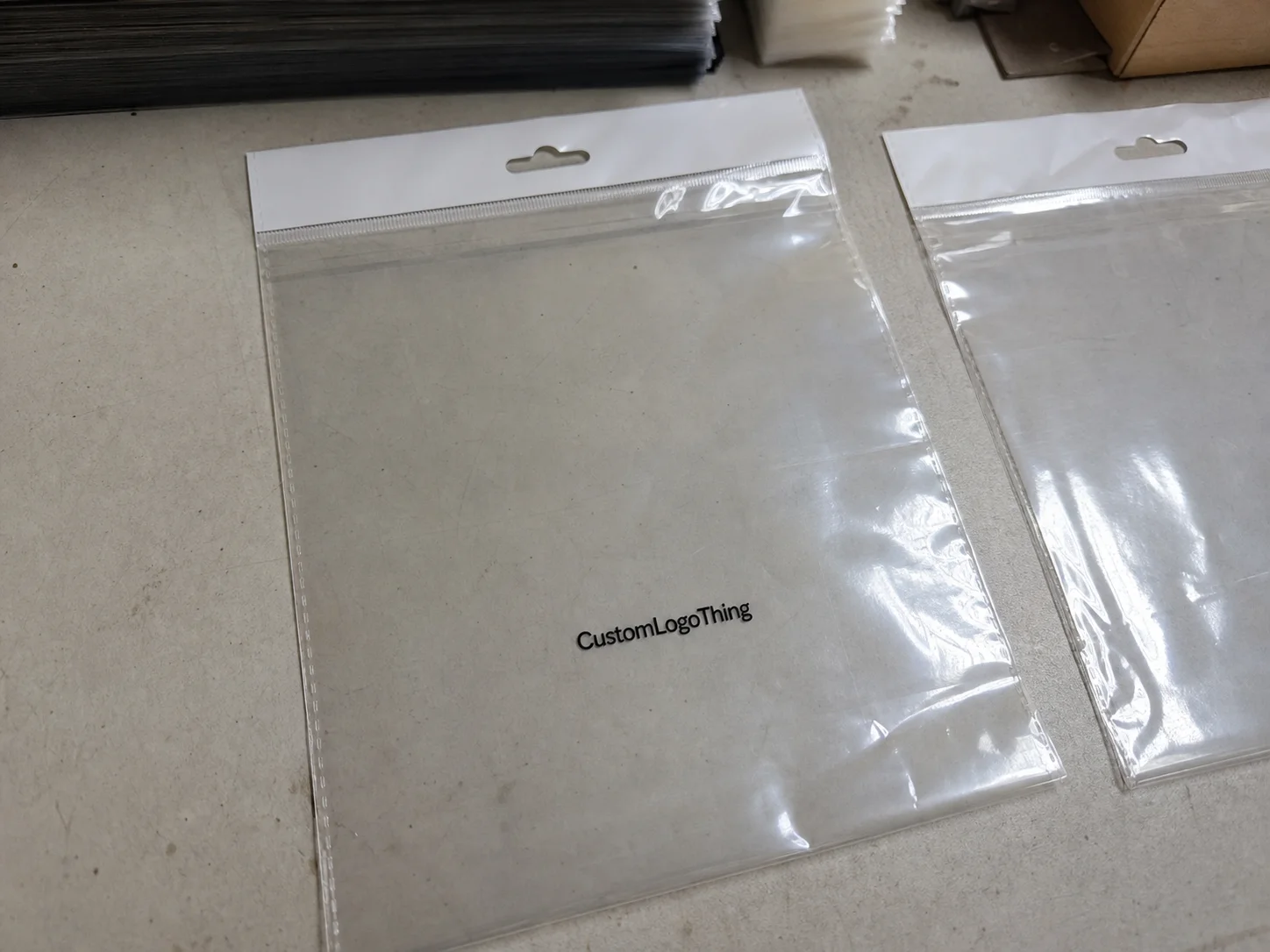
Clear bags make product checks fast. That sounds basic because it is. But basic is often what saves time in a warehouse. A packer can verify size and color without opening the bag. A receiving team can check that the garment is folded correctly. Retail staff can inspect print placement without tearing through a unit that was supposed to stay clean.
That visibility reduces handling. It also reduces the number of times a pack gets touched before it reaches the shelf or the customer. Every extra touch raises the chance of wrinkles, mislabeled units, or a bad reseal. Clear film avoids most of that drama.
Resealability adds another useful layer. Adhesive flap bags are common for retail-ready apparel because they close neatly and are easy to reopen if the item needs relabeling, inspection, or repacking. Press-to-close styles are better when the same pack may be opened more than once during fulfillment or returns processing. For small accessories and socks, a hang-hole version can keep merchandising simple on peg displays.
The planning question is not just “what size bag fits the garment?” It is also how many units should be committed now, how often the style will reorder, and what happens if the assortment shifts before the next run. That is where clear Resealable Poly Bags for Apparel brands moq planning becomes a real forecasting exercise instead of a quick quote request.
“If the bag is the wrong size, the rest of the packaging stack has to compensate. If the bag is right, the whole line moves cleaner.”
There is also a sustainability angle, but it should stay honest. Clear poly bags can be right-sized to reduce film use, made with lighter gauges, or specified with recycled content in some programs. That does not magically make them recyclable everywhere. Local infrastructure still decides a lot of the outcome. For general packaging stewardship guidance, the EPA has a useful baseline at epa.gov.
For teams comparing bag formats with other packaging items in the line, our Custom Packaging Products page shows related options, and the FAQ covers common setup questions. Simple pages. Less guessing. A rare luxury.
Product Details That Affect Fit, Seal, and Shelf Readiness
Most apparel bags are made from LDPE or polypropylene. The difference shows up fast once you hold both. LDPE is softer and more forgiving. That helps with thicker folds, bulky seams, and garments that need a little give at the seal. Polypropylene is crisper and often looks cleaner on shelf. It can deliver strong clarity, though the actual finish depends on the film structure and thickness.
The reseal feature matters just as much as the film. An adhesive flap gives a clean close and works well for basic retail packing. A press-to-close zipper is better for repeat opening or rework. Some programs use a permanent adhesive strip, while others specify a reusable closure because the bag will be handled more than once during sorting or returns. Hang-hole versions are useful when the bag needs to display upright on hooks or pegs.
Bag sizing causes more trouble than most buyers expect. The right size is not based on the flat garment measurement. It is based on the folded pack, the fabric weight, the seam bulk, and any insert card, size label, or barcode that needs room inside the pack. If the fit is too tight, the film bows and the presentation looks stressed. If it is too loose, the garment slides around and the retail look becomes inconsistent.
The best way to confirm size is to test the actual fold. A 12" x 15" bag may work beautifully for one tee and look wrong for another if one style has heavier print, thicker trim, or a bulkier fold. A fleece hoodie needs far more allowance than a lightweight jersey top. Paper measurements do not tell you that. The sample usually does.
Finish options also affect day-to-day handling. Fully clear film keeps the product visible. Frosted film can soften the look and hide scuffs, but it reduces the “see it immediately” benefit. Printed warning text, care notes, or branding may be placed on the flap area. Some programs also need a writable panel for SKU control or a barcode window that can be scanned without unsealing the bag. Static resistance matters too. In dry facilities, cling slows packing and turns a simple job into an irritating one.
- Adhesive flap: clean close, common for retail-ready apparel.
- Press-to-close zipper: better for repeated opening and rework.
- Hang hole: useful for peg display and small accessories.
- Writable panel: helps with SKU control and warehouse labeling.
- Warning text: often required for child-safe and retail compliance needs.
If your bags are going into a retailer with packaging rules, confirm them early. Some chains specify warning language, print placement, or the size of the text. Others care about how the bag hangs or how visible the barcode remains after folding. The problem with packaging rules is not that they are complicated. It is that they are usually invisible until the receiving team rejects something.
For shipping and distribution context, the ISTA site offers useful material on transit testing and handling. Helpful if the apparel is traveling farther than the nearest warehouse dock, which, inconveniently, is most of the time.
Specs Buyers Should Lock Before Requesting a Quote
The fastest way to get a reliable quote is to specify the bag like a production part. Not a rough idea. Not “something clear and resealable.” The quote gets much more accurate once the core details are defined:
- Width and height
- Thickness or gauge
- Flap style
- Adhesive type
- Hang hole shape
- Print coverage
- Warning text or branding
Thickness and bag size should be chosen together. A lighter gauge may be enough for a soft tee, but sharp trims, stiff labels, dense prints, or embroidered details can benefit from a heavier film. For fold-heavy programs, the difference between 1.5 mil and 2 mil is usually noticeable. Not in a glamorous way. In a “why does this bag look tired before we even ship it?” way.
You also need to define the use case. A bag for retail display does not need the same handling tolerance as a bag used only for warehouse protection. If one structure has to do both jobs, the spec usually needs a bit more durability and more disciplined labeling. That is a much cheaper decision to make before sampling than after the first carton arrives looking half right.
Compliance and labeling details worth confirming early
Apparel bags used in consumer-facing channels often need suffocation warnings, recycled content requests, barcode windows, or tamper cues. Some retailers specify exact wording or placement. Others care only that the warning is visible and does not interfere with the brand mark. Those details look tiny in a spreadsheet. Then they turn into a proof revision because the legal line is too close to the seal or the logo blocks the scan area.
For multi-SKU programs, one of the smartest moves is to build a bag family that can serve several styles. Standardizing one structure across related garments lowers inventory fragmentation and makes reorders easier. It also keeps the display system consistent. If the front-end pack looks different every time the style changes, the whole line starts to feel less organized than it actually is.
| Option | Typical Use | Pros | Planning Note |
|---|---|---|---|
| LDPE adhesive flap bag | Basic tees, kidswear, soft goods | Flexible, economical, easy to handle | Good for higher-volume programs and standard folds |
| Polypropylene zipper-style bag | Retail basics, premium basics, repeat-open use | Crisper presentation, strong clarity, reusable | Often chosen when presentation matters more than lowest unit cost |
| Printed flap bag with warning text | Retail-compliant apparel packaging | Combines branding and compliance messaging | Requires tighter artwork control and proof approval |
| Hang-hole resealable bag | Socks, intimates, accessories | Works well for peg display and small formats | Check retailer peg requirements before final sizing |
Cost, Pricing, and MOQ Planning for Apparel Programs
Pricing for Clear Resealable Poly Bags depends on size, film thickness, print count, closure style, and whether the order is a standard format or a fully custom build. Add a logo, warning text, or multiple colors and the price usually moves up. Not because anyone enjoys charging more for fun. Because print setup, inspection, and registration control take time.
The MOQ issue is mostly about setup costs spread across fewer units. A run of 5,000 pieces will usually have a higher unit cost than a run of 25,000 because the same prepress, machine setup, and packing work is divided across fewer bags. That is the basic math. The harder part is deciding how much inventory you want to carry in a market that can change styles, colors, or promotion plans faster than the packaging schedule would like.
For rough planning, a plain clear resealable bag in a standard apparel size may land around $0.06 to $0.14 per unit at higher volume. A printed or specialty closure version can move into the $0.12 to $0.28 per unit range depending on size, thickness, and print coverage. Those are planning ranges only, not fixed quotes, but they are useful when comparing options across seasons or supplier bids.
Lower MOQ reduces inventory commitment, but it usually raises the unit cost. Higher MOQ improves pricing and often makes reorders easier, but it ties up cash in cartons that may not move right away. Brands with multiple colorways or short seasonal windows feel that tradeoff immediately. One wrong forecast and you own a very efficient bag in exactly the wrong quantity.
The cleanest cost control method is often standardization. If one bag size can support several shirt styles, or one closure type can cover a family of products, setup charges, artwork management, and purchasing effort all come down. That is why clear resealable poly bags for apparel brands moq planning gets easier when the bag spec serves the line instead of just one style.
Simplifying graphics helps too. A single-color logo, one warning panel, and standardized size marking can keep the packaging clean while reducing print complexity. Fewer moving parts usually means fewer approval loops and a better chance of hitting the target lead time.
If you want a broader view of packaging cost structure, the Case Studies page shows how packaging decisions affect production flow and replenishment planning across different product categories.
Lead Time and Production Steps From Artwork to Delivery
Once the spec is locked, production usually follows the same sequence: spec confirmation, artwork review, proof approval, material procurement, production, quality checks, packing, and shipment. Straightforward on paper. Less so when someone discovers a missing barcode, an unapproved warning line, or a logo file that was never actually print-ready.
The fastest programs are the ones where the buyer has already settled the final dimensions, warning copy, logo files, and carton labeling before the quote is approved. A clean vector logo, outlined fonts, and accurate barcodes save more time than most teams expect. Late changes to size, flap position, or compliance wording can push the schedule back because the production files have to be rechecked and re-approved.
Typical turnaround depends on volume and print complexity, but many orders land in the 12 to 15 business day range after artwork approval, with shipping added on top. Larger runs or more detailed print requirements can take longer. Expedited freight can shorten the delivery leg, but it will not fix a file that still needs revision.
Approval routing can slow things down more than the factory. Merchandising wants one thing, operations wants another, and compliance wants a third. If all three have to sign off separately, one late comment can hold the order even if the line is already scheduled. A single internal owner makes the whole process less painful. Rare, but effective.
For packaging and distribution context, the Packaging Institute is a useful reference for general industry practices. Helpful when comparing package structures or deciding whether a bag is only a bag, which, for the record, it almost never is.
Clear resealable poly bags for apparel brands moq planning work best when artwork, format, and logistics are all decided before production starts. That sounds obvious. It also happens to be the part teams skip when the calendar gets tight.
How We Support Brand Consistency, Compliance, and Reorders
Consistency is what turns packaging into a system. If the film clarity shifts from run to run, the seal feels different, or the logo moves even a little, the pack starts looking sloppy. Not broken. Just sloppy. And retail buyers notice that immediately.
A proper QC process checks film thickness, seal integrity, adhesive performance, print alignment, and carton count before goods leave production. Those are not glamorous checks. They are the checks that keep the order usable. A weak seal or short count can create a problem long before the bag reaches the shelf.
Repeatability matters just as much on reorders. If the spec is stored clearly, the next run does not need to be interpreted from scratch. That reduces reapproval risk and keeps the brand presentation uniform across restocks. For seasonal apparel programs, that kind of consistency matters because the team can replenish without rebuilding the whole packaging decision every time.
The best packaging partner does not just quote dimensions. It translates brand intent into production-ready details. Buyers should not have to guess which gauge is safest, how much extra room a zipper needs, or where a warning line should sit so it does not fight the artwork. That guidance belongs in the quoting process, especially when the order includes printing, retailer rules, or recurring SKUs.
If you are comparing formats beyond bags, the same standard applies across the packaging stack. The discipline is the point. That goes for apparel packs, inserts, and broader Custom Poly Mailers too.
Next Steps to Move Your Apparel Bag Order Forward
Start with three things: folded garment dimensions, required bag features, and monthly or quarterly volume by SKU. Those three inputs will get you much closer to a correct spec than a vague “we need clear bags” request ever will.
Then decide what matters most. Retail presentation? Warehouse speed? Lower unit cost? Those priorities change the bag more than most teams expect. A pack built for shelf impact will not always be the cheapest. A low-cost bag may not support the handling, labeling, or resealability your operation actually needs.
Before requesting pricing, gather logo files, warning copy, barcode requirements, and any size-label logic already used by the merchandising team. That reduces back-and-forth and lets the quote reflect the real job instead of a guess.
For apparel brands trying to control inventory without giving up presentation, clear resealable poly bags for apparel brands moq planning should be treated as a structured purchasing decision, not a rushed add-on. Once the spec is right, the bag helps the line run cleaner, faster, and with fewer surprises.
Check the spec, compare MOQ scenarios, approve a sample or proof, and lock production only after the details are right. That is the practical route. Usually the cheaper one too.
What size clear resealable poly bags work best for apparel brands?
Choose the bag size from the folded garment dimensions, not the flat garment measurements, and leave room for thickness, inserts, and a clean seal. For multi-size programs, standardize around the largest common fold when possible so one bag family can cover more SKUs.
How does MOQ planning affect the price of custom resealable apparel bags?
Lower MOQs usually raise unit cost because setup and production expenses are spread across fewer bags. Higher, standardized runs usually improve pricing and make reorders simpler, especially for brands with steady sell-through.
Can clear resealable poly bags include branding and warning text?
Yes, most programs can include logos, size marks, care cues, suffocation warnings, and barcode windows depending on the print method and bag structure. Keep the artwork legible and the layout simple so the bag still looks clean in retail and e-commerce use.
What information do you need for a quote on apparel poly bags?
Provide bag dimensions, material preference, thickness, seal style, print requirements, quantity, and any compliance or labeling needs. If possible, include a sample garment or folded size reference so the bag can be specified correctly the first time.
How long does production usually take after approval?
Production timing depends on quantity, print complexity, and the approval stage, but many orders fall in the 12 to 15 business day range after artwork approval. Shipping method also affects delivery date, so confirm whether the order needs standard freight or an expedited timeline.


