Buyer Fit Snapshot
| Best fit | Cmyk Printed Folding Cartons projects where brand print, material claims, artwork control, MOQ, and repeat-order consistency need to be specified before quoting. |
|---|---|
| Quote inputs | Share finished size, material target, print colors, finish, packing count, annual reorder estimate, ship-to region, and any compliance wording. |
| Proofing check | Approve dieline scale, logo placement, barcode or warning zones, color tolerance, closure strength, and carton packing before bulk production. |
| Main risk | Vague material claims, crowded artwork, missing packing details, or unclear freight terms can make a low unit price expensive after revisions. |
Fast answer: Cmyk Printed Folding Cartons: Board, Finish, Dieline, and Unit Cost should be specified like a repeatable production item. The safest quote records material, print method, finish, artwork proof, packing count, and reorder notes in one written spec.
Production checks before approval
Compare the actual filled-product size with the drawing, then confirm tolerance on folds, seals, hang holes, label areas, and retail display edges. Reserve space for logos, QR codes, warning copy, and material claims before decorative graphics fill the panel.
Quote comparison points
Review material grade, print process, finish, sampling route, tooling charges, carton quantity, and freight assumptions side by side. A quote is only useful when the supplier can repeat the same color, closure quality, and packing count on the next order.
CMYK Printed Folding Cartons can look perfect on a monitor and still shift once they hit paperboard, die-cutting, folding, gluing, and retail lighting. I've been on enough press checks to know that gap is small on screen and loud in the room. It is exactly why cmyk Printed Folding Cartons deserve a production-minded review before anyone signs off on artwork or starts talking budget. The process sounds tidy on paper. Real production is messier. Substrate choice, ink density, finishing, and carton construction all tug at the final result.
For a brand team, that can mean the difference between a crisp shelf-ready carton and one that looks dull, muddy, or just slightly off next to the approved mockup. For a packaging buyer, it can mean the difference between a clean quote and a surprise change order after proofing. So here's the practical version: cmyk Printed Folding Cartons need to be planned like a manufactured component, not a pretty PDF. I am not going to pretend color on a screen is the same as color on board. It isn't. And if you are trying to hit a launch date, that distinction stops being academic pretty fast.
What CMYK Printed Folding Cartons Are and Why They Matter
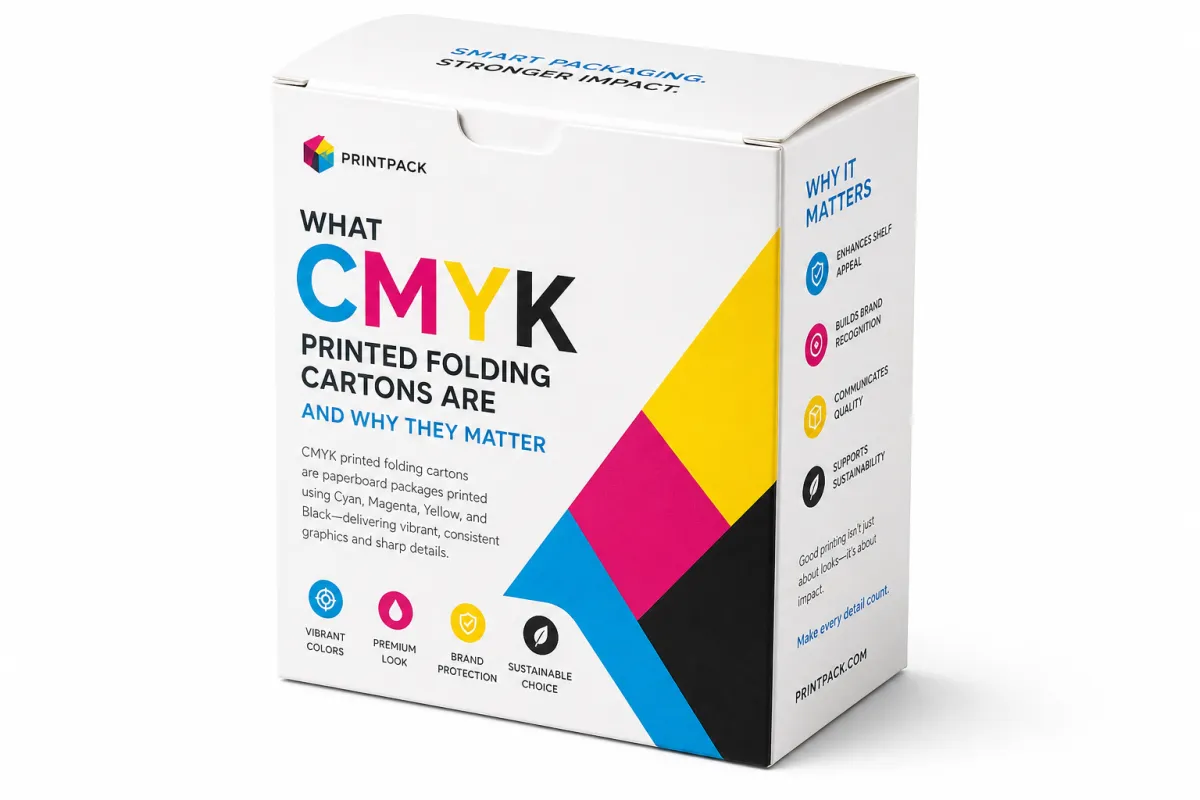
At the simplest level, cmyk Printed Folding Cartons are paperboard cartons printed with the four process colors: cyan, magenta, yellow, and black. Those inks are built into tiny halftone dots, and the eye blends them into images, gradients, type, and multi-color graphics. The carton is then die-cut, folded, and usually shipped flat so it can be filled later on a packing line. That structure is part of the appeal. It is sturdy enough for retail presentation, but it still stores efficiently before use. Packaging loves that kind of contradiction.
Brands choose cmyk printed folding cartons for plenty of product categories. Cosmetics want a carton that can carry photography and delicate color shifts. Supplements need room for regulatory copy, icons, and product claims. Food packaging often needs shelf presence with easy-to-read panels. Ecommerce and promotional items benefit from a carton that looks polished without forcing a custom structural build every time the artwork changes. In all of those cases, cmyk printed folding cartons give the designer more freedom than a single-color print format.
The biggest advantage is flexibility. A full CMYK workflow can reproduce product photos, soft shadows, layered backgrounds, and detailed illustrations without setting up a separate plate for each color. That matters because many brands now use packaging as a marketing surface, not just a container. A well-planned carton can carry the logo, product story, legal copy, and imagery in one print pass. For cmyk printed folding cartons, that efficiency is often the reason the format beats more limited print methods. You get more visual range without building the entire job from spot inks.
Still, the print process is not magic. Color consistency depends on the board, the ink coverage, press calibration, drying behavior, and the way the carton will be converted after printing. A bright coated SBS board will hold color differently than an uncoated or recycled board. Heavy solids behave differently than a carton built mostly from white space and fine type. Even fold lines matter, because ink and coating at a crease do not always look like the open flat sheet. That is why cmyk printed folding cartons need production planning, not just good artwork.
Honestly, the most common mistake is treating CMYK like it is just a digital file format. It is not. It is a print system with limits and strengths, and cmyk printed folding cartons work best when those limits are understood before approval. The rest of this piece looks at how the process actually works, what affects cost, and what to check before the cartons go into production.
How CMYK Printed Folding Cartons Work on Press
CMYK is a four-color process, and the trick comes from layering tiny dots at different angles and densities. Cyan pushes toward blue-green, magenta brings in red-violet, yellow creates warm tones, and black adds depth, contrast, and cleaner text. For cmyk printed folding cartons, that means the press is not printing a single solid image the way a screen displays one. It is building the picture dot by dot, which is why small changes in ink film or paper absorbency can change the look.
The workflow usually starts with separated artwork and plate creation, or with a direct digital file setup if the run is short enough for digital printing. In offset printing, each color moves from a plate to a blanket and then onto the board. The press operator controls ink flow, water balance, registration, and drying conditions. After print, the sheets may move to coating, curing, cutting, and finally folding and gluing. cmyk printed folding cartons depend on each stage lining up cleanly, because a small shift early in the process can show up later at the fold or panel edge.
Board choice matters more than many people expect. Coated paperboard tends to hold ink on the surface, so shadows stay cleaner and colors look more saturated. Uncoated stocks absorb more ink, which can soften detail and cut contrast. Specialty boards, including recycled substrates, may have a warmer cast or a more open surface, so brand colors do not always behave the same way from one material to the next. If you are planning cmyk printed folding cartons for a premium product, test the actual board grade instead of trusting a monitor or a generic proof. Screens are confident. They are also kinda optimistic.
There are technical variables inside the pressroom too. Screen rulings around 150 to 200 lpi are common in many packaging environments, but the right choice depends on the artwork, the press, and the board. Dot gain, which is the natural spreading of a printed dot, can make dark areas heavier and fine reverse type less crisp if it is not managed well. Trap, overprint settings, and total ink coverage matter too. That is why cmyk printed folding cartons with thin lines, small text, or subtle gradients need careful prepress work and a press crew that understands packaging, not just flat commercial print.
Finishing adds another layer of decisions. An aqueous coating can improve scuff resistance and speed handling. Varnish may add protection or a light visual effect. Soft-touch lamination gives a smoother, more premium feel, but it also changes how the printed color reads because the surface diffuses light. Spot UV, foil accents, and other finishing choices can lift a carton visually, though they should be planned with the CMYK image so the final package does not feel busy or overworked. cmyk printed folding cartons often look strongest when the finish supports the design instead of fighting it.
Digital printing and offset printing both have a place. Digital printing is often better for short runs, lots of versioning, and faster turnarounds, especially when the quantity is too low to justify plate costs. Offset printing tends to become more economical at higher volumes and usually offers strong consistency once the press is dialed in. Flexographic printing shows up much more often on corrugated work, labels, and continuous-web packaging than on folding cartons, though it still matters in the broader packaging mix. For cmyk printed folding cartons, the right choice depends on volume, artwork complexity, and the finish the brand wants.
If you want a reliable benchmark for distribution and transit behavior, the ISTA testing framework is worth knowing. Packaging teams do not need to memorize every test sequence, but they should understand whether the carton only needs shelf performance or whether it must survive shipping vibration, compression, and drop exposure as part of a broader pack-out system. That distinction affects everything from board choice to glue flap design.
CMYK Printed Folding Cartons: Cost, Quality, and Timeline Factors
Cost starts with the basics: carton size, board grade, quantity, print coverage, finishing steps, and how much conversion work is involved after press. A small straight tuck carton on standard SBS board will usually cost less than a larger carton with multiple panels, specialty coating, foil accents, and tight registration requirements. For cmyk printed folding cartons, every extra operation adds time, labor, and risk, so the budget should reflect the actual structure, not just the artwork file.
Quantity is one of the biggest drivers. Short runs often make digital printing attractive because setup is lighter and changeovers are faster. Larger runs usually favor offset printing because the unit cost can drop as the press keeps running. That said, cmyk printed folding cartons are not priced on print alone. Plate charges, die costs, make-ready time, proofing, ink density targets, and carton folding all feed into the final number. If the design is heavy on ink coverage or requires multiple revisions, the cost can rise quickly even before production starts. No one can quote a carton accurately from a JPEG and a wish list. I wish they could. They cannot.
Timelines deserve the same attention. A straightforward project with finalized artwork, stock on hand, and a simple finish might move from quote to delivery in roughly 10 to 15 business days after approval, depending on the supplier's queue. A more complex carton with custom coatings, multiple proof rounds, or structural changes can stretch far beyond that. cmyk printed folding cartons usually move fastest when the product specs are locked before quote requests begin. Late changes to copy, barcode placement, or fold structure can force a new proof, which pushes the schedule back. Packaging can be patient. Procurement usually is not.
Color-critical work tends to add another layer of timing. If the carton must match a legacy package, a retail line extension, or a tightly controlled brand standard, the approval path often includes soft proofs, hard proofs, and sometimes a press check. Each step gives more confidence, and each step also adds calendar time. For cmyk printed folding cartons, the hidden schedule risk is often not the press run itself; it is the waiting between design review, internal signoff, and production release. That is where smart planning saves the most headache.
Here is a practical comparison that packaging teams often use early in planning:
| Printing Method | Best Fit | Setup Effort | Unit Cost Trend | Color Strengths |
|---|---|---|---|---|
| Digital printing | Short runs, versioned artwork, quick launches | Low to moderate | Higher per unit at scale, often easier for small quantities | Good for flexible CMYK artwork and rapid proofing |
| Offset printing | Medium to large runs, steady brand graphics | Moderate to high | Usually drops as quantity rises | Strong detail, stable repeatability, good solids |
| Flexographic printing | Corrugated and continuous-web packaging more than folding cartons | Moderate | Efficient for high-volume web work | Useful in broader packaging systems, less common for premium cartons |
That table does not tell the whole story, but it helps frame the conversation. For cmyk printed folding cartons, the question is rarely only "Which print method is cheapest?" More often, the real question is "Which method gives the right balance of color, quantity, and schedule without creating unnecessary risk?" That is where a smart packaging buyer saves money, because they avoid overbuying inventory or paying for a premium finish that the product does not truly need.
A useful rule of thumb is to separate core print cost from finish cost. A carton with simple CMYK graphics and aqueous coating may sit in a very different budget band than a carton with soft-touch lamination, foil, spot UV, and a high-end insert. The finished look can be worth it, but only if it supports the selling price and the channel. cmyk printed folding cartons should feel appropriate for the product tier, not automatically expensive or automatically basic.
Step-by-Step Process for CMYK Printed Folding Cartons
Good packaging work starts before anyone opens the design file. The first step for cmyk printed folding cartons is defining the product fit, retail goals, compliance needs, and shipping requirements. A carton for a fragile cosmetic bottle may need a snug insert or a tighter board choice. A supplement carton may need more room for regulatory panels, barcode placement, and lot code space. If the box must support ecommerce fulfillment, you also need to think about compression and edge crush, not just shelf appearance.
Next comes the dieline. This is the structural template that shows panel size, fold lines, glue flaps, tuck areas, and bleed. The artwork has to respect those boundaries, because a logo that looks centered on screen can land too close to a fold once the carton is assembled. For cmyk printed folding cartons, I usually tell teams to keep a clean safe zone around folds and glue areas, and to place important copy well away from any panel edge that may be trimmed during conversion. Barcode quiet zones matter too, because a scanner cannot read a code that is squeezed by nearby art.
Proofing is where the project moves from concept to reality. A soft proof is useful for layout, copy, and image placement, but it will not fully show how cmyk printed folding cartons will look on the actual board. A hard proof, drawdown, or contract proof gives a better view of color and finish. If the carton is highly brand sensitive, a press check can be worth the time because it lets the buyer see ink on the actual substrate before the whole run is committed. That is not always necessary, but for color-critical cmyk printed folding cartons, it is often the cheapest insurance available.
Production setup follows approval. Files are preflighted, fonts are checked, images are confirmed at usable resolution, and the print team prepares either plates or a digital workflow. Board stock is inspected for consistency, because variations in shade or caliper can affect the finished look and the fold quality. At this point, even a minor material change can alter how cmyk printed folding cartons read under retail lighting. After printing, the sheets may go through coating or curing before they are die-cut and converted.
Folding and gluing sound simple, but they are where a lot of cartons either feel solid or feel sloppy. Registration across panels has to stay clean. Glue must hold without squeezing out and damaging the printed surface. If the carton has windows, tear strips, or specialty folds, the conversion process becomes more sensitive. cmyk printed folding cartons can look excellent on the sheet and still disappoint if the converting step is rushed or the glue pattern is wrong for the board. That is not drama. It is just how carton production works.
A physical proof costs far less than a reprint. If the carton color, text, or finish matters to the brand, do not skip the proof stage just because the PDF looks clean on a monitor.
The final stage is inspection and fulfillment. Packaging teams usually verify carton count, check random samples for print quality, confirm fold integrity, and make sure the cartons are flat packed in a way that protects edges and corners during transit. If the cartons are destined for a production line, receiving instructions matter as well: how many cartons per case, how the pallets should be wrapped, and where the cartons should be staged. cmyk printed folding cartons are a manufactured component, not just a printed piece, and the handoff to operations should reflect that.
For some teams, sustainability also enters the step-by-step plan. If the board needs to come from certified sources, look for FSC-certified materials and confirm the chain-of-custody claims before ordering. The FSC system is a practical place to start if your packaging brief includes responsible sourcing or retailer requirements tied to paperboard origin.
Common Mistakes With CMYK Printed Folding Cartons
One of the easiest ways to create problems is to design in RGB and assume the printed carton will match the screen. Screens emit light; paperboard reflects it. That difference alone changes the look of saturated blues, oranges, and deep reds. For cmyk printed folding cartons, conversion to the correct color space, paired with a realistic proofing plan, is not optional. It is the foundation of predictable color.
Another common issue is ignoring the dieline. Teams sometimes place key text on a fold, forget the glue flap, or crowd a barcode too close to the trim edge. That may be invisible in a mockup, but it becomes obvious on press and on the finished carton. cmyk printed folding cartons need artwork that respects the structure from the start, not a design that gets forced onto the structure later.
Fine type and dark solids can also cause trouble. Rich blacks need to be built with care, because an overly heavy black build can dry slowly or print muddy on the wrong board. Reversed type that is too small may fill in or break apart after print and finishing. Tiny icons, legal footnotes, and ingredient lines can become hard to read if the ink spread is not managed. For cmyk printed folding cartons, legibility is part of quality, not a side detail.
Files with mixed color spaces, low-resolution images, or inconsistent brand assets cause expensive rework late in the process. A 72 dpi photo placed inside a carton layout is not going to sharpen itself on press. A logo pulled from five different sources will not magically become consistent either. If cmyk printed folding cartons are part of a line extension or a brand refresh, the art package needs one clean source of truth, not a folder full of mismatched files and crossed fingers.
Material mismatch is another trap. A design that looks elegant on bright white coated board may feel flat on a recycled board with a warmer tone. A soft-touch finish may suit one product, while a simple aqueous coating is better for another because it resists scuffing more predictably. cmyk printed folding cartons are at their best when substrate, finish, and branding all point in the same direction. If one of those choices fights the others, the final package usually feels less certain.
Perhaps the most expensive mistake is rushing approval. Teams that sign off on a proof without checking the panel order, the copy, the barcode, and the color target often pay for that shortcut later. A reprint is not just a press issue; it can delay launch, waste inventory, and create awkward conversations between procurement, marketing, and operations. With cmyk printed folding cartons, slow approval is still faster than fixing a bad run.
Expert Tips for Better CMYK Printed Folding Cartons
The best cmyk printed folding cartons usually start with disciplined file preparation. Use the correct dieline, embed or package images properly, and confirm that fonts are handled the way your supplier expects. If the project calls for outlined type, do that only after final copy approval, because editable text is safer during revisions. Keep a clean version history too. Packaging files get passed around more than people admit, and one stray revision can snowball into a mess.
Test brand color on the actual board and finish whenever possible. A color that looks balanced on a monitor can swing warmer, duller, or more muted once it is printed on paperboard and coated. That is why cmyk printed folding cartons for cosmetics, supplements, and premium retail items often benefit from a physical proof or a press-approved target. You do not need to overcomplicate every project, but for color-sensitive work, one real sample is worth a lot more than several polite opinions in a meeting.
Design with the shopper's eye in mind. Shelf impact matters, and readability at arm's length matters just as much. A carton can carry a lot of information and still feel calm if the hierarchy is good. Product name, benefit statement, and key visual should be the first things the eye catches. Secondary claims, instructions, and compliance text should support the main story instead of crowding it. Strong cmyk printed folding cartons usually communicate quickly, then reward a closer look with texture, detail, or a well-chosen finish.
Choose finishing strategically. Aqueous coating is practical for many cartons because it adds protection without making the surface feel overprocessed. Soft-touch lamination can elevate perceived value, but it should match the brand personality and the product price. Spot UV works well on selective highlights, though it should be used with restraint so the design stays readable. In packaging, finishing should solve a problem or reinforce a message, not just add another effect. That is especially true for cmyk printed folding cartons, where the image quality is already carrying a lot of the load.
If the carton will ship, test the full pack-out path, not just the shelf sample. A carton can look great straight out of the press and still fail if it scuffs in transit, opens too easily, or crushes under stack pressure. That is where practical packaging standards and performance testing matter. If you need a baseline for transit simulation, many teams align with ISTA methods so the carton is judged under real handling conditions, not just a photo shoot table.
Build one internal review checklist and use it every time. Include structure, copy, color, compliance, barcode, finish, and shipment details. Let packaging, marketing, procurement, and quality all sign off before production is released. cmyk printed folding cartons reward teams that slow down just enough to check the details, because the details are exactly where most costly mistakes hide. If you want fewer surprises, this is the boring part worth obsessing over.
Planning CMYK Printed Folding Cartons: Next Steps
If you are planning cmyk printed folding cartons, the next decisions are usually the most practical ones: product dimensions, quantity, board choice, print method, finish, and delivery timing. Once those are clear, quotes become much easier to compare because you are not asking vendors to guess at structure or quality level. The more complete the brief, the cleaner the pricing conversation.
Before you request a quote, gather the final dieline, artwork files, target quantity, and product specs. If the carton needs to fit a bottle, jar, tube, or device, include those measurements as well, because the inner fit can influence board grade and structural style. cmyk printed folding cartons are much easier to price accurately when the supplier sees the full picture, including whether the job needs folding, gluing, special coating, or a particular shipping format.
It also helps to compare sample proof, production estimate, and timeline together instead of treating them as separate steps. A low price that stretches the schedule or weakens color control may be a poor fit for a launch that has a fixed retail date. A slightly higher quote with a better proofing plan can save money if it avoids rework, scrap, or delayed inventory. That tradeoff matters a lot with cmyk printed folding cartons, especially for brands that need steady repeatability across multiple SKUs.
Document your color expectations, structural requirements, and transit conditions in one place. If the carton will sit on a shelf, resist handling in a fulfillment center, or travel through long distribution routes, say so early. If the board must come from certified sources, specify that as well. If the finish must feel premium but not overly glossy, write that down. cmyk printed folding cartons perform best when design, material, and manufacturing are planned together rather than patched up after the quote is already approved.
The best sequence is simple: audit the artwork, confirm the stock and finish, request samples or proofs, then schedule production with enough buffer for review. That rhythm is what keeps a project calm. It also gives the press room the information it needs to produce clean, repeatable results. In my experience, cmyk printed folding cartons deliver the strongest value when the team treats them as part design brief, part production plan, and part quality check, all at the same time.
Handled that way, cmyk printed folding cartons become less of a gamble and more of a reliable packaging tool. The practical takeaway is simple: lock the dieline, choose the exact board and finish, and approve a real proof on that material before you release the run. Do those three things in order, and you cut out most of the avoidable surprises.
FAQ
How do CMYK printed folding cartons compare with spot color cartons?
CMYK printed folding cartons are usually the better choice for photos, gradients, and multi-color artwork, while spot color cartons are stronger when a brand needs a very exact, repeatable color match. Spot inks can make logos and large solid fields feel more controlled, but they add setup complexity if the design uses many colors. Many packaging projects use both: CMYK for imagery and spot color for a critical brand tone or logo.
Are CMYK printed folding cartons good for small product runs?
Yes. CMYK printed folding cartons can work very well for small runs, especially if the artwork is detailed or if the project may need a quick launch. Digital printing is often the better fit for short quantities because setup is lighter and artwork changes are easier to manage. The tradeoff is that the unit cost may be higher than a larger offset run, so the best choice depends on quantity, timeline, and inventory risk.
What affects the color accuracy of CMYK printed folding cartons?
Board color, coating, ink coverage, press calibration, and dot gain all affect how the finished carton looks. A coated white board will usually show stronger color than an uncoated or recycled board, and a soft-touch finish can mute the image slightly. For color-sensitive CMYK printed folding cartons, a physical proof or press check is the most dependable way to judge real color on real material.
How long does it take to produce CMYK printed folding cartons?
The timeline depends on artwork readiness, proof approval, printing method, finishing steps, and how complex the carton structure is. A simple job can move quickly if files are clean and stock is available, while custom finishes or multiple revisions add time. CMYK printed folding cartons usually stay on schedule best when the artwork, dieline, and approval process are all locked before production begins.
What should I send when requesting a quote for CMYK printed folding cartons?
Send carton dimensions, product size or weight, quantity, preferred board, finish options, artwork files, and any compliance or shipping requirements. Include whether the carton needs folding, gluing, a special dieline, or transit testing, because those details affect both Pricing and Lead time. The more complete the request, the easier it is to compare quotes for CMYK printed folding cartons without chasing revisions later.