What this checklist protects before guests ever notice it
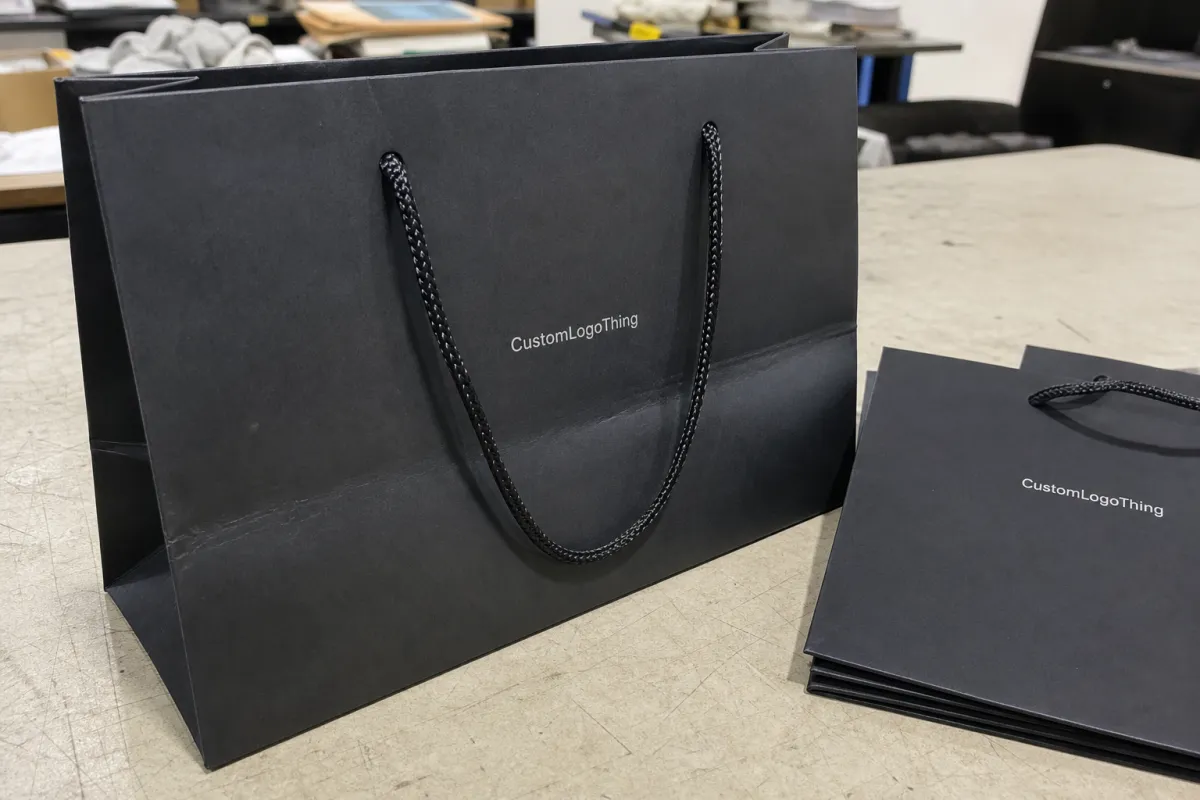
At check-in, on a pillow, or tucked into a turn-down gift, a bag is already doing brand work before the guest reads a card or opens the tissue. A hotel Black Paper Gift Bags sample checklist exists for one reason: to catch the things that look minor on a screen and become obvious in hand. A slightly soft corner, a handle that twists under load, or a scuffed black panel can make a premium bag feel improvised.
Black paper raises the bar. Warm lobby lighting reveals fingerprints. Glossy coatings can reflect unevenly. Heavy ink coverage can hide fold fatigue until the bag has been handled a few times. What looks deep and elegant in a rendering can look flat, streaked, or tired once the sample is folded, carried, and set down on a counter.
That is why the checklist should cover more than artwork approval. It needs to test structure, paper weight, finish, handle strength, print quality, carton packing, and real-world durability. Buyers often discover that the most expensive failures are not the dramatic ones. They are the quiet ones: a bag that still functions but no longer feels worthy of the room rate it supports.
From a procurement perspective, the checklist reduces three common risks. First, the wrong material stack gets approved because the sample looked rich but behaved poorly. Second, the bag size is chosen before the actual gift set is measured. Third, the quote leaves out a finish, a reinforcement, or a packing detail that turns into a surprise later. Those misses rarely stay small. They usually show up as rush fees, rework, or a compromise in presentation that staff notices immediately.
A black bag can look polished in a spec sheet and still fail under hotel lighting, real handling, and a real fill weight.
The practical value of the checklist is alignment. Procurement, brand, operations, and the supplier all review the same sample against the same standards before production starts. That keeps the final bag tied to the guest experience instead of floating away from it.
How the hotel black paper gift bags sample checklist works from dieline to delivered bags
The best sample process moves in stages. It should never jump straight from artwork to final approval. First comes the flat dieline proof, which confirms size, gusset depth, panel layout, fold lines, bleed, and the logo’s safe area. Then comes an unprinted structural sample. That step tells you whether the bag folds cleanly, stands square, and holds its shape without glue distortion. After that, a printed pre-production sample shows how the black substrate, logo, and finish behave together. Final approval should only happen after the sample matches the actual material stack planned for production.
That sequence sounds obvious until a project gets rushed. Buyers often sign off on a PDF before the die is locked, or they approve a plain mockup and assume the printed version will behave the same way. It usually will not. Black coverage, coating, handle attachment, and board stiffness all change the appearance once the bag is built as a real object rather than a flat file.
| Sample stage | What it confirms | What it cannot confirm |
|---|---|---|
| Flat dieline proof | Dimensions, panel layout, logo placement, bleed, and fold lines | Rigidity, handle strength, scuff behavior, and glued construction |
| Unprinted structural sample | Fold memory, bottom shape, gusset depth, glue accuracy, and overall feel | Color depth, print registration, foil alignment, or coating effect |
| Printed pre-production sample | Artwork position, black consistency, finishing, and presentation in hand | Full carton performance across a shipment or every unit in a large run |
For black paper in particular, the sample review should cover logo contrast, registration, coating quality, edge color after folding, and any foil or spot UV effect. If the supplier is showing you a substitute board or a different finish, the approval can become misleading fast. Ask for the exact paper grade, handle style, and coating that will be used in the run, not a close match. That one request removes a lot of ambiguity.
A useful detail that gets missed: a sample should be evaluated at the same size as the order. Reducing or enlarging the bag changes the way the black surface reads, the way the handles sit, and the amount of tension on the bottom seam. A small sample of a large bag is not a reliable guide.
The specs that decide whether a hotel bag feels premium
Paper stock is the first decision, and it shapes almost everything that follows. For hotel use, Black Paper Gift Bags often sit in the range of 150-250 gsm art paper or 210-350 gsm board, depending on the size of the bag and what it carries. Smaller amenity bags can work on lighter board. A welcome-kit bag carrying a bottle, a boxed product, or multiple inserts usually needs a stiffer structure. If the board is too soft, the top rolls inward, the side panels lose their sharpness, and the bag starts to look used before it reaches a guest.
Handle style matters just as much. Ribbon handles create a gift-led look. Rope handles support more weight and usually feel more durable in daily hotel handling. Twisted paper handles are often the cost-efficient choice for larger runs. Die-cut handles can look sleek, but they need careful reinforcement if the bag will be carried more than once. The weak point is often not the handle itself; it is the attachment point. Ask how the handle is anchored, whether the patch is reinforced, and what fill weight the sample was tested with.
Size planning should start from the actual contents. A spa set, a turndown gift, and a retail carryout bag are not interchangeable. Leave room for tissue, inserts, and enough air around the product so the bag does not bulge or collapse. A bag that is technically large enough can still look wrong if the contents press against the gusset or force the handles outward.
Finish is where black paper becomes tricky. Matte lamination reduces glare and can make the bag feel calmer and more expensive. Soft-touch coating changes the hand feel and usually reads more premium in a guest-facing setting. Spot UV and foil can lift a logo, but they need restraint; too much decoration on black can look busy rather than refined. The tradeoff is simple: black paper shows fingerprints, edge wear, and burnish marks more easily than lighter stock. If the bag will be touched repeatedly, stacked, or carried through a lobby, the finish should be tested for those conditions rather than judged only by appearance.
There is also a practical detail many teams skip: odor. Some coatings and laminations can retain a noticeable smell when the shipment is first opened. That can matter in a hotel setting, especially for room-service presentation or spa packaging. Ask for a sealed sample if the bags will be used close to guests and stored in enclosed areas.
- Paper weight: match the board to the actual fill weight, not just the visual style.
- Handle strength: test the bag with the real item inside, not empty.
- Finish: confirm whether matte, soft-touch, foil, or spot UV survives handling.
- Black coverage: check whether the color stays even across folds, corners, and panel joins.
- Odor and rub-off: make sure coating and ink do not transfer or smell too strong out of the carton.
For buyers who need a responsible sourcing paper trail, FSC-certified stock is worth asking about, especially if the bags support a broader sustainability message; the Forest Stewardship Council explains certification and chain-of-custody details at fsc.org.
One more buyer observation: what feels premium in a sample room can feel ordinary under hotel lighting if the black is too warm, too cool, or visibly uneven from batch to batch. Color consistency matters more on black than on many other shades because guests notice contrast immediately, even if they cannot describe the defect.
Cost, pricing, MOQ, and quote details to compare
The hotel black paper gift Bags Sample Checklist also acts as a pricing filter. Paper grade, size, handle style, print coverage, finishing, and packing all move the number. A simple one-color logo on a standard black bag costs far less than a bag with full-surface print, foil, soft-touch lamination, reinforced handles, and custom packing. For planning purposes, sample charges often fall in the $35-$120 range depending on complexity. Production pricing can move from roughly $0.20-$0.45 per unit at larger quantities to $0.60-$1.20 or more at smaller runs with heavier materials or special finishes.
MOQ matters because setup costs get spread across the order. If you want a custom size, special board, and decorative finish, the unit price rises quickly at low quantity. That does not automatically mean the quote is inflated. Usually it means the order requires die cutting, tooling, setup, and extra inspection on a short run. Ask whether the MOQ is tied to the bag size, the print method, the handle type, or the finish. Those are not always the same constraint.
| Quote item | What to confirm | Why it changes price |
|---|---|---|
| Exact dimensions | Width, gusset, height, and bottom style | Material usage and die setup vary with size |
| Paper spec | GSM, coating, color consistency, and board type | Heavier or coated board raises cost and improves stiffness |
| Handle style | Ribbon, rope, twisted paper, or die-cut | Attachment method and reinforcement affect labor and materials |
| Print and finish | Ink count, foil, embossing, lamination, spot UV | Each added process adds setup, time, and inspection |
| Pack-out | Bulk carton pack, polybagging, inserts, labeling | Packaging method affects labor, freight, and damage risk |
A fair comparison only works if every supplier is quoting the same spec. One quote may include coated board, a reinforced handle patch, and printed outer cartons, while another leaves all three out. That is why buyers should ask for a line-by-line breakdown rather than relying on a single unit price. Freight terms matter too. Shipping from sample approval to final delivery can quietly change the landed cost more than expected, especially when cartons are dense or the order ships by air.
Sample fees are sometimes credited back on production orders, but not always. Treat that as a negotiation point, not an assumption. If a supplier waives the fee, ask whether it is tied to a minimum order value or limited to one revision cycle.
For a practical benchmark on shipment protection and distribution testing, the ISTA site is a useful reference point for common transport test methods.
Process, timeline, and production steps from sample to shipment
A clean project flow starts with the brief, moves to the dieline, then to sampling, revision, approval, production, inspection, packing, and freight booking. That sounds orderly, but delays usually come from missing artwork, unclear carton specs, or a sample approved before the team tested it with the actual gift set inside. If the bags support a hotel opening, peak season, or a new amenity program, every handoff needs a date attached to it.
Typical timing depends on complexity. A plain structural sample may take 5-7 business days once dimensions are confirmed. A printed pre-production sample often takes 7-12 business days, especially if foil or soft-touch coating is involved. Production after approval can land around 12-20 business days for simpler runs and longer for larger quantities or special finishes. Those are working ranges, not promises. Peak season, board availability, and handle sourcing all affect the calendar, and shipping time sits on top of that.
The checkpoints that deserve hard signoff are usually the same: design approval, sample approval, carton pack approval, and final ship date confirmation. If a supplier says a rush is possible, ask which step is being accelerated. Printing may speed up. Coating cure time, handle assembly, or carton loading often cannot. That distinction keeps plans realistic.
If the bags will travel in master cartons with other goods, ask about drop testing or at least a simple transit simulation that reflects real handling. A formal lab program is not necessary for every order, but the bags should survive stacking, corner pressure, and room-service handling without losing shape. Black paper, especially on sharp-edged bags, can reveal damage quickly at the corners and top edge.
There is also a quality-control detail that saves time later: request final production photos or a carton-level approval if the order is large enough to justify it. The sample may be perfect and still not protect you from a packing mistake on the run itself.
- Fastest steps: artwork signoff and dieline approval.
- Slowest steps: coating cure, special handles, and custom packing.
- Least flexible: material sourcing and tooling once production starts.
For buyers who want a broader sense of packaging performance testing, ASTM D4169 is a common distribution-testing reference used across shipping categories, and many suppliers align internal checks with similar logic even if their paperwork looks different.
Common mistakes that slow down hotel bag sampling
The biggest mistake is approving from a screen and calling it done. A PDF can show layout, but it cannot show the hand feel of black board, the way a fold line breaks light, or whether a logo disappears into the background once the bag is carried. If the bag is guest-facing, a physical sample is not optional.
Another common miss is ignoring the real fill weight. A bag that looks crisp when empty may bow at the gusset, split at the handle, or feel awkward once it holds a boxed amenity set or a glass bottle. The sample should be tested with the actual item, the actual tissue, and the actual insert arrangement if there is one. That is the only way to know whether the structure is truly fit for use.
Quote comparisons also get messy fast. One supplier may include heavier board, better coating, and printed cartons; another may quote a bare-bones version that looks cheaper until the extras are added back in. The checklist keeps those differences visible. Without it, buyers often compare a finished bag against a stripped-down placeholder and end up choosing the wrong offer for the wrong reason.
Handling and storage checks are easy to skip because they feel mundane. They are not. Black paper can show scuffs from stacking, fingerprints from repeated handling, and crushed corners if the cartons are packed too tightly. Ask for samples to be viewed under the same warm lighting used in the hotel, then move them around, stack them, and carry them a short distance. Those small tests reveal more than a polished presentation ever will.
Another slow-down is over-editing. Some teams ask for one more revision because the logo seems a touch low or the black seems slightly different on one screen. That may be justified once. After that, the project can drift. The fastest route is usually to define the acceptable range early, approve against that range, and avoid chasing tiny differences that will disappear in real use.
If the sample cannot survive a simple hotel routine, the production run will not improve it.
The checklist matters because it turns instinct into a repeatable review. It helps the team approve what actually works, not what merely photographs well.
Expert tips and next steps for requesting the right sample kit
If the bag is for guest gifting, room drop service, or boutique retail add-ons, ask for a sample kit that matches the exact size, board, handle, finish, and print method planned for the order. A generic black paper bag tells you very little about the final program. A matched sample tells you where the weak points are before they become expensive.
For high-visibility projects, request two versions: a physical pre-production sample and an unprinted structural sample. The first checks branding, color, and surface behavior. The second shows whether the body, bottom, and handles can actually support the load. Together, they reduce guesswork and make the approval less subjective.
Before asking for a quote, gather the essentials:
- Artwork files: logo format, color references, and any special finish callouts.
- Quantity range: expected order size plus any likely reorder volume.
- Budget target: a unit price ceiling and any must-have features.
- Ship-to location: hotel address, distribution center, or warehouse.
- Use case: check-in gift, spa retail, turn-down service, or amenity bundle.
It also helps to share the exact contents, not just the bag dimension. A bag for folded textiles behaves differently from one carrying glass, boxed skincare, or a rigid welcome kit. If the supplier knows the load, they can often recommend a better gusset, a stronger handle, or a slightly different board weight before the first sample is even cut.
Use the hotel black paper gift Bags Sample Checklist as the final filter before approval. It keeps the request specific, makes pricing comparisons fair, and locks in the details before production starts. For custom logo buyers, that usually means fewer surprises, cleaner presentation, and a much better shot at getting the bag right the first time.
The main lesson is simple. A black paper bag is only as good as the combination behind it: board, finish, handle, build, and packing. If one of those pieces is weak, the guest feels it before they ever say a word.
What should be on a hotel black paper gift bags sample checklist?
Start with exact bag size, gusset, and bottom construction, then confirm paper weight, finish, handle style, and print placement. Add fill weight, carton pack, and delivery timing so you can judge the bag as a real hotel item, not just a flat proof.
How do I compare hotel black paper gift bag samples before approval?
Place the samples side by side under the same lighting, then check fold memory, edge crush, and handle strength with the real product inside. Compare scuff resistance, logo placement, and how the bag feels when carried, because those details change the guest experience quickly.
What changes hotel black paper gift bags pricing the most?
Size, paper grade, and handle type usually have the biggest impact, followed by print coverage and special finishes. MOQ, rush service, and freight distance can move the landed cost as well, so quote the whole job instead of only the unit price.
How long does hotel black paper gift bags sampling usually take?
A simple structural sample can move quickly if dimensions and artwork are ready. Printed samples usually take longer because of setup, finishing, and review cycles, and revisions or seasonal demand can extend the timeline further.
Which mistakes most often derail a hotel black paper gift bags order?
Approving a sample that was never tested with the real item inside is one of the most common problems. Other frequent issues are comparing quotes with different specs and skipping final checks for scuffs, fingerprints, and carton packing before production.

