Coffee Roaster Logo Patch Beanies That Move in Bulk
Coffee roaster logo patch beanies Bulk Order Planning gets messy fast if someone treats a knit hat like a throw-in item. It is not. A beanie sits on a head all winter, shows up in customer photos, and turns into a tiny mobile billboard that either makes the brand look deliberate or makes it look rushed. There is very little middle ground.
For roasters, Logo Patch Beanies usually beat direct print for one simple reason: the patch reads cleaner on a stretch surface and keeps the logo from disappearing into the knit. That matters for staff uniforms, retail shelves, subscription gifts, and event giveaways. One good beanie can carry more visual weight than a stack of flyers nobody keeps.
The order gets easier once three things are settled: the patch style, the knit construction, and the quantity tier. Those decisions shape the whole job. If they are not locked before sampling or production starts, the calendar starts eating the budget. A winter merch run is not the place for vague approvals and optimistic guessing.
The practical buyer lesson: the cheapest-looking detail is often the one that creates the most expensive problem. A patch that is too small, a hat that fits oddly, or packaging that falls apart in transit can turn a decent idea into rework. That is why a beanie program works best as a repeatable spec, not a one-off inspiration sprint.
That also means the order should be planned with the actual use in mind. Staff hats need comfort and durability. Retail needs shelf appeal. Promo items need a price point that does not destroy margin. Mixing those goals into one generic brief is how buyers end up approving a hat nobody is fully happy with.
Patch styles, yarns, and fit choices that hold up
Patch style drives both the look and the lifespan of the beanie. For coffee brands, the safest choices are usually the ones that keep the logo legible, handle wear well, and still feel like something a customer would buy without a second thought. The hat should feel like merch, not a decoration experiment.
| Patch style | Best use | Typical unit impact at 250 pcs | What to watch |
|---|---|---|---|
| Woven | Detailed logos, small type, clean retail look | Usually moderate | Best when the artwork has strong line weight and not much tiny copy |
| Embroidered | Bold marks, heritage branding, textured feel | Usually moderate to higher | Fine detail can disappear if the logo is too busy |
| Leather or faux leather | Premium gift sets, rustic specialty coffee branding | Often moderate | Looks great with simple logos; small type rarely survives cleanly |
| PVC or rubber | Modern brand feel, water resistance, rugged wear | Often higher | Can skew sporty if the roaster has a softer visual identity |
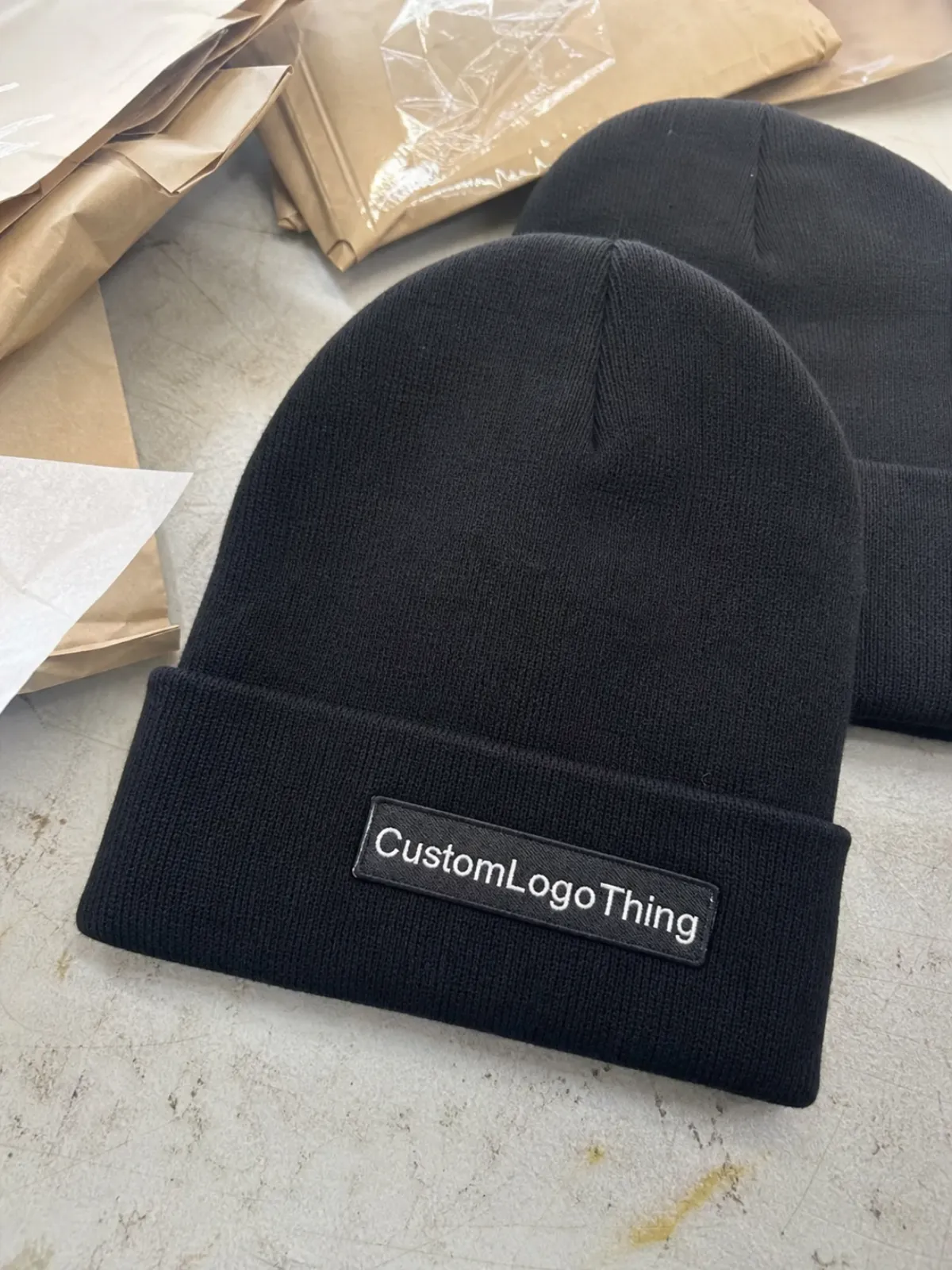
Placement matters just as much as material. A front cuff patch is the safest choice because it stays visible, photographs well, and gives the logo a stable field. A patch that is too large starts fighting the knit. One that is too small looks like an afterthought. Both mistakes are common, which is annoying because both are avoidable.
The body of the hat matters too. A cuffed knit is the most reliable option for retail and staff programs because it gives the patch a clean landing zone and a familiar fit. Slouch styles can work, but they change the visual balance and can swallow a logo if the crown is too tall or the front panel stretches too much. Rib knit usually holds shape better than loose weaves. Cable knit looks richer, but it is not always the best surface for a crisp patch application.
Material choice should follow the brand, not the mood board. Matte finishes suit rustic and specialty coffee identities. Leather-look patches work for premium holiday sets and gift bundles. High-contrast woven patches are the safest bet if the logo includes small lettering. If the mark is already simple, a cleaner texture usually wins. The more texture the patch has, the faster small details disappear.
Fit is a bigger issue than most buyers expect. One size does not mean one fit. Crown depth, cuff height, and stretch profile affect whether the beanie feels snug, slouchy, or awkward. A hat that rides too shallow looks cheap. A hat that sits too deep flops around and gets worn less. Neither is a good outcome if the goal is sell-through or staff adoption.
Sampling should include a real head, not just a flat proof. Check how the cuff sits, how the patch reads from a few feet away, and whether the logo still feels intentional after the hat has been worn for a few minutes. A good visual on screen can still fail in hand if the proportions are off by even a little.
A beanie program should look finished before it ever reaches production. If the patch, knit, and fit do not agree with each other, customers notice immediately, even if they never say it out loud.
Spec sheet details that prevent rework and size drift
The cleanest coffee roaster logo patch beanies Bulk Order Planning starts with one written spec sheet. Not a thread of half-remembered approvals. Not a set of screenshots buried in email. One document that locks the order before production starts.
At minimum, the spec should cover yarn type, gauge, cuff height, body color, patch size, patch material, thread colors, label type, and packaging. If you do not write those details down, someone on the other side of the order has to guess. Guessing is how rework begins. It also tends to be how budgets quietly disappear.
Lock these points before approval:
- Yarn type and weight for the body knit.
- Gauge so the hat feels dense enough without becoming stiff.
- Cuff height so the patch lands in the right place.
- Patch dimensions to avoid crowding the logo.
- Thread or print colors with realistic tolerance.
- Packaging details such as fold-and-pack, hang tags, or polybags.
Color matching deserves more attention than it usually gets. Pantone references help, but yarn and patch stock still have natural variation. A dark olive knit can look warmer under retail lighting. Cream can pull yellow in photos. Leather-look patches can shift from rich brown to muddy brown depending on the finish and artwork contrast. That is not always a defect. Sometimes that is just what the material does.
Artwork prep matters just as much. Vector files are the standard for a reason. Small type needs strong line weight, and tiny copy on a patch often needs to be simplified. If the logo includes a long tagline, that phrase may need to come off the hat entirely. That is normal. It is better to keep the mark readable than to cram six words into a space that can barely support two.
Packaging should have its own line on the spec sheet, especially for wholesale or retail programs. Some buyers need fold-and-pack only. Others need belly bands, barcode stickers, woven labels, or polybags that survive shipping. If the beanies are going to stores, the packing instructions should match how the receiving team will handle them. Loose hats in a carton create extra work. Extra work becomes extra cost somewhere.
For buyers who care about transit and presentation, it helps to treat the outer package as part of the product. The ISTA testing framework is a useful reference for package handling and shipping durability. If the order includes paper components like hang tags or belly bands, the FSC system is worth checking when certified sourcing matters to the brand. Neither one is flashy. Both can save headaches later.
Cost, pricing, MOQ, and unit cost tradeoffs
Price comes down to a handful of predictable variables: patch material, decoration complexity, yarn quality, quantity, labeling, and packaging. The hat itself is only part of the bill. Setup, handling, and finishing usually make the difference between a fair quote and a fake bargain.
For most bulk programs, MOQ often starts around 50 to 100 pieces, though some suppliers will go lower if the build is simple and the artwork is clean. Better unit pricing usually shows up at 100, 250, and 500+. That is where setup costs spread out enough to matter. If the order is tiny, the per-unit price will climb. That is not a trick. It is just math.
As a working range, a simple cuffed beanie with a clean patch may land around $4.50 to $7.50 per unit at higher quantities. More complex patch construction, premium yarn, multiple decoration steps, or retail-ready packaging can push the number into the $8 to $12+ range. That is still a range, not a promise. The actual price depends on the finish level and how much custom work the order needs.
Always ask for three tiers. A quote at 100, 250, and 500 pieces shows where the real savings start. It also exposes the cost of packaging upgrades, special labels, and freight. Without tiered pricing, buyers end up making decisions on the wrong number.
Common cost drivers
- Patch material — woven and leather-look patches often price better than highly specialized builds.
- Setup charges — artwork cleanup, machine setup, and patch tooling can add a one-time cost.
- Color count — more colors usually mean more handling and more room for mistakes.
- Packaging — retail-ready finishing adds labor and materials.
- Freight — knit goods are bulky, which means shipping can surprise buyers if it is not quoted clearly.
Hidden fees are usually the part that annoys people. Sample costs. Revision fees. Color matching. Split shipping. Rush production. If a quote looks too clean, something important may be missing. Ask for the extra line items before they become a surprise. It is a lot cheaper to sound picky than to eat a bill later.
The cheapest hat is rarely the best buy. If the patch peels, the knit stretches out, or the fit feels odd, sell-through drops and the brand takes the hit. A low unit price does not matter much if the inventory sits in boxes. Better to spend a little more and sell the product than to save a dollar and get stuck with dead stock.
Process, timeline, and production steps from art to arrival
The production path should be boring. That is the goal. Inquiry, artwork review, mockup, sample or digital proof, approval, production, quality check, packing, transit, delivery. If a supplier cannot explain the order in that sequence, the process is not under control.
Timeline depends on how much decision-making sits before production. Digital proofs may move in a day or two. Sampling can add time if the logo is busy, the patch needs refining, or the body color needs another pass. Once approval is done, bulk production still needs time for knitting, patch attachment, finishing, inspection, and packing.
For planning purposes, a simple order often lands in the range of 12 to 20 business days after approval, plus transit. Faster is possible on short, clean runs. Slower is normal when the order includes custom labels, special packaging, or a crowded winter calendar. If the hats matter to a launch, build in a cushion. Freight delays do not care about your event date.
Here is what usually slows an order down:
- Unclear artwork that needs cleanup before a proof can be built.
- Last-minute color changes after the proof is already approved.
- Slow feedback from too many stakeholders.
- Vague delivery targets that do not match the actual event date.
- Seasonal congestion when winter merch orders pile up at the same time.
That seasonal pressure is real. Coffee merch has a habit of spiking right when the weather turns cold. The buyers who plan early usually get better material options and fewer compromises. The late orders get whatever survives the queue. Not glamorous, but true.
Quality control should happen before a carton leaves the facility. A useful check includes patch alignment, stitch density, color consistency, cuff symmetry, and packaging accuracy. For retail orders, one crooked patch can make a whole run feel off. For staff orders, bad fit is the bigger enemy. The product should be checked as it will be used, not just as it looks on a table.
Ordering mistakes coffee brands make with winter merch
The biggest mistake is treating every use case the same. Staff hats, retail stock, and promo giveaways do not need the same quantity split or finish level. Staff programs usually need durability and comfort. Retail wants shelf appeal. Giveaways need a price point that leaves room for the rest of the campaign. One format rarely solves all three cleanly.
Another common problem is forcing too much detail into a small patch. Coffee logos often include roastery names, origin notes, mountains, beans, circles, and taglines. That can work on a poster. It is much harder on a 2.5-inch patch. If the artwork is busy, simplify it or choose a patch style that handles detail better. Woven usually beats heavily textured options here because it keeps the edges cleaner.
Color is another quiet failure point. Low-contrast logos vanish on dark yarn. Muted earth tones can look elegant in a deck and flat in store lighting. A deep green patch on charcoal may look moody online and unreadable in person. The product has to work in the real world, not just under perfect mockup lighting.
Inventory math also gets ignored. Too few pieces and freight efficiency goes out the window. Too many and cash gets tied up in slow-moving stock. For coffee roasters, the better split is usually a mix of staff, retail, and event inventory that matches actual demand, not hopeful demand. Hope is not a reorder strategy.
One more thing: keep the approved spec. If the first run sells, the second order should not turn into a fresh design debate. Save the artwork, note the cuff height, record the patch size, and keep the finish details with the approval file. A repeat order should be easier and cheaper than the first one. If it is not, somebody lost the document that mattered.
What to send for a fast quote and a clean reorder
If you want a fast quote, send a complete brief the first time. That means a vector logo, target quantity, preferred beanie style, patch material, color references, packaging needs, and the delivery deadline. If the hats are for retail, say so. If they are for staff, say that too. Use case changes the quoting logic.
The cleanest quote requests include:
- Logo file in vector format
- Desired quantity with at least two alternate tiers
- Beanie style preference such as cuffed, slouch, or rib knit
- Patch material choice or a short list of acceptable options
- Color references for body, patch, and thread
- Labeling and packaging requirements
- Deadline, event date, or store launch date
Ask for a written quote that separates unit price, sample cost, production time, and shipping estimate. Do not accept a single lump number with no breakdown. That makes comparison impossible later. A usable quote should show what changes if the quantity goes up or the patch changes material. If it does not, the buyer is probably looking at a half-quote.
For reorders, keep the approved spec sheet and mockup together. That one habit makes coffee roaster Logo Patch Beanies Bulk Order planning much easier the second time around. It also prevents version drift when several people have commented on the same file and nobody remembers which file actually got approved.
The cleanest path is straightforward: confirm the design, lock the quantity, approve the timeline, and move the order into production before the season closes in. That keeps the hats on track for retail, staff wear, or event distribution without paying extra for panic.
One last practical habit helps more than it gets credit for: match the order size to actual sell-through, not wishful traffic. A tightly planned first run gives you real data on color preference, fit, and patch style. That data is more useful than a pile of opinions and a guess.
What MOQ should I expect for coffee roaster logo patch beanies bulk orders?
A common starting point is 50 to 100 pieces, but the exact MOQ depends on patch type, decoration method, and packaging requirements. Ask for tiers at 100, 250, and 500 so you can see where the real savings start. Smaller runs usually cost more per unit because setup and handling are spread across fewer hats.
Which patch material is best for coffee roaster beanies?
Woven patches work well for detailed logos, leather or faux leather suits premium retail branding, and PVC or rubber gives a modern, durable finish. If your logo has tiny text, avoid patch styles that blur detail or create heavy texture. Choose the material based on how the brand should feel in hand, not only on screen.
How long does production usually take after approval?
Digital proofs move quickly, but actual production and shipping depend on quantity, patch type, and season. A sample stage can add days or weeks if revisions are needed, so build that into the calendar early. Ask for production time separately from transit time because those are not the same thing.
What details should I include when requesting a quote for patch beanies?
Send the logo file, quantity, beanie style, patch material, color preferences, label or packaging needs, and the delivery deadline. Include whether the hats are for retail, staff, or promo use so the supplier can quote the right finish level. The more complete the brief, the fewer expensive surprises later.
How can I keep unit cost down on a coffee roaster beanie program?
Simplify the patch, keep the color count under control, and choose one strong style instead of splitting the order into too many variants. Order at a higher tier if sell-through is predictable because unit cost usually improves quickly. Reuse the approved spec for reorders so you do not pay again for avoidable setup and revision work.