Cosmetics cuffed knit beanies Bulk Order Planning usually goes wrong when buyers approve the color before they lock the construction. Cuff depth, knit density, and logo scale change the final look more than many briefs assume, especially when the beanie has to photograph well beside a cosmetics launch, gift set, or seasonal bundle.
The best orders are specific from the start. A cuffed knit beanie can support employee gifting, influencer kits, retail add-ons, or event swag, but each use case asks for a different balance of fit, finish, cost, and delivery speed. The buyer's job is to define which tradeoffs matter before the supplier starts quoting.
Cosmetics cuffed knit beanies bulk order planning starts with fit
The quickest way to delay a headwear order is to treat it like a color decision instead of a construction decision. Rework usually starts with fit, cuff height, or logo placement. Buyers focus on the shade because it is easier to picture, but the structure determines whether the piece looks retail-ready or giveaway-grade.
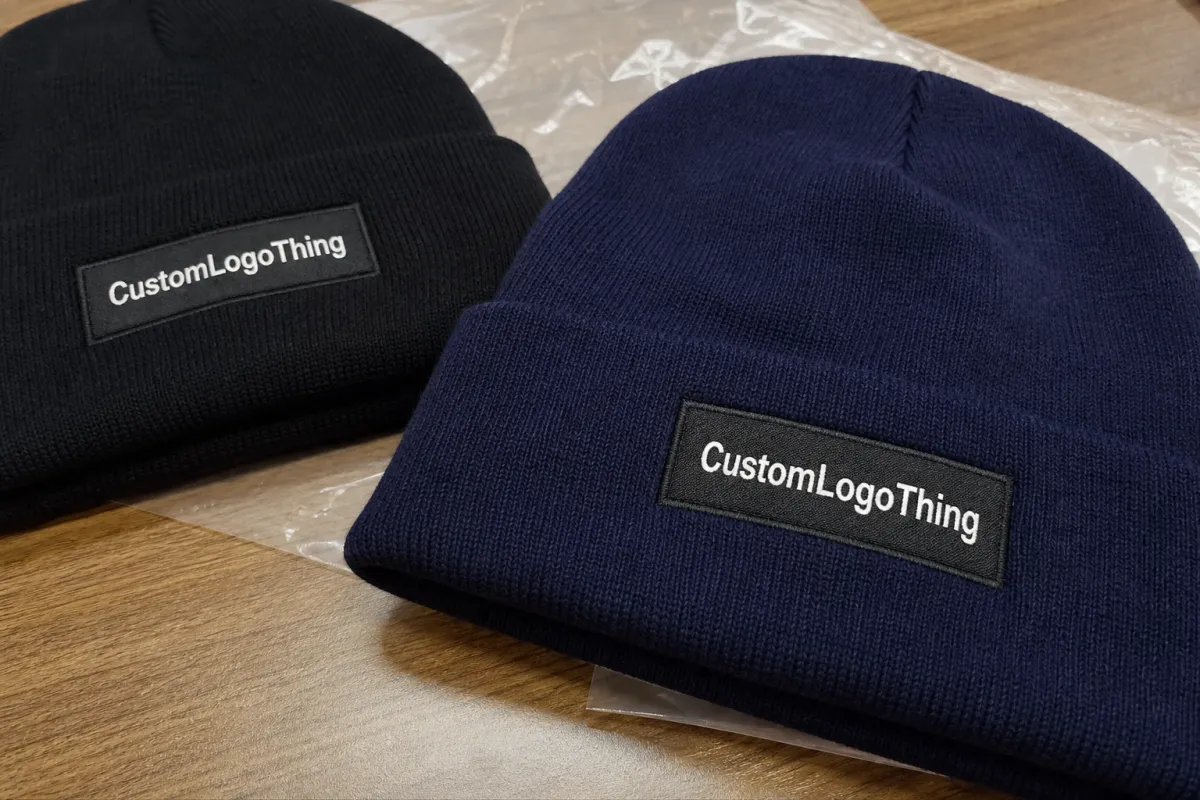
Cuffed Knit Beanies work well for beauty campaigns because they create a clean front panel for branding and photograph with a more polished silhouette than a slouch style. The cuff also gives the logo a defined area, which matters when the beanie has to sit beside premium packaging and still feel intentional.
A logo cannot rescue a poor fit. If the cuff is too shallow or the front panel stretches unevenly, the decoration starts fighting the knit instead of sitting cleanly on it.
Fit details deserve more attention than many buyers expect. Adult unisex beanies often land around 8.5 to 9.5 inches wide laid flat, with an overall height near 8 to 10 inches and cuff depths in the 2.25 to 3 inch range. Those are practical starting points, not fixed standards. A deeper cuff can improve logo visibility, while a tighter body can look neater in photos but feel less forgiving across head sizes.
The brief should also reflect use case. Employee gifts can tolerate a softer hand feel and simpler branding. Retail add-ons usually need a more polished finish. Influencer kits may need presentation value as much as product value, because the unboxing becomes part of the marketing. Holiday campaigns need all three: dependable construction, clear logo placement, and enough calendar buffer to avoid missed ship windows.
Choose the knit profile and decoration method that matches the brand
Cuffed Knit Beanies seem simple, but yarn content, gauge, stretch, and cuff depth all change the result. Most promotional styles use 100% acrylic because it is cost-efficient, easy to color-match, and stable in mass production. Acrylic also takes embroidery well when the stitch count is kept in check. Acrylic-wool blends usually feel warmer and more substantial, though they can raise cost and complicate care expectations.
Knit gauge matters as much as fiber choice. A heavier gauge can read denser and more premium, while a lighter gauge often feels more casual and stretchy. That affects how the logo behaves once the beanie is worn. Thin yarns and open knits can distort embroidery edges. Dense knits reduce that problem, but they can also feel warmer and heavier than a cosmetics campaign wants. The right choice depends on the intended look.
Decoration is the next major decision. Embroidery is still the default because it is durable, recognizable, and efficient at scale. Woven patches bring finer detail for small type or more fashion-led logos. Woven or sew-on labels work better when the brand wants quiet branding rather than a front-panel statement. Jacquard knit moves the logo into the fabric itself, which can look excellent but changes the production route and usually increases planning pressure.
| Decoration method | Look and feel | Typical MOQ impact | Best fit for cosmetics promos |
|---|---|---|---|
| Embroidery | Clean, classic, durable | Usually the easiest to scale | Brand giveaways, employee gifts, launch kits |
| Woven patch | Sharper detail, more fashion-led | Moderate setup complexity | Small logos, fine type, premium merch |
| Woven or sew-on label | Subtle, understated | Often efficient at mid-size runs | Retail add-ons, minimalist beauty branding |
| Jacquard knit | Integrated into the fabric | Higher setup and tighter planning | Fashion-led collections, custom drops |
For bulk orders, the practical constraint is front-panel space. A cuff gives visibility, but not unlimited room. Small text, thin lines, and detailed gradients can blur or distort when the knit stretches. Logo scale should be checked against stitch density and front-panel width before the quote is approved. A specialist supplier should flag that early instead of leaving the buyer to discover it in sampling.
Packaging can matter almost as much as the beanie itself. Inserts, belly bands, hangtags, and retail cartons should match the campaign objective. If recycled content or FSC-certified paper is required, that needs to be written into the brief. If the goods need to survive parcel shipment, carton strength and pack testing should be discussed early so the product does not look good in sample form and fail in transit.
Lock the specs: size, color, labels, and packaging details
The quote becomes useful only after the spec sheet is fixed. A supplier needs beanie dimensions, cuff depth, stretch range, yarn content, and intended fit before pricing can be trusted. Adult and youth sizing should never be assumed to be interchangeable, and even subtle fit shifts can affect who actually wears the piece after the campaign ends.
Color control is another common source of delay. Stock yarn colors are faster and usually less expensive because the color already exists in the supplier's production flow. Custom-matched colors can add lead time and may require a minimum per shade. If the campaign depends on a brand tone, send the Pantone reference, but expect knitted material to land close to the target rather than match it like coated stock.
Labels and pack-out details deserve the same discipline. Woven labels, care labels, hangtags, individual polybags, belly bands, and master carton counts all affect cost and timing. A simple beanie with one decoration method can move quickly. The same item with a retail hangtag, folded insert, and custom carton marks becomes a different production job.
- Artwork placement and logo scale
- Pantone or brand color references
- Exact spelling for all text
- Packaging mockup or insert layout
- Carton counts and shipping marks
- Any care-label or compliance notes
One more detail gets overlooked: knit products relax after production. A beanie that looks snug in a sample may open up after finishing, while a very loose sample can settle into shape once packed and worn. Ask whether the supplier blocks or steam-finishes the goods before final inspection, because that affects the apparent size and the stability of the front panel.
Pricing, MOQ, and unit cost levers that move the quote
Pricing for headwear is not mysterious, but it is easy to misread if you only look at the headline unit cost. The price usually drops as quantity rises, yet decoration complexity, yarn selection, and packaging can pull it back up. A one-color embroidered beanie in stock yarn is very different from a custom-colored knit with a woven patch and retail hangtag. The quote should show those differences line by line.
| Order profile | Typical unit cost range | What pushes it higher | Best use case |
|---|---|---|---|
| 500 pcs, stock yarn, one-color embroidery | $3.20-$5.20 | Heavy stitch count, individual bagging, rush timing | Internal gifting, small launches |
| 1,000 pcs, stock yarn, embroidery plus label | $2.60-$4.10 | Extra labeling, multiple logo positions | Brand merch, seasonal campaigns |
| 2,500 pcs, custom color, woven patch, custom pack-out | $2.20-$3.80 | Color matching, packaging inserts, carton spec changes | Retail add-ons, larger promotions |
| 5,000 pcs, jacquard knit with custom trim | $2.00-$3.40 | Complex knit structure, broader approval cycle | Fashion-led or high-volume branded programs |
Those ranges are directional, not promises. In a real quote, the main cost drivers are usually the number of colorways, the stitch count in the logo, whether the order needs custom packaging, and how quickly the goods must ship. Sample fees can run from roughly $35 to $150 depending on whether the supplier is providing a digital proof, a knit sample, or a pre-production copy. Embroidery digitizing is often separate and may fall in the $25 to $80 range.
MOQ is driven by setup more than by the word bulk itself. One color and one logo is the easiest route. Multiple colorways, mixed decoration methods, and custom packaging across several SKUs create more approvals and usually raise the floor. Ask for tiered pricing so you can see where the breakpoints begin before finance signs off.
Freight should never be treated as an afterthought. A low unit price can disappear once shipping, split delivery, carton rework, or extra handling gets added. That is especially true when the campaign date is fixed and the supplier has to move faster than standard production. The cheapest beanie is not cheap if it arrives late and misses the launch window.
Production steps and timeline from sample approval to delivery
The calendar matters as much as the artwork. The process usually runs in a familiar sequence: brief intake, artwork check, digital mockup, sample or pre-production proof, buyer approval, bulk knit and decoration, inspection, packing, and shipment. If everyone responds quickly, the project moves. If one approval stalls, the schedule can slide.
- Brief intake: quantity, color, fit target, decoration, packaging, and destination are confirmed.
- Mockup review: the supplier shows logo placement, approximate scale, and any label or pack-out details.
- Sample or proof: the buyer checks the physical or digital reference before bulk production begins.
- Bulk run: knitting, decoration, labeling, and finishing move into production.
- Inspection and packing: carton counts, defect checks, and shipping marks are verified.
- Transit: the order leaves the factory and moves through freight, customs, or domestic delivery.
Simple stock-yarn embroidered orders often move faster than custom-color or retail-packaged programs. A straightforward run can land in roughly 12 to 18 business days after proof approval. Custom colors, woven labels, or specialty packaging can push the timeline into the 4 to 6 week range. If the order needs a photo sample, a revision round, and final pack-out sign-off, the calendar stretches again.
The common delay points are predictable. Late art files are number one. Missing approval notes come next. After that are sample revisions, quantity changes after production has started, and shipping addresses that were not confirmed early. For parcel deliveries, ask how cartons are tested. A soft product still travels inside a box, and the carton can fail if it is overpacked, underbuilt, or poorly sealed.
Quality control should not stop at visual inspection. For knit beanies, useful checks are stitch consistency, seam strength, yarn lot consistency, embroidery puckering, label placement, and measurement tolerance after finishing. Buyers should ask for an acceptable defect threshold and a packing count sheet before goods ship.
What a specialist headwear supplier does to reduce rework
A general promo vendor can sell a beanie. A specialist headwear supplier is more likely to understand why the piece behaves the way it does. That difference shows up in cuff construction, stitch behavior, logo placement, and reorder consistency. On a soft knit product, a millimeter matters more than many buyers expect.
The main advantage is repeatability. If the supplier tracks yarn lots, panel dimensions, decoration specs, and proof approvals well, the reorder should look much closer to the first shipment. That matters for cosmetics teams because product launches rarely happen once. They come back in waves, and the second order should not force a new round of guesswork.
Look for production visibility, not vague reassurance. Buyers should receive clear proof images, carton counts, and a defined defect threshold before production closes. If a supplier can show sample archives and reorder records, future buys become easier to manage. It also helps merchandising and operations teams coordinate around the same spec without rebuilding it each time.
Specialist support can also reduce friction around packaging. Some orders need retail-ready folding, some need individual polybags, and some only need a bulk master carton. A supplier who understands the difference can quote more accurately and keep receiving predictable for the buyer's warehouse or 3PL.
Next steps to turn the beanie brief into a clean PO
Good cosmetics cuffed knit beanies Bulk Order Planning starts with a one-page order sheet. If that sheet is complete, the quote gets sharper, the sample round gets shorter, and the approval path gets easier to manage. If the sheet is vague, the order usually pays for the ambiguity later.
- List the quantity by color and size.
- Attach the artwork file and note exact logo placement.
- State the fit target, packaging needs, and in-hand date.
- Confirm the shipping destination before pricing is finalized.
- Route the sample deadline to merchandising, marketing, finance, and operations at the same time.
Ask for a quote only after the non-negotiables are fixed. Changing decoration or packaging after pricing is the fastest way to create churn. If the order needs a custom insert, a different label, or a more premium finish, make that decision now rather than treating it as a later upgrade.
A better brief also includes the business reason behind the purchase. Is the beanie meant to support a launch window, protect margin on a retail bundle, or fill a seasonal calendar gap? Those are different decisions, and the supplier should be quoting against the real objective. If the order is meant to anchor a campaign image, proofing should be tighter. If the goal is a fast giveaway, production speed may matter more than a richer finish.
How early should bulk beanie planning start before a launch?
Start as soon as the campaign date is fixed. Simple embroidered orders need less runway than custom colors, labels, or retail packaging, but even the easier jobs benefit from extra time. If the beanies must match a product launch or holiday shipment, build in sample time so approval does not become the bottleneck.
What decoration works best on cuffed knit beanies for cosmetics promotions?
Embroidery is the default choice because it is durable and gives a clean premium look. Woven patches work well when the logo has fine detail or small type, and label-based branding suits a subtler fashion-led presentation. The right answer depends on how close the beanie sits to retail versus giveaway use.
What MOQ should I expect for custom cuffed knit beanies?
MOQ depends on yarn type, decoration method, and whether the order uses stock or custom colors. One-color embroidered runs are usually easier to scale than mixed-color or multi-decoration orders. Ask for tiered pricing so you can see where the best unit-cost breakpoints begin.
Can I mix colors or sizes in one beanie order?
Often yes, but each colorway can create its own setup or yarn requirement. Mixing colors is usually easier than mixing multiple product constructions or decoration types. Confirm the split early so the quote reflects the actual production plan instead of a placeholder estimate.
What do I need to send for an accurate quote?
Send quantity, target delivery date, artwork, preferred decoration, and packaging requirements. Include the shipping location, color references, and any label or compliance notes. If you can add a sample image or a reference item, the supplier can price against the look you actually want, which is the fastest way to keep the order on track.