Cosmetics Woven Label Beanies Sample Guide for Buyers
For beauty brands, a cosmetics woven label Beanies Material Sample guide is not a nice extra. It is where a logo stops being a file and starts being a physical object that can pass or fail. A woven label can look clean on screen and still lose detail once it is stitched into a soft knit, so the sample is doing real work. It shows whether the design survives thread density, edge finishing, backing choice, and the stretch of the beanie itself.
Why One Swatch Can Save an Entire Beanie Run
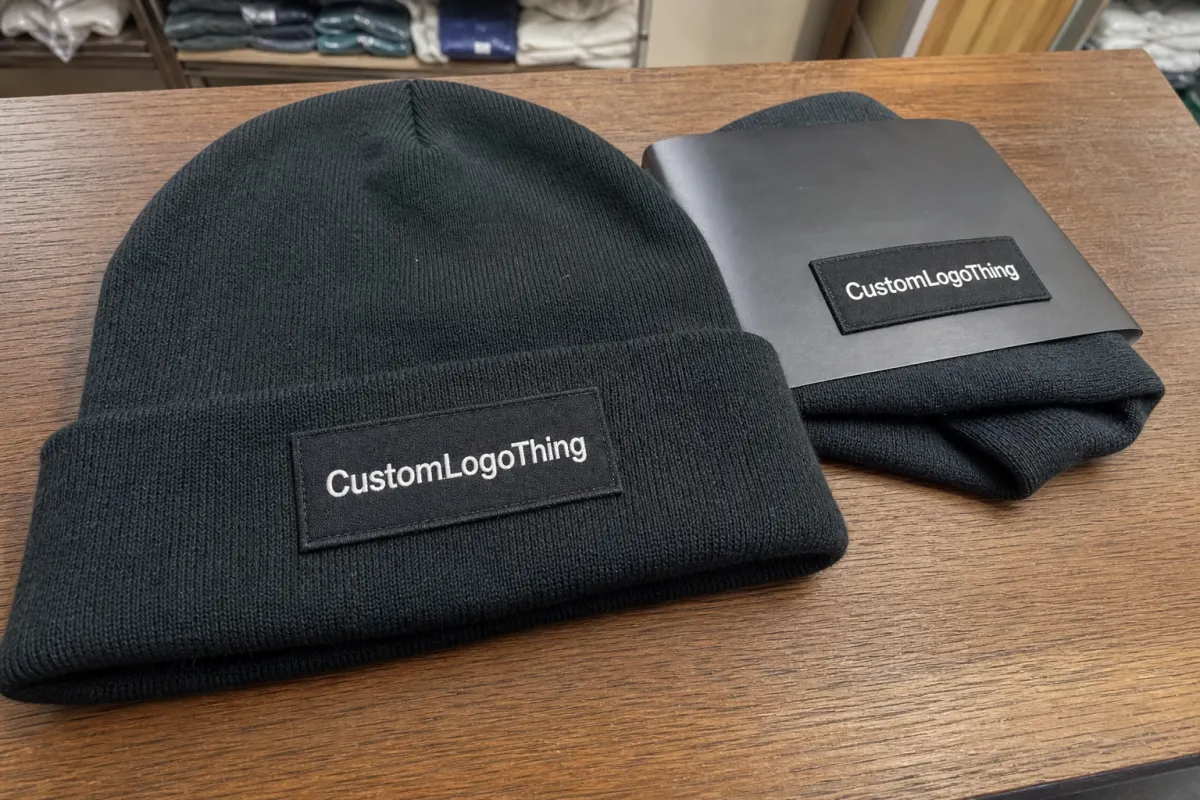
A small swatch can prevent a large mistake. From a buyer’s point of view, the sample is the first real test of yarn choice, weave density, border clarity, backing, and color accuracy. It is not a tiny logo preview. It is the only way to see whether the label still behaves once it meets stitching, movement, and wear on a knitted beanie.
That matters more for cosmetics branding than many teams expect. Beauty buyers notice surface quality fast. They compare sheen, softness, and finish almost instinctively, because those cues already live in the carton, insert card, bottle, and mailer. If a brand has invested in FSC certified paper cartons, kraft paper tissue, recycled materials, or corrugated cardboard shippers, a fuzzy or scratchy label can break the system. The beanie may be a merch item, but it still sits inside the same brand language.
A sample is not a smaller version of the final product; it is a decision tool.
The first sample should answer a few blunt questions quickly:
- Can the logo be read at arm’s length?
- Does the fabric bend without warping the text?
- Does the label feel smooth, or does it irritate skin?
- Does the finish match the calm, premium tone of the cosmetics line?
That last point is where many teams drift. A glossy label can look richer in isolation and still feel wrong beside a minimal skincare launch or a clean makeup kit. A good sample review is less about “pretty” and more about fit. Does the label belong in the brand family, or does it look borrowed from a different one?
One more practical reality: beanies are not flat packaging. The cuff stretches, folds, and moves. A woven label that seems fine on a table can puck er once it is sewn into a knit surface. That is why a sample should always be handled as a wear test, not a display piece.
How the Sample Process Moves From File to Fabric
The process starts with the artwork file, but the file is only the opening move. The supplier checks line thickness, color count, small text, and the amount of detail the loom can hold. If the logo includes fine serif type or a narrow icon, the weave has to support it. Otherwise, the result can blur even if the file looked perfect in a PDF.
In practice, the workflow usually runs like this: artwork review, thread recommendation, loom setup, first strike-off, inspection, and then either approval or revision. Some suppliers send a flat swatch first. Others sew the sample onto the actual beanie style so the buyer can judge stretch, placement, and drape under real conditions. That second version is usually more useful, especially on a cuff that moves a lot during wear.
The best suppliers treat sampling as a controlled test. They are trying to prove repeatability. Can the label be made the same way again without losing detail? Can the edges stay clean? Can the colors stay close enough that the production run does not wander? If the answer is yes, the buyer can approve with more confidence. If the answer is no, the revision should be specific: tighten contrast, widen the border, change the backing, or simplify the smallest text.
This is also where brand teams should compare the beanie label against the rest of the product system. If the cosmetics line already uses recycled materials in its cartons, a recycled polyester woven label may fit better than a standard glossy thread. If the outer pack uses kraft paper with a Soft Matte Finish, a low-sheen label often feels more coherent than a bright reflective one. Good sample review has a design side and a production side. Ignore either one, and the order gets riskier.
For teams already managing shipping tests or kit assembly, the same discipline applies here. Standards groups such as ISTA and material frameworks such as FSC are useful reminders that verification beats assumption. The sample should be treated with that same seriousness.
If you are comparing trim options across a launch, the broader Custom Labels & Tags category is a useful reference point, and the main Custom Logo Things catalog can help you line up labels, tags, and other branding elements under one order plan.
Material, Backing, and Finish Choices That Actually Matter
Material choice looks simple until the sample arrives. Polyester is still the common baseline because it holds detail well and usually gives the cleanest edges for small logos. Recycled polyester is increasingly attractive for brands that want the label story to line up with recycled materials and lower-waste packaging. Cotton blends can work too, but they read softer and more natural; that can be a good thing or a mismatch, depending on the cosmetics line.
Backing matters just as much. A sew-in label is usually the safest option for a beanie because it stays stable and does not add unnecessary stiffness to the knit. Iron-on backs can be useful in some applications, but they are not always the best fit for a stretchy cuff that needs movement. Soft backing, folded construction, and clean edge sealing all change how the label sits on the fabric and how comfortable it feels on skin.
Finish decisions should be made with a buyer’s eye, not a supplier’s default. Matte threads usually feel more refined for beauty brands. Slight sheen can work if the logo is bold and simple. High gloss is where projects often go sideways. It can make a label feel louder than the rest of the range, which is a problem if the cosmetics line is built around quiet, premium cues instead of flash.
Here is the part that gets missed most often: small text needs more stitch density than people expect. If the logo includes a tagline, ingredient claim, or sub-brand line, the weave has to be tight enough to hold that detail. Edge sealing matters too, especially if the label will rub against a knit cuff, scarf, or lining over time. And color matching should be checked against both the beanie fabric and the brand palette, not just the artwork file.
A useful sample review also checks hand feel after a few minutes of handling. Some labels feel fine at first touch, then become stiff or grainy once stitched. That is a production issue, not a cosmetic one, and it should be caught before bulk approval.
| Material / Finish | Best Use | Typical Sample Signal | Indicative Price Impact |
|---|---|---|---|
| Polyester woven label | Sharp logos, small text, general beanie branding | Clean edge, strong contrast, reliable repeatability | Lowest setup complexity |
| Recycled polyester woven label | Brands emphasizing recycled materials or lower-impact packaging | Similar clarity with a more sustainability-aligned story | Usually a modest premium |
| Cotton blend label | Soft, natural, lifestyle-led cosmetics merchandise | Less sheen, gentler hand feel, slightly softer detail | Often higher for similar detail |
| Matte finish with soft backing | Premium beauty branding, comfort-first wear | Balanced look, less glare, less scratch risk | Depends on backing and finishing step |
One useful trick is to compare the sample against the packaging palette. If the brand uses white cartons, kraft paper wraps, and biodegradable packaging elsewhere, the beanie label should not suddenly turn glossy and loud. That visual mismatch may seem small, but buyers feel it immediately.
Cost, MOQ, and Quote Variables That Change the Per-Unit Price
Costs on Woven Label Beanies are shaped by a handful of variables, and most of them show up in the sample stage. Loom setup is one. Number of colors is another. Custom shapes, tighter borders, special backings, and extra cutting steps all add labor or machine time. If the logo is detailed, the supplier may need a higher thread count or a slower run, which also affects price.
For sample orders, many suppliers quote a one-time setup charge plus the sample itself. In the market, a simple woven label sample might land around $35-$90, while more complex sampling can move higher if multiple revisions are needed. Bulk pricing is a different story. At a run of 5,000 pieces, a standard polyester woven label might fall roughly in the $0.06-$0.12 range per unit, while recycled polyester or more complex finishes can push that upward. Those are working ranges, not promises, because size, color count, and backing change the math fast.
The MOQ matters because it changes the cost curve. A label that seems inexpensive in a 10,000-piece run can feel heavy in a 500-piece program if the setup cost is spread across fewer units. That is why the sample is not wasted money. It is risk control. A $50-$120 sample process is small compared with the cost of approving unreadable labels and discovering the problem after the bulk run is already in motion.
Read the quote line by line. Look for sample fees, revision fees, shipping, rush charges, and whether a sample fee is credited back to production. Some suppliers do credit it, some do not. Ask directly. The same goes for transport terms. If the sample ships in a rigid carton, costs can differ from a simple mailer, especially when the supplier uses corrugated cardboard inserts or kraft paper protection to keep the strike-off flat.
For teams with launch math to manage, the practical question is not “What is the cheapest label?” It is “What is the lowest-cost label that still passes review and scales cleanly?” That usually leads to a better decision.
Production Steps, Lead Time, and Approval Timing
A clean approval process keeps the label from becoming the bottleneck. The usual sequence is straightforward: artwork submission, file review, loom setup, sample weaving, inspection, revisions if needed, and then bulk production release. The real problem is not complexity; it is timing. Each loop adds days, and each day matters if the beanie drop is tied to a cosmetics launch, a gift-with-purchase campaign, or a holiday window.
Simple samples can move quickly, but the calendar often stretches once the details get tight. A basic label may be ready for review in roughly 5-10 business days after artwork sign-off. More intricate work, or work that needs a second round of color adjustment, can take 12-15 business days or longer before the buyer sees the final proof. Shipping time sits on top of that. If the buyer is ordering for a multi-item kit, the beanie sample should be reviewed early enough that it does not hold up cartons, inserts, or outer packaging.
For brands that already plan shipping validation with ISTA-style thinking, the lesson is the same: build in a buffer. The label should not be the one component that arrives late because it was treated as a small item. It is part of the customer’s first impression. If the beanie ships inside an outer mailer, with a kraft paper insert or an FSC certified carton, the label is still visible when the customer opens the package. That moment matters.
Approval timing should be set before the sample lands. Decide who signs off on color, who signs off on hand feel, and who decides whether a minor issue is acceptable or not. Without that clarity, one round of feedback turns into four email threads and a delayed order. A simple pass/fail structure helps:
- Pass: sharp text, clean edges, comfortable hand feel, acceptable color match
- Revise: minor contrast issue, slightly stiff backing, border too narrow
- Reject: blurred logo, poor stretch behavior, scratchy surface, wrong size
That kind of checklist is dull, but it is efficient. Buyers who use it tend to move faster, not slower.
One caution: a sample that looks perfect on day one can still fail after handling, folding, or a quick wear test. If the beanie is part of a longer shelf-life program, ask how the label behaves after storage, heat, or humidity. A good supplier should be able to discuss that without hand-waving.
Common Sample Mistakes That Quietly Raise Reorder Risk
The biggest mistake is approving a digital proof and treating the physical sample as a formality. A screen can hide blurred edges, weak contrast, and thread density problems. Once the label is woven, those issues do not disappear. They get locked in.
Another common miss is testing in only one condition. A label can look fine under studio lighting and still fail when stretched by hand or rubbed against knit fibers. It may even hold up during a short try-on and then reveal problems after repeated wear. That is why brands should inspect samples under natural light, indoor light, and simple hand stress. No lab setup required. Just honest handling.
Gloss is another trap. Many teams assume a shinier finish equals higher quality. Not always. For beauty-driven products, a soft matte label often feels more intentional because it echoes the tone of premium skincare or minimal makeup packaging. A glossy finish can fight that mood and make the beanie feel more sporty than cosmetic.
Placement also gets underestimated. If the label is sewn too close to a seam, it can pucker. If it is too large, it can overpower the beanie silhouette. If it is too small, the logo disappears when the cuff stretches. The sample should answer these questions before the production line starts. A well-placed sample teaches more than a hundred guesses.
There is also a common sizing problem: teams approve a label width without checking how much the knit cuff compresses once worn. That can make a technically correct label look too wide in real use. Measuring the beanie while stretched and relaxed gives a better picture than measuring it flat on a table.
For buyers trying to keep the whole product family consistent, this is the right moment to check whether the label speaks the same language as the carton, the mailer, and the insert. Recycled materials, post-consumer waste content, kraft paper wraps, and biodegradable packaging all affect perception. The beanie label should belong there.
What to Send Before You Approve the Final Sample
The cleanest approvals start with clean inputs. Before the final sample is confirmed, send the supplier the final artwork file, the exact label dimensions, Pantone or brand color references, and a clear photo or mockup showing where the label will sit on the beanie. If the beanie style changes the cuff depth or stitch tension, that photo matters more than most teams realize.
It also helps to request at least two options if the order is strategic: one material choice and one finish choice. For example, compare standard polyester against recycled polyester, or matte thread against low-sheen thread. The extra step gives the brand team something real to evaluate instead of arguing over assumptions.
Use plain language for pass/fail criteria. Terms like “premium” and “high-end” are too vague. Better to write: sharp text, no frayed edges, soft hand feel, exact logo proportions, and color close to the approved cosmetics palette. That makes the supplier’s job easier, and it makes the approval harder to misread later.
Then lock the sequence. Approve the sample first. Confirm quantity second. Fix the quote third. Release bulk production only after the physical test passes. That order sounds basic because it is. It is also the difference between a controlled order and a rushed one. For a cosmetics brand trying to protect its image, the cosmetics Woven Label Beanies Material Sample guide is one of the simplest ways to cut expensive guesswork.
One final practical habit: keep the approved sample, the quote, and the final artwork together in the same file set. Reorders get messy when teams rely on memory. A good sample record makes the next run faster and reduces the chance of “almost the same” becoming a real problem.
Frequently Asked Questions
What should a cosmetics woven label beanie sample include?
A useful sample should show the exact weave, color match, edge finish, and backing so you can judge the label as it will actually be made. Ask for a sewn-on test on the beanie style whenever possible, because a flat swatch does not reveal stretch, placement, or drape. Keep one sample beside the artwork and one beside the finished beanie so you can compare legibility and overall brand fit.
How do I compare sample materials for beanie branding?
Judge the sample under natural light first, then check it again under indoor light because thread sheen and contrast can shift. Rub and stretch the label by hand to see whether the weave distorts, frays, or becomes hard to read after movement. Compare the finish against your cosmetics packaging palette so the beanie label feels like part of the same product family.
Which material works best for premium cosmetics beanie labels?
Fine-denier polyester or recycled polyester usually gives the clearest detail and a smooth, premium look on small woven labels. A matte or low-sheen finish often works better for beauty brands than a shiny thread, especially when the logo is delicate. If comfort is a priority, pair the material with a soft backing so the label does not feel scratchy against the knit.
How much does a woven label sample usually cost?
Sample cost depends on setup labor, number of colors, label size, finish complexity, and whether the supplier needs a new loom run. Some suppliers credit the sample fee back against the bulk order, so ask whether the quote includes that offset. Compare sample pricing with the cost of a mistake, because a rejected production run is far more expensive.
What is the usual lead time for approval and production?
Simple samples can move quickly, but artwork review, loom setup, and shipping all add time before you see the physical piece. Revisions extend the timeline, especially when you need a tighter color match or a different backing for comfort. Build a buffer into the schedule so the beanie launch is not delayed by one round of sample corrections.