Buyer Fit Snapshot
| Best fit | Custom Boxes Order Minimums projects where brand print, material claims, artwork control, MOQ, and repeat-order consistency need to be specified before quoting. |
|---|---|
| Quote inputs | Share finished size, material target, print colors, finish, packing count, annual reorder estimate, ship-to region, and any compliance wording. |
| Proofing check | Approve dieline scale, logo placement, barcode or warning zones, color tolerance, closure strength, and carton packing before bulk production. |
| Main risk | Vague material claims, crowded artwork, missing packing details, or unclear freight terms can make a low unit price expensive after revisions. |
Fast answer: Custom Boxes Order Minimums: Board, Finish, Dieline, and Unit Cost should be specified like a repeatable production item. The safest quote records material, print method, finish, artwork proof, packing count, and reorder notes in one written spec.
Production checks before approval
Compare the actual filled-product size with the drawing, then confirm tolerance on folds, seals, hang holes, label areas, and retail display edges. Reserve space for logos, QR codes, warning copy, and material claims before decorative graphics fill the panel.
Quote comparison points
Review material grade, print process, finish, sampling route, tooling charges, carton quantity, and freight assumptions side by side. A quote is only useful when the supplier can repeat the same color, closure quality, and packing count on the next order.
Custom Boxes Order Minimums: What Buyers Need to Know
Custom boxes order minimums matter because the lowest quote is rarely the lowest total cost. A run that looks cheap on paper can become expensive the moment it starts eating shelf space, warehouse square footage, or a second rush order three months later. For any brand comparing custom boxes order minimums, the real question is not only how many boxes a supplier requires, but whether that quantity matches sales velocity, cash flow, inventory planning, and packaging risk. There is no universal MOQ, and anyone pretending otherwise is skipping the part that makes the math interesting.
I have watched teams save a few cents per unit, then lose the savings to storage fees, rework, and a scramble for a repeat run after launch outperformed the forecast. The carton looked fine. The spreadsheet did not. That disconnect is where packaging budgets tend to wobble.
How Do Custom Boxes Order Minimums Affect Total Cost?
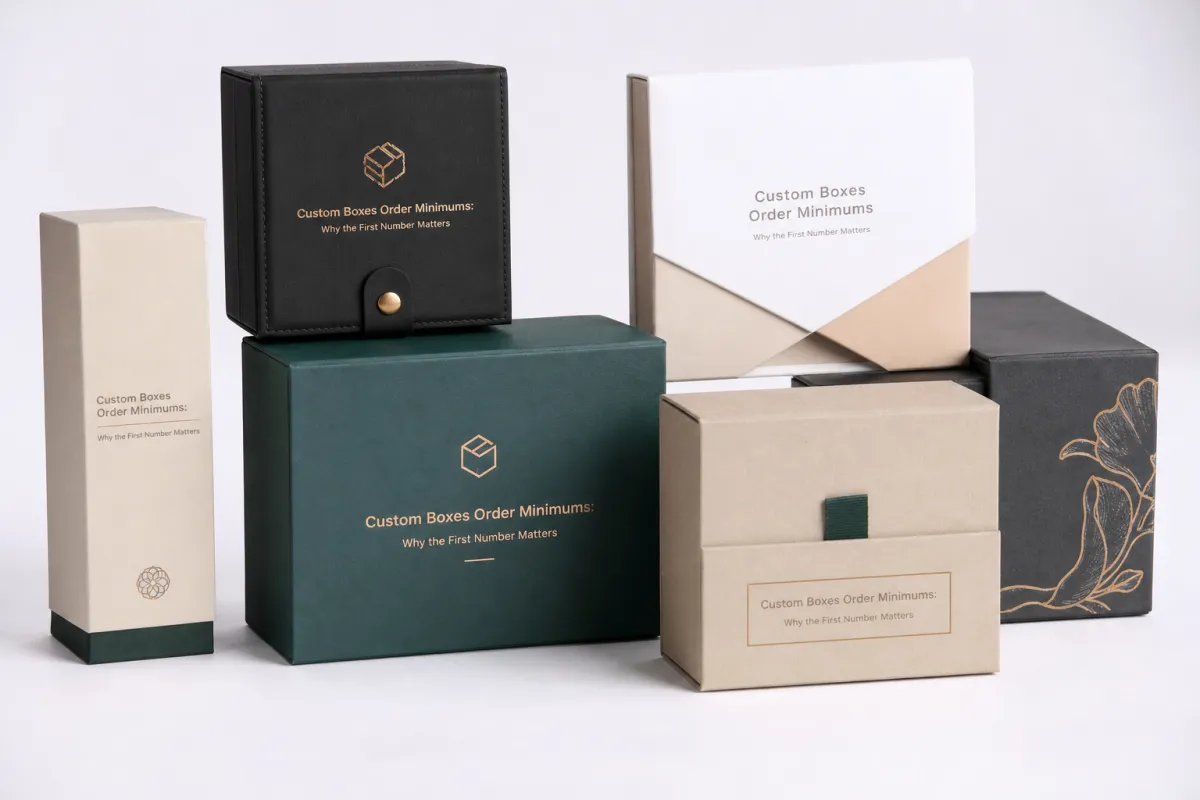
Custom boxes order minimums are the smallest quantity a manufacturer will run for a specific structure, print method, and finish. That number exists for a practical reason. Every production run carries setup costs, prepress work, material staging, machine calibration, and the sort of labor you do not see in a unit price. If the order is too small, the factory spreads those fixed costs across too few boxes, and the economics start to wobble.
From a buyer’s point of view, that first number tells you more than a quote sheet does. A low per-box price means little if the minimum is 2,500 boxes and your monthly usage is 600. Suddenly the business is funding inventory it cannot move yet. Cash gets tied up, cartons occupy storage, and a label change, regulatory update, or SKU refresh can make part of the run obsolete before it ships. That is the hidden math behind custom boxes order minimums.
The trap cuts both ways. Ordering too few usually raises the unit cost, but ordering too many can be worse. Excess branded packaging can sit in a warehouse for months, take up pallet space, and collect dust while the product line changes faster than the forecast did. I have seen small launches pick the lower MOQ, then pay more for a second emergency run because sell-through beat expectations. That second run tends to arrive with rush freight, compressed proofing windows, and less room for error, which quickly erases the savings from the first quote. Kind of annoying, but very real.
Picture a startup shipping one hero SKU in a mailer box. The brand wants strong package branding, a clean unboxing feel, and enough inventory for three months of sales. If the supplier’s custom boxes order minimums line up with that demand, the buyer gets a predictable first print run. If the MOQ sits far above the forecast, the brand either overbuys or changes to a box style that fits the product less well. Neither option is elegant. One wastes capital. The other chips away at presentation.
Custom boxes order minimums are not just a supplier rule. They are a signal about production efficiency, print economics, and the right balance between inventory risk and unit cost.
The cheapest unit price is not the cheapest order if the minimum forces storage, obsolescence, or a reorder before the first run is even sold through.
Custom Boxes Order Minimums by Box Type and Use Case
Custom boxes order minimums vary by structure because each format asks the production line to do a different job. A simple tuck-end folding carton is usually easier to run in lower quantities than a rigid setup with wrapped board, magnetic closure, and inserts. Shipping boxes behave differently from retail packaging too. The print method, board grade, and structural requirements are not the same, so the production threshold changes with them.
The clearest rule is simple: the more complex the structure, the higher the custom boxes order minimums tend to be. That is not a penalty dressed up as policy. It reflects setup time, cutting complexity, assembly labor, and the cost of making a premium result consistent across the lot.
| Box type | Typical MOQ range | Common pricing trigger | Best fit use case |
|---|---|---|---|
| Mailer boxes | 250-1,000 units | Digital print, single-color or short-run full color | Subscriptions, DTC shipments, influencer kits |
| Folding cartons | 500-2,500 units | Die-cutting, folding, glued or lock-bottom structures | Cosmetics, supplements, small consumer goods |
| Rigid boxes | 500-3,000 units | Wrapped board, specialty finishes, hand assembly | Luxury retail, gift sets, premium package branding |
| Shipping boxes | 250-5,000 units | Corrugated grade, print coverage, freight zone | Ecommerce fulfillment, warehouse distribution |
| Retail display packaging | 1,000-10,000 units | Display mechanics, shelf performance, assembly steps | Promotions, club store programs, seasonal launches |
That table is a starting point, not a promise. A single-color mailer with a standard dieline can support much lower custom boxes order minimums than a rigid box with foil stamping and custom inserts. Folding cartons follow the same logic. A straight tuck with modest ink coverage is easier to approve than a carton with windows, embossed panels, and tight fit tolerances. Every added detail asks the production line to slow down or reset, and that changes the minimum.
Use case matters as much as structure. A subscription brand often needs a modest first run so it can test retention and confirm pack-out speed. A seasonal promotion may need a larger run because the sell window is short and the boxes must arrive before the campaign starts. A test-market launch may favor low custom boxes order minimums because the buyer is still validating pricing, conversion, and retail packaging performance. The use case changes the right answer almost as much as the box style does.
Print method changes the equation too. Digital printing usually supports smaller runs because it avoids plates and large press setups. Offset and flexographic production often favor larger quantities because the setup is spread over more units. That is why custom boxes order minimums often run lower for short-run digital jobs and higher for long-run commercial packaging work. The printing process is not background noise. It is one of the main levers.
For a brand comparing options, the real question is not “What is the lowest MOQ?” It is “Which MOQ matches my sales curve, warehouse space, and next reorder date?” That is where custom boxes order minimums stop being a procurement surprise and start becoming a buying tool.
Specifications That Change Custom Boxes Order Minimums
Specifications drive custom boxes order minimums more than most buyers expect. Size, board grade, print coverage, coating, finish, and add-ons like windows or inserts all affect how efficiently a plant can run the job. A box that looks simple on a screen can become a different production class once the dieline is finalized and the tolerances are real.
Dimensions are the first variable to check. A box that fits the product with only a few millimeters of clearance may require a custom die and tighter quality control than a generic size. Once dimensions shift, the board layout changes, trim waste changes, and the producer may need a higher quantity to make the run economical. That is why custom boxes order minimums often move after final measurements are confirmed. A small size change can have a large effect on the sheet layout.
Board grade matters just as much. Lightweight SBS works well for many retail cartons, while E-flute or B-flute corrugated is better for protective shipping jobs. If the box needs stronger compression resistance, better print holdout, or more durable retail packaging performance, the supplier may recommend a thicker or more specialized board. Those changes can push custom boxes order minimums upward because they affect cost per sheet and alter the run setup.
Print coverage also changes the cost profile. A one-color logo on a natural kraft surface is less demanding than a full flood of rich color with tight registration. Heavy ink coverage, underprints, and complex artwork increase setup attention, and that can change the production threshold. In practice, custom printed boxes with large image panels often need more units to justify the press setup than minimalist branded packaging. A restrained design can lower the bar in ways a buyer might not expect.
Finishing is another major variable. Foil stamping, embossing, debossing, matte lamination, soft-touch coating, spot UV, and Custom Die Cuts tend to raise custom boxes order minimums because they add tooling, setup, or secondary finishing steps. A box with a basic aqueous coat may run at a lower threshold than a box with multiple finishes layered across the same panel. One extra finish can change the job class. Two can move it into a different pricing lane altogether.
Compliance can also shift the order logic. Food, cosmetics, and supplement packaging often require accurate claims, legible ingredient panels, and material choices that meet regional expectations. That does not always mean a higher MOQ, but it can affect the print method, substrate, and proofing time. In regulated product packaging, a change in copy after approval can be more expensive than the original setup. The box may be physical, yet the risk sits in the text.
For brands shipping products through rough handling, it is smart to ask whether the packaging should be tested against recognized methods such as ISTA testing standards. That matters because a low MOQ is meaningless if the box fails in transit. Carton fit, compression strength, and drop performance should all be considered before the first production run. A box that looks excellent on a sample table can still collapse under a warehouse stack.
There is a mechanical side to all this. Tolerances, product inserts, and dieline accuracy influence how confidently the factory can quote custom boxes order minimums. If the product dimensions are still in flux, it is better to prototype first than to commit to a full run that may not pack correctly. A sample can save thousands in waste if the inner fit is off by a few millimeters. That tiny gap can become a big expense.
For materials tied to sustainability goals, buyers may ask about FSC-certified board or recycled content. If that is part of the brief, note it early. The sourcing requirement can influence lead time and, in some cases, the available MOQ. A good supplier should explain the tradeoff plainly rather than masking it behind a single price line. If sustainability is a priority, review options through FSC certification guidance and align the board choice with your Retail Packaging Needs.
Custom Boxes Order Minimums and Pricing: What You Actually Pay For
Pricing is where custom boxes order minimums become most visible. Buyers usually see a unit price first, but the real cost is built from setup, tooling, plates, proofing, substrate, finishing, and freight. If you do not compare those pieces line by line, two quotes that appear close can end up far apart in total spend. Packaging pricing is a stack, not a single number.
The first invoice often contains more fixed costs than many buyers expect. A short run can carry a disproportionate share of prepress and machine setup, which is why custom boxes order minimums matter so much for first-time orders. In many packaging programs, the first run absorbs the highest share of setup expense, while later reorders benefit from repeat tooling and a cleaner workflow. The second order is often cheaper to manage than the first, even before the unit price changes.
Here is a simple way to think about the economics. As quantity rises, the unit cost usually drops because the fixed costs are spread across more boxes. The total spend rises at the same time, and that total is what affects cash flow. A buyer who only compares unit cost might choose the larger run, then discover the warehouse is carrying six months of stock that should have been cash in the business. A 10% savings per box does not help much if it locks up the budget for half the year.
Custom boxes order minimums also create pricing tiers. A brand might see one price at 500 units, another at 1,000, and a better unit rate at 2,500. That does not mean the 2,500-unit run is the right decision. It means the buyer needs to compare landed cost, storage, and reorder timing side by side. The best choice is rarely the lowest per-box price alone. The best choice is the one that leaves the business with enough cash to do the next thing.
Common cost drivers include:
- Setup and prepress for artwork, dielines, and proofing
- Tooling and die-cut creation for the box structure
- Plates for offset or flexographic production
- Board, paper, or corrugated substrate selection
- Special finishing such as foil, embossing, or spot UV
- Freight, split shipments, and delivery timing
Hidden costs deserve special attention. Artwork changes after proof approval can trigger rework fees. Rush production often raises the quote because it interrupts the normal schedule. Split shipments can also affect the bill if part of the order needs to go to a fulfillment center and part to a retail warehouse. International freight can introduce delays that force extra storage or air shipping to meet launch dates. The number on the quote is only the first layer of the story.
That is why quoting custom boxes order minimums should never happen in isolation. Ask for at least two scenarios so you can compare what happens if the quantity increases or decreases by a meaningful amount. If the unit cost drops only slightly between 500 and 1,000 units, the extra cash outlay may not be justified. If the step down from 2,500 to 1,000 units is large, the smaller run may be the smarter cash decision. The gap between tiers often reveals the supplier’s real pricing structure.
A clean quote should show the same dimensions, the same board grade, the same finish, the same shipping terms, and the same approval stage. If any of those differ, the comparison is not real.
Use a landed-cost mindset. Add the product packaging price, freight, warehousing, and the likely reorder schedule together. A lower MOQ can be more expensive per unit, yet cheaper overall if it prevents dead stock. A larger MOQ can save pennies per box and still hurt margin if the inventory sits too long. The right answer depends on turnover, not pride.
If you are comparing packaging vendors, ask whether they can support both low custom boxes order minimums and repeat-volume programs. That flexibility matters as a brand scales. It prevents a packaging redesign every time volume changes and keeps branded packaging consistent across launches. If you need a broader view of container options, browse the available Custom Packaging Products before requesting a quote.
Process and Timeline for Custom Boxes Order Minimums
The process from quote to delivery is usually straightforward, but every step can change custom boxes order minimums or the lead time attached to them. The typical sequence is quote request, dieline review, artwork setup, proof approval, production, quality control, and shipment. Miss one of those steps, and the whole schedule shifts.
For a simple short run, the timeline is often faster because the setup is lighter and the print method may be digital. A more customized order with specialty finishing, custom inserts, or structural testing can take longer, even if the quantity is not huge. Quantity alone does not tell the whole story. Complex finishing can slow a 1,000-unit run more than a plain 5,000-unit run. That surprises buyers who assume smaller always means quicker.
Delays usually happen for the same reasons: missing dimensions, late artwork, unclear color expectations, and slow proof sign-off. I have seen buyers lose a full week because the logo arrived as a low-resolution file or the barcode placement had not been approved internally. None of that is a packaging problem; it is a project management problem. Still, it affects custom boxes order minimums because the supplier has to hold slots, materials, and schedule space until the artwork is ready.
Here is a practical planning sequence that helps avoid those delays:
- Confirm product dimensions and pack-out method.
- Choose the box style and print method.
- Send final artwork files, not working drafts.
- Review the proof carefully for copy, barcode, and color.
- Approve only after the internal team signs off.
- Plan reorder timing before the first shipment arrives.
That last step matters more than many brands admit. If sales are moving faster than forecast, the reorder point should be set before inventory gets tight. A supplier may quote favorable custom boxes order minimums on the first job, but the second order will be slower if the first run sold through unexpectedly and the buyer waits until the last pallet is opened. The cleanest orders are usually the ones that never feel urgent.
The relationship between quantity and timeline is not always linear. Smaller runs can move faster in some formats, yet specialty finishes or a busy press schedule can still extend lead time. That is why “low minimum” and “fast turnaround” are not the same thing. A well-run supplier will explain the difference up front, and a careful buyer will plan for it instead of assuming the calendar will cooperate.
If you are building launch plans, the safest move is to create a packaging timeline that includes proofing, transit, and contingency time. Then match the quantity to sales velocity, not optimism. That is how custom boxes order minimums support the launch instead of becoming a bottleneck.
What A Good Supplier Should Handle for Custom Boxes Order Minimums
Brands do not need inflated order quantities. They need a supplier that understands how custom boxes order minimums interact with budget, inventory, and the pace of real sales. That is the practical advantage of working with a team that treats packaging as a business decision, not just a print job. A box should support the launch, not pressure it.
At Custom Logo Things, the goal is straightforward: match the structure, print method, and finish to the order size that makes sense for the brand. That means helping buyers avoid overcommitting to a quantity that drains cash or undercommitting to a run that creates repeat freight charges. Custom boxes order minimums should be chosen with the whole launch plan in view, not in isolation from the rest of the calendar.
Consultative support matters here. A buyer may think the only variable is quantity, but the better choice often comes from adjusting the box style, board grade, or finishing method. A clean folding carton might meet the brief better than a rigid box if the product needs a lower entry cost. A durable corrugated mailer may be better than a premium retail carton if the item ships every week and the packaging has to survive handling. The smartest solution is not always the fanciest one.
Good quality control also protects the order. Consistent color, stable structure, reliable adhesives, and accurate die cutting are not decorative details. They are the difference between packaging that protects the product and packaging that creates returns. In branded packaging, a box that opens correctly and holds its shape supports the product story without drawing attention to itself.
Transparent quoting is another real advantage. Buyers should see setup fees, material changes, finish costs, and shipping assumptions clearly. Vague quotes make it difficult to compare custom boxes order minimums across suppliers, and they often conceal the true cost until proof approval or freight booking. Clear pricing is better for trust and better for planning. It also makes reorders much easier to forecast.
For scaling brands, continuity is especially valuable. A first run and a repeat run should feel connected, not like two different packaging programs. That consistency protects package branding and reduces rework later. If you are preparing a launch or building a replenishment program, review the available Wholesale Programs to see how larger-volume packaging support fits your model.
There is also a time-saving benefit that buyers appreciate. Once the first spec is locked, repeat orders become easier to forecast, proof, and schedule. That matters if your product line is growing or if you are managing multiple SKUs at once. A supplier that understands custom boxes order minimums can help you scale without redesigning the packaging every quarter. The best partner keeps the paperwork lighter after the first order.
For additional support, the FAQ page is a useful place to confirm common ordering questions before a quote request goes out.
Next Steps for Custom Boxes Order Minimums
The smartest next step is not to guess. Measure the product, confirm the box style, collect artwork, and identify the board and finish before requesting quotes. That simple prep work makes custom boxes order minimums easier to compare because the numbers are built on the same assumptions. Comparable quotes beat clever quotes every time.
Ask for at least two pricing scenarios. One should reflect the smallest viable quantity, and another should show the next practical price break. That comparison reveals whether moving up a tier actually improves value or just inflates inventory. For many buyers, that exercise is the fastest way to understand custom boxes order minimums without overbuying. It can also expose whether the supplier is pricing for efficiency or simply filling a press slot.
Before approving the first production run, confirm lead time, proofing requirements, and reorder thresholds. A quote without those details is incomplete. If sales can spike, set the reorder point early so you are not forced into rush freight later. Track inventory turnover from day one so the next run is based on real demand, not wishful thinking. The math gets easier when the data is honest.
If sustainability is part of the brief, write it into the quote request. If the boxes need to be FSC certified, printed with lower ink coverage, or optimized for shipping efficiency, say so at the start. Those choices can influence both the cost and the MOQ, but they are easier to handle before production starts than after a proof is approved. A late change is the most expensive kind.
Custom boxes order minimums should help you buy with confidence, not create friction. The practical takeaway is simple: match the quantity to your sell-through rate, your storage capacity, and your next reorder date. If the MOQ forces dead stock, it is too high. If it triggers a panic reorder, it is too low. The sweet spot is the run that keeps packaging, inventory, and cash flow moving together.
FAQ
What are typical custom boxes order minimums for a small brand?
Minimums vary by box style, print method, and finishing, but smaller brands often see lower thresholds with simple structures and digital printing. Rigid boxes, specialty finishes, and complex inserts usually require higher quantities because setup costs are spread across more units. The best approach is to ask for tiered quotes so you can see where the next price break starts. In practice, custom boxes order minimums for a small brand are often lower for mailers and folding cartons than for premium retail packaging.
Can I mix different products under one custom boxes MOQ?
Sometimes, but only if the packaging specifications are close enough to run efficiently in the same production setup. Different dielines, sizes, or finishes can count as separate jobs even if the artwork style is similar. Ask whether your supplier can combine SKUs, split quantities, or standardize components to reduce the effective minimum. If the custom boxes order minimums are built around the same board and die, mixing can be possible; if not, the run usually needs its own setup.
How do custom boxes order minimums affect my unit cost?
Higher quantities usually reduce the per-box cost because setup, tooling, and proofing are spread over more units. Lower quantities can be more expensive per box but may be the smarter choice if demand is uncertain or storage is limited. Always compare total landed cost, not just the unit price, before deciding on the order size. That is the core tradeoff behind custom boxes order minimums and one of the most common sources of surprise on first orders.
Do I need to order samples before meeting the minimum?
Yes, if the structure, fit, or print accuracy is still being finalized. Prototype samples help confirm dimensions and assembly, while production proofs help validate color and layout before the full run. A sample order is often cheaper than correcting a full batch after production begins. For custom printed boxes, sample approval can protect the entire first run from avoidable waste, especially when custom boxes order minimums are tight.
How long do custom boxes order minimums usually take to produce?
Lead time depends on print method, finishing, order size, and how quickly proofs are approved. Simple runs usually move faster than orders with foil, embossing, inserts, or Custom Die Cuts. Build in extra time for shipping and approval delays so your packaging arrives before inventory runs out. For many programs, the lead time tied to custom boxes order minimums is less about quantity alone and more about how complex the box structure is.

