Buyer Fit Snapshot
| Best fit | Custom Corrugated Boxes for Retail projects where brand print, material claims, artwork control, MOQ, and repeat-order consistency need to be specified before quoting. |
|---|---|
| Quote inputs | Share finished size, material target, print colors, finish, packing count, annual reorder estimate, ship-to region, and any compliance wording. |
| Proofing check | Approve dieline scale, logo placement, barcode or warning zones, color tolerance, closure strength, and carton packing before bulk production. |
| Main risk | Vague material claims, crowded artwork, missing packing details, or unclear freight terms can make a low unit price expensive after revisions. |
Fast answer: Custom Corrugated Boxes for Retail: Board, Finish, Dieline, and Unit Cost should be specified like a repeatable production item. The safest quote records material, print method, finish, artwork proof, packing count, and reorder notes in one written spec.
Production checks before approval
Compare the actual filled-product size with the drawing, then confirm tolerance on folds, seals, hang holes, label areas, and retail display edges. Reserve space for logos, QR codes, warning copy, and material claims before decorative graphics fill the panel.
Quote comparison points
Review material grade, print process, finish, sampling route, tooling charges, carton quantity, and freight assumptions side by side. A quote is only useful when the supplier can repeat the same color, closure quality, and packing count on the next order.
A lot of retail packaging headaches start long before a pallet reaches the dock. With Custom Corrugated Boxes for retail, the real question is not whether the product ships. It is whether it arrives looking right, stacks correctly, and opens the way the buyer expects. I have seen a product lose shelf appeal because the fit was sloppy, the print was muddy, or the carton made every step of pack-out more annoying than it needed to be. That is the real job of Custom Corrugated Boxes for retail: protect the goods, support the brand, and keep the supply chain from getting weird.
Retail teams usually juggle three pressures at once: damage prevention, presentation, and cost. The best Custom Corrugated Boxes for retail handle all three without turning into a bad tradeoff. They are not just shipping containers. They can be display packaging, storage packaging, subscription packaging, or shelf-ready packaging, depending on the product and the channel. Once that clicks, the rest of the decisions get a lot easier.
What Custom Corrugated Boxes for Retail Actually Do
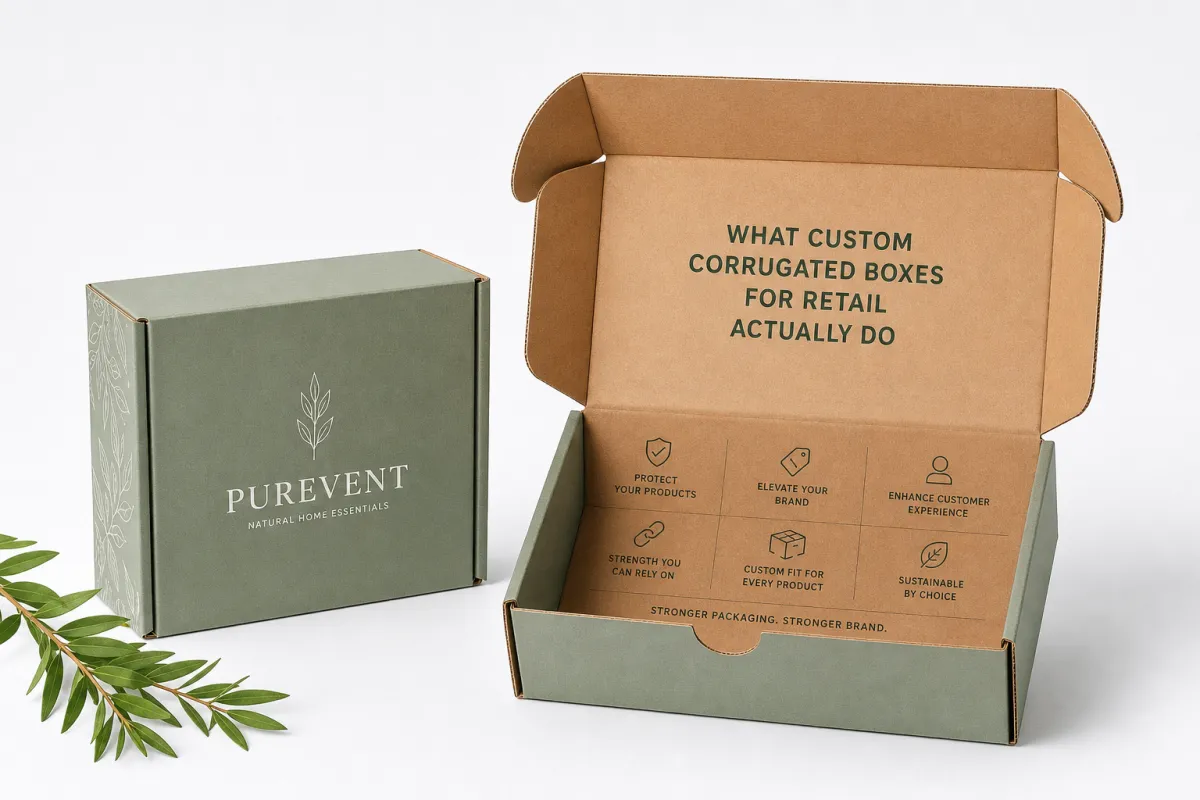
In retail, the box often becomes the first physical touchpoint. A customer may never think about the carton in a warehouse, but they definitely notice it when it arrives dented, the print is crooked, or the opening feels clumsy. Custom Corrugated Boxes for retail are built around the product, not around whatever generic size happened to be in stock. That means the box can be engineered for fit, weight, stacking strength, and brand presentation from the start.
Corrugated board is not the same thing as paperboard. Paperboard is the thinner carton stock you see on folding cartons, cereal-style boxes, and lightweight sleeves. Corrugated board uses linerboard and a fluted medium sandwiched in between, which gives it much better crush resistance and cushioning. That extra structure is why custom corrugated boxes for retail are usually the better choice when products need to survive distribution, warehouse handling, and repeated touches before they ever hit the shelf.
There is a practical side too, and buyers care about it whether they admit it or not. A well-built retail box can reduce returns, lower in-transit damage, and make receiving more predictable. If the carton is right-sized, staff waste less time stuffing in void fill or taping loose flaps back together. If the graphics are clean, the package branding supports the product instead of fighting it. If the structure is designed for shelving or display, store associates spend less time repacking and more time merchandising.
From a packaging buyer’s point of view, custom corrugated boxes for retail can do several jobs at once:
- Transit protection for shipping from the factory or fulfillment center
- Shelf-ready presentation for club stores, mass retail, or open display
- Subscription unboxing where the package becomes part of the brand experience
- Seasonal or promotional packaging where graphics need to carry the campaign
- Backroom storage where the carton must hold shape until stock is replenished
People sometimes underestimate how much value comes from a box that fits the channel. A product sold in a boutique may need cleaner print and easier opening than a bulk-shipped club pack. A product sold through ecommerce may need stronger edges and better closure design than a box sitting in a display tray. Custom corrugated boxes for retail let you build for those differences instead of forcing one carton to do a job it was never meant to do.
If you are comparing options, a broader packaging conversation helps. Our Custom Packaging Products page is useful if you want to see how different formats fit together, while our Custom Shipping Boxes category is a good reference for retail cartons built around protection and logistics.
The real value comes from matching structure, print, and cost to the product and the retail channel. That is the simple test I use when I look at custom corrugated boxes for retail: does the box protect the item, present it well, and move cleanly through the supply chain without adding waste or friction?
How Custom Corrugated Boxes for Retail Are Made
The construction starts with the board itself. Corrugated board is made from linerboard on the outside and a fluted medium in the middle. Those layers create stiffness, cushioning, and stacking strength. A single-wall board is common for many retail packs, but the exact build depends on the product weight, the amount of compression the case will face, and how much visual quality the surface needs to deliver. That is one reason custom corrugated boxes for retail can feel very different from a standard brown shipper, even when both are made from similar raw materials.
Flute profile matters more than many buyers expect. Smaller flutes, such as E-flute or F-flute, tend to print more cleanly and can give a sharper retail surface, which helps shelf appeal and custom printed boxes. Larger flutes, such as B-flute or C-flute, usually offer more cushioning and better crush resistance. Heavier goods or cartons that will be stacked deep in storage usually make more sense with a larger flute. Boxes that need a crisp retail face and a cleaner presentation often work better with a thinner flute. That is why custom corrugated boxes for retail should always be selected by use case, not by habit.
Once the board spec is set, the box moves through converting. The sheet is sized, the dieline is cut, fold lines are scored, openings or locking tabs are added, and the blank is finished with print, coatings, or adhesive seams as needed. Depending on the style, the box may be glued, stitched, or left as a fold-and-lock design. A die-cut tray, a tuck-top mailer, and a retail-ready shelf carton all start from the same material family, but each has a different converting path and a different cost profile.
Retailers and brands use a wide range of styles:
- Mailer boxes for ecommerce and subscription shipments
- Tuck-top cartons for lightweight branded product packaging
- Die-cut trays for display and shelf presentation
- Partitioned shippers for multi-pack or fragile items
- Shelf-ready packaging that opens cleanly for merchandising
Print methods also shape the final result. A simple one-color logo may be enough for a utility-forward box, while a full outside print can turn the carton into branded packaging that carries the product story before the customer even sees the item. Some projects also call for inside printing, which adds a nice touch for unboxing, instructions, or promotional messaging. I always tell buyers that print coverage should follow the product journey, not the mood board alone. A beautiful render is nice. Custom corrugated boxes for retail still need to survive stacking, transit vibration, and rough handling.
For more technical distribution planning, many teams use test methods from ISTA, especially for vibration, drop, and compression scenarios. That matters because a box that looks good on a screen may still fail once it gets loaded, palletized, and shipped through real channels.
One more practical point: the design should reflect the actual retail journey. A box meant for store replenishment may need a stronger tear strip or easier opening feature. A box for direct-to-consumer fulfillment may need better closure security. A box for seasonal displays may need print placement that still looks clean after being handled a few times. Custom corrugated boxes for retail work best when the structure is chosen for the path the carton really travels.
Key Factors That Shape Custom Corrugated Boxes for Retail
The product itself always comes first. Size, weight, fragility, moisture sensitivity, temperature swings, and odd shapes all affect the box choice. Sharp corners can puncture weaker cartons. Heavy items need more compression resistance. Products with glass, metal parts, or delicate surfaces often need inserts or partitions. If the item shifts around inside the carton, the risk of damage rises fast. That is why custom corrugated boxes for retail should be engineered around the item, not just wrapped around it.
Channel matters just as much. A box for direct-to-consumer fulfillment has a different job than a box for a club-store shipper, a boutique shelf box, or a replenishment carton moving between distribution centers. A DTC carton often needs a better opening experience and stronger product branding. A wholesale retail box may need better pallet efficiency and easier store handling. A shelf-ready pack may need tear-away panels and front-facing graphics. Custom corrugated boxes for retail work better when the channel rules are clear at the beginning.
Strength specs are easier to understand than they sound. Burst strength, Edge Crush Test, and stacking performance each describe a different aspect of board performance. A 32 ECT board may be fine for a lightweight retail item, while heavier or more compressible loads might need 44 ECT or a different board build entirely. The wrong choice usually shows up later as crushed corners, blown seams, or unstable pallets. A box spec should reflect actual shipping conditions, not wishful thinking. That is where custom corrugated boxes for retail earn their keep.
Branding needs are another major factor. Some buyers want a simple kraft look with a clean label. Others need rich graphics, Pantone-sensitive color, or inside print. Some boxes must do double duty as display packaging. That pushes the design toward better print coverage, cleaner die-cuts, and more attention to how the box reads on shelf. Good package branding does not mean covering every surface with ink. Sometimes the strongest retail packaging is the one with disciplined graphics, a clear logo, and structural choices that make the product easier to understand.
Sustainability belongs in the brief too. Corrugated is widely recyclable, and many brands ask for recycled content, FSC-certified paperboard, or right-sized packouts to reduce waste. The EPA’s recycling guidance at EPA recycling resources is a useful reference when teams are sorting through what can be recovered and how to communicate that to customers. Recyclability is only part of the story. A box that is recyclable but wildly oversized still wastes fiber, freight space, and handling time. Custom corrugated boxes for retail should support sustainability with smart sizing, not just recycled language.
Here is the blunt version: the best box is not always the strongest one. Sometimes a slightly lighter board with smarter sizing performs better overall because it lowers freight cost, reduces overpack, and still protects the goods. Other times the safer move is to upgrade the board because the product is fragile, valuable, or prone to crushing. The right answer depends on the full supply chain, not just the pack spec sheet. That is the practical value of custom corrugated boxes for retail; they let you balance structure, presentation, and operational reality instead of overbuilding every carton by default.
Custom Corrugated Boxes for Retail Cost and Pricing
Pricing is where many retail projects get misread. Buyers sometimes compare only the unit price and miss the setup, tooling, freight, and damage costs that show up later. Custom corrugated boxes for retail are priced by a stack of variables: dimensions, board grade, flute choice, print complexity, quantity, inserts, finishing, and whether the design needs a new dieline or custom tooling. A box that looks simple can still cost more than expected if it needs specialty converting or tight tolerances.
Volume changes everything. On short runs, setup cost is spread over fewer units, so the unit price stays higher. On larger runs, setup gets diluted and the unit price drops, but storage planning becomes more important. If a brand orders more cartons than it can actually move, the savings on paper can disappear into warehouse space and inventory carrying cost. I usually remind teams that custom corrugated boxes for retail should be bought with a total landed cost view, not just a per-piece quote.
Hidden costs show up too. Oversized cartons can increase freight. Poor right-sizing can force the use of more dunnage. Extra sample revisions can slow a launch and push the product calendar. Returns caused by damaged goods will almost always cost more than the board upgrade that might have prevented them. Compare the actual supply chain impact of each choice, not just the carton price.
| Option | Typical Retail Use | Approx. Unit Price at 5,000 Units | Notes |
|---|---|---|---|
| Plain kraft RSC | Basic shipping and backroom storage | $0.35-$0.85 | Lowest print cost; best when labels or stickers carry branding |
| One-color printed mailer | Ecommerce, subscription, lightweight retail packs | $0.55-$1.20 | Good balance of branding and cost; often used for custom printed boxes |
| Die-cut shelf-ready tray | Club store, mass retail, display packaging | $0.90-$2.10 | Better presentation and merchandising; may need more precise converting |
| Premium full-color retail carton with insert | Fragile or high-value product packaging | $1.40-$3.50 | Higher print and structural cost; strong for branded packaging and unboxing |
Those ranges are directional, not a promise. A small carton with heavy print coverage can cost more than a larger plain shipper if the setup is more complex. A lighter board is not automatically cheaper if it creates damage risk or shipping inefficiency. Custom corrugated boxes for retail should be quoted with the full spec in hand so you can see what part of the price is going toward structure, what part is going toward print, and what part is simply setup.
When a quote comes back, ask three questions. What board and flute are included? What is the print method and coverage? What is the minimum order quantity, and what setup cost is being spread across the run? Those three answers usually explain most of the price difference. If you need help comparing more than one format, our Custom Packaging Products page and Custom Shipping Boxes listing can help frame the trade-offs before you request formal pricing.
Custom corrugated boxes for retail often reward buyers who ask for multiple options. One version might use a stronger board with simpler print. Another might use a lighter board with more visual finish. That side-by-side view makes the actual business decision easier: pay more for protection, pay more for presentation, or keep the box lean and save money where the product allows it.
A box that saves a few cents but increases damage, returns, or store labor is rarely the cheaper box once the whole system is counted.
Process and Timeline for Ordering Custom Corrugated Boxes for Retail
The cleanest projects follow a simple flow: discovery, measurement, structural recommendation, artwork prep, sampling, approval, production, and shipment. That sequence sounds basic, but every step matters. Custom corrugated boxes for retail move faster when the supplier knows the product dimensions, weight, quantity, pack-out method, storage environment, and shipping conditions from the start. If the box also needs to satisfy retailer compliance rules or pallet dimensions, those details should be shared early too.
Dieline development is where the box becomes real. The structure is drawn to size, folds are checked, closures are tested, and the graphics are mapped onto the blank. The first sample is usually the most valuable part of the process because it reveals fit issues, print alignment, flap behavior, and how easy the carton is to assemble. A box can look perfect in artwork review and still feel clumsy in the hand. That is why I always encourage at least one physical sample for custom corrugated boxes for retail when the product is premium, fragile, or retail-facing.
Timelines vary, but a typical path might look like this:
- Discovery and spec gathering: 1-3 business days if the product details are ready
- Structural design and quotation: 2-5 business days depending on complexity
- Prototype or sample: 3-7 business days for many standard builds
- Artwork revision and approval: 1-5 business days, often longer if multiple stakeholders review
- Production: commonly 10-20 business days after approval, depending on quantity and print method
- Freight and delivery: varies by destination and shipping mode
Simple custom corrugated boxes for retail can move faster than that, and highly specialized builds can take longer. New tooling, difficult color matching, custom inserts, or extra testing can add days or even weeks. The biggest delays usually come from missing artwork files, late sign-off, unclear spec changes, or discovering too late that the box needs to satisfy both shelf presentation and pallet efficiency.
One practical way to keep the schedule predictable is to build a clean approval chain. Decide who signs off on structure, who signs off on graphics, and who approves the final proof. Too many retail packaging delays come from open-ended reviews where no one wants to be the last person to say yes. Once the sample is approved, the rest of the process should be straightforward. That is the beauty of a well-managed run of custom corrugated boxes for retail: the project feels controlled instead of rushed.
If transit performance is a concern, ask the supplier whether the box should be tested against an ISTA profile or a comparable distribution test plan. That is especially useful when the product is sensitive to vibration, drop impact, or compression. A little test discipline upfront can save a lot of damage later.
Common Mistakes When Choosing Custom Corrugated Boxes for Retail
The first mistake is sizing the box only to the product and forgetting the rest of the pack-out. Inserts, hand clearance, merchandising headers, closure tabs, and transit movement all need room. A box that is dimensionally tight on paper can become a bad fit in the real world once tape, sleeves, or protective components are added. Custom corrugated boxes for retail should always account for the full packing system, not just the bare item.
The second mistake is choosing board that is too light. That usually shows up as crushed corners, seam failure, or unstable pallets after the boxes have moved through a few facilities. Weak packaging often looks fine on the dock and fails after a couple of stacking cycles. For retail goods with any meaningful weight or resale value, the carton spec should be conservative enough to survive the real route. That is one reason custom corrugated boxes for retail should be judged by performance, not by the cheapest quote.
Overdesign is the opposite problem. Some buyers specify heavier board, more print effects, or extra inserts they do not actually need. That can raise cost, increase lead time, and make packing more cumbersome. I have seen beautiful boxes that were simply too complicated for the product category. If the package is not carrying premium value, extra complexity may not pay back. Good packaging design should feel intentional, not inflated.
Branding mistakes happen too. A graphic can look sharp on a monitor and still reproduce poorly on corrugated if the colors are too subtle, the fonts are too thin, or the layout is too busy. Unreadable copy, weak contrast, and cluttered panels all reduce the value of the package branding. With custom corrugated boxes for retail, the print system should be chosen with the board in mind, because corrugated is not the same as coated folding carton stock.
Finally, some teams skip samples and go straight to a large order. That is a risk, especially with new product packaging. The sample catches issues that spreadsheets will never show: flap interference, awkward loading, inconsistent print placement, and how the carton feels in a real hand. In retail packaging, those small issues have a way of becoming big problems after launch. The most expensive mistake is usually not the board price; it is the downstream cost of damaged goods, delayed launches, and frustrated retail partners. That is where custom corrugated boxes for retail prove their value or expose a weak spec.
Expert Tips and Next Steps for Custom Corrugated Boxes for Retail
Start with the product journey, not with a generic shipping carton. Ask where the item will be packed, how it will be stored, how it will ship, and how it should look when it arrives. That sequence leads to better choices than starting with a blank box and trying to force the product into it. For many brands, custom corrugated boxes for retail work better when they are treated as part of the product strategy rather than an afterthought at the end of sourcing.
Build a simple spec sheet before you request quotes. Include dimensions, weight, quantity, packing method, storage limits, print needs, and any shelf or display requirements. If the carton needs to survive wet storage, long transit, or repeated handling, say so. If the box has to look premium, note that too. The more precise the brief, the easier it is for a supplier to recommend the right structure, and the easier it is for you to compare options fairly. Good custom corrugated boxes for retail sourcing starts with good inputs.
Ask for a sample whenever the product is fragile, premium, or visually sensitive. A prototype can reveal whether the closure feels secure, whether the artwork reads well, and whether the insert or partition actually holds the item in place. If there is a display requirement, the sample is even more valuable because you can see how the box behaves when it is opened, stacked, or faced forward. In retail packaging, a physical sample is often worth more than another round of email review.
One of the simplest cost-saving moves is right-sizing. A smaller, better-fitted carton often saves more over time than chasing the lowest board grade. Why? Because it can reduce freight waste, cut dunnage use, and lower the damage rate. That matters across thousands of units. I have seen brands save money not by choosing the thinnest board, but by choosing a smarter footprint. Custom corrugated boxes for retail are most efficient when the size supports the product and the supply chain together.
If you want a cleaner decision, compare at least two construction paths. One might use a lighter board with simpler branding. Another might use a slightly stronger board with better shelf appeal. Seeing both options helps you understand whether the premium version is actually buying better retail performance or just a nicer spec sheet. A supplier should be able to show you where the money is going and what you get in return.
From a buyer’s point of view, the final check is straightforward: does the box fit, protect, present, and ship properly in real conditions? If the answer is yes, then custom corrugated boxes for retail are doing their job. If not, adjust the structure before launch rather than after the first damaged shipment. That single decision can save a lot of friction later.
Frequently Asked Questions
What are custom corrugated boxes for retail used for?
They protect retail products during shipping, warehousing, and store handling while also supporting branding and presentation. Depending on the product and channel, they can work as shipper boxes, shelf-ready packs, subscription mailers, or display trays. Custom corrugated boxes for retail are especially useful when standard cartons do not fit the product well or do not match the retail experience the brand wants.
How much do custom corrugated boxes for retail usually cost?
Pricing depends on size, board grade, flute type, print coverage, quantity, and whether the design needs custom tooling or inserts. Short runs usually cost more per box because setup is spread over fewer units, while larger runs lower the unit price but require more inventory planning. The best comparison is total landed cost, including freight, waste, and damage risk, not unit price alone. That is the most useful way to judge custom corrugated boxes for retail.
What information do I need to order custom corrugated boxes for retail?
Have product dimensions, weight, quantity, packing method, shipping conditions, and any shelf or display requirements ready. Share artwork files, brand colors, structural preferences, and any compliance or retailer guidelines that must be met. The more precise the spec, the faster a supplier can recommend the right board, style, and pricing for custom corrugated boxes for retail.
How long does it take to produce custom corrugated boxes for retail?
Timelines vary based on complexity, sample approvals, print requirements, and quantity. Simple boxes can move quickly, while new structures, artwork revisions, and tooling changes add time. The fastest projects are the ones with complete specs, fast feedback, and early sample approval. For many programs, custom corrugated boxes for retail move from approval to production in a predictable rhythm once the artwork and structure are locked.
Can custom corrugated boxes for retail be printed on both sides?
Yes, many retail boxes can be printed outside and inside, depending on the design and budget. Inside printing is useful for unboxing, promotional messaging, assembly instructions, or brand storytelling. Double-sided print usually adds cost and may affect lead time, so it is best reserved for packaging where the inside surface adds real value. On the right project, both sides can strengthen the retail experience.
Custom corrugated boxes for retail work best when fit, protection, branding, and shipping performance are checked in real conditions before the final order is approved. The practical takeaway is simple: define the product journey first, request a sample before the run, and choose the board based on the route the box will actually travel.

