Buyer Fit Snapshot
| Best fit | Custom Corrugated Boxes with Die Cuts projects where brand print, material claims, artwork control, MOQ, and repeat-order consistency need to be specified before quoting. |
|---|---|
| Quote inputs | Share finished size, material target, print colors, finish, packing count, annual reorder estimate, ship-to region, and any compliance wording. |
| Proofing check | Approve dieline scale, logo placement, barcode or warning zones, color tolerance, closure strength, and carton packing before bulk production. |
| Main risk | Vague material claims, crowded artwork, missing packing details, or unclear freight terms can make a low unit price expensive after revisions. |
Fast answer: Custom Corrugated Boxes with Die Cuts: Board, Finish, Dieline, and Unit Cost should be specified like a repeatable production item. The safest quote records material, print method, finish, artwork proof, packing count, and reorder notes in one written spec.
Production checks before approval
Compare the actual filled-product size with the drawing, then confirm tolerance on folds, seals, hang holes, label areas, and retail display edges. Reserve space for logos, QR codes, warning copy, and material claims before decorative graphics fill the panel.
Quote comparison points
Review material grade, print process, finish, sampling route, tooling charges, carton quantity, and freight assumptions side by side. A quote is only useful when the supplier can repeat the same color, closure quality, and packing count on the next order.
Custom Corrugated Boxes with die cuts are usually where packaging stops pretending the product is a perfect rectangle. That matters more than most teams expect. A box that fits well can cut down on void fill, trim pack-out time, and lower damage claims, which is a much better story than buying a cheap carton and paying for it in tape, labor, and replacements later. If the item is awkward, fragile, or supposed to arrive looking polished, custom corrugated Boxes with Die cuts are often the cleaner answer.
Most packaging failures start as structure problems, not print problems. Build around the product first, then decide how much branding the box can carry without getting in the way.
Why custom corrugated boxes with die cuts solve awkward packaging problems
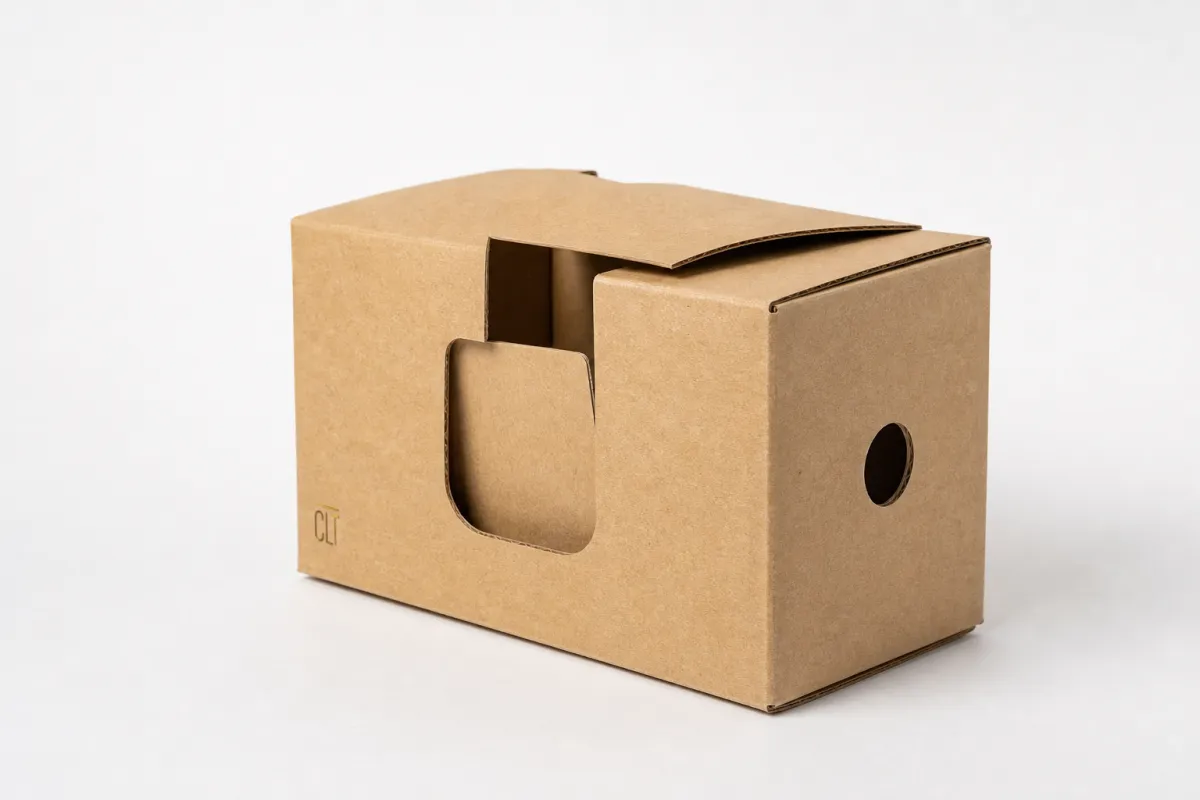
Custom Corrugated Boxes with die cuts solve a problem that looks small on a spreadsheet and turns messy in a warehouse: products are rarely neat cubes, while stock cartons are designed as if they were. That mismatch creates movement, filler, extra handling, and the kind of bruising that shows up after transit, not during pack-out. A sourcing team might call the issue minor. A returns team usually does not.
Plain language helps here. Custom Corrugated Boxes with die cuts are corrugated board that has been cut, scored, and shaped so the package fits the product instead of forcing the product into a generic shell. The die cut can create finger notches, display windows, locking tabs, retention flaps, tuck closures, or internal cutouts that hold the item where it belongs. That precision is not decorative. It changes how the carton behaves.
Shipping is only one part of the picture. Custom corrugated boxes with die cuts can improve product retention, make opening easier, support retail presentation, speed up packing, and make the unboxing feel intentional instead of improvised. They work especially well for subscription kits, bottles, tools, accessories, cosmetics, electronics, and mixed-component products with odd dimensions. A plain RSC still has a place, sure. It is just not the best fit for every job, and pretending otherwise is how packaging budgets get goofy.
From a packaging design standpoint, die cuts earn their keep when a standard carton forces extra filler or makes the product look careless. Fragile items and kits with multiple parts usually benefit the most. Custom corrugated boxes with die cuts often beat a stock box because the structure does the holding, not a pile of kraft paper and hope.
I have seen teams spend weeks trying to "fix" an almost-right carton with inserts, shims, and extra tape, only to discover the real issue was a box that never matched the product in the first place. Once the right structure is used, the same pack-out can feel strangely simple. That's the point.
My rule is pretty straightforward: if the packaging team is spending money to correct the wrong box, the box is too generic. If pack-out needs too many hand motions, the box is too generic. If the product shifts in transit, the box is too generic. Custom corrugated boxes with die cuts remove that friction when they are built with discipline instead of decorative excess.
That discipline matters. The strongest die-cut design is usually the simplest one that protects the product and eliminates unnecessary void fill. Packaging programs often get overbuilt because someone wants every panel to do three jobs at once. In practice, one well-placed cutout or retention tab can do more useful work than five features added for visual flair.
If you are comparing broader options, it helps to browse Custom Packaging Products first, then narrow to Custom Shipping Boxes if shipping strength is the main requirement. The right structure depends on whether the carton lives in ecommerce, retail packaging, or a hybrid use case.
How custom corrugated boxes with die cuts are made: process and lead time
Custom corrugated boxes with die cuts are not mysterious. The work starts with a brief, moves into a dieline, then becomes a sample or production tool before full manufacturing begins. The slow part is usually not the cutting itself. Decisions about fit, board choice, print coverage, and how much structure the product actually needs tend to eat the clock.
The dieline comes first. A dieline is the flat pattern that shows the cut lines, score lines, glue areas, tabs, and openings. In CAD, that line becomes the blueprint for the box. Smaller or simpler orders may use digital cutting during development. Larger production runs usually rely on a steel rule die because it handles volume more efficiently and keeps repeatability tighter.
Board selection happens early because it drives rigidity, print quality, and price. Common options include single-wall corrugate with E, B, or C flute, plus heavier combinations for more demanding loads. A lighter flute can give a cleaner fold and sharper print detail, but it may sacrifice stack performance. A heavier flute improves crush resistance, but it can bulk up the carton and make tight die-cut features less forgiving. That tradeoff often stays invisible until the sample arrives and the fold behaves a little differently than expected.
There is also the unglamorous detail people skip: liner quality matters. A premium liner can print better and hold creases more consistently, while a lower-grade board may fuzz at the cut edge or crack at the score. That is not theoretical. I have watched a box look perfect in digital proof and then lose half its visual sharpness once the wrong liner and wrong coating were paired together.
The manufacturing sequence usually looks like this:
- Brief and measurements from the packed product, not just the product itself.
- Dieline development in CAD.
- Prototype, sample, or short-run approval.
- Cutting, scoring, and perforating.
- Printing, if the order includes custom printed boxes or branded packaging.
- Folding, gluing, and quality checks before shipment.
That sample stage deserves attention. Custom corrugated boxes with die cuts can look correct on a screen and still miss the mark in real life if the board thickness, retention depth, or fold pressure is off by a hair. One millimeter may not sound like much until a product rattles in transit or a retail flap catches on an edge that was never supposed to carry stress.
Lead time depends on whether the design is new or a repeat order. A simple repeat run can move in about 7-12 business days after approval. First-time custom projects often land closer to 12-15 business days from proof approval, not including freight. Add time if a new dieline, mockup, or tooling change is needed. Rush jobs exist, but they usually cost more and leave less room to catch mistakes.
For shipping performance, teams often use ISTA test methods or ASTM-based distribution testing as a baseline. For material sourcing, FSC certification is worth checking if the brand has sourcing goals or retailer requirements. Standards do not repair weak design, but they give everyone a common language for performance.
Custom corrugated boxes with die cuts move faster when the buyer approves a clean dieline early and avoids late structural edits. That sounds obvious. Delays in packaging design still come from one more tiny cutout or one more unnecessary flap that someone thinks will be quick to add. Usually it is not.
Custom corrugated boxes with die cuts: cost, pricing, and MOQ basics
Custom corrugated boxes with die cuts follow the same basic pricing logic as most packaging: the box gets cheaper as volume rises, but the setup work still has to happen. Size, board grade, cut complexity, print coverage, finish, quantity, and inserts all influence the quote. Add a tricky closure or nested pieces, and the number climbs quickly. That is manufacturing, not mystery.
Low-volume orders usually carry a higher unit price because setup and tooling cost are spread across fewer boxes. At higher quantities, those fixed costs get diluted, so the unit price drops. A small order might land in the $0.85-$1.50 range per unit depending on size and complexity. A mid-volume run could fall closer to $0.35-$0.70. At larger volumes, simpler custom corrugated boxes with die cuts can go lower still, especially if the design stays efficient and print coverage remains modest. Those are broad ranges, not quotes, but they are more useful than the word "affordable," which tells you almost nothing.
MOQ is not always a fixed number pulled out of thin air. Some suppliers quote by sheet, by die size, by material yield, or by how efficiently the job runs on their equipment. In practical terms, the minimum may be set by how many boxes fit on a sheet or how much waste the cut creates. One vendor may say 500 pieces while another says 1,000, and both may be responding to the same manufacturing pressure from different directions.
In the field, I have found that the cheapest quote is often the one with the least clarity, which is a funny way of saying it is not actually cheap once revisions show up. If the supplier is vague about freight, sample charges, or inserts, the final bill tends to creep. Packaging budgets usually do not fail all at once; they leak.
The best way to compare quotes is to look at landed cost, not just the unit price of the carton. Landed cost includes freight, proofing, revisions, storage if needed, and any assembly labor shifted onto the pack line. A box that looks cheap on paper can become annoying once the team has to fold it, fill it, and ship it three times because the first design missed the product by a few millimeters.
| Option | Best for | Typical unit cost at 5,000 pcs | Setup/tooling | Notes |
|---|---|---|---|---|
| Standard RSC carton | Plain shipping, simple products | $0.22-$0.45 | Low | Good for speed, weaker on presentation and fit |
| Custom corrugated boxes with die cuts | Odd shapes, retention, retail packaging | $0.30-$0.70 | Moderate | Better fit, less filler, cleaner unboxing |
| Die-cut box with inserts and print | Kits, premium product packaging, display-ready orders | $0.45-$1.10 | Higher | More branding, more labor, more ways to waste money if overdesigned |
A good supplier will also offer tiered pricing. Ask for 1,000, 3,000, 5,000, and 10,000 pieces if your demand is still moving around. That shows the breakpoints and helps reveal whether standardizing dimensions across multiple SKUs makes sense. Custom corrugated boxes with die cuts often become less expensive in ways that are invisible until the quote is broken into tiers.
Watch the hidden costs too. Freight can swing wildly. Sample revisions add time and sometimes add money. A box that requires hand assembly on every unit can quietly crush margin. If the design needs custom inserts, do not pretend those are free. They never are.
Step-by-step: how to spec custom corrugated boxes with die cuts
The cleanest way to spec custom corrugated boxes with die cuts is to start with the product, not the carton. That sounds obvious enough to be boring, yet plenty of teams still choose the box first and then spend weeks making the product fit the decision. The result is usually wasted time, wasted material, or both.
Begin with a real product spec sheet. List the product dimensions, weight, stackability, fragility, and shipping method. Add photos from several angles if the item is irregular. If the carton will hold accessories, cables, chargers, or printed materials, measure the packed set, not just the main item. A packaging buyer who forgets the extra pieces often ends up with a box that fits the hero product and ignores everything else in the kit.
Define the use case next. Is this retail packaging, ecommerce shipping, shelf display, subscription fulfillment, or a hybrid? The answer changes the structure. A retail box can prioritize presentation and easy opening. A shipping box can prioritize compression strength and stackability. Custom corrugated boxes with die cuts can handle both, but the brief has to be specific enough for that to happen.
- Measure the packed size. Include inserts, sleeves, tissue, or protective wrap.
- Pick the box job. Shipping, display, presentation, or a mix.
- Request the dieline. Mark where the retention, opening, and display cuts need to happen.
- Confirm the board spec. Flute type, liner weight, and recycled content all matter.
- Prototype it. Test the fit and the pack-out speed with real staff, not just one person in procurement.
- Lock the final spec. Put dimensions, tolerances, print method, and acceptable sample outcomes in writing.
That final step prevents a lot of arguments later. Once the sample is approved, the written spec should say what can move and what cannot. If the board grade changes, if the die-cut opening shifts, or if the printed logo size is adjusted, the revision should be documented. Custom corrugated boxes with die cuts are easy to almost approve and then blame later when the run arrives slightly off.
Prototype before volume. A single short run or mockup tells you whether the box is hard to assemble, whether the retention is too tight, and whether the opening feels intuitive. You can also measure packing time. If one person takes 12 seconds per unit and another takes 28, that difference matters a lot at 10,000 units. Packaging design is not only visual. It is labor, damage prevention, and brand experience in one object.
Ask for both flat and assembled samples. Flat samples show how the board behaves. Assembled samples show whether the product sits correctly, whether the tabs hold, and whether the custom corrugated boxes with die cuts still close cleanly after a few folds. That small distinction saves a surprising amount of rework.
Common mistakes that wreck die-cut box performance
Most failures with custom corrugated boxes with die cuts are boring, not dramatic. They start with small misses that stack up. The product was measured correctly, but the packed product was not. The box looked strong, but the cutouts sat too close to the edge. The branding looked polished, but the folds cracked because the print area crossed a stress point. None of that is glamorous. All of it is preventable.
Measuring only the product and ignoring the packed dimensions is the first mistake. Cutting too close to high-stress zones is another, because that weakens the panel and can lead to crush damage. Choosing the wrong flute for the weight or stack height causes problems too. A carton that bows on the pallet is not a good carton, no matter how nice the render looked.
Overcomplication causes plenty of damage as well. People love to add tabs, windows, inserts, display features, and branded details until the box becomes a puzzle. A simpler retention feature often works better and costs less. Custom corrugated boxes with die cuts are supposed to reduce friction, not create a new assembly ritual.
- Too many openings: reduces rigidity and increases failure points.
- Weak fold placement: makes repeated assembly rough on the board.
- Fancy mockups, no testing: beautiful on screen, useless in a drop test.
- No pack-line timing: the design may be elegant and still slow to build.
Skipping actual product testing is another familiar mistake. A mockup can hide small fit issues because nobody is dropping it, stacking it, or handing it to a warehouse team. Test the carton under realistic use. If the product will ship parcel, ask for a drop test and compression guidance. If the product will ride on a pallet, test stack performance. If the package is meant to open cleanly at retail, test the opening action with someone who has never seen the design before.
The print layer causes trouble too. Custom printed boxes often perform better when print coverage stays away from cut lines and heavily compressed folds. Ink, coating, and board structure all affect how the print survives handling. A supplier that understands branding and board behavior will usually steer you away from layouts that look polished in a PDF and fail after a few hundred units.
Assembly speed deserves attention as well. That is where margin disappears. If the box needs six hand movements and three extra folds, someone pays for it. Custom corrugated boxes with die cuts should make packing easier, not turn the line into origami practice.
Expert tips for stronger, cleaner, more efficient packaging
Good custom corrugated boxes with die cuts are not about piling on features. They are about choosing the right features. The carton should solve a structural or usability problem first, then carry the brand. Reverse that order and you start paying for decoration while calling it packaging design.
Keep print away from the most stressed folds and cut lines unless the supplier confirms the ink and coating can handle it. A sharp logo is not worth a split score line. Standardize internal dimensions across multiple SKUs whenever possible. That one move can cut tooling sprawl, reduce inventory headaches, and make procurement less messy.
Ask for both flat and assembled samples. Flat samples tell you about board quality and cut precision. Assembled samples tell you about retention, fit, and how the box behaves under pressure. If the product shifts during a simple hand test, it will not improve during transit. Packaging does not improve by hoping harder.
Think about the end use before finalizing the dieline. Retail packaging needs a different opening experience than warehouse shipping. Ecommerce packaging needs different compression behavior than shelf display. Custom corrugated boxes with die cuts can support all of that, but the priorities need to be defined early. Otherwise the result is a carton that is half retail display and half shipping box, which is usually the worst of both worlds.
These are the details I would ask for before signing off:
- Board grade and flute type, with a clear reason for the choice.
- Drop test or compression guidance if the product is fragile or heavy.
- Packing-time estimate per unit for hand assembly.
- Freight assumptions and whether the quote includes delivery.
- Sample type, revision count, and approval process.
If the supplier cannot answer those questions cleanly, the project is still too vague. Vague projects are where margins disappear. In practice, custom corrugated boxes with die cuts perform best when the brief is specific enough that everyone knows what success looks like before production starts.
Ask about recycled content and chain-of-custody claims if sustainability matters. Do not assume every brown box is automatically eco-friendly. That is not how sourcing works. FSC-certified board and lower-material designs can support better product packaging goals, but only if the supplier can document the claim. Branded packaging and responsible sourcing can coexist. They just need to be planned instead of guessed.
Next steps: how to compare samples, quotes, and specs
If you are ready to compare custom corrugated boxes with die cuts, gather the basics first: product dimensions, weight, photos, shipping method, pack-out contents, and branding requirements. Better input leads to a cleaner quote. A large share of bad pricing complaints trace back to a bad brief wearing a fake mustache.
Send the same spec sheet to every supplier. That sounds basic, yet people routinely request quotes with different dimensions, different quantities, and different assumptions about print or freight. Then they compare the numbers as if the quotes are interchangeable. They are not. Equal inputs are the only fair way to compare custom corrugated boxes with die cuts without fooling yourself.
Ask each supplier for these items in writing:
- Dieline or structural drawing.
- Board spec and flute type.
- Production method and tooling notes.
- Sample type and approval timeline.
- Turnaround estimate and freight assumptions.
Order a physical sample or short run and test it with the actual product. Look at fit, crush resistance, opening behavior, and packing speed. If the box is being used for retail packaging, check shelf presentation and how the customer handles the opening. If it is being used for shipping, simulate the rough handling the carton will actually see. Custom corrugated boxes with die cuts need real-world proof, not just a polished render and a hopeful email.
Use the sample feedback to simplify wherever you can. Remove unnecessary cutouts. Reduce complicated folds if they do not serve a purpose. Standardize dimensions across similar items if the internal fit allows it. That is how you protect margin on the next order. It is also how you keep custom printed boxes from turning into expensive vanity projects.
Check lead time against your launch date before you place the order. A clean approval path can get a production run moving in about 12-15 business days from proof approval, but revisions, tooling changes, and freight can stretch that quickly. The safest path is still the boring one: approve the dieline early, test the sample honestly, and keep the specification tight.
Custom corrugated boxes with die cuts work best when they solve a real fit or usability problem, not when they are built to impress a spreadsheet or pad a presentation. If you confirm the fit, the cost, and the lead time before you commit, you get packaging that earns its keep instead of taking up shelf space. The practical move is simple: measure the packed product, test one real sample, and only then lock volume. That is the fastest way to avoid a box that looks right and behaves wrong.
What are custom corrugated boxes with die cuts used for?
They are used when a standard carton does not fit the product cleanly or protect it well enough. Common uses include ecommerce shipping, retail display, subscription kits, and fragile items with awkward shapes. Custom corrugated boxes with die cuts can reduce filler, improve presentation, and make packing faster.
How much do die-cut corrugated boxes usually cost?
Cost depends on box size, board grade, cut complexity, print coverage, finish, and quantity. Higher-volume runs usually lower the unit price because setup costs are spread across more boxes. Freight, samples, and inserts can change the landed cost a lot, so compare the full quote instead of staring at one line item.
What information do I need for a quote on custom corrugated boxes with die cuts?
Provide product dimensions, weight, pack-out contents, quantity, print needs, and shipping destination. Photos or a rough sketch help if the product shape is unusual. The more exact the spec sheet is, the less likely you are to get a quote that misses the real cost.
How long is the turnaround for die-cut corrugated packaging?
Turnaround depends on whether the project needs a new dieline, a sample, or tooling changes. Simple repeat orders move faster than first-time custom projects. If you need a shorter lead time, approve the dieline early and avoid late structural edits.
Can custom corrugated boxes with die cuts be used for shipping and retail display?
Yes, but the structure has to be designed for both functions, not just one. Shipping boxes need strength and stackability; retail boxes need presentation and easy opening. A good design balances both so the package does not look good only until it hits a warehouse pallet.

